
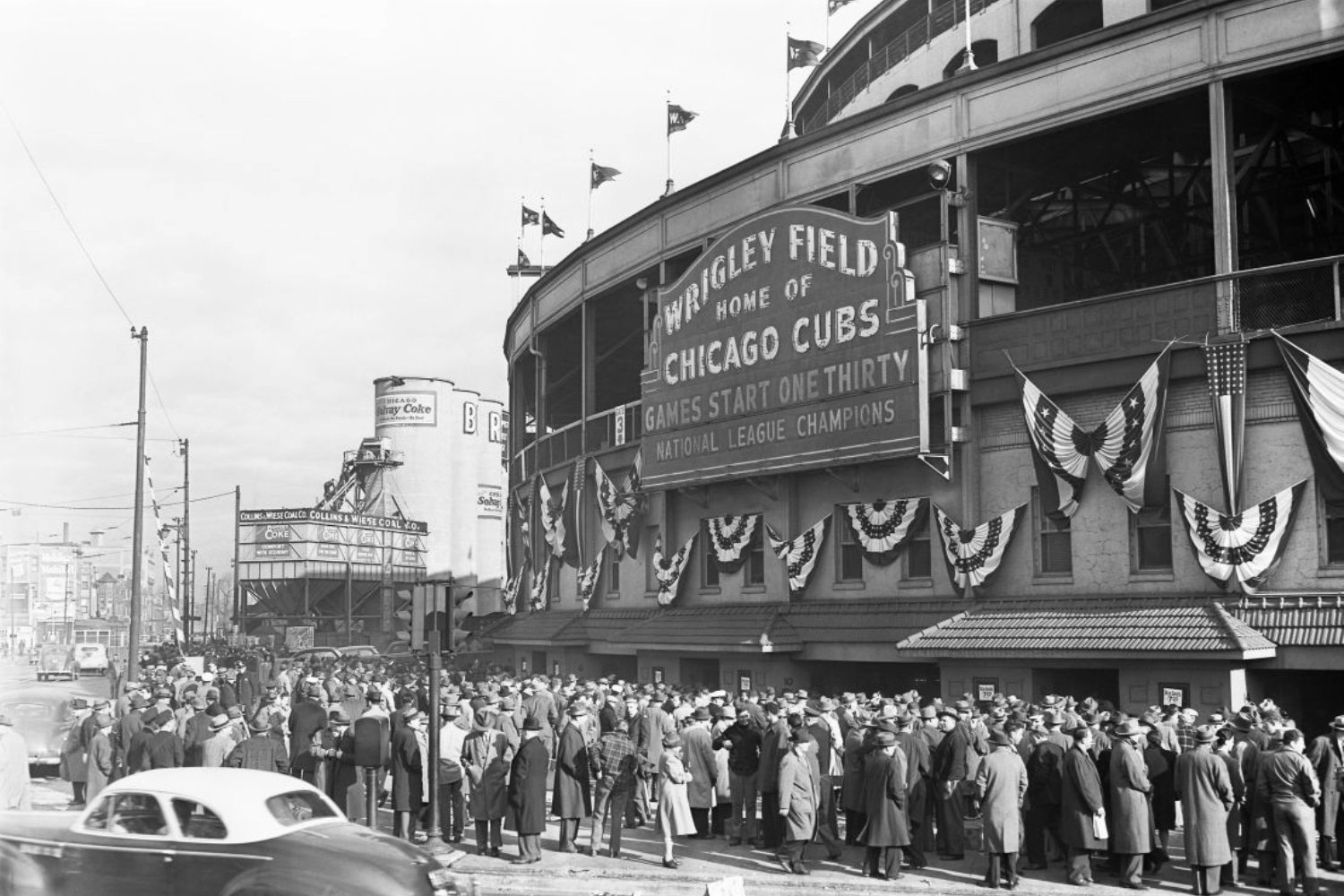
Welcome to part six of North Side Baseball’s offseason series covering the 1918 Chicago Cubs. You can find the first five parts here:
In part six, we’ll examine how the Cubs performed in the month of July, including a wild, 21-inning affair.
Another Showdown with the Giants
The Cubs started July by taking five of seven from St. Louis to set up another series with the second-place New York Giants, this time a five-game set. With the Giants having started the month 2-4, the North Siders had a nice four-game cushion over New York in the National League standings.
The Cubs took the first game 1-0, entirely thanks to Hippo Vaughn. The left-handed hurler threw 12 shutout innings and then drove in the walk-off run in the bottom of the 12th with a single. Shohei who?
The second game was a 6-1 rout in favor of Chicago, with Phil Douglas throwing nine innings of one-run baseball and two hits and two RBIs from second-baseman Rollie Zeider. This put the Cubs six games up on the second-place Giants.
The six-game lead would be short-lived. After splitting a double header the next day, the Giants came back from down 6-0 to win in 10 innings on a home run from Jim Thorpe. Yes, the very same Jim Thorpe that won two gold medals in the pentathlon and decathlon in the 1912 Olympics.
Despite the couple of losses to finish the series, the Cubs, at 50-23, were still five games up on the Giants and firmly in control of the National League. They proceeded to take four of five games from the Boston Braves, and then dropped two of the first three games in a four-game set with the Philadelphia Phillies. Game four of that series would pit Lefty Tyler against Milt Watson.
A Historical Pitching Performance
July 17, 1918 started as a normal baseball game. After the Phillies went three up, three down in the top half of the first inning, the Cubs jumped out to a lead in the bottom half. Max Flack walked, Charlie Hollocher singled him over to third, and Flack came around to score on a ground out from Les Mann.
The Phillies tied things up in the fourth. An error from Hollocher put Cy Williams on base to start the inning, and he was plated after singles by Fred Luderus and Gavy Cravath.
That next run wouldn’t be scored for 16 more innings. The Cubs managed to get runners into scoring position in the fifth, sixth, seventh, 10th, 12th, 13th, 15th, and 19th innings; however, every time, they failed to get even one run across.
The Phillies, on the other hand, went without a baserunner in eight of the 17 innings following the fourth inning. Both Tyler and Watson were absolutely dealing.
The game was going so long that, according to the Society for American Baseball Research, the umpires informed the teams that the game would be called at 7 P.M. so the Phillies could catch their 8 P.M. train.
As the 21st inning got underway, the Cubs got a leadoff single from the seldom-used Turner Barber, who had pinch hit for Zeider. After Bill Killefer got hit by a pitch, the Cubs called on another pinch hitter, this time Bill McCabe, who would notch just 51 plate appearances for the Cubs that season.
McCabe laid down a bunt that ended up going for a hit, which set up Flack with the bases loaded, who ended the game after 21 brutal innings. Per SABR, the game lasted approximately four hours.
Both Lefty Tyler and Milt Watson pitched the whole thing. Tyler gave up 13 hits and one walk in his 21 innings pitched, allowing just one unearned run. Watson gave up 19 hits and four walks in his 20 innings pitched.
Perhaps exhausted from a 21-inning marathon, the Cubs would go on to lose seven of 11 games to close the month. Despite a small rough patch, the team still stood at 60-32 as the calendar flipped to August. They were 3.5 games up on the second-place Giants, and with only two months left in the season, they had to feel good about their chances of playing in the World Series, which, back then, simply pitted the best team in the American League against the best team in the National League.
Unfortunately, World War I loomed.
Work or Fight
At the start of July, Secretary of War Newton Baker issued a “work or fight” order. According to the Baseball Hall of Fame, this meant that all draft-eligible men must sign up for war-related work, or they risked being drafted to fight in the war.
The New York Times wrote on July 20 that “both leagues will make an attempt to play out their schedules this season and many of the teams hope that they will be able to get some of their players exempted until the season ends because of the heavy contracts under which they are playing. However, baseball officials believe that under the ruling of Secretary Baker, no time exemption will be granted to any of the players.”
The Times followed that up with more reporting on July 31. “While President John K. Turner of the National League is not in favor of playing a [World Series] with the American League this season, he is willing to abide by the decision of the clubs owners of the organization, and has called a meeting in [New York] on next Saturday at 10 o’clock.”
With the fate of many of the league’s players up in the air, the National League was considering simply ending its season, with a meeting to happen in early August to discuss how to move forward. While still a far cry from the worldwide issues happening at the time, this was surely a devastating possibility for a Cubs team that currently sat in first place.
Are you interested in Cubs history? Then check out the Chicago Cubs Players Project, a community-driven project to discover and collect great information on every player to wear a Cubs uniform!