
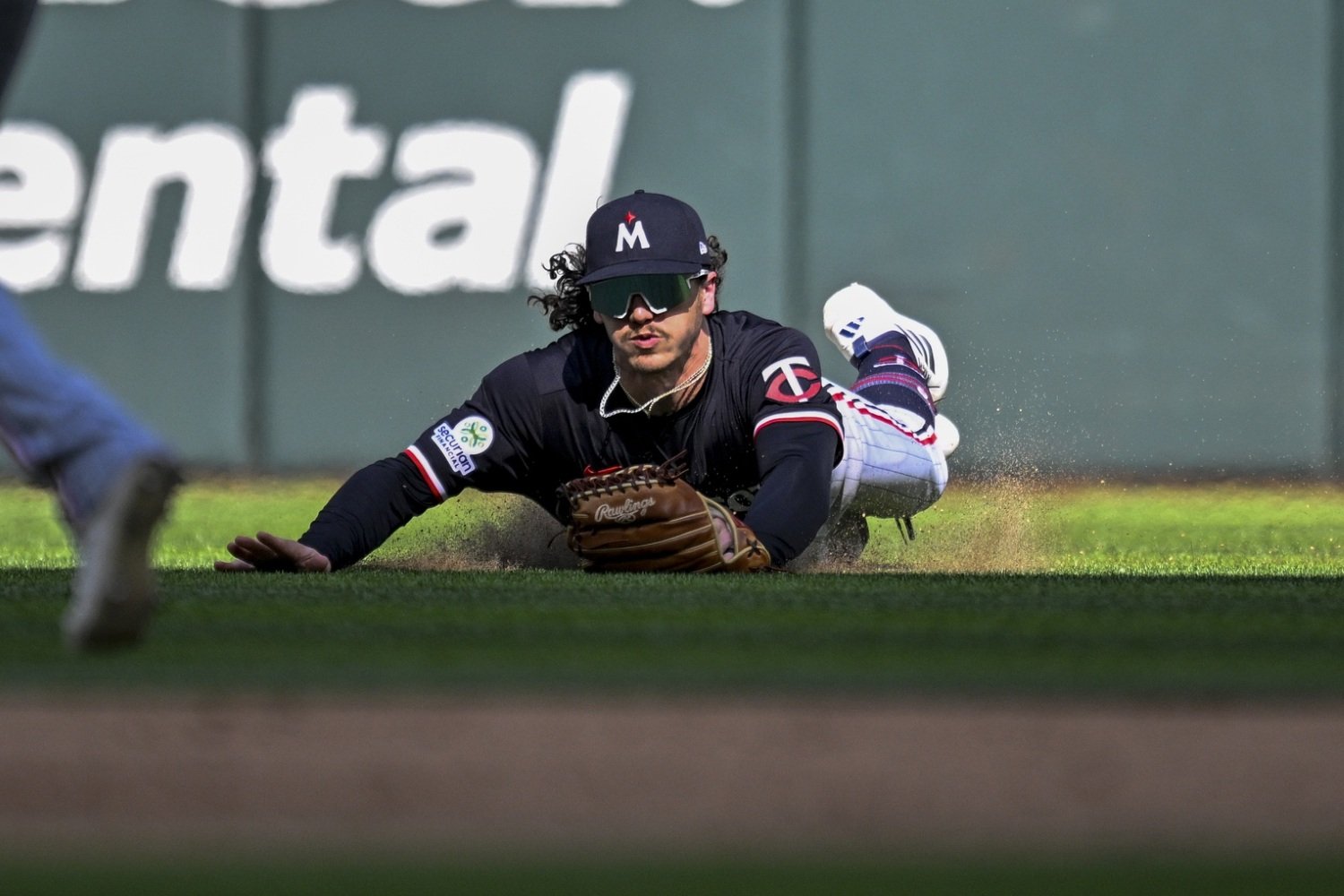
This is not an article about James Outman. It’s written around James Outman, but he didn’t really do anything to deserve it. Instead, James Outman has become the poster boy for a concerning trend with the functional utility of the Minnesota Twins’ roster.
Let’s start in 2023: the season in which the Twins put together one of their most functional rosters of all time, even if it wasn’t the best roster. Roster functionality, in this case, can be understood as each player having a specific role and providing something uniquely valuable for the team’s success.
As the team awaited the return of the injured Jorge Polanco, Royce Lewis, and Alex Kirilloff, each of whom would go on to play significant roles during the season, the Twins started Opening Day with the following lineup:
Not all of these players made it to the end of the season in a Twins uniform, and many had rough years. But what we’re focusing on is utility, not just quality. The Opening Day bench underscores what I’m talking about: catcher Ryan Jeffers, infielders Kyle Farmer and Donovan Solano, and super-utility Willi Castro (note: Castro wasn’t in that role at the time; he was expected to be sent down once Polanco returned, and he was more emergency depth and pinch-running).
Let’s highlight some of the roles these players filled, or were expected to fill. Taylor was acquired via trade to add depth behind Byron Buxton in center field. He was hailed as an elite defender, and he was right-handed, so he could platoon with Gallo, Larnach, Kirilloff, or Kepler, moving over to a corner against lefty staters. Obviously, he played the whole season in center field, but that just highlights his usefulness. They tried to do the same in 2024 and 2025 with Manuel Margot and Harrison Bader, with mixed results.
Farmer was also acquired via trade to start at shortstop, though that was short-lived, as the Twins re-signed Carlos Correa a month later. Farmer was bumped to a utility infield role, as a good enough defender to handle shortstop, second base, and third base. He also was an effective hitter against lefties, so he had a second role: platooning with Gordon at the beginning of the season and Edouard Julien at the end.
Gordon had a unique role, too. He started at second base while Polanco was hurt, but his intended role was to bounce around the infield and outfield, hit a bit, and pinch-run. Essentially, he was expected to provide what Castro eventually did. This role was reduced when Buxton moved to a full-time DH role, but there was a clear intention to get his bat into the lineup, coming off the 2022 season in which he batted .272/.316/.427.
Solano was a late signing, not joining the Twins until spring training had already started, but he was counted on to platoon with Kirilloff during the season and provide infield depth. Beyond that, he was a reliable pinch-hitting option against both lefties and righties, given his pure hitting ability. They brought in a platoon partner for Kirilloff again in 2024, which ended up being a very good offensive and defensive year from Carlos Santana.
I could go on, but I’ll add one more tidbit to the pile—this team had a bunch of multi-positional players. Gallo and Kirilloff could both play the outfield and first base; Gallo could even fake it in center. Gordon and Castro could both play infield and outfield, including up-the-middle positions. Miranda could play first and third.
Today, though, the Twins look nothing like that.
Let’s assume the following starting lineup:
And a bench of:
This projection leaves Alan Roden in St. Paul, starting alongside top prospects Walker Jenkins and Emmanuel Rodriguez. This is also the only way to put James Outman on the Opening Day roster without either starting him or playing without a backup shortstop.
I want to preface the Outman discussion by acknowledging that the offseason is not over. The Twins have more moves to make, and that I’m not privy to the real plans the front office is making. We saw them add one plausible backup shortstop via trade on Wednesday, in Tristan Gray. But focusing on Outman is, I believe, the best way to convey my point.
Outman has no options left. He’s been below replacement level since his very good rookie season in 2023. But he’s on the roster, after being the return in the trade that sent Brock Stewart to the Dodgers at the 2025 trade deadline. Right now, he’s wedged into the Opening Day picture, at least in the popular imagination (you’re welcome to disagree; I have my doubts he makes it to Opening Day). Why? Because he can play center field. It didn’t look pretty, honestly, after he arrived in Minnesota, but that’s his reputation. He can play it better than Martin, Kreidler, and Keaschall, probably. But that’s really it.
Recall Taylor’s role in 2023. He could play center—better than Outman, mind you. But he also hit better in 2023 than Outman has across 2024 and 2025. He also suited the roster beter, hitting right-handed and hypothetically being a platoon option in a corner. Outman, on the other hand, is a lefty on a team full of lefties. To get regular reps in a corner, he needs to outplay Wallner, Larnach, Roden, probably Clemens and Bell, and eventually Jenkins and Rodriguez. If he can’t, he might cover center field once or twice a week against righties and pinch-run a little. That’s not a positive net value from a roster spot.
The Twins have lefties covering left and right field, first base, (effectively) DH, (effectively) shortstop, and (effectively) backup catcher. Their only platoon option is the batting average-dependent Martin, mostly in left field.
If they want to commit to Roden in left field, that costs them either Outman or a shortstop, and it can’t be a shortstop, because Kreidler (or Vidal Bruján, or Orlando Arcia, or Gray) would be the only player beyond Lee who can cover shortstop. Even with one of those three infielders on the roster, their roles will be very limited—basically only playing shortstop, because none of them hit. Unlike Farmer, they can’t even fake league-average production or platoon against lefties.
Caratini might be the bench player with the most utility right now, because he can hit from both sides and plays a passable first base, but in every remedial math class, there’s a brightest pupil. Martin has some flexibility, but it’s unclear whether the Twins want to play him in center field or at second base.
Gregg’s note: Clemens, if considered to be a bench player—perhaps if Martin is the everyday left fielder—does have the most utility, because he plays a fine first base, second base, and corner outfield, but it’s unclear that will be his role at this point.
So, if Outman does make the roster, the bench is a backup catcher; a left-field platoon bat who can play emergency second base and center field; a lefty who should only play center field once a week; and an infielder who should only play shortstop—again, once a week.
Again, they aren’t done, but the current outlook pales in comparison to the average player’s usefulness in 2023, regardless of overall ability. There may be things that clear the outlook up—committing to one of Martin, Kreidler, or Keaschall as a backup center fielder; trading a corner outfielder; opting to play Caratini at first base and DH; acquiring another infielder who bats right-handed and/or is a better option as a backup shortstop. But right now, it’s bleak. No one exemplifies that more than poor James Outman, a man whose profile lies at the unfortunate crossroads of uniqueness and redundancy.