
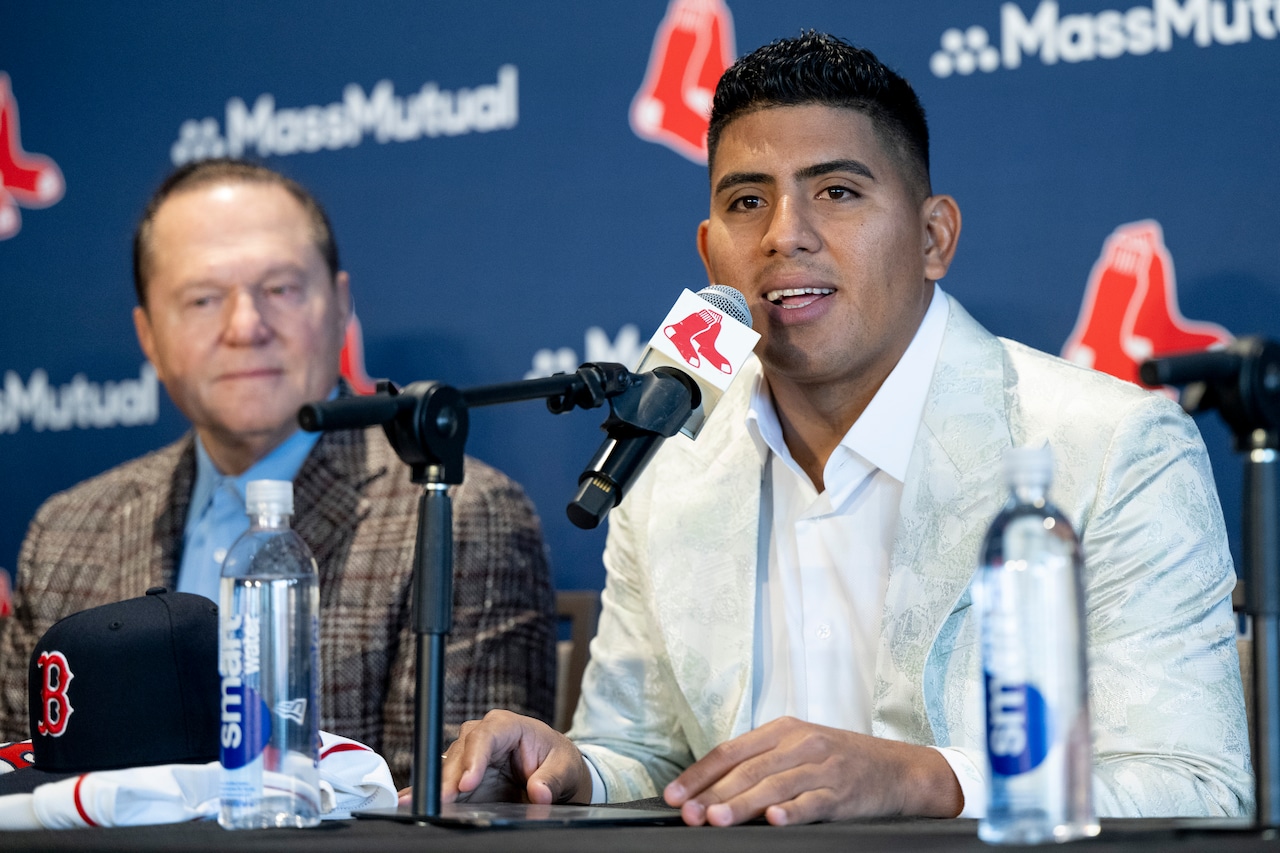
BOSTON – The Red Sox’ first big free agent addition of the offseason is officially a member of the team. Boston announced its signing of starting pitcher Ranger Suárez on Wednesday and subsequently introduced him at a press conference at Fenway Park.
The details of Suárez’s five-year, $130 million deal, which is otherwise rather straightforward, are rather interesting. The contract is heavily backloaded, according to sources familiar with the agreement. In total, Suárez will earn just $25 million in salary over the next two seasons before getting a large chunk of the deal ($105 million) over the following three seasons. That structure tamps down real money expenditure by the Sox over the next two seasons but does not affect how much Suárez will cost against the competitive balance tax (CBT) threshold, which is calculated based on average annual value. He will come with a $26 million hit in each of the next five years.
Suárez’s deal calls for a $3 million signing bonus. He will then receive a $7 million salary in 2026 and a $15 million salary in 2027. From there, the number jumps significantly, with Suárez receiving $30 million per year in 2028 and 2029 and $35 million in 2030. There’s also a mutual option (which is never picked up by both sides) for 2031 valued at $35 million with a $10 million buyout. Suárez’s contract does not include a no-trade clause, opt-outs, deferrals or incentives, according to sources.
The structure of the contract — the largest free agent deal given out by chief baseball officer Craig Breslow since taking over in the fall of 2023 — continues a pattern of Boston’s CBT payroll in 2026 being much higher than the club’s actual cash spend. While the CBT number is estimated to be around $269-$270 million (higher than the second penalty threshold of $264 million), Boston’s actual cash outlay for the 2026 season is much lower because certain players are making significantly less than the average value (and therefore the CBT) hit of their deal. In addition to Suárez (making a $7 million base salary compared to a $26 million AAV), Roman Anthony ($2 million salary, $16.25 million CBT hit), Kristian Campbell ($2 million salary, $7.5 million CBT hit), Ceddanne Rafaela ($2 million salary, $6.25 million CBT hit), Brayan Bello ($6 million salary, $9.25 million CBT hit) and Garrett Crochet ($24 million salary, $28 million CBT hit) are on backloaded deals.
The club’s exact plans are unclear, but the structure of the Suárez agreement suggests the Red Sox might be willing to add more payroll to their 2026 cash outlay — remember, club sources with knowledge of the inner workings of Fenway Sports Group, across different regimes, have long-described the budget set by principal owner John Henry as a “moving target” when it comes to whether it’s calculated by CBT, cash spend or other accounting factors — despite having a relatively high CBT total because the current cash payroll remains significantly lower. In general, teams are in favor of backloading big contracts because of the time value of money equation, which suggests the overall expenditure ends up being a little less. Another factor in the structure of Suárez’s deal is that the Red Sox took future commitments into consideration. Suárez’s salaries increase in 2028 when other sizable deals, including those of Trevor Story, Masataka Yoshida, Jordan Hicks and potentially Willson Contreras, will be off the books.
“Trying to give ourselves as much flexibility as we can,” Breslow said Wednesday. “In looking at the way our commitments line up, just felt like this was the way to do that.”
To clear a 40-man roster spot for Suárez, the Red Sox traded infielder Tristan Gray to Minnesota for minor league catcher/first baseman Nate Baez. The 40-man roster is now full once again, so further additions would require further subtractions. Suárez will wear No. 55 in Boston.