
Image credit:
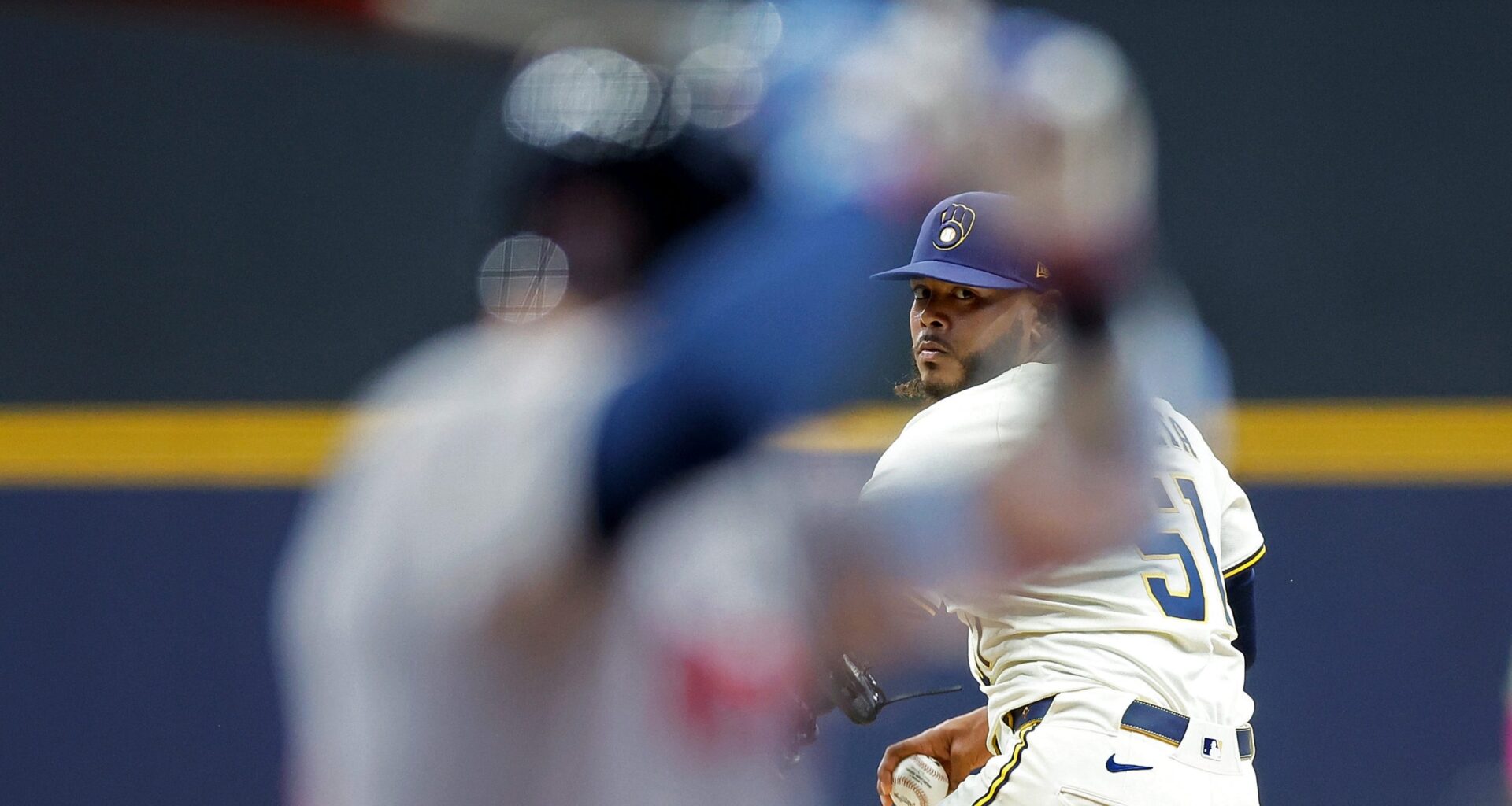
MILWAUKEE, WISCONSIN – MAY 28: Freddy Peralta #51 of the Milwaukee Brewers throws a pitch in the first inning against the Boston Red Sox at American Family Field on May 28, 2025 in Milwaukee, Wisconsin. (Photo by John Fisher/Getty Images)
The Mets’ red-hot January rolled on late Wednesday night when they swung a deal with David Stearns’ former team, the Brewers, to land Freddy Peralta in exchange for Top 100 Prospects Jett Williams and Brandon Sproat. Milwaukee righthander Tobias Myers is also expected to head to New York, according to several reports. ESPN’s Jeff Passan first reported the news.
The trade is yet another big swing from the Mets, who land a much-needed top-of-the-rotation starter after also signing infielder Bo Bichette and trading for White Sox center fielder Luis Robert Jr. this month. Stearns has continued to overhaul New York’s lineup after letting Pete Alonso walk in free agency and trading both Brandon Nimmo, which brought back Marcus Semien, and Jeff McNeil earlier this winter.
Adding Williams (No. 71 in Baseball America’s Preseason Top 100) and Sprout (No. 81) gives the Brewers six Top 100 Prospects, which ties for the most in baseball.
BREWERS RECEIVE
Jett Williams, SS
Age: 22
Williams is a high-energy athlete whose value comes from versatility and impact across the stat line. After wrist surgery cut short his 2024 season, he returned healthy in 2025 and showed durability and production across Double-A and Triple-A, combining fringe-average power, on-base ability and aggressive baserunning to slash .261/.363/.465 with 17 home runs, 34 doubles, seven triples and 34 stolen bases. He gets on base at a solid clip, pressures defenses with plus speed and finished among organizational leaders in total bases and extra-base hits.
At his best, Williams keeps his swing compact and focused on hard line-drive contact, using his speed to stretch hits and create value beyond raw power. When he overswings, his swing length can lead to empty fly balls, average in-zone contact and strikeouts in bunches, making approach consistency the next step in his offensive development. Defensively, he is playable across the middle of the diamond and in center field. His quickened first step and improved range make him a serviceable shortstop, while his plus arm plays comfortably at second base or in the outfield, where his athleticism translates to reliable routes and competitive throws.
Williams profiles as a top-of-the-order regular whose speed, on-base skills and defensive flexibility give him multiple avenues to everyday value, most likely as a middle infielder who can move around the field as needed.
Brandon Sproat, RHP
Age: 25
Drafted twice by the Mets before signing as a senior in 2023, Sproat took a nonlinear path to the big leagues, stalling at Triple-A before finding traction late in 2025 and earning a September callup. An athletic righty with above-average arm speed, Sproat evolved from a fastball-changeup college arm at Florida with spotty control into a legitimate starter with strike-throwing ability and a deep, spin-heavy mix.
Sproat’s mid-90s sinker and average four-seamer function best as groundball-generators rather than bat-missers. His breaking pitches drive his profile. Sproat offers a mid-80s sweeper and high-70s curveball that flash plus. He has struggled with lefties at times but his high-80s to low-90s changeup has proven to be an equalizer thanks to late armside run. With improved command, feel for spin and a plus changeup, Sproat looks the part of a durable No. 3 or 4 starter. He is positioned to compete for a regular role in 2026 even after changing organizations.
METS RECEIVE
Freddy Peralta, RHP
Age: 30
Peralta has been one of the most effective MLB starters over the past three seasons, his profile led by a 28.9% strikeout rate that ranks 11th among qualifiers since 2023. For a pitcher dubbed “Fastball Freddy” when he debuted, Peralta has expanded his repertoire in recent seasons to throw about 50% fastballs, 30% breaking pitches and 20% changeups.
Batters don’t pick up the ball well out of Peralta’s hand, contributing to low rates of zone contact—about 82% since 2023, which is lower than all but five qualified starters—and low batting averages. While not generally regarded as a true ace, Peralta has a strong No. 2 starter profile and could lead a playoff rotation, as he did in Milwaukee in 2024 and 2025. Last season he went 17-5 with a 2.70 ERA and 204 strikeouts against 66 walks in 176.2 innings. Peralta will qualify for free agency in November if his contract is not extended.
Tobias Myers, RHP
Age: 27
Myers had a surprisingly stout season as a 25-year-old rookie in 2024, when he pitched to a 3.00 ERA in 138 innings over 27 appearances, 25 of them starts. He struggled at the outset of 2025, spent time on the injured list with an oblique injury, lost his rotation spot and was optioned to Triple-A in May. Recalled in July, Myers pitched much more effectively as a reliever for Milwaukee in the second half, recording a 2.64 ERA in 30.2 innings.
When he’s going good, Myers limits walks and gets batters to swing through his riding four-seam fastball. He also has good feel for a cutter and slider, but is not a big swing-and-miss or strikeout pitcher. Myers is an extreme flyball pitcher who relies on weak and mis-hit contact to succeed. He has five more seasons of club control and can help the Mets as a reliever or spot starter in 2026.