
Jeff Passan@JeffPassan
BREAKING: The New York Mets have acquired All-Star right-hander Freddy Peralta in a trade with the Milwaukee Brewers, sources tell ESPN. Deal is done. Top prospects Jett Williams and Brandon Sproat are headed to Milwaukee. One more big league pitcher will head to the Mets.
2:45 AM · Jan 22, 2026 · 3.26M Views
1.29K Replies · 2.71K Reposts · 15.5K Likes
My gut says the Mets overpaid for one year of Freddy Peralta. The actual surplus value moving back and forth from each side agrees, but doesn’t suggest this is a slam dunk for the Brewers. The more I mull it over, the more I see why the Mets would do this. There was no other clear upgrade if they didn’t love Framber. The 2026 SP free agent class is stacked. Come next offseason, their rotation is going to be crowded if they plan to pursue Freddy, Skubal, and any of the other arms available. Let’s quickly dig through each piece of this trade…
Freddy Peralta and his morphing slider now reside in Queens. If you’ve followed my Substack, you have probably read a post of mine from years past highlighting how this pitch has shape-shifted (here, here, and here). Last year, the evolution was the lowest slider usage of his career at ~10%. Instead of throwing 30% slider to righties as he did in 2023 and 2024, he split up his non-fastball usage. He threw curveballs and changeups each around 15%, and cut back his slider to that mark as well. The results were positive. Peralta pushed his K-BB from 18.5% to 24.6% against righties when compared to 2024. Against lefties, he mimicked his 2023 approach, throwing fewer sliders and embracing his curveball and changeup. Refining both attack plans allowed him to post the best season of his career (2.70 ERA). He also moved toward the third base side of the rubber at the beginning of the season and stuck there throughout the year.
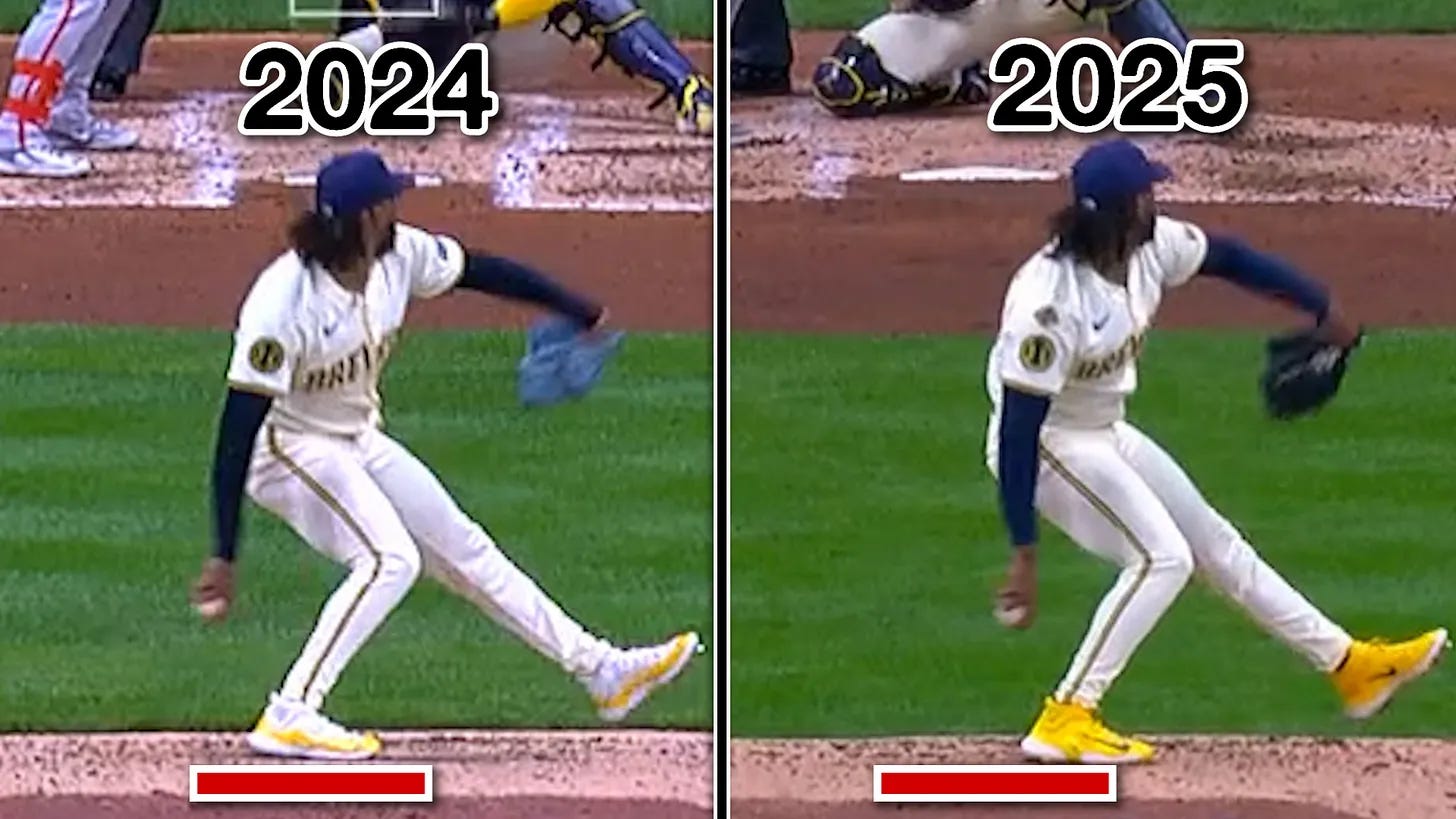 Freddy Peralta’s rubber shift from 2024 to 2025.
I bet the Mets attempt to right the ship with his slider and feature that pitch more against right-handed hitters. It grades better than his changeup and curveball and seems as though a blip in performance back in 2024 pushed him off the pitch. I’ll also point out his feel for the offering remains a mystery. As I mentioned, the pitch morphs. If you look at a monthly log of this shape since 2024 and focus on the glove-side movement, you’ll see how much the pitch has contracted and shortened its shape. Is his feel just bad? Is it all intentional? Is his feel actually very good, hence the manipulation? These are questions I have that I’ve not discovered answers to, but my lean is that he lost his feel for the pitch. Otherwise, he’d be throwing it more. I do think this shape is a key to beating his projections by a material amount. He’s currently pegged for a 3.80 ERA across 180 innings with a really strong 27% strikeout rate and a ~1.20 WHIP, a top 30 pitcher in baseball.
The prize of his profile I have buried the lead on. Peralta has one of the better righty four-seam fastballs in MLB. He extends nearly 7 feet down the mound despite standing just 6 feet in height. He has an average arm angle (40°), but a release height that is nearly 6” lower than average for pitchers with comparable arm angles. This results in a very flat approach of his four-seam fastball into the strike zone. It’s a tough pitch to generate damage on in the zone. Peralta presents stability for the Mets in what was an otherwise unstable rotation. Let’s see if he can push well beyond his projections in a contract year.
I ranked Sproat as my 12th-best pitching prospect late last season (link). His 2025 season is odd to dissect. He added a sinker, which cut his four-seam usage in half from 2024, where he ripped it 50% and found success below Triple-A. The tweak made sense, but his 4% K-BB and 5+ SIERA through his June 22nd start in 2025 caused some analysts to balk at his profile. Sproat righted the ship and finished with an 18.6% K-BB between Triple-A and the majors, with his velo ticking up to 97 mph, a full tick higher compared to early in the 2025 season.
The Mets played with Nolan McLean’s usage when he got to the majors and did the same with Sproat. Sproat’s sinker ballooned to 54% against righties across his four MLB starts compared to half that at Triple-A. He also threw more curveballs and sweepers to lefites, backing off his four-seam fastball (the same thing McLean did). Mix diversity is his clear route to neutralize left-handed hitters, which Sproat has already embraced. Against righties, he has multiple paths if the sinker-sweeper lean doesn’t pan out, but I expect it to be fine.
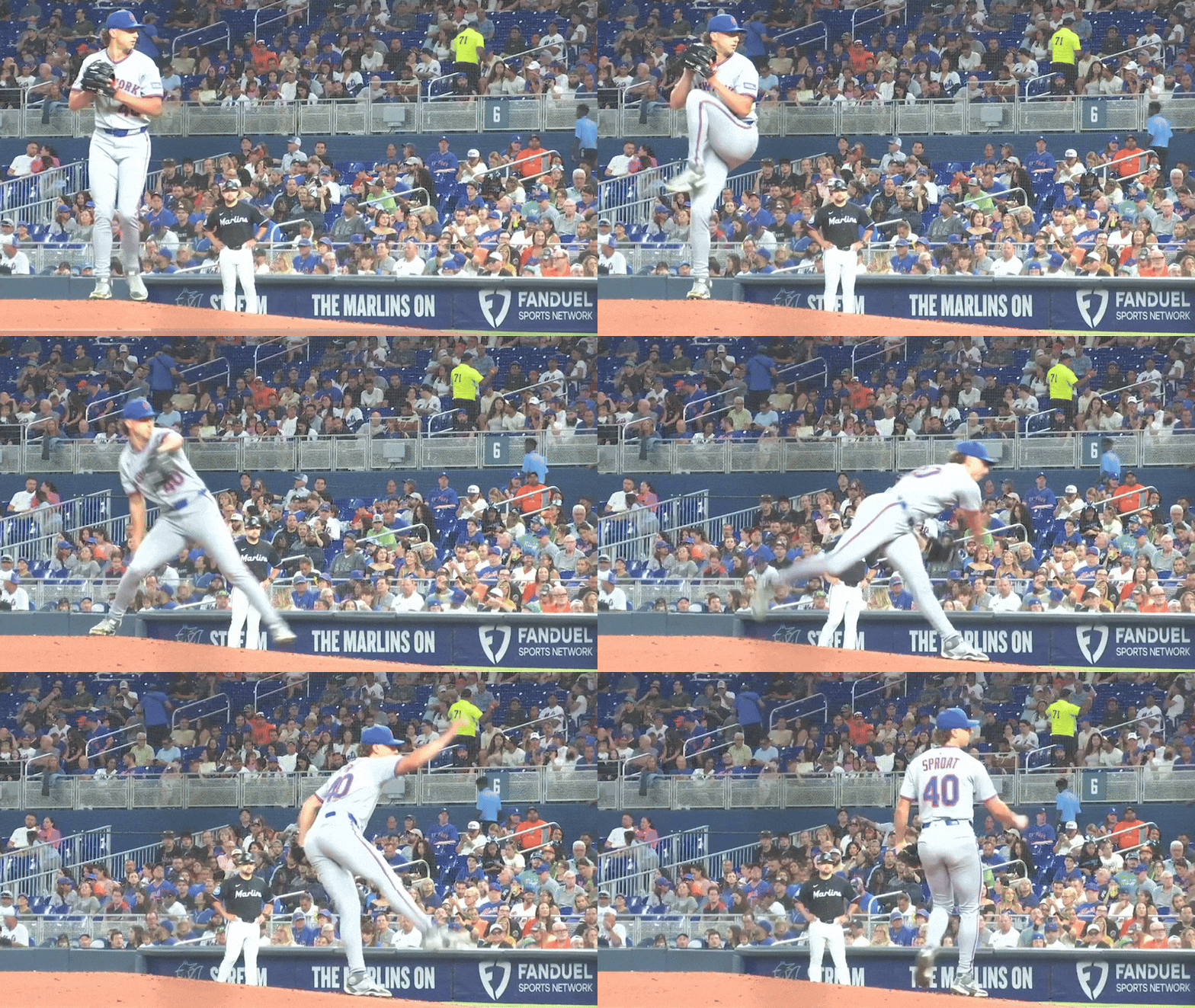 Brandon Sproat’s mechanics. Of note is his arm action, which I would consider long relative to tighter-arm-circle throwers like Cade Horton and Shane Bieber. “Long” does not in this instance mean bad.
I view Sproat as a high-floor, low-ceiling arm. The 50 future value grade I placed on him in my prospect list update suggests 2 WAR per season and #4 SP status, with variance for better and worse, of course. He is a pitcher who will get to that 1.5-2 WAR area through innings totals rather than stellar strikeout rates. He’s projected for a 19% K rate next season and an 8-9% walk rate. This means a lot of his profile rides on the ability to limit barrels, which he showed he could do over 100+ innings last season. Whether that’s a true skill for him is something the Brewers will find out with the rest of us. I’d bet his strikeout rises over time as the optimization of his righty attack evolves.
The Brewers have one starting pitcher projected for over 2 WAR, and it’s the 32-year-old Brandon Woodruff, who has one of the shakiest 140+ inning projections in the sport. There was speculation that Sproat would be used as a multi-inning reliever for the Mets in 2026. Now, I’d expect him to eat up starts in Milwaukee, which is great for his development. Nothing is glaring that I expect the Brewers to change with his mix or approach.
I didn’t think I’d be considering Myers a key to a trade that involves Freddy Peralta and Brandon Sproat on a random Wednesday night in late January, but here we are. It’s not that Myers will make or break the trade for the Mets. It’s more that turning him back into the 2024 version of himself would surely help calm the sting of losing 6 more years of Sproat. Baseball Prospectus released new arsenal metrics early last season, and Myers was the cover boy. In short, he “disguises” his pitches well. This means the trajectories of his shapes converge such that it’s difficult for the hitter to discern (among other things presented in their article). The problem? Myers strained his oblique early in the season and never seemed to right the ship after a demotion to Triple-A. We were never able to back up a stellar 2024 with confirmation that he is an odd enough pitcher to buck Stuff+ models, which think he’s mediocre and reliant on location.
Myers has a 61° arm angle, which is higher than 98% of pitchers in MLB. Because he has good extension, his release height is spot on the average for MLB righties, but the visual he creates as a pitcher is anything but standard. He also gets behind the ball well, meaning much of what he creates from a pitch shape standpoint has a lot of lift. Put another way, he has trouble creating depth on his shapes or getting around the ball. This is why almost everything on his plot sits higher than the 0” horizontal line (look at the far right widget at this link). I wonder if this is really what Baseball Prospectus’ arsenal metrics were highlighting—Myers shapes look the same out of the hand because they all have a vertical component that makes them hard to distinguish.
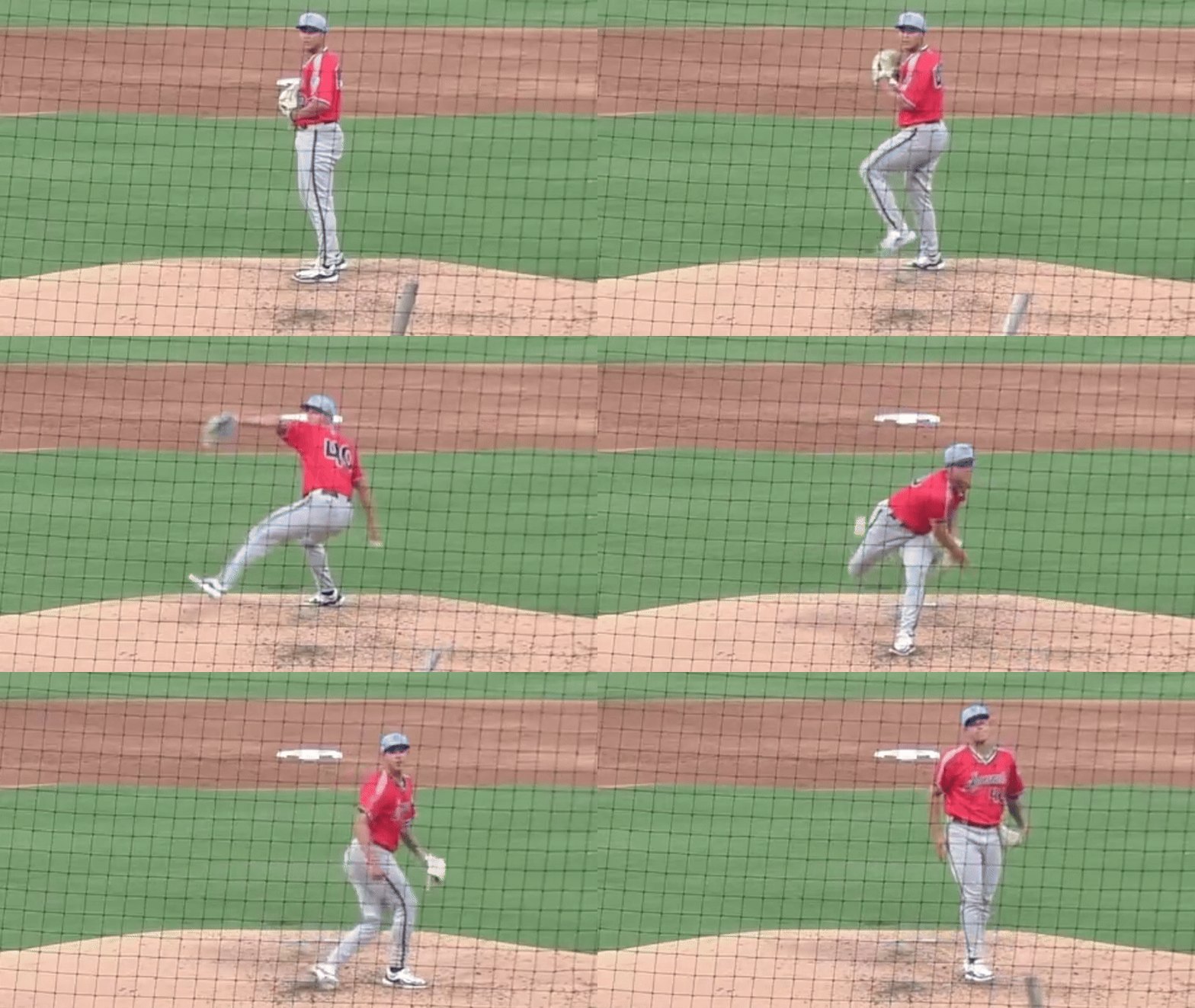 Tobias Myers’ delivery from a hitter’s POV (2025).
Myers appeared to have some issues with right-handed hitters in 2025 compared to 2024, but looking under the hood, he generated a comparable number of whiffs, his locations looked similar, and the underlying batted ball data wasn’t awful. Perhaps he just ran into some sequencing luck that locked up his ability to put away hitters? Maybe it was a result of being in zone too much with his slider compared to 2024 (45% in 2024 compared to 59% in 2025)? He’s historically been slightly worse against left-handed hitters, so there’s not much to knock between 2024 and 2025. From glancing at his heatmaps, however, his consistency of location was poor. Put another way, it seemed like, despite being in the zone more, he was non-competitive at a higher rate, a weird combination.
Pitch designing Myers is going to be tough, given the limitations of Myers’ release. I think he currently possesses every pitch he’ll probably need to find his ceiling. The question is how his 2024 locations and consistency reemerge in what I’d imagine is a non-starter role. It wouldn’t hurt to see more velocity than 93.5 on his four-seamer as a reliever, too.
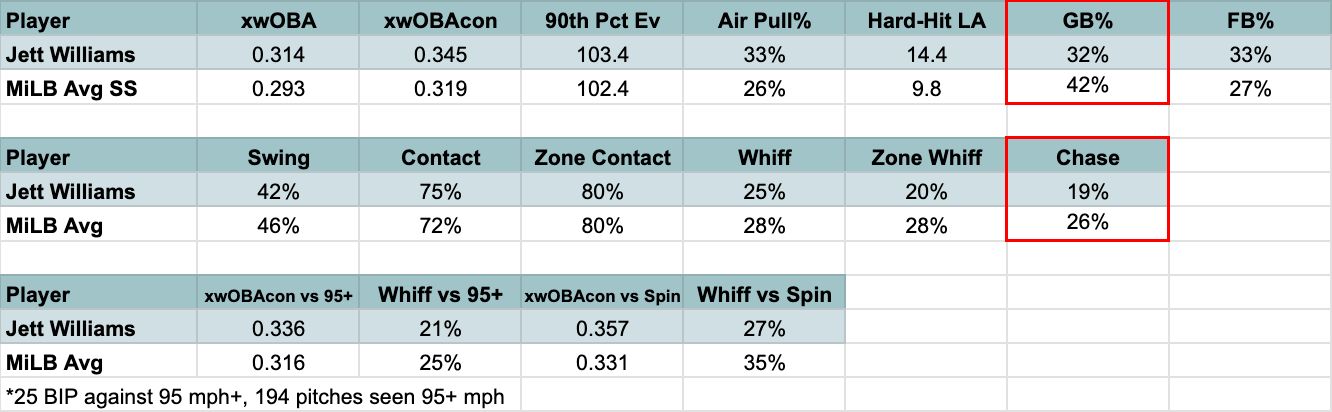
I’m not going to dive too deep into Jett Williams, but here is his batted ball data from the minors this season. It’s fascinating he’s not a pure slap-hitting middle-infielder despite a 5-foot-7 frame. There’s some ability to lift the ball and do damage, mixed with a good approach, which should play at either 2B or SS.