
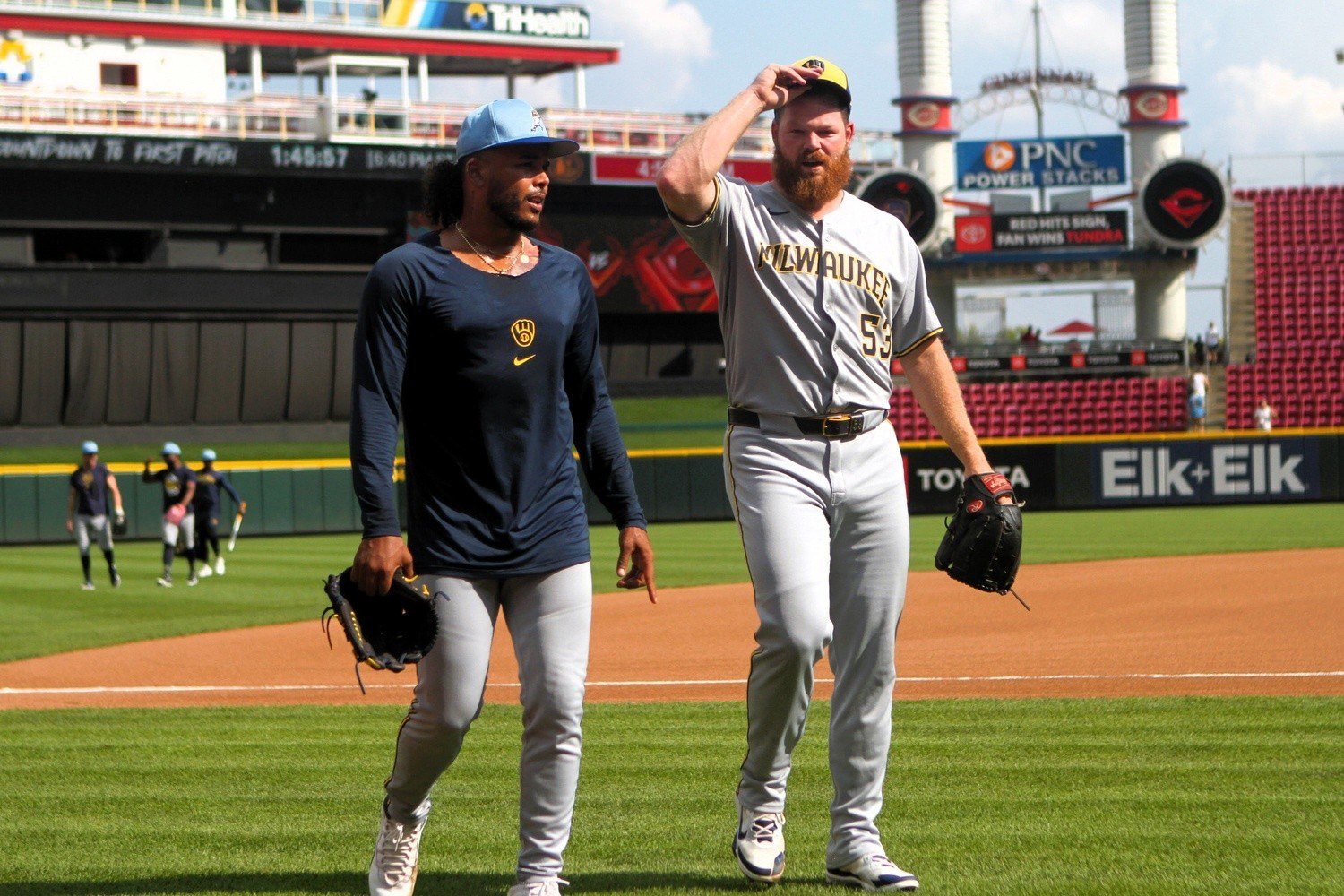
The unthinkable (yet inevitable) happened. The Milwaukee Brewers traded away ace right-hander Freddy Peralta to the New York Mets for two prospects on Wednesday night. The Brewers acquired infielder-outfielder Jett Williams, the Mets’ No. 3 prospect according to MLB Pipeline, and right-hander Brandon Sproat, their No. 5 prospect, while also shipping right-hander Tobias Myers to New York.
Losing the 29-year-old Peralta, who developed from a minor-league wild card when acquired in a December 2015 trade from the Seattle Mariners for first baseman Adam Lind, certainly puts a dent in the Crew’s rotation. Last year, Peralta finished fifth in NL Cy Young Award voting after an NL-best 17 wins, a 3.64 FIP, 2.70 ERA, and more than 200 strikeouts for the third consecutive year. Opponents hit just .193 against him in 2025, as he put up 5.5 bWAR.
Still, with Peralta due a very affordable $8 million in his last season of club control in 2026 and being likely to earn three times that amount in average annual value in his next contract, he became a hot trade commodity, with the Brewers unlikely to re-sign him. It was the second time in three offseasons that the Brewers traded away their ace. In early 2024, they swapped former NL Cy Young Award winner Corbin Burnes to the Baltimore Orioles for left-hander DL Hall and shortstop Joey Ortiz.
Where does that leave the Brewers’ starting rotation? They’re still in pretty good shape, regardless of where Sproat is slotted.
The Brewers finished with the third-best starting rotation ERA in MLB at 3.56, and figure to roll out a top five of Brandon Woodruff, Quinn Priester, Jacob Misiorowski and two of Sproat, Logan Henderson, Chad Patrick, Robert Gasser or Hall. All but Gasser and Hall are right-handers. Myers would also have been in the last group battling for the No. 5 role or a spot in the bullpen.
Woodruff, who turns 33 on Feb. 10, stayed with the Crew after accepting the qualifying offer of $22.025 million instead of becoming a free agent. Woodruff also becomes the leading candidate for Opening Day starter, after returning in 2025 from right shoulder surgery but then missing the postseason with a right lat injury. He is expected to be fine when spring training begins next month. In 12 starts, Woodruff had a 3.17 FIP and 3.20 ERA with 83 strikeouts in 64⅔ innings. He had a 5.4% walk rate and 32.3% strikeout rate, both the best of his career. Now, Woodruff will be asked to lead the staff in what could be his final season with the Crew.
The No. 2 spot in the rotation is likely to go to Priester, although Misiorowski could easily step up. The 25-year-old Priester was the feel-good story of the Brewers’ rotation in 2025. Acquired just a couple weeks into the season from the Boston Red Sox while stuck at Triple-A Worcester, all Priester did was finish second to Peralta in wins with his 13-3 record, which included going unbeaten in 19 straight appearances, all but three being starts. Priester had a 4.01 FIP and 3.32 ERA in 29 games (24 starts). Priester is not a big strikeout pitcher, which is reflected in his 20.2% strikeout rate against a 7.7% walk rate. It wouldn’t be surprising to see Priester take the next step, as he enters camp locked into the Brewers’ rotation and on the Opening Day roster for the first time.
Misiorowski, meanwhile, has something to prove after being shifted to the bullpen late in the season and for the postseason following a spectacular start to his MLB career. His triple-digit four-seam fastball is what makes all the highlights, but his growth into an ace hinges on improving his control and how he uses his slider and curveball. Misiorowski had a 3.62 FIP and 4.36 ERA in 15 games (14 starts) in the regular season. At 6-foot-7, with a gangly frame, he had a whopping 11.4% walk rate, which is only slightly offset by his 31.9% strikeout rate. He did allow just a .213 opponent batting average. Misiorowski will turn 24 just after Opening Day. If he can mitigate his wildness, his combination of blazing fastball and knee-buckling breaking balls would be deadly.
Those three are locks in the rotation. The rest of these names are in much more fluid positions.
Let’s start with the 25-year-old Sproat, a second-round draft choice by the Mets in 2023 as a senior out of Florida. He’s the player who will initially draw a lot of attention, as a direct replacement for Peralta. While ranked as the Mets’ No. 5 prospect, he was not in MLB Pipeline’s Top 100. Sproat did rank 81st in Baseball America’s just-released Top 100; Williams checked in at No. 71. A 6-foot-3, 215-pound right-hander, Sproat made four late-season starts for the Mets in 2025. He pitched six innings in each of his first two starts, while his last two were more rocky. He allowed four runs in each, one going four innings and the other 4⅔. He struck out 17 in 20⅔ innings, including seven in his debut, while walking seven.
While Sproat has a good four-seamer at 96.7 mph, he only used that 13.8% of the time. A 95.7-mph sinker was his most-used pitch in his four big-league starts, at 34.1%, indicating he is more of a groundball pitcher, which suits the Brewers’ defense. He had a 66.7% grounder rate on balls in play off his sinker. In addition to his four-seamer and sinker, Sproat also mixed in his 84.2-mph sweeper (16.2%), 90.2-mph changeup (14.8%) and 79.9-mph curveball (14.8%). He sprinkles in an 87.9-mph slider 6.2% of the time. Sproat, who made 25 starts at Triple-A Syracuse in 2025, will obviously get a long look in spring training and be given every chance to earn a rotation spot. If not, a trip to Triple-A Nashville wouldn’t be out of the question, but he would likely be the first starter summoned when an injury arises. Sproat doesn’t profile as a top-of-the-rotation pitcher, but a solid mid-rotation performer.
A month shy of turning 24, Henderson is perhaps a forgotten part of the Crew’s rotation plan. Henderson made just five big-league starts, before missing almost the entire final two months of the regular season with right elbow inflammation. While something to monitor in spring training, it shouldn’t be a concern. Henderson made his debut in late April with a nine-strikeout performance over six innings. After going back to Nashville for about three weeks, he made three more starts, going five innings each time, and allowed a total of three runs. He made one more start in early August, before being sidelined. He had a 3.02 FIP and 1.75 ERA in those five starts, with an 8.1% walk rate and 33.3% strikeout rate. Combine that with a 3.59 ERA in 16 games (15 starts) at Nashville, and he has proven himself worthy of a rotation berth.
Patrick proved to be a valuable piece of the Crew’s pitching puzzle in 2025. He made 23 starts and four relief appearances during the regular season, posting a 3.53 FIP and an identical ERA, with an 8% walk rate and 25.2% strikeout rate. While the 27-year-old profiles as a starter, Patrick found a different gear in a late-season and postseason relief role. That makes opening the season in the bullpen even more enticing, while knowing that he could convert back to a starter if needed. Patrick allowed three hits and one walk while striking out 11 in nine relief innings in the postseason.
Gasser returned to the majors in late September for two abbreviated starts, then made two postseason relief appearances. He made the Brewers’ Opening Day roster in 2024 and had five starts before blowing out his left elbow. He is the last piece of the Josh Hader trade still with the Crew, and was the most anticipated player acquired, but has yet to truly showcase himself because of the injury. Gasser will be at full strength come spring training, and a front-runner for the rotation as the lone left-hander among these candidates.
Finally, Hall, who hasn’t been able to stay on the field long enough the past two seasons to make an impact, deserves at least momentary consideration. He has appeared in 33 games since coming over from the Orioles, 23 of them in relief. Hall began 2025 with a lat strain, came back around Memorial Day, pitched in 20 games, then went down with a strained right oblique in mid-August that ended his season. He put up a 3.73 FIP and 3.49 ERA in 2025, but had an 11% walk rate and just a 17.4% strikeout rate. It might be better to keep him in a relief role until he can prove he can remain healthy.
Although they’re dark horses, I will mention two other rotation candidates, in left-handers Aaron Ashby and Ángel Zerpa. Ashby has carved out a nice relief role and been a little uneven when given a chance to start, so it is difficult to see the Brewers forcing him out of his comfort zone, but letting him try to stretch out in the spring wouldn’t hurt anything. Zerpa was acquired this offseason from the Kansas City Royals for outfielder Isaac Collins and right-handed reliever Nick Mears. He’s likely to stay in the bullpen, where he found success in Kansas City, but the team did mention trying him as a starter just after the trade.
Of course, the Brewers could always sign a veteran on a short deal for more competition, like they did with left-hander Jose Quintana last year. For now, though, they have a clear top three and a high-variance but high-upside battery of options to round out the back of the rotation. Even without Peralta, they should be a good pitching staff in 2026.