
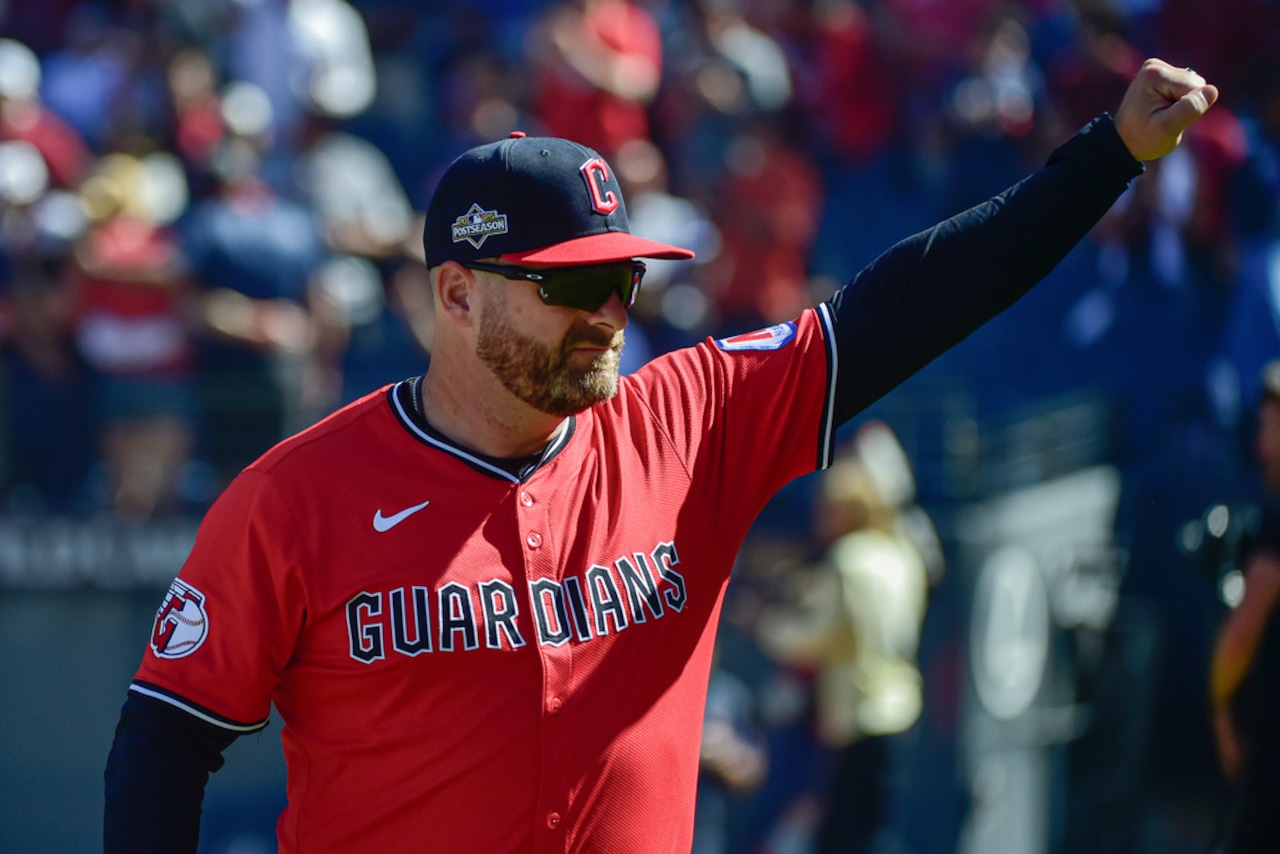
CLEVELAND, Ohio — Stephen Vogt’s remarkable rise from recently retired player to one of sports’ most respected leaders was a focal point in the latest Cleveland Baseball Talk Podcast, where Joe Noga and Paul Hoynes discussed The Athletic’s surprising ranking of Vogt as the 31st most admired person in sports.
For perspective, this places the Guardians manager ahead of figures like Dave Roberts (fresh off back-to-back World Series wins), Shohei Ohtani, and two-time NL Manager of the Year Pat Murphy. What makes this recognition so extraordinary is that Vogt has barely begun his managerial career.
“To me it’s not so much the baseball side of things, it’s the leadership side of things that really makes Stephen Vogt stand out,” explained Noga during the podcast. “You can tell when he walks in the room that he is a leader. He’s someone who the guys in the clubhouse get behind and they believe in him.”
This leadership quality was most evident during the Guardians’ historic comeback last season. As Hoynes recounted, “When they were 15 1/2 games out in July and had just gone through a 10-game losing streak and he still believed, I mean his belief was unshakable… He almost willed that team to get better, to go on that historic run, that comeback that saw them win the AL Central on the last day of the season.”
What makes Vogt’s ranking even more impressive is his unconventional path to management. Unlike traditional managerial hires who typically spend years working through the coaching ranks, Vogt had barely hung up his cleats when Cleveland came calling.
“Stephen Vogt hadn’t managed anywhere at any level,” Hoynes pointed out. “He had stopped playing, just retired from the Oakland A’s in 2022. He was a bullpen coach for Seattle in 2023. And then he replaces the winningest manager in Cleveland history, Terry Francona.”
The podcast hosts emphasized that Vogt’s true talent transcends traditional baseball management. When the team hit rock bottom during their 10-game losing streak, something beyond tactical decisions was needed.
“There’s no managing your way out of that,” Noga asserted during the discussion. “When you’ve lost 10 games, you’ve lost your closer and you’re at the lowest point in the season. There’s only leadership that gets you out of it, like you said, willing the team to do that sort of thing. That’s what was most impressive about Stephen Vogt last year.”
This recognition reflects a shifting paradigm in how teams evaluate managerial candidates. Rather than prioritizing extensive experience, organizations increasingly value authentic leadership, communication skills, and relationship-building abilities — areas where Vogt excels.
The Athletic’s survey, which polled 100 people across sports including executives, players, coaches, and managers, validates what Cleveland fans witnessed firsthand: Vogt possesses rare leadership qualities that inspire those around him to exceed expectations.
As quoted in The Athletic article and referenced in the podcast, former MLB player Matt Antonelli observed that Vogt “empowers players to be themselves. He’s a great communicator and a connector and understands that leadership is about relationships, and that’s why his players believe in him.”
Despite the accolades, Vogt remains characteristically humble — another quality that endears him to players and colleagues alike. As Noga noted, “He’s not going to be the guy waving that in anybody’s face. He’s just going to go out there and do his job next season.”
Want to hear more about how Stephen Vogt’s leadership transformed the Guardians and earned him recognition among sports’ elite? Listen to the full Cleveland Baseball Talk podcast episode for a deeper dive into what makes the young manager such a special presence in baseball.
Read the automated transcript of today’s podcast below. Because it’s an AI-generated transcript, it may contain errors and misspellings.
Podcast Transcript
Joe Noga: Welcome back to the Cleveland Baseball Talk podcast. I’m Joe Noga, joined by Paul Hoynes. Hoynsie, a little bit of movement yesterday in terms of free agency and some trades. Not a lot going on in guardians camp. But you know, the, the, the big name coming off the free agent board last night was Cody Bellinger. To not a lot of people’s surprise, he resigns with the Yankees. I believe the deal was five years, 162 million. And, and it, it involves a couple of opt outs, I believe one after, after the first two seasons. So Bellinger gets a deal to go back to New York and, and really the, the Yankees sort of, you know, save face there with their offseason. It’s, it’s pretty much their biggest move to bring back the guy who they, they had, you know, sort of circled and targeted all along.
Paul Hoynes: Yeah, this is a guy they had to have back. Joe, he does so much for him. He’s having a solid season. Gives protection to Aaron Judge. So yeah, I mean it looked like it. You know, they, they were kind of button heads there for, for a while. You know, they had stayed, the Yankees had backed off negotiations, but you knew this was going to get done. Yeah.
Joe Noga: And you know, the, the competition for him really might have even come from their own division in terms of the Blue Jays who again missed out on Kyle Tucker. And you know, there weren’t a lot of other landing spots for Bellinger. It was pretty much going to be the Yankees or the Blue Jays. And, and really, uh, this is, this is the way that it was, it was pretty much going to go. I think people were thinking Bellinger back to the Yankees all along. The other big move last night also in New York, the Mets, after missing out on Tucker, who went to the Dodgers and after signing Boba Shet, make a big trade and get the ace from the, the Brewers, Freddie Peralta. They get him in a trade for a couple of minor leaguers. You know, this is another example of a small market team in Milwaukee that saw the writing on the wall and saw that they weren’t going to be able to resign Peralta to a long term deal. So they ship him off to, you know, the, the, the Mets. And the Mets sort of saved their offseason in the last couple of weeks after missing out on, on Tucker. They go out, they, they make a couple of trades and they, they, they sign Boba Shet and they sort of save face in that way.
Paul Hoynes: Yeah, definitely. It was a busy day in New York yesterday. Joe Bellinger signs You know, Boba Shet is introduced to the media by the Mets. The day before there they got Luis Robert Jr. In the trade for the White Sox. And then, you know, Wednesday night they trade for Freddy Peralta. And the throw in, Joe, is Tobias Myers. He’s also coming, going to the Mets. And that’s an interesting name from Cleveland’s past.
Joe Noga: Yeah, it was the, the name of the, the minor league at the time. He was the minor leaguer traded by the, the, the, the Rays to Cleveland in exchange for a Junior Camin Arrow. So Junior Camino went from Cleveland to Tampa Bay. Tobias Myers came to Cleveland and didn’t stick around for very long. Was sort of underwhelming as a prospect. He moved on to Milwaukee where, you know, he put up a couple of really good seasons and now he’s the, the throw in along with Freddie Peralta in exchange for a couple of prospects. I guess it’s the continuation of a dark chapter in Chris Antony and Mike Chernoff’s trade. History came and there are what if.
Paul Hoynes: 40 plus home runs last season for the, for the Rays. Looks like a, you know, a budding superstar, a right handed power hitter. And he, he may have helped the guardians, Joe. I think he may have, you know, he may have been able to work his way into that lineup at some point.
Joe Noga: Yeah, at a right handed power hitter, 30, you know, the ability to, to hit 30 home runs or more and driving 100 runs. Something this lineup has been lacking for a while. I want to go back to the Mets though. Just, you know, their off season has been one of tremendous turnover in the way that they’ve approached building their roster. Francisco Lindor is obviously still there. He’s sort of the cornerstone and the, the focal point of that lineup. But they moved on from or, or lost Pete Alonso, they lost Edwin Diaz. The sky was falling at one point. You know, you think back to the winter meetings and, and just how much turmoil there was surrounding the Mets. Now Mets fans got to be, got to be puffing out their chest, feeling pretty good about what’s, what’s been going on with their club.
Paul Hoynes: Yeah, as well as this flurry of activity the last few days, Joe, you know, earlier this winter they added Marcus Simeon, Luke Weaver, Jorge Polanco, Devin Williams, you know, so they, they took care of. Those are some, you know, you know, really, those are decent, decent, decent moves and you know, established big league players and you know, and you’re right, they, they had what they traded Brandon Nemo. I think they traded Jeff McNeil so yeah, that’s a, that’s a club that really got turned over. It’ll be interesting to see how they gel in spring training and what kind of product they put on the field this season.
Joe Noga: Yeah, but with all of that comes a tremendous amount of pressure to win right away. I guess they, they sort of put out there going after a guy like Luis Robert who you could potentially only have for one season. It just looks to me like this is a team that is in the hey, you better win some games right away mode.
Paul Hoynes: Yeah, I’m sure they are. And I think that’s always the case almost every year in New York with the Yankees and the Mets. You know, it’s, it’s kind of a win now game. They both got huge payrolls behind them. I don’t, I don’t think these teams really go through, you know, the traditional kind of rebuild.
Joe Noga: Yeah, and how does that really compare to the way the comparing and contrast it with the way the Guardians build their roster and it’s just night and day different.
Paul Hoynes: What additions have the Guardians made this, this winter? And you know, you, you look down the list. Franklin Gomez, a minor league pitcher from the Mets. Carter Kaboom, Don Nunez, Pedro Avila, Cody Howard, you know, he, Sean Armstrong, Holderman Pette, Brandon Brogdon, mostly relievers on short term deals. We really haven’t seen, you know, a big addition among the post position players. And it’s a, you know, it’s a night and day contrast for sure.
Joe Noga: So a lot of differences there, you know, just two different ways of going about, you know, hopefully building for success in 2026. And the Guardians, the model has worked the last couple of years, so we’ll, we’ll keep an eye on the way that moves forward. All right. Wanted to bring up, you know, point out a, an article that was, you know, published in the Athletic within the last week or so. It ranks the, the 40 most admired people in sports. And this was, it was a sort of an interesting approach to this post. It said they asked a hundred people in sports, so these could be executives, players, coaches, managers, whoever made up the hundred people that they, they surveyed and they asked them their, their top five most admired people in sports and guardians, Manager Steven Vogt. I, I, he was one of, you know, only what, 1, 2, 3, 4, 5, 6, 7. Only seven people associated with Major League Baseball made the list. And the highest ranking person on that list was Aaron Judge at 21. So you know, it was very heavily, I think early in the list it was a lot of basketball players Leaders, coaches that were ranked highly in the list. You have to get down to number 21, Aaron Judge, before the first baseball person shows up on the Athletics list of the. The 40 most admired people in sports. But then There at number 31 is Stephen Vogt. And I want to read you sort of the quote or the quip there that they have about Vogt from the survey. It says credentials. When Stephen Vogt became the manager of the Guardians in late 2023, he had been retired for barely more than a year. Cleveland won the AL Central in 2024 and 2025, and Vogt instantly became one of the steadiest and most respected managers in baseball. And quote from Matt Antonelli, a former MLB player, he said, quote, he empowers players to be themselves. He’s a great communicator and a connector and understands that leadership is about relationships, and that’s why his players believe in him. So I ask you, Hoinsey, Steven Vogt ranked number 31 on the most admired people in sports list according to the Athletic. Is that something that, that he could probably hang up there on. On his wall right up there with his two manager of the Year trophies?
Paul Hoynes: I think so, Joe. That’s. That’s quite a compliment. And I think, you know, it’s, it’s. It represents, at least in baseball, to me, it represents one of the newer theories about hiring managers. Stephen Vogt hadn’t managed anywhere at any level. He had, what, stopped playing. Just retired from the Oakland A’s in 2000, I th. I believe, 2022 or. Yeah, 2022. He was a bullpen coach for Seattle in 2023. And then he replaces you. Winningest manager in Cleveland history. Terry Frank Francona is a manager and, you know, just. Has done. Just done a really, really good job in Cleveland with, you know, with all the, you know, kind of roadblocks that every manager who comes to Cleveland knows he’s going to have to face. They’re going to be a young team. They’re not going to have a big payroll. You’re going to have to, you know, really, you know, you’re going to have to continue develop players at the big league level because most of these guys are coming from the minor league system.
Joe Noga: Yeah. Not to take anything away from Stephen Vogt as a baseball guy, as a guy who knows, knows the game and manages and does that, that all the stuff associated with the baseball side of things, you know, excellent. But he came in and admitting, you know, there’s things that I don’t know about managing and I’m going to ask questions and I’m going to be that guy. To me it’s, it’s not so much the baseball side of things, it’s the leadership side of things that, that really makes Stephen Vogt stand out. And you can tell when he walks in the room that, that he is a leader of men. He’s, he’s someone who the guys in the clubhouse get behind and they believe in him. And that’s the mantra, that’s the, the, the calling card. Even before he showed up for his first day, I believe in Stephen Vogt was his champ. So it’s interesting you look at this list. Stephen Vogt is number 31 on the list. Dave Roberts, who’s got back to back World Series championships for the Los Angeles Dodgers is 32 on the list. Me says something. Shohei Ohtani, 33. Pat Murphy, the two time NL Manager of the Year, 35 on the list. And then rounding out the top 40, Kyle Schwaber and Mookie Betts tied for 40th on the list of most admired players or most admired personalities individuals.
Paul Hoynes: Yeah, I think so, Joe. And you’re right about the leadership quality that voters has displayed. I think it came to the forefront this past, this past season when there were 15 and a half games out in July and you know, had just gone through a 10 game losing streak and he still believed, I mean his belief was unshakable. I don’t know if what the player, you know, I don’t know if it would. The players in the locker room held that same belief. But he almost willed that team to get better, to go on that historic run, that comeback and that saw them win the AL Central on the last day of the season. I think that, that would, that had a lot to, you know, vote didn’t swing a bat or throw a p. But he had a lot to do with that rally.
Joe Noga: Yeah, there, there’s no managing your way out of, there’s no baseball managing in game decisions, you know, pitching changes or lineup situations. There’s no managing your way out of that system. When you’ve lost 10 games, you’ve lost your closer and you’re at the lowest point in the season. There’s only leadership that gets you out of that and there’s only, like you said, willing the team to, to do that, that sort of thing. That’s, that’s what was most impressive about Stephen Vogt this year was that he was able to accomplish that. And he’s, he’s very humble about it. He’s not going to be the guy waving that in anybody’s face. He’s just going to go out there and do his job next year. It’s, it’s kind of impressive to watch to, to have been here the last two seasons to see him do that and go about his business. It’s, it’s, it’s been a lot of fun. All right, you want to jump into some hey Hoinsies here and answer some questions to sort of round out the week? Let’s get into it with some of these reader submitted questions on our Cleveland Cleveland Guardians subtext. You can sign up by going to cleveland.com subtext it’s 3.99amonth to subscribe and you get text messages throughout the off season and during the regular season from Hoinse and from me behind the scenes stuff from the, from the clubhouse, from the dugout and from, you know, our pregame and post game availability with Steven Vogt and the players. Let’s, let’s jump in with Ted from Westlake Village, California. He wants to know if there will be any players not ready to start spring training due to injury. And really off the top of my head, I think we can only, I only came up with Andrew Walters, who’s probably going to be still slowed after the surgery during the season to repair what, a torn lap muscle?
Paul Hoynes: Yeah, yeah. And he, yeah, he’ll be behind when he comes to spring training. I’m sure he’s reported morning early with the other, you know, with other players that are nursing injuries. But he’s the major one, Joe. And I’m sure, you know, there’s always sore arms, there’s always pulled hamstrings. There’s always, you know, in spring training. So we’ll have to see how that the injury picture unfolds. But right now, you know, I think Walters is the only guy really on that list.
Joe Noga: You know, we’ve, we’ve had questions in the past about David Fry. We asked Stephen Vogt last week was Frey going to be ready to jump in and take a full, you know, turn as a, as a catcher, you know, doing, you know, the catching portion of preseason and all that. And he said, you know, after the, the injury the, that ended his season and taking the fastball to the face from Tarek Skubal, that he should be ready to go.
Paul Hoynes: Yeah. And you know, his, you know, the last time we talked to vote, he said he was throwing fine. He was. And you know, we saw, we saw Fry at the end of the season, Joe, when they were, you know, Cleaning out the. It seemed to be pretty well. And he was, you know, he had, he had removed some of the bandages, so it looked like he was, he was going in the right direction on that.
Joe Noga: Yeah. And, you know, you’re going to be behind the catcher’s mask and, you know, protected in that way. But it’s still, you know, the first time you take a foul tip off the mask, that’s going to probably going to give you, you know, a little, a little shock to the system. But the other thing with David Fry is you got to remember he’s coming off of more than a year ago, the off season, elbow surgery, and that was the reason why he could only DH last season. This year, we’re expecting to see him get back to that versatility utility that made him so valuable back in 2024.
Paul Hoynes: Yeah, and I’m sure he’ll be probably on some kind of, you know, like, slow go program early in camp. You know, there’s always a couple guys that you don’t, don’t expect that, you know, that they, you know, maybe, you know, they, they threw a lot last season, made a lot of appearances. A guy like Bazano who’s, you know, they have to see his. The ugly, all that comes into play as well.
Joe Noga: One from Bob in Lake Worth, Florida, he says, hey, Hoy. Everyone talks about. Guardians feature young, untested position players. In fact, most of the projected lineup of young players has at least one season of experience, including Nolan Jones, Angel Martinez, Kyle Manzardo, Gabriel Arias, Brian Rocchio, Daniel Schneemann and Bo Naylor. Some of those young players are entering their prime years with a degree of experience under their belt, including playoff exposure. Is it really that unreasonable to expect them to improve their performance this year as a group? That sort of harkens back to something Austin Hedges told us last week. What the front office and what Stephen Vod have been saying all along is these guys, you got to give them that, that opportunity to, to sort of establish themselves, you know, you know, work through the year and they stay, you.
Paul Hoynes: Know, that’s the whole theory behind why the Guardians haven’t made any moves this season, you know, among the position players. They want to give these guys a chance. And Hedges was right, what he said last week. You know, they’re a young team. They know they didn’t hit well last year. They’ve got to do better. But if you look up and down this roster and up and down the lineup, it’s, it’s. They’re young, but they’re, they are Most of them have played in the postseason, you know, from what they’ve been into the postseason, three, the last four years. And most of the, a lot of those guys have experienced that and, you know, and that’s got to help you, you know, during the regular season as well. But the thing that, that worries me, Joe, is, you know, not everybody, you know, not everybody takes a step forward at the same time, you know, and, you know, there’s going to be some guys that do, you know, some guys like Stephen Kwan that just, you know, roll out of, you know, roll out of the minors and, and, and they look like an All Star from day. The guys that are going to be up, guys that are going to stay the same, they’re going to plateau. So, you know, that, that’s my concern about having so many players, young players, and, and you know, kind of turning them loose at the same time. How much regression is going to be, is there going to be and how many, how much progress is there going to be? And I don’t know how you get a, you know, an even performance out of a lineup like that.
Joe Noga: Yeah, it’s not just regression. It’s inconsistency. And all of those guys at times have shown flashes over the last two seasons. It’s not there, there have been hot streaks. It’s just how, how do they maintain those streaks? How do they limit the, the slumps and can they pull themselves out of those slumps? Do they have the tools to do that of that group that, that Bob mentioned in his, his, his email here or his text? Nolan Jones, Angel Martinez, Kyle Manzardo, Gabriel Arias, Brian Rocchio, Daniel Schneemann, Bo Naylor, which one or two of those guys has the highest ceiling in terms of this is a guy who can, can stick around for more than just the, the one or two years that they’re trying to, to give them the opportunity?
Paul Hoynes: Yeah. You know, I think Manzardo is a guy that jumps out of me, Joe, just because, you know, the power numbers, the production he showed last year, that was his first full season, you know, so, you know, 27 home runs, 70 RBIs, you know, he still struck out over, you know, over 130 times. So that’s a part of his game. He’s going to have to, you know, tighten up. But that’s a guy that kind of jumps out of me. You know, I love Naylor’s power. What he hit 14 home runs last season, but I don’t know if we’re ever, he’s ever going to Be a consistent hitter, Joe. I mean, he needs some consistency. I know there’s a lot of, you know, a lot of, you know, he’s got a lot on his plate as a catcher, but if you’re going to be the starting catcher, you can’t hit 195. You can. You just, you September when he got hot and really kind of was. Was one of the best hitters on the teams. You know, it’s. It’s time. It’s time for guys like that to.
Joe Noga: Take a step forward to go with Brian Rocchio out of that group as a guy with a high ceiling. Don’t forget, you know, he’s. He just turned 25. It seems like forever that he’s been in the, in the guardian system and that he’s been sort of a highly regarded prospect, a guy that, you know, they sort of believed in. And he’s hit at every level that he played at once he got adjusted and got comfortable. I think that just by giving him a little bit more time and, and him maturing into sort of his body and knowing what he can do, I think. I think Rocchio’s got a really high ceiling. It’s just. Will he. He continue to get the opportunity to go out there and prove it and learn from all the mistakes that he’s made if he could be playoff Rokio in June, July and August?
Paul Hoynes: So, you know, that’s. This is what. This is the, the lineup. It seems like they’re going to roll out there. There’s still time between before, between now and opening day on March 26, but I don’t think that it. We’re going to see a drastic change. Joe. Any improvement in this club and is going to have to come from the players already on the roster. Any major improvement is going to have to come from. From internal guys that are. That are, you know, going to camp.
Joe Noga: Question here from our subtexters comes from the 602 area code. I don’t have a name or a hometown here from this individual, but he said on your podcast earlier this week, you mentioned Carlos Beltran allegedly was a Houston cheater. He’s in the hall of Fame. It’s. It’s the hall of cheaters. Now, you might as well put the steroid boys in Poinsy. As somebody who once voted for a steroid user or from the. The steroid era, and you and I believe you did vote for Carlos Beltran. How do you sort of explain the. The two sort of com. Competing theories there?
Paul Hoynes: I know, you know, the, The Astros Use a, a sophisticated system of stealing signs. But sign stealing has been going on for, in baseball for over a hundred years. As long as there’s been baseball, people have been stealing signs. I mean, I remember Bob Feller talking about they had a guy in the scoreboard in the old stadium with, with the binoculars, staring down into the, in trying to steal signs from the catcher or the bench or something. So it, it’s been going on a long time. Obviously, the, the, the, you know, the Astros took it to, you know, a different level despite banging the garbage can. There was a lot more stuff going on besides that. You know, to me, it’s apples and oranges. The steroid guys were changing their bodies. They were changing, taking themselves, taking, injecting their bodies with, with substances that added muscle weight, added. Added bat speed, added mass. I thought that was an illegal way to improve your performance. I mean, stealing signs, okay, is one thing. Sharpening your spikes going into second base is one thing. Changing your body mass, changing the way you physically can perform by throwing harder, by coming back with fewer days rest, by recovering from injury faster. That seemed to be above and beyond to me. That was, to me, that was illegal. I just, I, I just didn’t. You know, it changed the landscape of baseball. It changed the texture of all the records that we grew up, you know, as kids, loving. And so I, I just. It was a, it was a, it was a dark era for me, for a baseball, and. And the people that participated can’t feel.
Joe Noga: Sorry for him, I guess. The hall of Fame itself has display cases. It has a whole section that, that talks about or mentions. It doesn’t shy away from the steroid era. It sort of recognizes that that was a period in baseball’s history that that needs to be recognized and dealt with. Do you think that with Beltron going into the hall of Fame, with his, you know, induction and ceremonies later on the summer, do you think there will be talk about it surrounding, you know, that, that in July, do you think the hall of Fame needs to. Needs to come out and recognize or, or, you know, not shy away from the fact that the Astros cheating scandal happened and, you know, maybe recognize that it happens and might still be happening throughout baseball and, and just sort of put that out in the open if they’re going to have Beltron in the.
Paul Hoynes: Hall of Fame, I mean, who knows? It might be mentioned on his plaque. Who knows? I mean, you know, if. I guess if that’s the way they want to, you know, address might be on his hall of Fame plaque, but I Think, you know, he, he was kind of, he was, you know, he, he was. The Mets hired him as a manager. He never got to manage a game because of that, that, that MLB and, and MLB came down hard on him. Who else? Joey Cor. I mean, yeah, it came, came down hard on those guys and the general manager of Astros. So those are the only guys that got penalized. So I think, you know, I just, I just don’t see the comparison. I. And if they want to, you know, I’m sure Beltran is going to be asked about it in interviews leading up to his induction. That’s the way this thing works, and I’m sure he’ll be ready to answer it.
Joe Noga: Yeah, we’ll, we’ll look for another reason to look forward to getting to Cooperstown this, this summer. Hoynse will be to hear about, you know, how, basically how they sort of frame that discussion with Carlos Beltran and the hall of Fame.
Paul Hoynes: All right, so, you know, one more thing. We know there’s steroid users in the hall of Fame. Yeah, people have been that used have, are in the hall of Fame now. But you know, if, but you know that. So, you know, you know, people, you know, people, you know, people still voting for Alex Rodriguez, Danny Rodriguez, Manny Ramirez got a. God got what, 38, 39% of the vote this year. You know, that, that don’t take it as hard as some people do. They don’t have, they don’t have, they haven’t drawn a lot.
Joe Noga: And a lot of those are newer voters who came in and, you know, didn’t really go through the experience of that steroid era as, as you and some of the, the more, you know, established longtime voters necessarily did. So, yeah, it’s, it’s just a different sort of changing sort of attitude towards those guys now. Like you said, Manny and Alex Rodriguez. All right, Hines, that’s going to wrap up today’s edition of the Cleveland Baseball Talk podcast. We’ll be back next week to talk more, more baseball and a big weekend in New York for you at the BBWA gala there. So we’ll check in with you then.
Paul Hoynes: All right, Joe.