
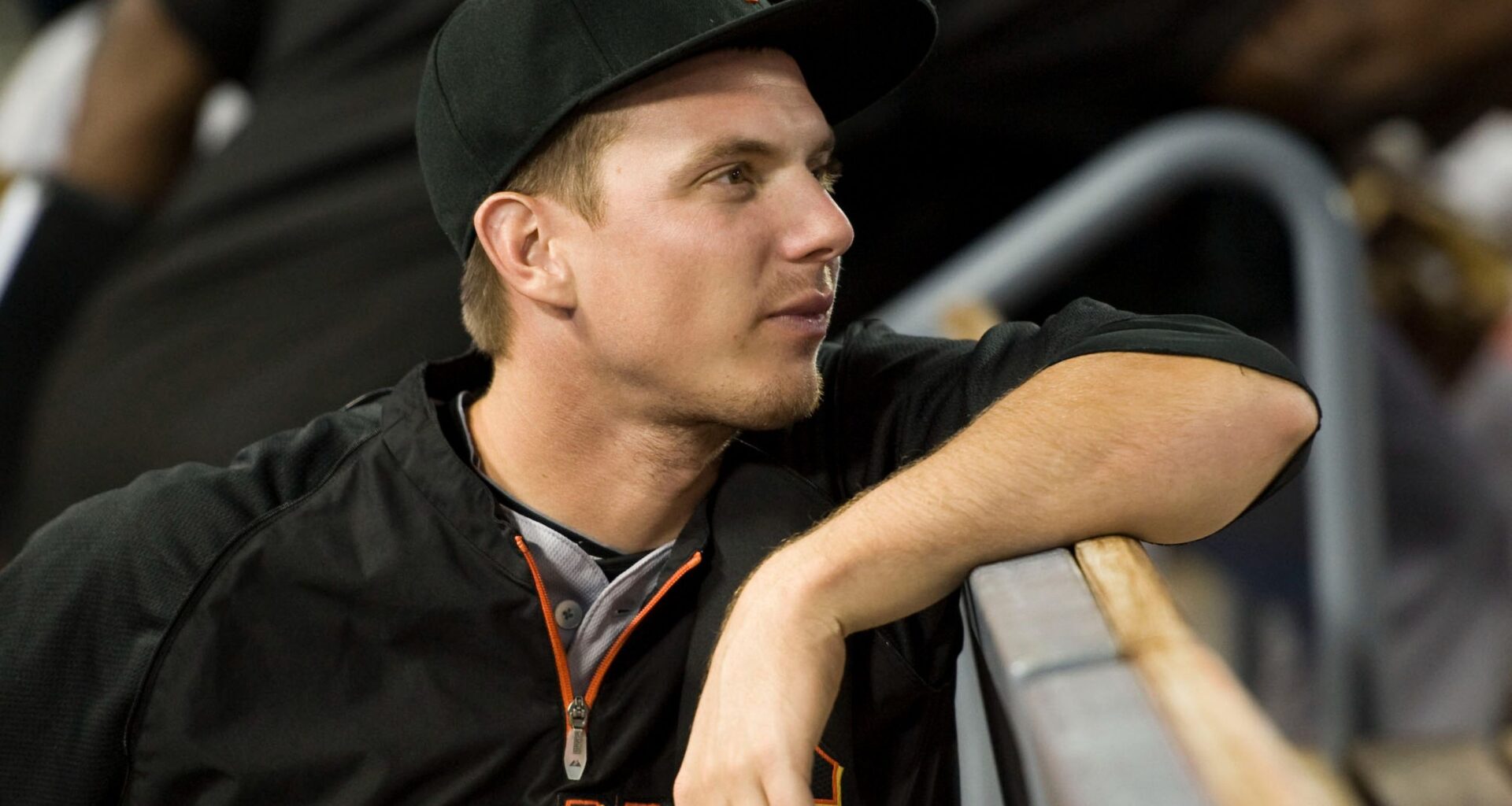
Image credit:
Gary Brown (Photo by Kevin Sullivan/Digital First Media/Orange County Register via Getty Images)
In the early-aughts, the Southern California high school baseball class of 2007 was shaping up to be an all-timer, with future top picks like Mike Moustakas and Josh Vitters leading a deep group.
But as the 2007 class entered high school, future first-round pick and Cal State Fullerton All-American Gary Brown wasn’t even close to being considered a part of that group.
“I wasn’t on the scene, really at all,” Brown said in his appearance on the latest From Phenom To The Farm podcast. “I actually repeated eighth grade because I was so small … I was a no-name guy.”
Whereas many prep baseball players spend their high school years on the travel ball circuit, Brown did not. The son of a single mother with four children living in a mobile home, Brown’s family didn’t have the money to cover the high costs of travel ball.
Brown entered high school and began to grow into his body, and with that came blazing speed and more pop in his bat. His grandfather paid the $70 fee for a local showcase, putting the cost on his credit card to give Brown one chance to get his name in front of the SoCal baseball world.
Want more podcasts like this one? Subscribe below!
Apple Podcasts | Spotify | Player FM
It proved to be a well-spent $70. Brown’s performance at the showcase led to an invitation to play on a team in a weekend tournament in San Diego. That led to college interest, campus visits and ensuing scholarship offers from Cal State Fullerton and Nevada, which in turn earned Brown a spot on a Royals scout team. In a tournament with that team, Brown ran a 3.8 home-to-first time three at-bats in a row, which finally cemented him as someone to know in SoCal prep baseball.
Brown was drafted in the 12th round by the Athletics in 2007, but unable to come to terms, he enrolled at powerhouse Cal State Fullerton. After spending years overshadowed by his peers, from the second Brown stepped foot on campus, he played like a guy determined to prove he belonged.
“I was full-go, full-steam,” Brown said. “I played with my hair on fire. I played like that most of my career.”
Brown found steady playing time early in his Fullerton career, and he was a Cape Cod League all-star in 2009. A crucial moment in the batting cage with coach Sergio Brown took him from good to great. Having previously told Brown ahead of his junior season that he wanted to hit .400, the 1995 College World Series champ offered a reality check.
“I’m in the cage one time, and I’m rolling over, hitting terribly, and he goes, ‘Ha! You want to hit .400 this year? You can’t even hit .400 in the cage!’” Brown recalled. “And it hit me, and I was like, golly, he’s right. After that point, my work in the cage became so much more fine-tuned and focused. It became, I’m not just hitting to get loose, I’m hitting to get ready with a purpose.”
Hitting with a purpose in the cage clicked. Brown’s average didn’t slip under .400 his entire junior season in 2010. He signed with the Giants as the 24th-overall pick in that June’s draft.
Brown’s professional career started much like his college career ended. He carried a .925 OPS and stole 58 bases in his full-season debut for High-A San Jose. On the way, he started in center field for Team USA in the 2011 Futures Game and made his way to the BA Top 100 Prospects list.
His introduction to Double-A Richmond the following year was rockier, but he turned it around late in the season and had a standout AFL performance.
“Going into ‘13, I felt really good about going into Triple-A and getting to the big leagues,” Brown said. “I felt like I went through my troubles, and I figured it out.”
Unfortunately for Brown, Triple-A brought more questions than answers, which took a strain on him physically and mentally. He hit just .231 for Fresno, careening down the Giants Top 30 prospects list and for the first time questioning his aptitude as a baseball player. While Triple-A wasn’t the step forward in his career he’d hoped for, the lessons learned via failure proved just as valuable.
“I look back at 2013, and I am so thankful for that year, for what it has done in my life today, and what it has done for my ability to communicate, to handle adversity,” Brown said. “I would not change a thing, because I think I am a better human because of it.”
Brown eventually made his big league debut towards the tail end 2014. He retired following the 2017 season without fulfilling the promise of his standout 2011 campaign but also never falling out of love with the game of baseball, either. Shortly after retiring as a player, Brown took a job as a scout with the Mets, setting him on a new path for getting everything he can out of baseball.
“I’m a lifer, man, I love this game,” Brown said. “You look at the kid from the trailer park, the opportunities that I was afforded from this game. It was more than just a game for me—it was my safe space.”