
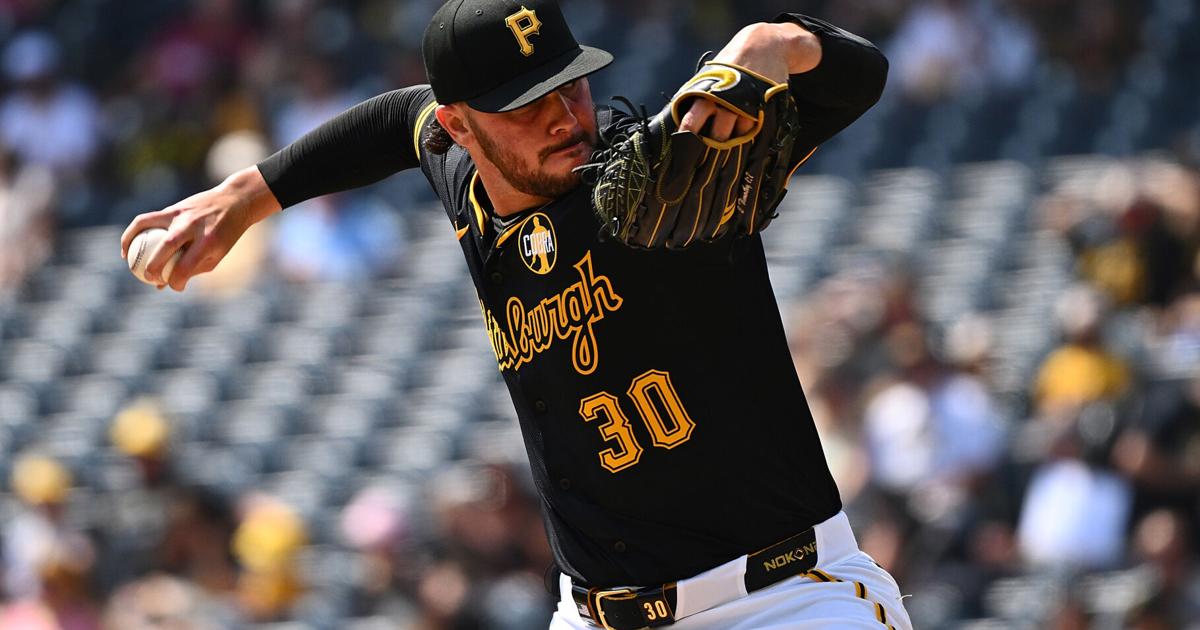
PALM BEACH GARDENS, Fla. — The pop of a catcher’s mitt mixed with saws screeching and hammers pounding provides an appropriate soundtrack inside Paul Skenes’ offseason workout facility, a baseball-lover’s paradise and an encapsulation of his unique personality.
It’s striking but not fancy, the same way Skenes commands attention but doesn’t seek it. Or how he’s confident without being cocky.
Watch Skenes go through a workout here, and that juxtaposition is hard to ignore, especially the gobs of expensive pitching technology sitting atop a rubber floor Skenes argued (unsuccessfully) against having, the Pirates’ ace talked out of sticking with the “gritty” feel of concrete.
Then there are the walls: plain black aside from an American flag — and, yes, that’s intentional. Nothing from winning a NCAA national championship, National League Rookie of the Year or his Cy Young Award. Skenes doesn’t want the distraction because he’s here to work, to improve, to obsess over competition and hopefully to revolutionize the way people think about baseball training.
“Don’t get me wrong, I want the facility to be nice, but it’s function over form,” Skenes said. “It’s doing the job rather than looking like you’re doing the job.”
Skenes has everything he wants here, along with a familiar face in Derek Groomer, who was on LSU’s staff when the Tigers won that national title and now works every day with Skenes and others, diving deep into baseball’s endless nuance.
What Skenes and Groomer have created is part training facility and part test lab, a way to prepare for this upcoming season but also a vehicle to push boundaries.
All of it points to Skenes far exceeding the best-pitcher-in-baseball label he has rightly earned.
Paul Skenes is looking for more. A lot more.
“He’s trying to revolutionize the game with how players train, execute and compete,” Groomer said, describing Skenes’ love of learning and doing whatever he can to gain an edge.
“He employs newer concepts but still relies on a lot of older mechanics and older techniques. It’s all kind of a mixture. But his biggest thing is that he wants to push. He wants to be leading the curve forward.
“The ideas that we’ve come up with in four years, people would be like, ‘That’s absolutely insane.’ Then we’ve figured it out and executed it.”
Skenes has a slightly different description with how he thinks about his ultimate goal. To quote a movie that features another version of baseball-boundary pushing in “Moneyball,” complacency is the moon to Skenes.
“Guys want to get to the show, but the work is what got you there,” Skenes said. “The way I think about it, I want to do something bigger.”
‘Very high level of intent’
The facility where Skenes trains sits in a nondescript office park, next to a printing company. There are no signs. You can’t see in the windows.
It’s a space Groomer leased just two months ago and one that’s still very much under construction. That rubber floor went down last week. There’s a row of golf simulators — the sport is the closest thing Skenes has to a hobby — that’ll be finished by the end of January.
The space is part of a private training company run by Groomer that serves roughly 30 clients throughout professional baseball — and does it well. There’s a NewtForce mound to measure ground force. TrackMan technology captures pitch and body movements. There’s every piece of workout equipment a player could want or need.
Called “The Facility” by Skenes and “No Brand” by Groomer (because it caters to players individually), the training space that probably won’t be named later is very nice — it just prioritizes business over show, work over what’s known in baseball parlance as “eyewash.”
In other words, exactly how Groomer’s top client and his endlessly curious confidant wants it.
“Certainly not talking bad about any other facility, but it can become a social thing,” Skenes said. “This isn’t social.”
The dozen or so people who came and went over the course of a day made for a busier-than-normal Sunday, Skenes said. There’s also a noticeable absence of music whenever Skenes works, the pitcher preferring quiet.
The only noise involves short conversations between him and Groomer or catcher Tyler O’Clair over what might be happening during a bullpen.
“Body good there?” Skenes asked Groomer at one point, asking him to check on real-time Trackman data from cameras positioned around the place.
“Yeah, really good,” Groomer answered.
A question for O’Clair squatting 60 feet, 6 inches away came after Skenes fired a breaking ball during his bullpen: “Shorter with a little more depth?”
While working through specific pitches and locations, at one point Skenes grew frustrated and scolded himself.
“Terrible,” he said. “I need to execute these next two.”
“No throw,” he’d later yell to O’Clair, mimicking a pitch to perfect his release point and correct a mechanical flaw. Again, another check with Groomer on how it checked out with an array of 3D data.
Nothing’s casual. Skenes doesn’t know how to go through the motions.
“He has a very high level of intent with everything he does,” O’Clair said. “Whether it’s mobility, medicine balls or whatever it may be, he’s just very purposeful with all of his actions and movements.
“He wants everything to be ironed out and feel really good. If there’s a small hiccup, it can be addressed and worked with right away.”
That way of operating traces back to Skenes’ time at LSU with Groomer and former Tigers pitching coach Wes Johnson, when Skenes learned pitching involved a lot more than throwing a baseball hard.
Groomer said their motto has been to “think about what’s impossible and make it possible.” Naturally, given what Skenes does for a living and the concern that exists throughout the sport, a great deal of that revolves around arm care and ensuring the pitcher’s body operates in a way that preserves his health.
Get updates from the editors of GMToday.com sent directly to your email inbox:
‘It’s a no-brainer’
“It’s really easy to throw 100,” Skenes says casually over lunch — curry salmon with rice — at a nearby coffee shop, a statement that doesn’t ring quite as true for others as it does for him. But he was making a point.
Pitchers nowadays can throw everything they have into a pitch to try and light up a radar gun. Many do. But the trick becomes doing it over and over again, in a way that preserves arm health.
It’s why Skenes loves this stuff. As much as he trains to compete and remain the best in the world at his job, he’s also interested in the science behind pitching, the way his stride or glove hand work, how he generates torque and force, the path his arm takes or the data gleaned from smart mounds.
One reason: Skenes is smart. Very smart. Another: He’s ridiculously competitive, always searching for an edge.
That combination of traits, along with a few others, is why he’s grown close to Groomer, who originally went to the University of Missouri-Kansas City for medical school, quit to play professional tennis, then got into baseball performance and helped the Mets start a minor league sport science department in 2019. After serving as LSU’s head of baseball performance/sport science coordinator, he went to Georgia with Johnson as its head of baseball sports performance.
With every throw Skenes makes, whether it’s a medicine ball, a plyometric ball or a baseball, Groomer stands in front of a computer screen and TV monitor, analyzing visual and numeric data on the tiniest of body movements, ensuring Skenes’ torso and limbs are moving in a way that’s healthy and sustainable.
Groomer leaves the art of pitching up to Skenes and others. His focus centers around years of data on potentially harmful movements and working to ensure they’re recognized and avoided.
“Our first priority is health,” Groomer said. “If the body feels good and is in a good, healthy place, he knows what to do with the rest, the same with all of our guys.”
Much like he would at PNC Park, Skenes worked through his warmup routine — stick mobility, a water bag strapped to his shoulders, tossing a football and more — every ounce of it crafted with a purpose. But there’s also an old-school element to Skenes’ work.
He started with PFPs (pitchers fielding practice) and finished with a bunch of running, mobility work and remaining at a set position — right foot down, left knee up — for a long, long time without so much as a flinch.
“History is important,” Groomer said. “But pushing the edge is where the newer concepts start to blend with how you train and compete in a game.”
The latest frontier for Skenes and Groomer involves golf, a sport Skenes has recently starting to play and is also convenient given the location of the facility. A few doors down is where PGA pros such as Dustin Johnson, Justin Thomas and Tommy Fleetwood train. The same for Charlie Woods, Tiger’s son.
How golfers rely on — and leverage — technology fascinates Skenes, from the numbers culled relative to swing speed and ball flight to how their bodies must be in sync to generate so much club speed.
It’s not all that dissimilar from baseball, Skenes argues, but he doesn’t know why others fail to realize that. It could be baseball’s traditional nature and sometimes archaic thinking. Or that organizations might not want to invest in something where they can’t immediately see the results.
Whatever the case, Skenes has enjoyed learning more about how golfers train and plans to dive even deeper when the simulators are installed.
“In my mind, it’s a no-brainer,” Skenes said. “It’s an investment in ourselves. I don’t understand the data. But I have somebody in Derek who does. If I didn’t have him, it would be useless. But I have him. Now, whatever we want to create, we know the people who can create it. We’ll learn whatever we have to learn.”
‘Have to love it’
The obsession with getting better can be tough to manage, Skenes admitted while taking another bite of salmon and thinking back to everything he and girlfriend Livvy Dunne have done this offseason.
They went to Italy and Hawaii, California and New Jersey. There was a recent trip to Buffalo, where Skenes enlisted the help of a Canisius University catcher to squeeze in a bullpen at the Bills practice facility.
The intensity never wanes.
“I think Liv probably gets tired of traveling with me,” Skenes said. “We might spend four days somewhere, but it’s really two because half of each day — the morning — is for me to train. We don’t get mornings. She can do whatever she needs to do in the morning. But we do not get mornings.”
Even in the offseason, Skenes works through a six-day routine, the same as if he were starting for the Pirates: high-intensity bullpen with multiple innings, a day off, light throwing and lifting, a bullpen and another lift, then catch play, a primer lift and into another “game.”
If he has thoughts on training tweaks, he might fire off a text to Groomer. If it’s Pirates-related, he’ll tap something out on his phone to manager Don Kelly as a way to not recycle the same thoughts over and over in his head.
As much as he likes to remain in the moment, when Skenes sporadically pokes his head above water to catch his breath, he’s amazed at everything he’s been able to learn and accomplish in such a short period of time.
“I think it’s how I’ve always been, at least over the past few years,” Skenes said. “But I can’t push anything if I don’t have someone else to help me push it.
“Now we know the people, we have the stuff, and we have the idea and a greater vision to make it happen. It’s gonna be interesting. … Everything’s evolving. Where’s the game gonna be in five years?”
Likely with Skenes in the middle of it, though the individual awards will only mean so much. Team success matters infinitely more. So does the idea of doing the work, grinding and trying to find better ways to train, never satisfied despite all he’s already accomplished.
It was actually a trip back to Air Force this past season that reminded Skenes of that. Back in early August, the Pirates played the Rockies at Coors Field. During that series, Skenes, former pitching coach Oscar Marin, bullpen catcher Jordan Comadena and a few others visited Air Force Academy.
Surrounded by cadets, Skenes watched Air Force coach Mike Kazlausky go around and ask everyone their “why.”
It’s easy to have that and feel optimistic in spring training when everyone is undefeated, Skenes told himself. But it’s when you’re surrounded by black walls, when the construction equipment is going and hardly anyone is watching … that’s what sets the great ones apart.
“I’d play baseball in front of zero fans,” Skenes said. “I think it’s probably the same thing with every industry. Successful people are successful people. They all live their life the same way. You have to be very clear on what your purpose is while showing up to work. And you have to love it.”