
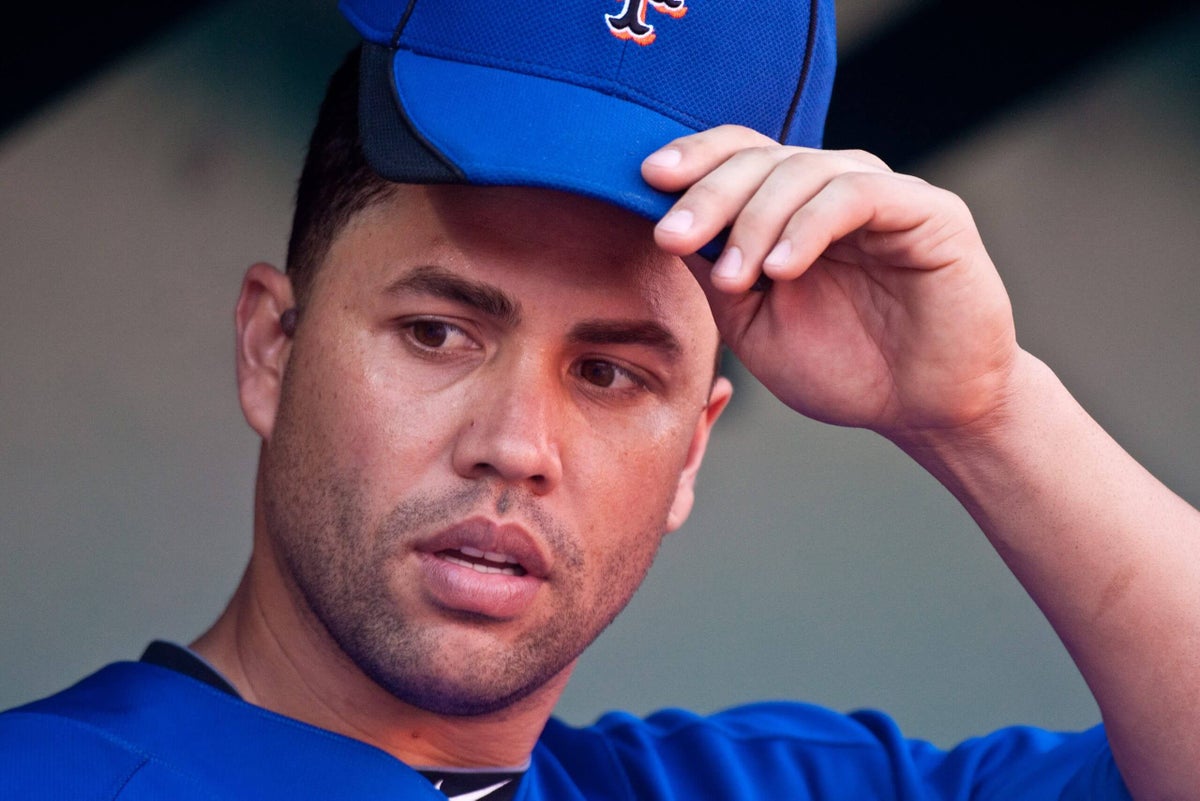
When Carlos Beltrán came to bat at the end of the 2006 National League Championship Series, with a pennant at stake in Game 7, Tony La Russa had already seen enough of him. In their two playoff matchups, Beltrán had reached base in almost half of his times up. He was hitting .360 off La Russa’s teams, with seven home runs in 14 games.
“In all our postseason appearances, which were a lot, he was the most dangerous,” La Russa said by phone on Thursday. “He was the last guy you wanted to see up. Anybody but him.”
Beltrán’s first playoff experience came with the Houston Astros in 2004, a few months after they’d acquired him in a trade with the Kansas City Royals. He was playing for the New York Mets in that 2006 NLCS, and his famous strikeout vaulted La Russa’s St. Louis Cardinals to the World Series.
Beltrán would later get there twice, as a Cardinal and an Astro, with brief October tours for the New York Yankees and Texas Rangers in between. He also played for the San Francisco Giants in a pennant race.
That’s seven teams in all, the most of the three inductees in the 2026 Hall of Fame class, which also includes Andruw Jones and Jeff Kent. Five other Hall of Famers who started their careers in the expansion era also played for at least seven teams: Roberto Alomar, Goose Gossage, Rickey Henderson, Gaylord Perry and Lee Smith.
All of them are represented by a single team on their plaques. But if Beltrán has a preference, he has not yet revealed it.
“They’ve been asking me which cap I’m going to wear, but I haven’t gone through the process yet on what are going to be my options, based on numbers and things that I have accomplished in the game of baseball,” Beltrán told reporters on Thursday in Cooperstown, N.Y., where he joined Jones for a news conference in the gallery.
“That’s a decision that I would love to sit down with my wife, Jessica, and have a (discussion) on which hat I should wear going into the Hall of Fame. So as soon as I finish the whole process here in Cooperstown, you guys will find out which hat I will wear.”
Our newest Hall of Famers take center stage. pic.twitter.com/X2Bb7OeSpm
— National Baseball Hall of Fame and Museum ⚾ (@baseballhall) January 22, 2026
Technically, inductees do not make that decision; the Baseball Hall of Fame does. But it’s really a matter of approving the inductee’s preference, as long as the reasoning is sound.
“As an educational and cultural institution, historical accuracy is of paramount importance to us,” Jon Shestakofsky, vice president for communications and education, said on Thursday. “That doesn’t mean there’s only one option, however, and sometimes we have a discussion with the Hall of Famer and come to a conclusion about what makes the most sense.
“To be clear, there doesn’t have to be a logo on the plaque. There are some situations where there’s an option to not have a logo if someone wants to not choose one team over another. And that’s become more prevalent in recent years as well.”
Beltrán played 63 percent of his career games with two organizations: the Royals (30.7 percent) and the Mets (32.4 percent). He made nine All-Star teams — five with the Mets, two with the Cardinals and one each with the Yankees and Royals. He had 31.1 bWAR with the Mets, 24.8 with the Royals and 14.2 with his five other teams.
All of that suggests Beltrán could join Tom Seaver and Mike Piazza as the only inductees with a Mets logo on their plaques. He also now works for the Mets in an advisory role; the club decision-makers who hired and fired him as manager in 2020 — after the revelation of his role in the Astros’ sign-stealing scandal — are long gone.
But Beltrán also retains great fondness for the Royals, the team that drafted him in 1995 and traded him in 2004. Only one player, George Brett, wears a Royals cap on his plaque, and it’s been a while: Brett was inducted in 1999, while Beltrán was winning the American League Rookie of the Year award.
“It was an incredible experience to be able to be around George Brett,” Beltrán said after his election on Tuesday night, “the influence that he was to me, being able to learn from him, to be able to go to the cages with George, listening to the way he approached the game, how hard he played and how much he enjoyed the game of baseball. So for me, it was a great experience.
“For a moment, I thought I was going to be able to be a Royal for the rest of my life. That was one of my dreams.”
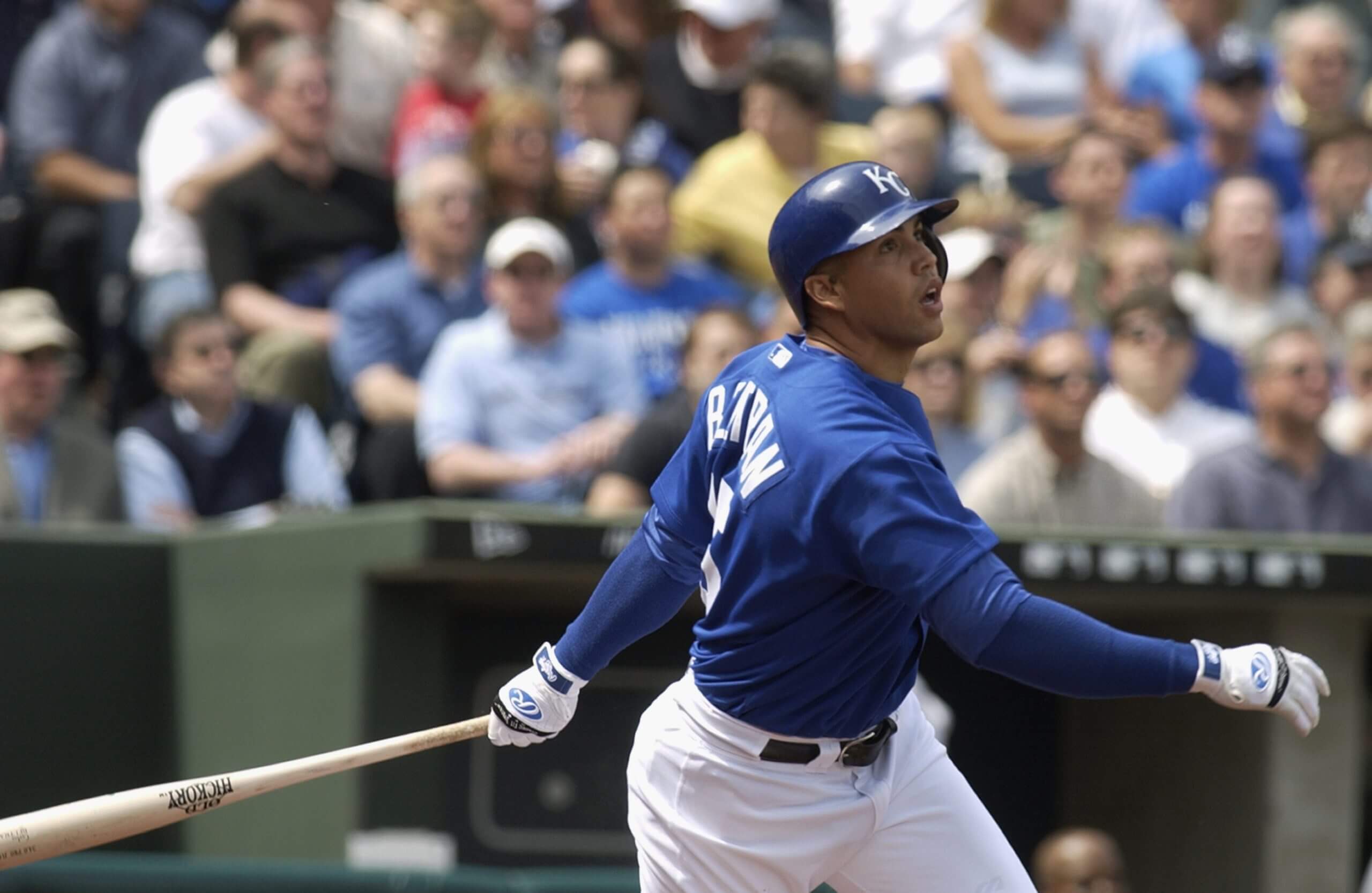
Carlos Beltrán played the first seven seasons of his 20-year career with the Royals. (Dave Kaup / Getty Images)
If Beltrán feels a strong enough pull to his roots, he could prefer a cap without a logo. La Russa, who managed more than 1,000 games with the Chicago White Sox, Oakland Athletics and Cardinals, chose that option when he was elected by a committee in December 2013. The Hall agreed.
“It was easy for me because of the three clubs,” La Russa said. “I had the hassle because it was 16 years with the Cardinals and the DeWitts (the team owners) were not happy with me at first, because they just naturally assumed. I said, ‘Look, first of all, (the White Sox) could have fired me at any time and I’d never gone anywhere. And then you go to the A’s, for crying out loud, and you had that wonderful experience.
“So they read their rules and said that it was possible. I caught quite a bit of criticism until January when Greg Maddux went in and then he decided: ‘No, I’m not picking between the Braves and the Cubs.’ And after that, nobody said a word.”
Catfish Hunter, who starred with the A’s and Yankees, went logoless in 1987, a fitting choice for a player whose landmark free agency was central to his story. The inductions of La Russa and Maddux revived the pace, and four others have since followed with no logo: Roy Halladay and Mike Mussina in 2019, Fred McGriff in 2023 and Jim Leyland in 2024.
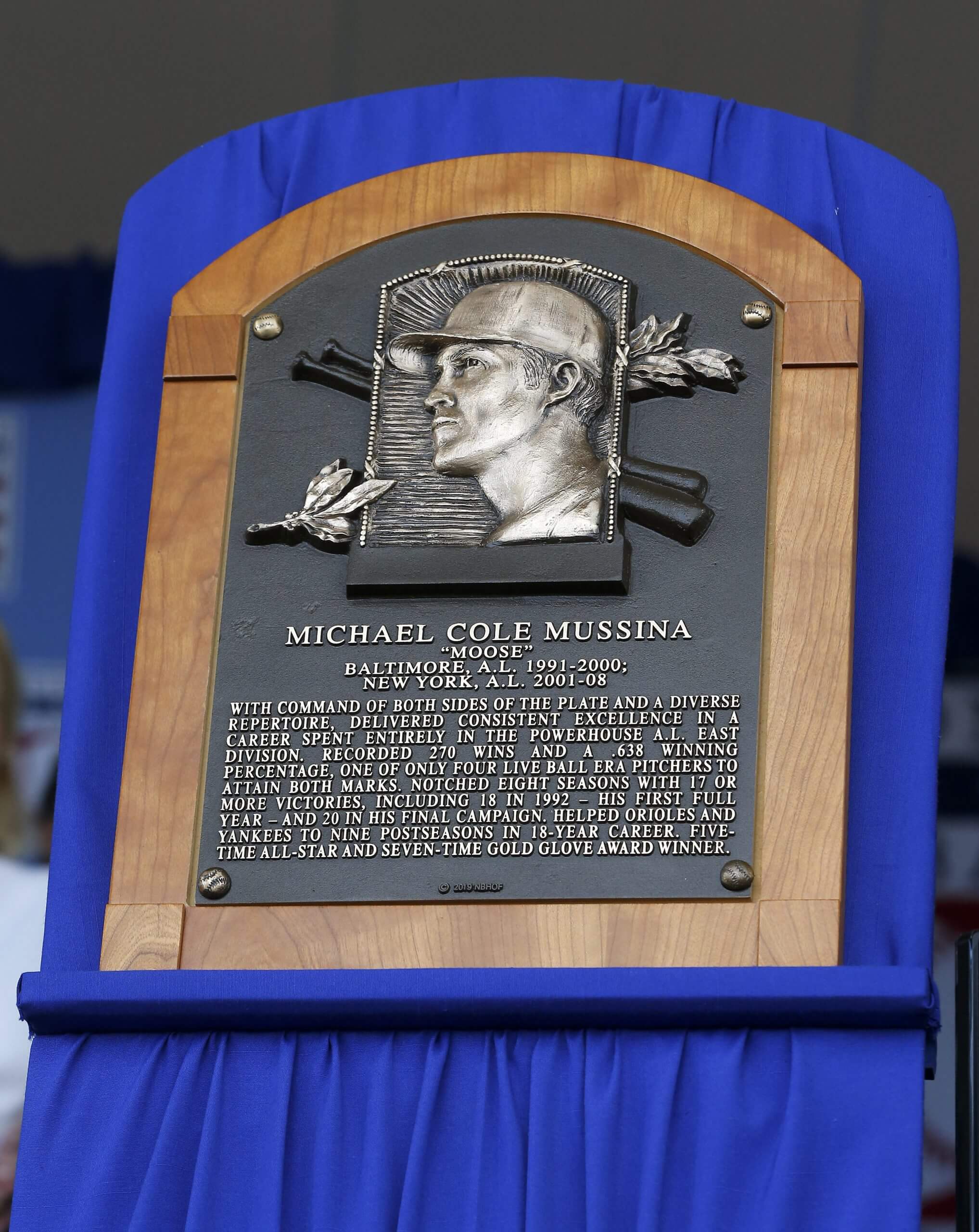
Mike Mussina, who played 10 seasons for the Orioles and eight for the Yankees, has no team logo on his plaque. (Jim McIsaac / Getty Images)
The gallery itself is filled with plaque oddities. Decades ago, players were sometimes depicted with no cap at all, even if — as in Mel Ott’s case — they never changed teams. Two players who won multiple championships with the A’s — Lefty Grove and Jimmie Foxx — are instead shown in a Boston Red Sox cap.
Jim Thome represents the Cleveland Indians, but not in the Chief Wahoo cap they wore in his prime; he is shown with a block-C alternate design from his brief return in 2011. Rollie Fingers’ cap says “A’s” but has hints of a style he wore with the San Diego Padres.
Historical accuracy, then, can be flexible — but it cannot be sold, a suspicion that shadowed two inductees in the early 2000s.
Dave Winfield went in as a Padre in 2001, even though he played 55 more games as a member of the Yankees. His lawyer denied to The New York Times that Winfield had negotiated the rights to his cap — “We were adamantly opposed to participating in an attempt to sell the cap,” the lawyer, Jeff Klein, said — and historically, the Padres do make sense. Winfield had more career WAR for San Diego than he did for New York.
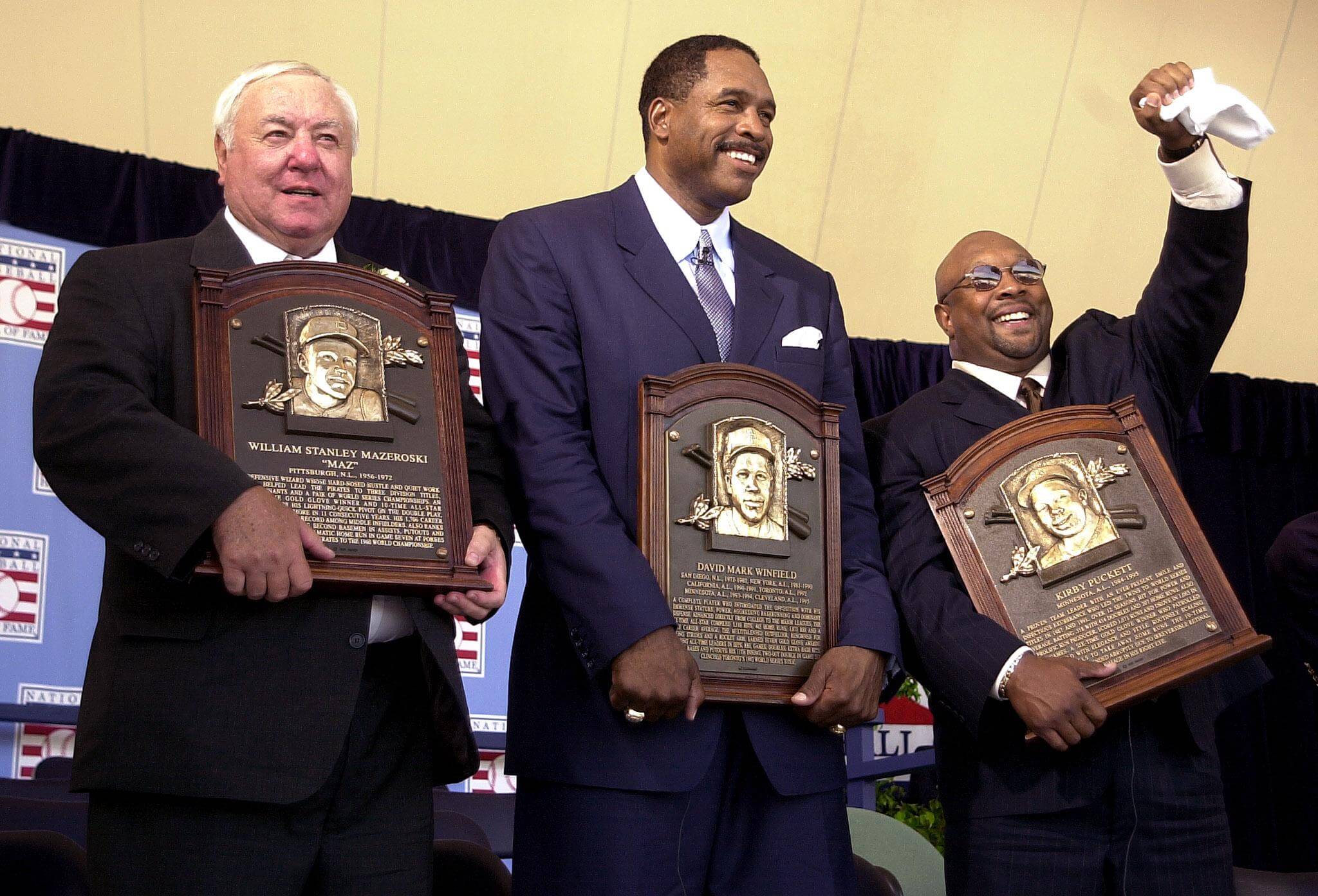
Dave Winfield, center, is inducted into the Hall of Fame as a San Diego Padre in 2001, alongside Bill Mazeroski and Kirby Puckett. (Henny Ray Abrams / AFP via Getty Images)
When Wade Boggs finished his career with the Tampa Bay Devil Rays long after his prime with the Red Sox, the story persisted that he would wear a Rays cap in the Hall. After his election in 2005, Boggs swore it was false. He wears a Boston cap in the Hall.
“Under no circumstances did I agree with the Tampa Bay Devil Rays that I was going in as a Devil Ray,” Boggs said then. “I did not make a decision or accept money from any other team in exchange for saying what team I would represent in the Hall.”
Indeed, by then the Hall had formalized the rule that gave the institution the final call on which cap players wear for posterity. Gary Carter and Andre Dawson both went in as members of the now-defunct Montreal Expos, though Carter had hoped for a Mets logo and Dawson has long wished he represented the Chicago Cubs.
At his Hall of Fame news conference in 2003, Carter seemed to understand the Hall’s decision.
“There’s a place in my heart for every team I played for,” he said. “But this is the most noble thing.”
The suitcase might have a lot of stickers, but when the destination is Cooperstown, it is hard to complain.
As Boggs said in 2005: “If the Hall of Fame were to pick my Little League hat, I would have been very happy with that also.”