
Rud’s Buds started last summer as a post-draft exercise in curiosity. After the 2025 draft wrapped, the list focused on undrafted free agents I couldn’t shake, players whose tools, production or underlying traits suggested their value exceeded their draft status.
My latest version of Rud’s Buds pushes the idea forward. The upside is no longer simply a pro opportunity. These players enter 2026 with a wider range of outcomes, including real draft helium if things break right.
“Sleeper” is an intentionally loose term. None of the players below project as preseason All-Americans and none currently sit in Baseball America’s top 60 draft conversation, but that reflects a January snapshot rather than a July verdict. Some are coming off quietly strong seasons that never cut through nationally. Others have loud traits still waiting to fully translate. A few are returning to roles or environments that better fit what they do best.
What ties them together is opportunity. This list lives in the space between recognition and results, where development still matters and scouting is at its most fun.
So, without further ado, here is the preseason Rud’s Buds team.
Catcher: Daniel Jackson, Georgia
Jackson is an athletic catcher whose draft profile hinges on turning raw strength into more consistent in-game damage. After transferring from Wofford ahead of the 2025 season, he hit .240/.365/.612 with 14 home runs and 12 stolen bases, then followed it with a strong Cape Cod League showing built around on-base ability and extra-base impact.
His batted-ball data supports the power, as his hardest contact comes off with authority and favorable launch characteristics. The concern last spring was not chase, but passivity, as Jackson too often let hittable pitches pass and did not make enough contact in the zone.
Georgia emphasized improving his swing decisions this offseason while encouraging more controlled aggression. If that adjustment carries into games, his strength, athleticism and defensive versatility give him a clear path to elevating his draft stock.
First Base: Grayson Fitzwater, VMI
Fitzwater returned to VMI for his senior year already established as one of the most productive bats the program has seen, and his 2025 season removed any doubt about the quality of that production. He hit .315/.425/.640 with 17 home runs, walked more than he struck out and set a program record with a 43-game on-base streak, earning first-team All-SoCon honors along the way.
Fitzwater’s offensive impact is driven by how frequently he squares the ball, as he consistently produces firm contact across the zone and does damage without selling out his approach. Fitzwater shows a measured plan at the plate, controlling the strike zone well for a power-first profile and maintaining contact rates that allow his strength to show up regularly in games. The swing is built for lift, with a natural ability to get the ball in the air to the pull side, but it plays because it is paired with balance and timing rather than effort.
The result is a dependable lefthanded bat with a long track record of run production whose offensive floor is raised by discipline and contact quality, keeping him relevant in the 2026 class despite senior status.
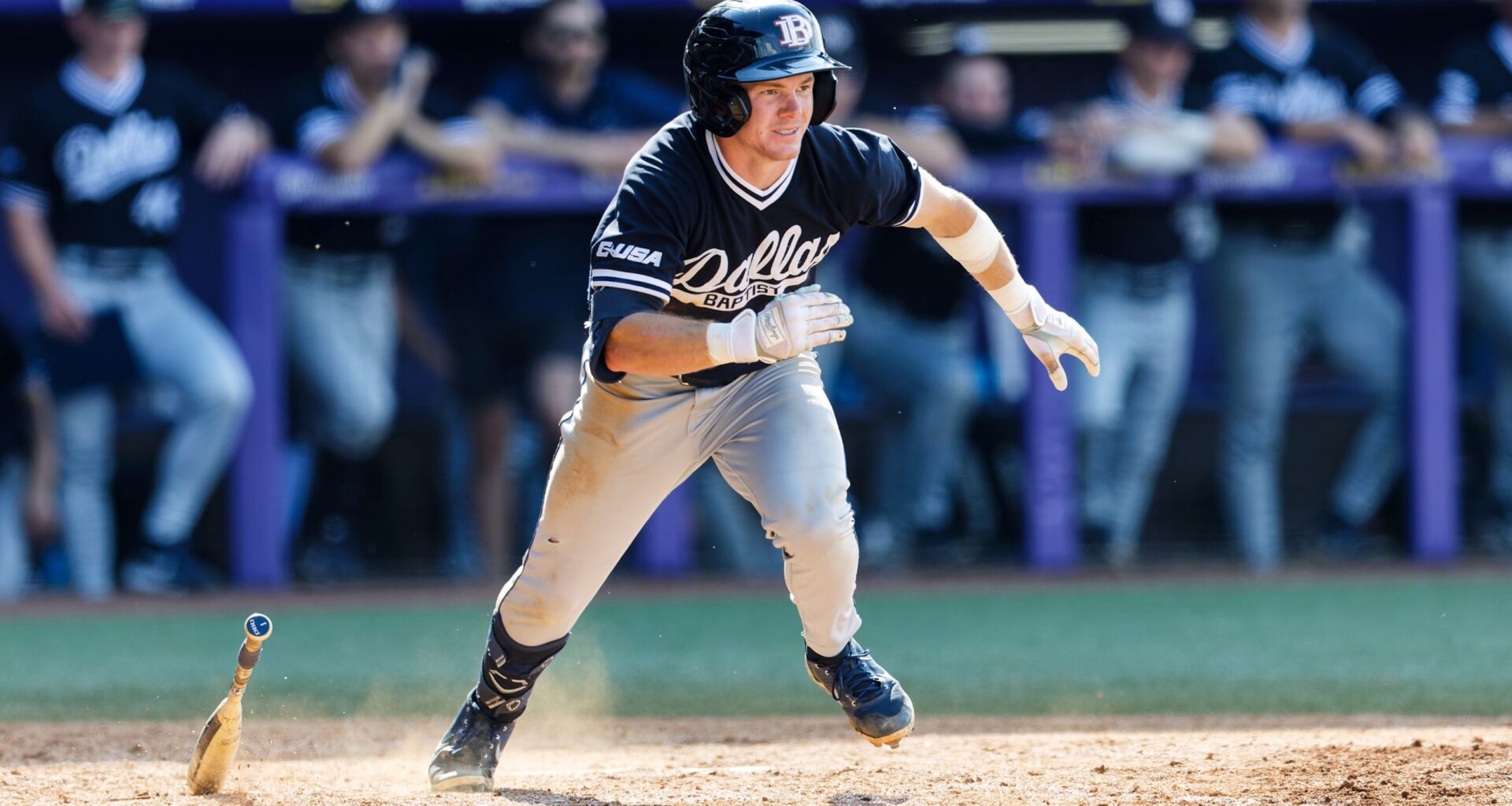
Second Base: Keaton Grady, Dallas Baptist
Grady’s 2025 season was a masterclass in offensive control. He hit .366/.449/.531 with four home runs, 14 doubles and 18 stolen bases, walking more often than he struck out and consistently dictating at-bats. His bat-to-ball skill separated him even among high-contact hitters, allowing him to live in the zone without giving pitchers a clean path to exploit. When challenged, he did not sell out for power, but stayed on time, spoiled quality pitches and punished mistakes with precision.
What kept Grady’s profile quieter nationally was not strength, but trajectory. He generated an 89.6 mph average exit velocity that provided a strong physical foundation, yet much of that contact came on flatter paths limiting home run output. The power existed, but it was not consistently accessed in the air.
That began to change in the fall. According to DBU coach Dan Heefner, Grady made targeted adjustments to create more lift without compromising the contact-driven core of his game, and those gains held throughout the fall slate.
If that balance carries into the spring, Grady’s profile shifts meaningfully. He has a pathway from high-end table-setter to lineup driver with a game built on discipline, speed and an uncommon ability to punish strikes. Even without a dramatic power spike, his offensive reliability and pressure application make him central to DBU’s identity and firmly worth tracking in the 2026 class.
Third Base: Michael O’Shaughnessy, Georgia
O’Shaughnessy forced his way into draft relevance last spring by controlling at-bats and doing damage without chasing. At Davidson, he hit .369/.482/.691 with 17 home runs and earned second-team all-conference honors, pairing impact production with one of the more disciplined offensive profiles in the country. That approach translated cleanly to the Cape Cod League, where he walked at an elite rate and continued to separate himself with strike-zone awareness rather than volume swings.
Underlying traits explain why the production held. O’Shaughnessy generates impact with intent, posting a 92.1 mph average exit velocity and consistently squaring balls in the air to his pull side. His aggression is selective and purposeful, as he attacks pitches in the heart of the zone while rarely expanding, allowing power to show up without compromising contact quality. The swing is geared for lift, but it plays because it is supported by timing, balance and decisions rather than effort.
O’Shaughnessy’s choice to honor a transfer commitment to Georgia carried some risk given his senior status, but it also creates opportunity. His skill set is built to be tested against better pitching. If the approach and contact quality hold in the SEC, O’Shaughnessy has a path to separate himself as one of the more reliable and productive senior bats in the 2026 class.
Shortstop: Trent Turner, Western Carolina
Set to turn 23 in April, Turner is older than most of his 2026 draft classmates, but his 2025 offensive profile is still difficult to ignore. He hit .329/.402/.585 with 14 home runs and 14 doubles, pairing power production with a nearly even walk-to-strikeout ratio. The foundation of that output is contact quality. Turner consistently squares the ball, getting to the barrel often and producing damage when he lifts the ball.
Turner’s approach supports the power. He is aggressive in the zone without expanding, showing strong swing decisions and the ability to make contact when he commits. He does not need to sell out to impact the baseball, and the batted-ball shape points to a hitter who can access power naturally, particularly to the pull side in the air.
Age limits the projection, but the bat gives him a chance. Turner profiles as a viable late-round selection or post-draft target for a club looking for a shortstop with present offensive value and a clear understanding of his offensive identity.
Outfield: Daniel Pacella, Ole Miss
Pacella enters 2026 with one of the clearer bet-on-the-bat profiles in the class and little margin for error. After producing at a high level at Illinois State, he chose to test his strength and data against SEC pitching at Ole Miss. The 2025 production was loud, as he hit .355/.429/.714 with 20 home runs and 19 doubles, consistently driving the baseball when he found something he could get extended on.
The power is real and it shows up in games, but it comes with tradeoffs. Pacella is aggressive by nature and will expand the zone, and his overall contact rates sit below average, even for a powerful corner profile. He missed more than you would like for a mid-major hitter, and the approach can drift when he hunts damage early, but when he connects, the ball comes off hard and carries. The batted-ball shape supports that impact, particularly to the pull side in the air, where his strength shows up most clearly.
Age and leverage will influence how clubs line him up, but the evaluation is straightforward. If Pacella trims the miss just enough, and the power translates against SEC pitching, he can still hang onto meaningful draft value. It’s a profile built on impact over efficiency, and the upcoming season will determine how much that impact plays against better arms.
Outfield: Ryan Novak, Miami (OH)
Novak brings a quieter offensive profile built on selectivity and contact quality rather than raw volume. The 6-foot-3 lefthanded hitter batted .292/.457/.536 with eight home runs, 13 doubles and five triples last year, nearly matching walks and strikeouts over the course of the season. He consistently put himself in advantage counts and showed the ability to drive the ball when pitchers came to him.
The issue is not discipline, but excess restraint. Novak rarely expands the zone and is one of the more selective hitters in the class. But that passivity can work against him, leading to called strikes and missed damage opportunities. The contact quality is solid when he commits, and his batted-ball profile supports gap power with some carry, but he does not always assert himself early enough to fully leverage it.
There is a workable balance point here. Novak has the athleticism and strength to do more damage if he becomes slightly more aggressive on pitches he can handle. If he finds that middle ground, his on-base ability and contact quality give him a chance to emerge as a well-rounded outfield bat worth tracking in the 2026 class.
Outfield: Peyton Bonds, Rutgers
To use a term my former colleague Peter Flaherty loved, Bonds is an “intriguing ball of clay” and looks the part of a modern upside bet.
The nephew of Barry Bonds, Peyton is 6-foot-5 and 225 pounds, runs well enough to handle center field and impacts the game on the bases, stealing 16 bags last season. The physicality shows up in the contact, too. As a sophomore in 2025, he produced a 90 mph average exit velocity with a 106.2 90th percentile mark and 41% hard-hit rate, translating to a .300/.384/.430 line with five home runs, 10 doubles and 16 stolen bases on 18 attempts.
The ceiling questions live in the at-bats. Bonds’ pitch recognition is still uneven, as he can let hittable pitches pass before expanding later in counts. Even so, he held an above-average 80.3% overall contact rate. The damage has been more linear than aerial, though his air pull tendency offers a path to improved shape if the swing matures.
Put it together and the ingredients are obvious. Bonds has size, athleticism, contact quality and defensive value in the middle of the field. If the decisions sharpen and the best contact begins to lift, he has the tools to push himself into a very different draft conversation.
DH: Johnny Sweeney, USC Upstate
Sweeney was a central piece of USC Upstate’s run to the regional round last spring, producing consistent impact in the middle of the lineup. He hit .345/.500/.701 with 18 home runs and 15 doubles, pairing damage with an approach that kept his strikeouts and walks nearly even. The 6-foot-5, 240-pound lefthanded hitter has a physical presence in the box and track record of impact against mistakes.
When Sweeney connects, he can vaporize baseballs. His contact frequency stands out for the profile, as he produces firm contact at average rates despite his size and lift-oriented swing. There is real strength here, and it plays in games rather than just in isolated flashes.
The main limiter is selectivity. Sweeney can drift into passivity, letting hittable pitches go by and leaving too much damage on the table for someone capable of creating a lot of it. His return to school gives him an opportunity to lean into his strengths, be more assertive in leverage counts and push the surface production even higher.
Age will ultimately cap the upside. Sweeney returns as a 23-year-old senior, which narrows draft-day margin significantly, but the bat still has value. He profiles as a late-round or post-draft option who could reward a club looking for immediate offensive impact from a mature lefthanded power bat limited to first base and DH duties.
Starting Pitcher: Ben Blair, Liberty
Blair is arguably the highest-upside player on this list. He’s included less as a sleeper than as an acknowledgment of present early-round upside. Multiple evaluators view him as the presumptive ace at Liberty, and the foundation of that optimism is the fastball. It comes from a low release with above-average extension and a flat approach, regularly touching the high 90s with heavy running life that makes it difficult to track at the top of the zone.
The fastball is complemented by a low-to-mid-80s slider that shows sharp, two-plane action and functions as a true swing-and-miss pitch. Blair has shown feel to manipulate the shape, occasionally tightening it into a cutter look that gives hitters a different angle to account for. He also mixes a mid-80s changeup that flashes some fade, though it remains more of a developmental offering than a separator.
Rather than overhauling his arsenal this offseason, Blair focused on refining how his fastball and slider play off one another, emphasizing tunneling to maximize an east-west attack.
The ingredients are already here. With performance, Blair has a realistic path into the second- or third-round range.
Starting Pitcher: Alex Philpott, South Carolina
South Carolina landed a real upside swing in Philpott, a former Florida righthander whose results lagged well behind the quality of his raw material. Now in Columbia, he enters the spring with a legitimate chance to seize weekend innings and rewrite how he’s evaluated.
The foundation is the fastball. Philpott has reached 98 mph with premium carry, and the pitch is driven by above average spin, a flat approach and more than six feet of extension that allow it to stay alive at the top of the zone. Hitters struggled to match the shape, and the pitch missed bats at a rate that points to real impact rather than empty velocity.
Philpott’s secondaries will determine his ceiling. The slider shows sharp two-plane action but has been held back by erratic strike throwing, while the changeup has quietly been his best bat-misser, flashing fade and tumble when featured. He threw well throughout the fall, and the ingredients are all there.
If the strike-throwing stabilizes and the pitch mix is optimized, Philpott has the look of an arm that can move fast.
Starting Pitcher: Tyler Albanese, San Jose State
Albanese broke out in 2025 as one of the West Coast’s more intriguing relief arms, pairing performance with traits that translate cleanly to pro ball. He posted a 2.97 ERA with 56 strikeouts over 39.1 innings for San Jose State, then reinforced that profile with a strong Cape showing in a wood-bat environment.
Albanese’s foundation is built on release and carry. He creates uncommon extension, releasing the ball more than seven feet out front, and pairs it with a flatter attack angle that allows his low-to-mid-90s fastball to stay on plane at the top of the zone. The pitch produces both misses and chase.
The breaking ball gives him a second put-away option. His curveball features real depth and sweep, with the ability to manipulate shape by adjusting velocity, and it consistently misses bats. A firmer slider adds another look and prevents hitters from sitting on one breaking profile.
The combination of size, movement traits and swing-and-miss stuff gives Albanese clear draft appeal. If he continues to sharpen command and sustain his shapes over a larger workload, he has a chance to move up boards in the 2026 class.
Relief Pitcher: Bo Rhudy, RP, Tennessee
Rhudy is the rare reliever whose entire profile is based around a single pitch that simply does not behave like it should. His fastball is not loud by radar-gun standards, but it consistently plays above the velocity band because of how difficult it is to track. Hitters see it and still swing underneath it thanks to elite and rare spin. His unusual release traits and carry allow the pitch to live at the top of the zone despite modest velocity.
Rhudy’s reliance on the heater is extreme—bordering on audacious—yet it has worked across environments because the pitch misses bats on its own. Rhudy has shown a secondary breaking ball that can steal swings when executed, but it is clearly a complement rather than a co-star at this stage. What makes him so compelling is not polish or pitch mix, but raw material. Very few college arms can generate that kind of fastball shape, and fewer still can repeat it in leverage innings.
For clubs, the appeal is obvious. If velocity ticks up or a professional development staff builds a consistent secondary that tunnels off the fastball, the outcome range expands quickly. Even as is, the fastball alone gives Rhudy real draft value.
Relief Pitcher: Jalen Porter, Arkansas Pine-Bluff
Porter is the widest-variance dart throw on this list thanks to a profile built almost entirely on raw material.
The 6-foot-4, 205-pound righthander transferred from NAIA Wiley University to Arkansas Pine-Bluff this offseason and immediately drew attention by showing triple-digit fastballs, a deep two-plane slider and a changeup with solid shape. The arm strength is undeniable and shows up easily, giving him traits that simply cannot be taught.
The risk, however, is just as clear. Across four seasons at the NAIA level, Porter never posted an ERA below 5.09 and walked nearly a batter per inning, making strike-throwing the defining question in his evaluation. His final season at Wiley was his most encouraging, as he missed bats at a career-high rate and showed tangible progress tied to modest delivery and body adjustments late in his amateur career.
Porter is a fifth-year senior, which further narrows the margin, but velocity like this forces continued looks. If the strike-throwing improves and the stuff holds against Division I hitters, he has a path to justify a late-round flier or post-draft interest.