
Until very recently, the Red Sox had a “type.”
When it came to pitching, and starting pitching in particular, the Red Sox were, far more often than not, in search of a big-bodied physique, upper-end velocity and someone with great extension off the mound.
That description fit Garrett Crochet, who cost the Red Sox four Top 10 prospects and in whom they invested $170 million. It applied to Johan Oviedo, whose big frame, lively fastball and 98th percentile in extension all attracted the Red Sox. The same variables held for Payton Tolle, the organization’s top starting pitching prospect.
Even the back end of the bullpen – setup man Garrett Whitlock and closer Aroldis Chapman — has the same allure: big, hard-throwing pitchers who finish their deliveries near the bottom of the mound slope.
Ranger Suárez, however, is different. Though solidly built (6-foot-1, 217 pounds), he’s hardly imposing. Meanwhile, his fastball velocity is in the seventh percentile and his extension is just 29 percent.
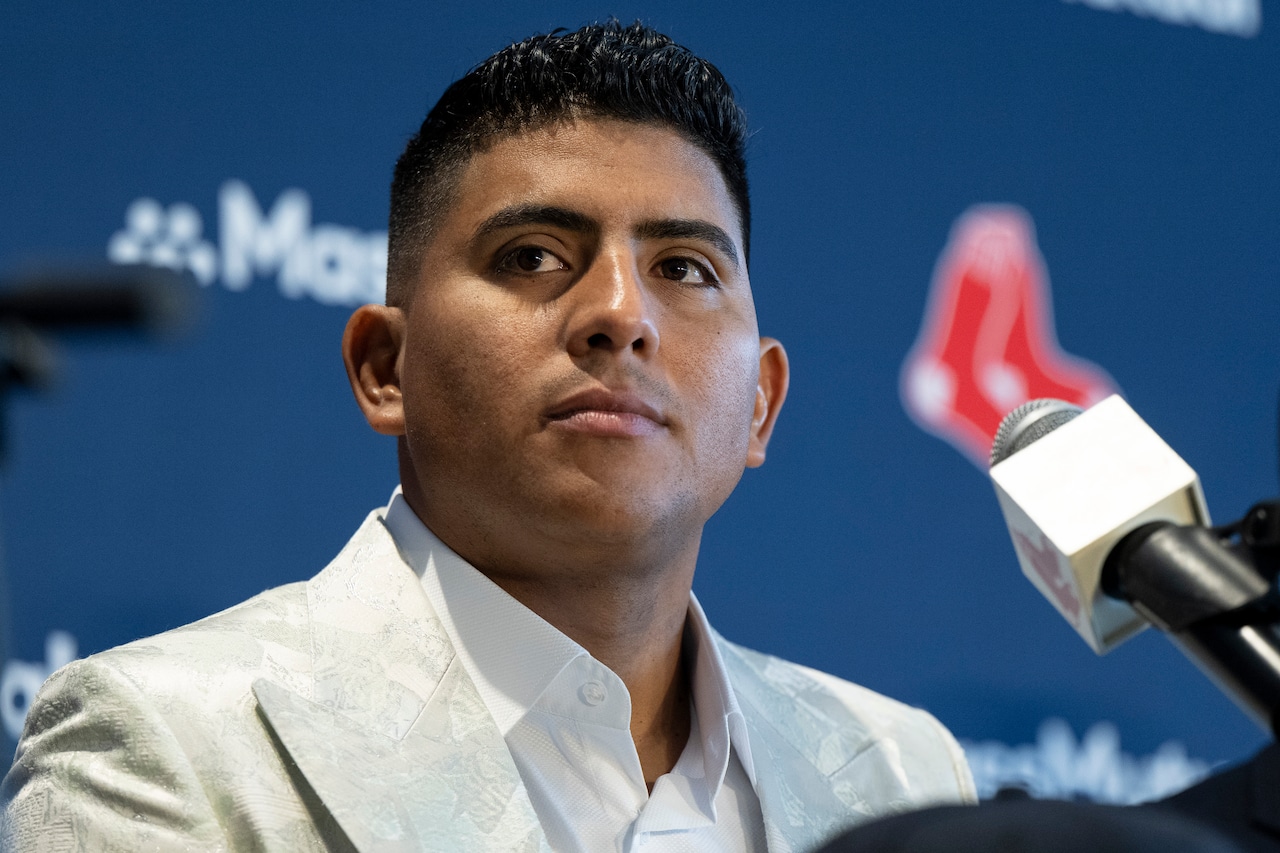
So why was it that the Red Sox swooped in a week ago and bestowed upon Suárez a five-year, $140 million dollar contract?
The most obvious answer is that Suárez has been an effective big league starter over the last four seasons. Pitching in a hitter’s ballpark in Philadelphia, Suárez didn’t give up a lot of homers (14 on average). Nor did he allow a lot of hard-hit balls, with an average exit velocity of 86.5 mph, one of the lowest figures among major league starters.
Suárez doesn’t overpower hitters. He just gets them out.
“I think if you have really good command of your pitches, and are able to mix them well, you really don’t need 100 (mph),” offered Suárez earlier this week. “That’s kind of what I do. In my case, that’s what’s given me the most success.”
“If you look at the pitch usage,” added Red Sox chief baseball officer Craig Breslow, “even last year sinker and changeup were the predominant pitches. But after that, I think the next three pitches in the repertoire all had equal use of about 16 percent per pitch. Which means that if you are trying to predict the incoming pitch, you’re probably going to get it wrong.
“So if you think about velocity, sure it gives pitchers more room for error. There’s some tradeoff between velocity and command and the less command you have, the more velocity and vice versa. Ranger is a guy who’s been on the other side of that equation, where the ability to locate five or six pitches and keep hitters off balance has been the recipe for success for him and it’s one that we believe will have real staying power.”
The “staying power” component would seem especially important here, since the Red Sox have made a five-year commitment to a pitcher who is already 30 and whose final year of the deal will be his age-35 season. Pitchers who rely on velocity are more apt to either break physically, or suffer regression as they age. With Suárez, who relies more on precision and guile, he’s likely to age better.
It also helps that Suárez has the potential to give the Boston rotation a different look.
Depending on how the Red Sox set up their rotation, they could arrange for a contrasting look to opposing teams. Crochet will be No. 1, of course, and if he’s followed, in order, by Suárez and then Gray, the Sox could bookend two flamethrowers with fastballs in the upper 90s around a more finesse approach.
“In some ways, the parallel is we talk about times through the order within a game, but then you also start to think about the number of times a lineup would be exposed to the same reliever in a series,” said Breslow. “So I think this idea of contrasting Garrett and Ranger and two very different styles of pitching could make for a really difficult time for a hitter.”
With the growing emphasis on velocity across the game, the number of soft-tossing lefties has been reduced. More than decade ago, Mark Buehrle, Barry Zito, Ted Lilly and others flourished.
No more. Now, the number has dwindled further. The Red Sox have reason to believe that ones like Suarez can still succeed. They’ve backed their belief with a $140 million bet over the next five seasons.
________________
For a time, the Red Sox seemed to have an obsession with stockpiling young shortstops.
There was — deep breath — Marcelo Mayer, Mikey Romero, and Nazzan Zanetello, each taken in either the first or second round over a period of three years from 2021 through 2023.
Mayer is on the threshold of becoming a major league regular, albeit not at short (for now, at least). Romero, who has moved around some, will start the year at Triple A while Zanetello has stalled out in the lower minors.
After Mayer, the most highly regarded shortstop prospect in the organization is Franklin Arias. He’s ranked as the Red Sox’ second-best prospect overall and in Baseball America’s recent Top 100 list, he was the second-highest ranked Sox prospect, coming in at No. 49.
Arias will start the year at Double A Portland, where he finished last season, but could work himself up to the Worcester by mid-season.
What’s intriguing about Arias is that he’s something of a throwback — a defense-first shortstop. That alone makes him something of an anomaly.
The shortstop position has evolved in the last quarter century, to the point where teams now expect offensive production from middle infielders. We may be past the days when shortstops like Alex Rodriguez could hit 40 homers, but there are several in the modern game — Francisco Lindor, Bobby Witt Jr., Corey Seager — who are capable of regularly hitting 30.
Arias is not that type of player. Slight of build and from Venezuela, Arias looks like he emerged from countryman’s Luis Aparicio’s era.
He displays smooth fielding action and sports above-average arm strength to go along with good baseball instincts. What he doesn’t offer is much slug — in three stops along the minor league ladder covering 116 games last season, he managed just eight homers in 2025.
But the Red Sox believe that as Arias builds up physically, more offense could be part of his game. If he doesn’t develop more home run potential, he could certainly be capable of displaying extra-base power to the gaps.
“I’d say with Franklin, he’s young (20), he’s still growing, he’s still adding strength, still adding size,” said Brian Abraham, the Red Sox VP of player development. “His profile as a hitter is one that makes really good swing decisions, makes contact. It’s a matter of turning that contact into more consistent power.
“We’ve definitely seen it through stretches in his career. But I definitely think with the added weight he’s put on this offseason and that he continues to add, making sure those swing decisions are good, he’s hitting the ball hard in the air — that will allow for more impact. I think there’s definitely more in the tank. Would we like to (add more pop)? Certainly.
“But I also think the defense plus the bat-to-ball skills, plus the swing decisions allow him to have a pretty high floor in terms of an overall profile. We’d love to see more impact consistently and I think, in today’s game, that is an important part of being a premier player.”
Abraham said Arias has added 10 or so pounds this winter, and the Red Sox are working closely with him to focus on nutrition to help him add muscle.
“One of the hardest things for young players is to maintain (weight) so you’re not losing strength,” said Abraham. “It’s a long year with a high work load and we want to make sure that guys are eating consistently. And there are some techniques and things that players learn as they progress through the system – ‘Hey, I need to have a pregame meal,’ or ‘I need to eat postgame…’ I think he’s at a point where he’s very well aware of that and has learned it. I think all of that will allow him to stack those pounds as he gets older.”
For now, Arias will stay at short, despite the logjam of others at the position ahead of him.
“The more reps he gets at short, the better,” said Abraham. “One of the things we like about shortstops is that they’re athletic and can generally play other positions. But we’re definitely at a point where we want him to continue to play shortstop. We feel like he’s an above-average defender there and can impact defensively at Double A, Triple A and eventually the big leagues.
“When we get to a point where we have to make a decision, we will. In a good way, we’re not there. We definitely see him as an everyday shortstop.”