
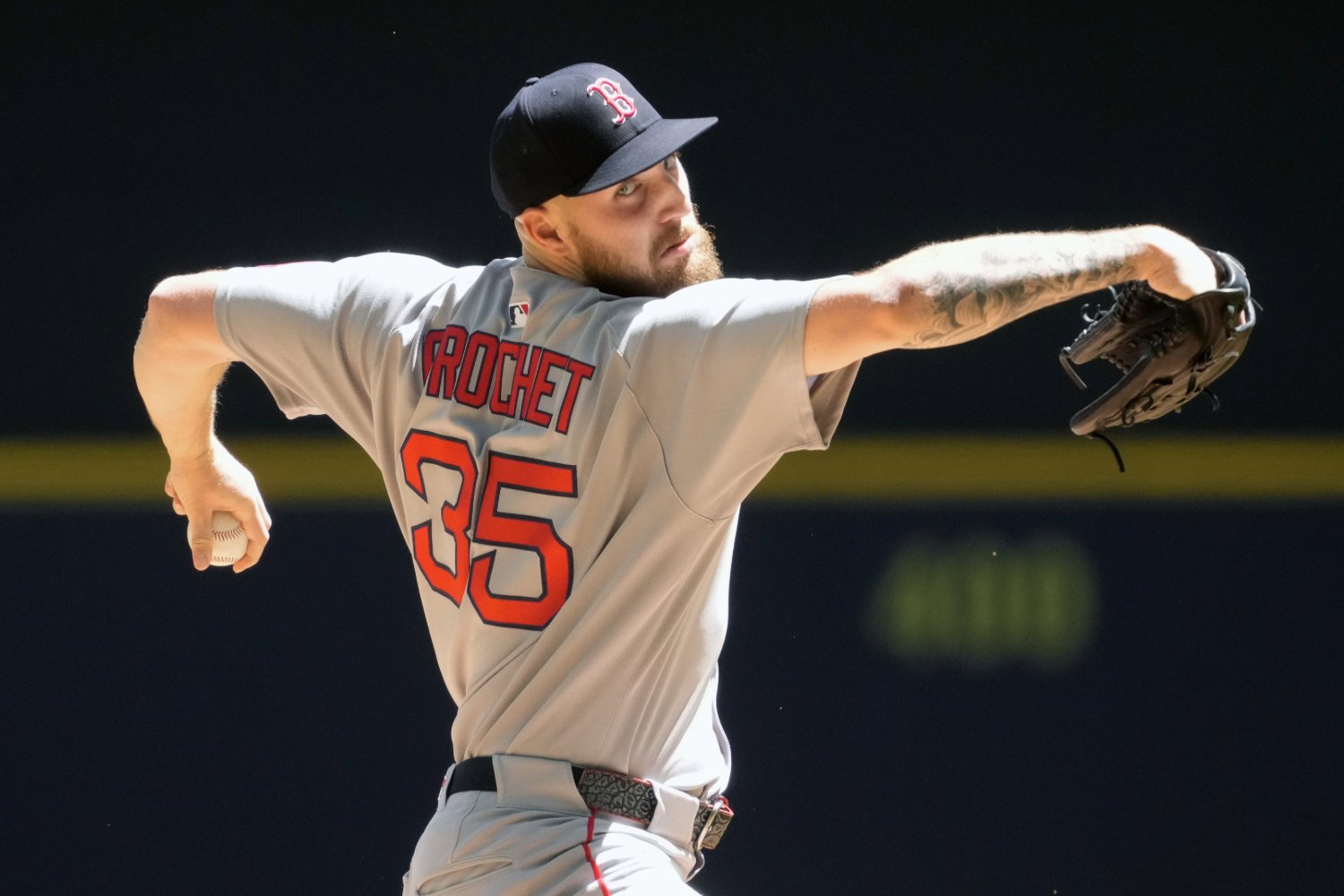
While most of Boston Red Sox Nation frets over the lineup, Chief Baseball Officer Craig Breslow got to work building a super rotation.
This offseason alone, the third-year executive added right-handers Sonny Gray and Johan Oviedo via trades, later signing left-hander Ranger Suarez to a five-year deal. Before diving in deeper, here’s how the 2024 Opening Day rotation compares to the projected one for 2026:
1. RHP Brayan Bello | LHP Garrett Crochet
2. RHP Nick Pivetta | RHP Sonny Gray
3. RHP Garrett Whitlock | LHP Ranger Suarez
4. RHP Kutter Crawford | RHP Brayan Bello
5. RHP Tanner Houck | RHP Johan Oviedo
The only constant in the two rotations is Bello, though Crawford remains with the organization. As a result of the turnover, just reading the names does little to emphasize the improvement, if not for Bello. The 2024 Opening Day starter went from de facto No. 1 to the No. 4 in two seasons. Even after a campaign in which he produced a 3.35 ERA, the 26-year-old once dubbed “Baby Pedro” has more people clamoring to trade him than vouching for him as a candidate to further break out in 2026.
That’s the rotation Breslow built this winter. One that FanGraphs projects as the No. 1 rotation in all of Major League Baseball.
Yes, including the superteam Los Angeles Dodgers.
Why is that? After all, the Dodgers have World Series hero Yoshinobu Yamamoto, two-time Cy Young winner Blake Snell, as well as All-Stars Shohei Ohtani and Tyler Glasnow.
Well, let’s go down the line of what each Red Sox pitcher accounted for in these projections.
Garrett Crochet — 5.7 Projected fWAR
The 2025 American League Cy Young runner-up isn’t just elite for the American League. He’s actually projected 2.1 fWAR higher than the best Dodgers arm, Yamamoto.
The southpaw is a jack of all trades in modern baseball. Long gone are the days of guys pitching 300 innings, or even 250. Honestly, even 200 is a stretch for most guys. But in 2025, Crochet matched dominance to volume, with a 2.59 ERA in 205 1/3 innings. Sure, there were signs of fatigue in the second half, but that was unchartered territory for him. He still reached back for a 101-mph fastball on Pitch 117 in his postseason start against the Yankees.
If not for Tarik Skubal, there’s a real argument for Crochet as SP1 in baseball, potentially over right-hander Paul Skenes of the Pittsburgh Pirates.
Sonny Gray — 3.9 Projected fWAR
Like Crochet, Gray is also projected more fWAR than the highest Dodger, by 0.3. This one is a shock to most, which makes sense given his 4.28 ERA in 2025.
But in spite of his 4.28 ERA, he posted 3.6 fWAR in 2025 on account of his 3.39 FIP and 21.6% strikeout-to-walk rate. This is why projection models love the 36-year-old despite the homer-proneness and velocity drop. He is a crafty right-hander who gets a lot of chase, whiff, and strikeouts in addition to avoiding “ball four”.
Ultimately, you can live with home run issues if you’re not also a walk liability. Gray forces opposing hitters to beat him. They did at points in 2025, but he remains ridiculously efficient on the mound. It wouldn’t shock me if Gray still underperforms his peripherals in 2026 in large part due to his home run issues, but his results will remain strong so long as he doesn’t change who he is as a pitcher.
Ranger Suarez — Projected 3.3 fWAR
Suarez is the first Red Sox starter not projected as high as the Dodgers’ ace, but he’s tied with Snell for second!
Suarez is a hound, even if you have to contend with a month of missed starts. His biggest deterrent, in addition to lingering velocity struggles, is his availability. So, when the Red Sox commit five years, $130 million, and lose a draft pick to sign him, it raises some eyebrows.
But he’s super talented. His secondaries are second to none in baseball. He ranked in the 88th percentile for breaking ball run value, and 90th percentile for off-speed. He misses barrels, he limits hard contact, and he gets hitters to expand the zone. He’s super crafty, a stark contrast to Crochet, but he’s a different kind of dominant.
There’s a reason he’s SP14 for fWAR since 2023, despite being tied for 47th in starts. The Red Sox will need him to be healthy, especially for October, but he’s among the best bang-for-your-buck arms in the game.
Brayan Bello — 1.8 Projected fWAR
Projection models don’t love Bello to repeat his 2025 success, and that makes sense. But he’s still someone who limits runs and eats innings.
What makes Bello so effective is his ability to keep the ball on the ground. When he couples his grounder proficiency with strong command, he gets deep into games. The Red Sox are hoping he can put it all together with volume and strikeouts, but the man they got a year ago was certainly anything but disappointing.
Reminder, this is their No. 4 starter.
Johan Oviedo — 1.2 Projected fWAR
Depending on who you ask, Oviedo is one of the more intriguing arms in the building for the Red Sox on Day 1 of camp. The truth of the matter, however, is there’s not a whole lot to point to in his MLB career that portends elite production.
Projection models like him slightly more than Bello by run prevention, but considerably less volume. He’s a talented arm, but will be in his first full year removed from elbow surgery rehab. He can light up the radar gun and is obviously a physical specimen.
Patrick Sandoval — 0.6 Projected fWAR
Sandoval signed with the Red Sox last offseason and suddenly doesn’t have a guaranteed spot in the rotation. However, he’s someone with past big-league success.
In 2022, he posted a 2.91 ERA for the Angels. That year, he also exceeded 150 strikeouts. While he’s a few years removed from being a viable member of a rotation, he’s still a guy with a plus changeup. At 29 years old and making roughly $13 million in 2026, it’s reasonable to assume the Red Sox will listen to trade offers for him. But should he factor into the mix this season – he’s an effective pitcher when healthy.
Connelly Early — Projected 0.6 fWAR
Early blossomed in a brief MLB stint last season and put a bow on what was a tremendous year for his stock as a prospect. His secondaries give him a complete arsenal, which is rare for someone his age, especially for someone who ascended through the prospect ranks so quickly.
He has a smooth delivery and appears to be ready for the moment. It’s no surprise teams want him badly in a trade for productive hitters. We’ve seen reports that Arizona wanted him in a potential Ketel Marte trade, and the same for Houston with Isaac Paredes.
Kutter Crawford — Projected 0.5 fWAR
Crawford is someone I’m excited to see in 2026 for a few reasons. First, he’s a talented pitcher. We saw it in the first half of 2024, his ability to command the zone and chew up innings. He ran out of gas, especially considering he was pitching hurt in the second half, but he’s still someone with a decent track record in MLB.
As a swingman, I think he can be a vital piece of the Red Sox’s pitching staff. In a lot of ways, similar to his 2023 self, where he emerged as one of the most intriguing arms in the organization. What will be pivotal for him to get back to that level is a resurrection of his fastball, which dropped from the 91st percentile to 50th in run value. If he can unlock the heater, he’s got potential to be a Swiss Army knife for the Red Sox in 2026.
Payton Tolle — Projected 0.4 fWAR
Tolle got a cup of coffee in 2025 and immediately put the league on notice. Overall, his numbers didn’t reflect the hype, but we learned there’s something special about that man’s fastball.
If he can develop even one off-speed pitch into a plus offering, he and Crochet might take the league by storm as a 1-2 punch for the next half decade. Right now, his safest bet would be the MLB bullpen or as a Triple-A starter, but he will be an important member of this team’s journey.
Kyle Harrison — Projected 0.1 fWAR
Rounding out the accounted-for starters is Harrison, the headlining piece of the Rafael Devers trade last June.
In limited exposure for Boston, he did alright in 2025. He made one strong relief appearance against the Athletics, and a so-so start against the Detroit Tigers in Game 160. His fastball is his primary offering, and it’s far and away his best pitch. It’s no surprise people like him as a left-handed reliever in 2026.
There’s precedent for the Red Sox doing that to get their talented arms into big-league action; Tanner Houck in 2021 and 2022, Crawford in 2023, even Tolle last year. They could go that route with Harrison, as that would be a great way to recoup some value lost in the trade already.
Overall Outlook — Projected 18.3 fWAR
FanGraphs projects the Red Sox to finish with the most fWAR, lowest FIP, and third-best ERA in baseball in 2026. It makes sense, as they’re the only team in baseball with a starter projected for 5.0 or more fWAR alongside another arm projected over three wins. And they have two of those!
Say what you want about the Red Sox’s lineup, but the rotation is an enviable strength of the team. They’ll obviously need to prove they can score to be a real threat to win it all, but their pitching staff is certainly up to snuff on paper.