

Doubt lingered after the Luis Robert Jr. trade. Not just about how the White Sox would replace the production, but whether the payroll flexibility it created would actually be used. Some assumed the savings would sit untouched. Others questioned whether Chicago could land an impact player this late in the winter even if it wanted to spend.
That question did not last long.
The White Sox continued reshaping their roster Friday, agreeing to a two-year, $20 million contract with right-handed reliever Seranthony Domínguez. The signing lands the most accomplished reliever left on the market and turns the post-Robert payroll debate into something tangible.
Right-handed reliever Seranthony Domínguez and the Chicago White Sox are in agreement on a two-year, $20 million contract, sources tell ESPN. Dominguez, 31, is expected to close for the White Sox, who use the money saved in the Luis Robert Jr. deal to continue adding this winter.
— Jeff Passan (@JeffPassan) January 23, 2026
Chris Getz and the front office moved quickly. When asked directly whether the money freed up in the Robert trade would be reallocated, Getz answered with a simple “yes.” It was notable not for what it promised, but for how clearly it was delivered. Getz is typically deliberate with his language and careful not to create false expectations through the media. That approach held here, and the Domínguez signing backed it up.
The move still leaves room for additional spending as the calendar turns toward players reporting in Arizona.
Domínguez, 31, is expected to take over as the White Sox’s primary closer. Even if the ninth inning remains fluid by design, the larger point is structural.
Contract Details
Domínguez’s contract guarantees $20 million over two seasons with a $10 million average annual value. The timing matters as much as the number. Chicago cleared significant salary in the Robert trade and redirected half of that space toward the bullpen rather than treating the savings as a hard reset. The team hasn’t announced the deal yet; however.
The deal also compares favorably to the other closer lane the White Sox were tied to earlier in the winter. Pete Fairbanks signed a one-year, $13 million contract with Miami on January 13. For Chicago, the two-year commitment to Domínguez provides a cleaner fit at a lower annual cost while addressing a defined late-inning need.
An earlier Robert trade might have positioned the Sox to engage more aggressively when the market moved fastest. Instead, this outcome reads as a better-aligned bet for the role Chicago is trying to stabilize.
Chicago’s 40-man roster is currently full, so a corresponding move will be required once the signing is finalized.
Why This Fits
This signing aligns with how the White Sox have approached pitching since December. The focus has been targeted spending without long-term commitments. The goal has been building a roster that is more usable now while keeping future payroll flexible. Domínguez fits as the late-inning counterpart in that framework and gives the bullpen a defined spine without forcing the organization into a single outcome for 2026.
The broader point is that Chicago is not treating Robert’s departure as a single-position replacement. That has been consistent in the messaging. The emphasis has shifted toward increasing overall talent and letting spring competition shape the depth chart rather than forcing a one-for-one solution.
Getz framed that approach after the Robert trade.
“I know when you move on from a Luis Robert, there’s an assumption that a certain position needs to be filled,” Getz said. “But it’s increasing talent on the team to help us win ballgames. That could come in starting pitching, relievers, balancing right-handed vs. left-handed. So we are very open-minded and excited to get to work in being creative and bringing in that talent.”
Domínguez is that philosophy applied directly to the bullpen. The move brings a clearer late-game plan now and preserves a potential lever later in the season.
Background
Domínguez debuted with Philadelphia in 2018 and quickly emerged as a late-inning weapon. He paired upper-90s velocity with swing-and-miss secondary stuff and looked like a long-term high-leverage piece before injuries reshaped his trajectory, including Tommy John surgery.
Since returning, he has settled into a steadier relief profile that still misses bats at an elite level. The defining tension has remained command. When he is in the zone, outings look dominant. When he is not, they can unravel quickly. That volatility has kept him in setup roles more often than a full-time closing job.
Across the last four seasons, Domínguez has totaled 55 holds and 24 saves while posting a 3.60 ERA with the Phillies, Orioles, and Blue Jays. The résumé places him firmly in the proven late-inning tier even without extended closer labeling. In 2025, he logged 20 holds while carrying a real workload that reflected trust rather than protected usage.
That context is what makes this deal notable. It gives Domínguez a clear runway to a defined role and reflects a bet that structure and usage can allow the value to play up.
2025 Performance
Domínguez split the 2025 season between Baltimore and Toronto and finished with a 3.16 ERA across 62.2 innings in 67 appearances. The line captures the defining tension in his profile. He struck out 30.3 percent of hitters and walked 13.8 percent.
That same balance shows up in the broader results. Domínguez went 4-4 with a 3.16 ERA and a 3.47 FIP. He posted a 1.28 WHIP while allowing just 6.3 hits per nine innings and 0.7 home runs per nine. The underlying indicators reinforce why teams remain comfortable using him late. He held opponents to a .198 expected batting average with a 33.3 percent whiff rate and a 3.26 xERA. Squaring him up consistently remained difficult even when traffic followed.
That foundation is central to how the White Sox evaluated the deal. The bat-missing traits still align with what contenders chase in leverage, which helps explain why the contract did not require an extreme overpay. Chicago is buying into the same market reality that values swing-and-miss arms even when the command is imperfect.
Domínguez’s pitch mix explains how that profile holds together. He works primarily off a four-seam fastball that accounted for roughly 43 percent of his usage in 2025. The pitch sets the table for a sweeper that served as his main chase option against right-handed hitters and made up about 22 percent of his mix. He complemented those offerings with a splitter at roughly 17 percent usage, a sinker around 13 percent, and a curveball as a change-of-shape look.
The sweeper stands out by the numbers. Hitters batted .132 against it on meaningful volume, and the expected results were just as loud. The pitch carried a .112 xBA, a .185 xSLG, a .166 xwOBA, and a 22.6 percent hard-hit rate. That production helps explain why the overall bat-missing profile held even when strike throwing wavered.
The most important adjustment came with the splitter. Introduced in 2025, it gave Domínguez a more reliable way to challenge left-handed hitters and pushed his profile closer to a full-inning closing option rather than a right-handed leverage specialist. That development remains central to how his role will be evaluated going into spring. Lance Brozdowski pointed to the splitter as a potential league-wide trend in 2026 after its usage surged during the postseason.
The raw stuff continues to support that bet. Domínguez ranked among the league’s top velocity tiers across his arsenal in 2025, with elite readings on his fastball, sweeper, and sinker. The contrast between his average fastball velocity and the quality of contact he allowed remained among the strongest in the league, reinforcing how difficult it has been for hitters to square him up even when command wavers.
The platoon split still lingers as part of the conversation. Right-handed hitters were limited to a .132 average against Domínguez in 2025, while left-handed hitters produced a .277 average. Continued splitter growth is the cleanest path toward narrowing that gap and solidifying everyday ninth-inning usage.
Domínguez also handled a heavy workload in October. The process was uneven, with strike-throwing coming and going (17.56 pitches per inning), but the outcomes reflected the same core trait that defines his value. Across 12 postseason appearances in 2025, he allowed five hits and four earned runs while holding hitters to a .132 average.
The broader playoff résumé provides context. In the 2023 and 2024 postseasons, Domínguez logged seven scoreless innings with a much stronger strike rate (71%). Domínguez also carries a 1.86 ERA and a 4-0 record across 29 postseason appearances. That history explains why contenders continue to buy into this profile. Swing-and-miss plays in October even when command is not pristine, and Chicago now holds an arm that fits that market.
Fit With the White Sox Bullpen
Chicago’s bullpen entered the offseason heavy on youth and light on structure. Domínguez brings immediate definition whether he is labeled the closer or deployed as the top leverage option regardless of inning. His presence allows younger arms to settle into more natural roles rather than bouncing between roles.
The need for late-game stability showed up clearly. The White Sox used eight different relievers for saves last season and lost 36 one-run games. Those outcomes were not all bullpen-driven, but the absence of stable leverage lanes had a cumulative effect. Young arms were miscast, and workloads became uneven. Games began to feel like they were slipping earlier than they should. Domínguez has been effective at limiting damage once runners are on. He stranded 88% of inherited runners in 2025.
Chicago entered last spring aware that the bullpen lacked premium velocity. Domínguez changes that immediately and gives Will Venable another high-octane option alongside Grant Taylor. Additional pitching depth could also influence how the White Sox deploy Grant Taylor long-term. Strengthening the bullpen now creates optionality later, whether that means keeping Taylor in leverage or eventually exploring a transition back to the rotation without urgency.
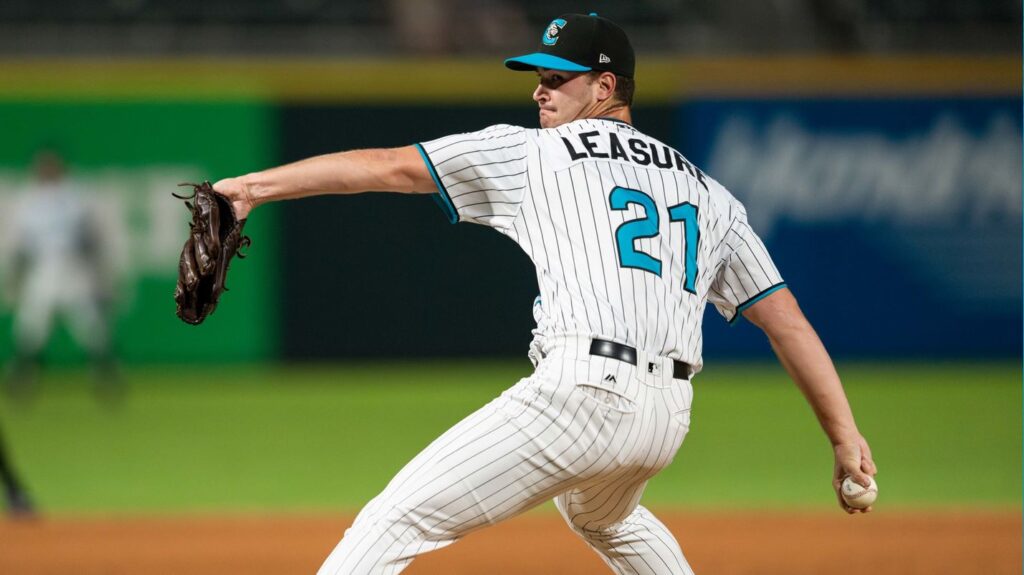 Credit: Laura Wolff/Charlotte Knights
His arrival also reduces the pressure on Jordan Leasure to handle the ninth simply by default.
One remaining variable is the rotation. Adding another starter would allow Sean Newcomb to settle more cleanly into a relief role, where his profile fits better and further stabilizes the bullpen depth behind Domínguez.
Beyond usage, Domínguez could have an indirect impact on development. Leasure’s splitter remains a pitch with real upside, and Domínguez’s success with the offering provides a clear reference point. Having that example in the same bullpen could help Leasure refine the pitch and unlock another level in his profile.
The White Sox bullpen could be a pretty solid unit in 2026:
– Seranthony Dominguez
– Grant Taylor
– Jordan Leasure
– Sean Newcomb
– Mike Vasil
– Jedixson Paez
– Alexander Alberto
Fun blend of powerful stuff and soft contact inducing arms. Will be much better than 2025.
— Elijah Evans (@ElijahEv8) January 23, 2026
The signing tightens the roster picture as well. Once a veteran late-inning arm enters the mix, bullpen spots become harder to win. That squeeze tends to surface quickly in March decisions.
Trade and Value Outlook for White Sox
The most useful way to frame this signing may be beyond April. Relievers who miss bats and can handle leverage tend to be among the most movable assets at the deadline. If Domínguez is healthy and effective through the first half, contenders will call. That remains true even when the command wobbles, because the traits that underpin his value are the ones teams consistently pay for in July. It is also fair to note that even a merely solid first half could position Domínguez to return more at the deadline than Luis Robert Jr. would have if both were performing at similarly mediocre levels.
Chicago does not need the deal to be perfect for it to work. It needs Domínguez to take the ball regularly and provide a stable baseline in the late innings. If that happens, the White Sox either maintain a functional ninth-inning plan through the season or create a clear mid-season path to value. That flexibility is what allows the signing to function as both bullpen stabilization and a rebuild lever, without requiring the club to spend like a desperate team to land it.
White Sox Offseason Coming to a Close
The Domínguez signing will not alter the White Sox’s competitive timeline on its own, but it does reinforce a clear organizational approach built around improving the roster in the present without sacrificing future flexibility. Chicago addressed a defined need, stabilized a fragile area of the roster, and did so while still leaving room to maneuver.
That remaining room matters. Even after committing $10 million annually to Domínguez, the White Sox still project to have enough space to layer in additional help, whether that comes in the form of a modest investment in the rotation or a complementary outfield addition as camp approaches. While $20 million guaranteed is a meaningful commitment for a reliever, the structure reflects market alignment rather than desperation, particularly given the flexibility it preserves. The move does not box the front office into a single outcome, and it does not close the door on further spending before Opening Day.
It is also notable in context. This was not a team widely expected to pursue a veteran reliever at this level, particularly this late in the offseason. The signing reflects opportunism rather than urgency. It shows a willingness to redirect resources created by the Luis Robert Jr. trade instead of simply pocketing them.
Domínguez fits cleanly into that framework. Chicago has not had a true set-it-and-forget-it closer since the Liam Hendriks era ended roughly three years ago, and the bullpen has spent that time in a constant state of improvisation. Domínguez may not replicate Hendriks at his peak, but he restores structure to the back end and provides a level of credibility the group has lacked. If the White Sox remain competitive, he anchors the late innings. If the season tilts toward July selling, he becomes a viable deadline lever. Either outcome aligns with where the organization currently sits.
Getz has operated this winter with an eye toward optionality, and this signing follows that pattern. It is an encouraging signal for a team that was not expected to be active in this corner of the free-agent market, especially at this stage of the calendar. With players set to report to Arizona in just a few weeks and flexibility still intact, the more important takeaway may not be what Domínguez solves on his own, but what the move suggests is still possible. The offseason does not feel finished, and Getz does not appear done yet.
Post Navigation