
Look in any book of pop psych or new-agey, psudeo-Zen platitudes, and you’re sure to see something about the importance of never looking back. It’s not necessarily bad advice, but it is advice that is hard to square with the life of a baseball fan. Glancing at the box scores in the morning paper (forgive the anachronism, it’s more evocative than looking at a phone) is looking back at what happened yesterday. Every statistic is a measure of where the player stands now, but it’s also an accumulation of what they’ve done in the days past. A baseball game observed by people who steadfastly refuse to look at anything other than the present would be played by teams without standings comprised of players without statistics. It would be intelligible, but only partially.
A few weeks back, I took a look at Aaron Nola’s rookie season for TGP’s 2015 in review series. As part of that, I looked at what an MLB.com scouting report from August of that year said about him as a prospect. Between that and an excellent series on FanGraphs in which players are asked to react to their own scouting reports, I’ve been thinking: Can we recognize the Nola we see today when we look at the pitcher he was imagined to be a decade ago? This isn’t entirely meaningful— who Nola was when he had only a few appearances to his major-league career doesn’t tell us much about what he’ll do when he returns to the rotation. But it’s not without meaning, either. The arc of his career, considered without the path he took along the way, wouldn’t be an arc at all.
The MLB.com report, written by Bernie Pleskoff, begins by looking at Nola’s pitch mix, consisting of “a two-seam fastball [sinker] that sits between 92 and 94 mph, an infrequent four-seam fastball, a very good changeup and a curveball that can be very effective”. Pleskoff further goes on to note that the two-seamer was the bread and butter of his arsenal, the foundation upon which his other pitches rested.
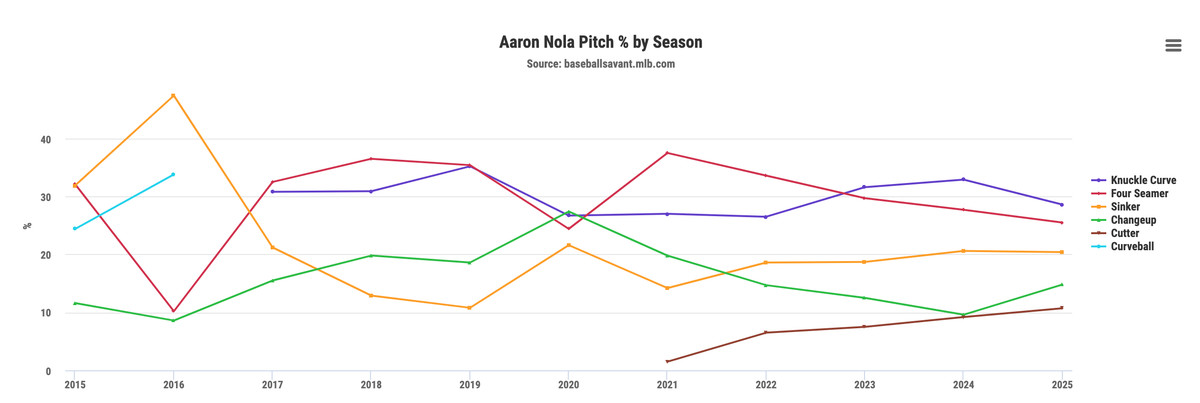
Here’s Nola’s pitch mix over the years.
via Baseball Savant
Nola diverged from that scouting report as soon as he got started. Far from being infrequently seen, the 4-seamer was offered just as much as the 2-seamer in 2015. He did, however, return to the predicted approach in 2016, making the sinker his primary pitch as the 4-seamer made itself scarce. But that was temporary: the very next year the 4-seamer overtook the sinker in terms of usage, and Nola has kept that approach ever since. The curveball was replaced by a knuckle curve in 2017. A cutter appeared four years later, and he’s maintained the 2021 version of his pitch mix, with minor usage changes, to date. The Aaron Nola of 2025 has the knuckle curve as his most frequent offering, and the 2-seamer, though still a common sight, is no longer as crucial to his approach as it was.
One thing that has not changed from the time of the scouting report, however, is the movement on his pitches: Nola was noted to be unusually good at producing movement with the entirety of his arsenal, and that has been the case even as his arsenal has changed; the Nola of 2025 gets greater than average horizontal movement on every pitch except his cutter.
Further strengths noted in the report were a good K/BB ratio, an effectiveness against opposite-handed batters, and a tendency to keep the ball on the ground. Nola has indeed been good at racking up the Ks and shooing away the BBs; he’s been above average in both K% and BB% in every year of his career save for 2019, when his BB% ballooned before returning to form the next season. The assessment of his capability against lefties also proved accurate: Nola’s splits generally don’t show large differences by handedness, and he’s had several seasons in which he posted lower WHIPs against southpaws than same-handed opponents.
The ground ball rate is something of a different story. In his early years he was indeed excellent at keeping the ball on the ground: after a rookie season in which he was in the 67th percentile in GB%, he soared to the 91st percentile the next season, then remained above-average for the next 4 seasons. But 2021 saw his GB% crash to the 37th percentile, and while that represented a nadir, he’s been no better than so-so in that regard ever since.
All those balls that he used to keep on the ground have to go somewhere. And that brings up the biggest point of discussion with the Nola of today: the home runs. The contemporary Nola is undoubtedly homer-prone. What did the scouting report have to say about that? Far from raising warning signs about the round-tripper, Pleskoff instead noted that Nola’s ability to keep the ball on the ground had helped him ward off homers to that point, and that he “should be able to limit long ball damage”. But Pleskoff wasn’t off base, at least not immediately. Nola wasn’t especially good at avoiding homers in his first few seasons, but he wasn’t unusually bad at it either. It wasn’t until 2019 that Nola showed signs of being particularly vulnerable to the long ball. Since then, as any Phillies fan can unhappily attest, he’s been one of MLB’s biggest victims of the gopher ball.
The question isn’t so much whether or not Nola’s scouting report was accurate, but rather whether or not the pitcher it described is still recognizable today. A scouting report is meant to be forward-looking, but only to a certain point; asking a scout to assess what a pitcher’s general ceiling or style might be a decade hence would be reasonable, but asking them to predict the specifics of how they’d look in ten years would be asking too much. Unless you believe in the power of tarot cards and other esoteric forms of fortune-telling, you can’t reasonably have expected a scout to predict that Nola would be solid at limiting homers for the first four years of his career and then become unusually bad at it. The Aaron Nola described a decade ago was described as capable and effective, not in possession of overwhelming stuff or the potential to reach pitching’s Mount Olympus, but more than able to serve as a very solid member of the Phillies’ rotation. In the broad view, and uncharacteristically bad start to 2025 aside, that sounds like the Aaron Nola we have come to know.