
For the first five years of his major-league career, Wilbur Wood pitched in 73 games and had 1 victory to his credit. Everything changed when he finally joined the right team at the right time — with the right pitch. Thanks to his knuckleball, he was one of the best and most durable pitchers in baseball. A freak injury cut his peak short, but he had 9 remarkable seasons as a reliever and a starter. Wood died from cancer on January 17 at the age of 84. He played for the Boston Red Sox (1961-64), Pittsburgh Pirates (1964-65) and Chicago White Sox (1967-78).
Wilbur Forrester Wood Jr. was born in Cambridge, MA, on October 22, 1941. A lefty, he saw early success pitching for the Watertown Junior American Legion. He also was a co-starting quarterback for the Belmont High School football team and a center for the school’s hockey team, but a tryout at Fenway Park resulted in Wood being named to the 1958 Hearst New England All-Star Team in 1958 as a pitcher. In 1959, he was an easy selection to the Boston Globe‘s 1959 All-Scholastic team after leading Belmont to a state championship. He threw 3 no-hitters, including a perfect game, and he had the first 9-inning no-no in the Eastern Massachusetts Tournament history. He was carrying on a family tradition, as his father, Wilbur Sr., made the 1927 Globe team. The elder Wood later played infield at Boston University
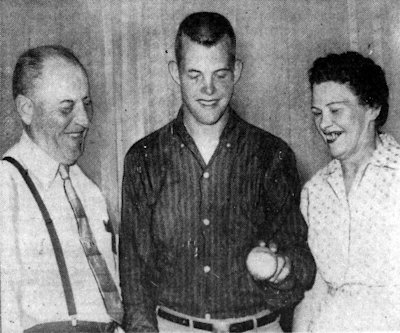 Wood and his parents during his high school days. Source: The Boston Globe, June 13, 1959.
The Boston Red Sox snapped up the Massachusetts native as soon as Wood graduated high school in June 1960, and he spent the better parts of 1960 and ’61 pitching in the low minors. He won 11 games in 1961 while splitting the season with Johnston of the Eastern League and Winston-Salem of the Carolina League, with a 3.74 ERA and 147 strikeouts. Boston decided to try the teenager at the major-league level in the summer of 1961. Wood made his major-league debut on June 30, during a blowout loss to the Cleveland Indians. Wood entered the game in the sixth inning to a big ovation from the crowd, and he proceeded to retire Miguel de la Hoz, Jim Piersall and Tito Francona in order. He ran into some trouble in the seventh and allowed RBI hits to Vic Power and Woodie Held, but he retired the last 8 batters he faced for a line of 2 runs allowed in 4 innings, with 3 strikeouts. Manager Mike “Pinky” Higgins was impressed by the debut and dismissed reports that Wood’s fastball couldn’t cut it in the majors. “A good curve, control and poise are Wood’s main assets,” he said. “He may be a little faster than former Yankee pitcher Eddie Lopat, and a lot of people were mistaken about Lopat. He was cute but could throw hard when necessary.”
Wood struggled over his remaining games with the Sox, and his first career start against Cleveland on July 19 ended when he gave up a 2-run homer to John Romano in the fourth inning. The Red Sox sent Wood back to the minors on July 24, with a 5.54 ERA in 6 games. He spent almost all of 1962 with the York White Roses of the Eastern League, where he won 15 games and struck out 178 batters in 219 innings. He made one appearance with the Red Sox, a start against Washington on September 22. Wood pitched shutout ball into the eighth inning before allowing an RBI single to Ron Stillwell. He was relieved by Mike Fornieles with a 2-1 lead, but the reliever let 2 inherited runners score. Wood was given a no-decision when the Sox tied the game. He began 1963 in Triple-A Seattle and pitched brilliantly (5-2 record, 1.13 ERA) in 8 starts, earning another promotion to the majors. This time, Boston released veteran starter Ike Delock in order to give Wood a long look in the majors. “It feels great to be up with the Sox again but now I’m going to have to prove I should stay here,” Wood said. He made 6 starts for Boston through June and July and had an 0-4 record and 5.46 ERA to show for it. He was shifted to a mop-up reliever and had a 2.45 ERA through the end of the season to finish with an 0-5 record and 3.76 ERA. Wood came to spring training in 1964 as a faded prospect, but he displayed a better fastball and was able to stick with the team. Once the season started, he pitched infrequently and was hit hard when he did get into a game. His last chance to stick in the majors came with an appearance against Cleveland on May 11, just before teams were required to reduce their roster sizes. But Wood gave up 4 runs in an inning of work, including a 3-run homer to Larry Brown. That home run basically ended Wood’s career with Boston. He was sent back to Seattle and didn’t receive a September promotion after winning 15 games. At least, not with the Red Sox. The Pittsburgh Pirates purchased Wood’s contract and returned him to the majors. He appeared in 3 games for Pittsburgh, including 2 starts, and had an 0-2 record and 3.63 ERA. In his last game of the year, he pitched into the 10th inning of a 2-2 tie but walked Woody Woodward with the bases loaded, letting the Milwaukee Braves win 3-2. Yes, Wilbur Wood walked Woody Woodward to waste a would-be win.
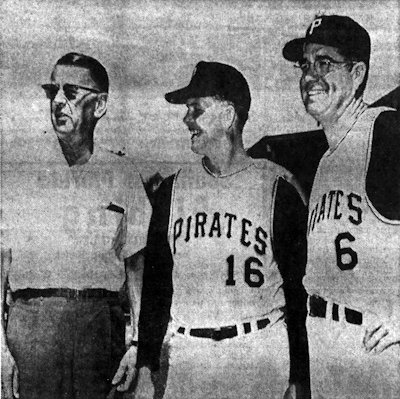 Hall of Fame pitcher Lefty Gomez, left, visits the Pirate training camp and talks with Wood, center, and pitching coach Clyde King. Source: News Press, March 11, 1965.
For the first time in his career, Wood spent the entire season in the majors in 1965. He made all but one of his 34 appearances out of the bullpen, and he was very good in a very unglamorous role. Even though the ’65 Pirates won 90 games to finish in third place, Wood pitched almost exclusively in losses. But he had a 3.16 ERA in 51-1/3 innings with 29 strikeouts. He lost his only start of the year, but on August 29, Wood entered the sixth inning of a 2-2 tie after Bob Friend put the first two Houston Astros on base. Wood got Joe Morgan to ground into a force play, walked Jim Wynn intentionally and got an inning-ending double play from Rusty Staub. The Pirates scored twice in the bottom of the inning and won 6-4. After 5 seasons and 67 major-league games, Wood had his first career win.
Wood’s breakout season didn’t end up as a breakout after all. He spent all of 1966 in Triple-A Columbus and was among the league leaders with 14 wins and a 2.41 ERA. He was voted an All-Star and the IL’s best lefty, but Pittsburgh sold his contract in October to the Chicago White Sox. A month later, the Pirates purchased the contract of pitcher Juan Pizarro from the Sox, and Baseball Reference describes it as a trade between the two teams. However, they appear to be separate transactions.
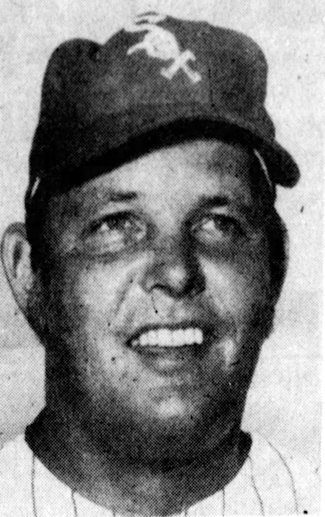 Source: The Pantagraph, July 14, 1975.
Going into 1967, Wood knew he was pitching for his career. “[I] didn’t know for how much the White Sox paid, but I’m glad to be back. I still think I can pitch in the big leagues,” he told The Boston Globe in February. Wood pointed to his track record of success in the minors and hoped that he would be seen as a starter and not a reliever. He also addressed false reports that he had become strictly a knuckleball pitcher. “I don’t know how that started. I throw less knucklers than anyone else… I think I’m a little faster than I was,” he said. It was a pitch he’d toyed with his whole life and occasionally threw in a game, but it wasn’t a big part of his repertoire. Wood’s new White Sox teammate was Hoyt Wilhelm, who was still a very successful pitcher in his mid-40s thanks to his knuckler. Wilhelm and pitching coach Marv Grissom had plenty to teach Wood about the pitch. One of the pieces of advice that Wilhelm gave was that a pitcher cannot throw a knuckleball, drop it for a while and come back to it later. “Hoyt Wilhelm taught me that when I joined the White Sox,” Wood explained in a 1969 Globe interview. “He said, ‘You have to make a decision — and then stick to it.’ I made the decision — and I stuck.”
Wood became a busy White Sox pitcher. He pitched regularly over the first half of the season and allowed a grand total of 3 earned runs through the end of June — 21 games and 26-1/3 innings. He was a long reliever and occasionally a stopper, picking up 4 saves on the season. The first one came against Boston on June 6, after Wilhelm loaded the bases in the ninth inning with one out and Chicago clinging to a 5-3 lead. Wood induced Carl Yastrzemski to ground into a game-ending double play. The White Sox let Wood start games in mid-July, and he beat the Kansas City A’s and Jim “Catfish” Hunter twice to pick up his first wins of the season. In the second start, a 5-4 win on July 21, Wood estimated that 80 percent of his pitches were knuckleballs. Wood made 8 starts among his 51 appearances in 1967, and all his decisions — a 4-2 record — came in those starts. He had a 2.45 ERA — 1.86 as a reliever and 3.21 as a starter — and struck out 47 batters in 95-1/3 innings.
Between 1968 and 1970, Wood became an ironman reliever, leading the AL in appearances each year and establishing a major-league record with 88 games pitched in 1968. He was the team leader in saves each season and also led the Sox with 13 wins in 1968, even though just 2 of his record-setting appearances were starts. Wood’s 1968 season was overlooked among the feats accomplished during the Year of the Pitcher, but with a 13-12 record, 159 innings pitched, a 1.87 ERA and 16 saves, it was a remarkable campaign. Wood even received a pair of down-ballot MVP votes. His 1969 and ’70 seasons are a little less eye-popping, but if you needed a reliever to give you an inning or even 5 innings, you could count on Wood. He noted that his knuckleball eased the strain on his arm, and the managers that cycled in and out of the team in those three years took advantage of it. Two of Wood’s 10 victories in 1969 came at the expense of the Seattle Pilots during a June 24 doubleheader. He relieved in both games and threw a total of 5-2/3 shutout innings, allowing 2 hits.
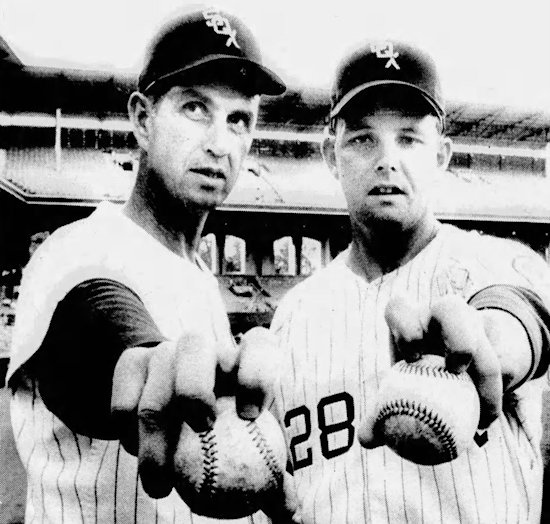 The White Sox knuckleball duo of Hoyt Wilhelm and Wilbur Wood. Source: The Los Angeles Times, July 8, 1985.
Chuck Tanner took over as White Sox manager in the final days of the 1970 season and kept the role in 1971. One of his first decisions was that Wood would be used as a spot starter — when there was a doubleheader, or when a pitcher was scratched for any reason. Just days into the season, starter Joe Horlen injured his leg and had to miss significant time with surgery to repair torn cartilage. Wood was thrown into the rotation and turned into one of the best starters in the majors. He won 22 games and lost 13 with a 1.91 ERA and a career-best 210 strikeouts. His 11.7 Wins Above Replacement, per Baseball Reference, were best in all of baseball, as was his 189 ERA+. Wood still threw his knuckleball about 80 percent of the time, so moving to a starting pitcher role didn’t affect his process much. “It really makes no difference to me which I do. I liked the feeling be being able to come back and pitched the next day, though. A starter has to wait his turn,” Wood said. He waited less than other starters did. Tanner took advantage of Wood’s durability by starting him frequently on 2 days’ rest, allowing him to make 42 starts in his 44 appearances. Wood completed 22 of them, 7 of which were shutouts. His 334 innings were second-best in the AL, and his arm held up extremely well. In the month of September, Wood started 9 games — five on 2 days’ rest and four on 3. He completed 7, throwing shutouts in 3 of them. One of the other amazing statistics in an amazing season was that Wood walked 62 batters in 334 innings — 1.7 batters per 9 innings. Knuckleballs are famously impossible to aim, but Wood was throwing them with a level of control that baseball has rarely ever seen.
Wood finally began to get some recognition for his success. He was named to the 1971 All-Star Team but didn’t appear in the July 13 game — he had thrown a 5-hit shutout over the Milwaukee Brewers two days earlier. His amazing season would have normally made him a favorite to win the AL Cy Young Award, but 1971 was also the year Vida Blue had such a dynamic rookie season –24 wins, a 1.82 ERA — that he won the Cy Young and the Most Valuable Player award. Wood finished third in the Cy Young vote behind Blue and Mickey Lolich, the Tigers pitcher who led the AL with 25 wins and 308 strikeouts. He also finished 9th in the MVP vote. Wood’s weight also became a favorite topic for sportswriters. The White Sox media guide charitably listed him at 190 pounds, but the adjective most often used to describe Wood was “durable,” followed closely by “chunky.” “I could smell a beer and gain 3 pounds,” he once quipped.
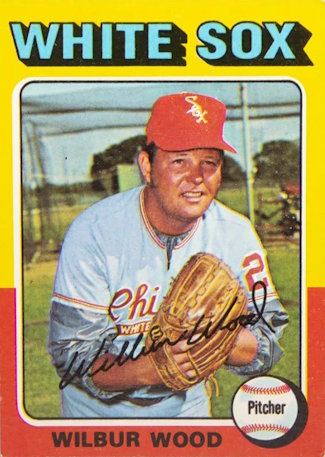
Wood’s success proved to be no fluke. He won 24 games in 1972 and 1973, leading the AL in victories in each season. He also led the AL in games started (49 in 1972, 48 in 1973), innings pitched (376-2/3, 359-1/3), batters faced (1490, 1531), hits allowed (325, 381) and earned runs (105, 138). Those last two categories are just a consequence of throwing so many innings, as Wood still posted very good ERAs of 2.51 in ’72 and 3.46 in ’73. He was an All-Star in 1972 and allowed a run in 2 innings during the game. He also came within a eyelash of winning the 1972 AL Cy Young Award, losing to Cleveland’s Gaylord Perry, 64 points to 58. Perry had 9 first-place votes, while Wood had 7 and four others split the remaining 8 votes. Both Wood and Perry won 24 games, but Perry’s 1.92 ERA was more than a half run lower than Wood’s. Perry also completed 29 games to Wood’s 20, though Wood threw more innings. Coincidentally, Perry also threw an uncommon pitch. Wood had his knuckleball, and Perry had his jar of Vaseline. In 1973, Wood finished fifth in the Cy Young Award vote, and that seems about right. Winner Jim Palmer and runner-up Nolan Ryan had outstanding seasons, and Wood was starting to get hit a little harder than past seasons. He had 20 losses to go with his 24 wins, and opposing batters hit .270 off him after batting .229 during the 1971 and ’72 seasons. During that summer, Wood became possibly the last pitcher to start both ends of a doubleheader, on June 20, 1973. He was knocked out of the first game without retiring a batter, as the Yankees scored 5 runs off him and won 12-2. Wood returned to start the nightcap and made it into the fifth inning before New York knocked him out of the game again, winning 7-0.
Chicago finished at .500 in 1974, with Wood flashing some of the brilliance of his early years as a starter. He threw a 2-hit, 10-inning shutout against Detroit on May 7, striking out 10. After beating Milwaukee 3-2 on July 20, Wood led the majors with 16 wins, and he earned his final All-Star nod. He reached the 20-win mark for the fourth straight season with a 10-inning complete game win over Kansas City on September 2, but he lost his final three decisions to end the year at 20-19. His ERA once more crept higher, ending at 3.60, but he continued to top 300 innings pitched and equaled his career best with 22 complete games. Wood stumbled out of the gate in 1974, starting the season with a 1-6 record. A 6-game winning streak in July and August got him to within a game of .500, but he finished the year with 16 wins and a league-high 20 losses. Wood also fell just shy of pitching 300 innings once again. He completed “just” 14 games, as ineffective starts and the presence of closer Goose Gossage in the Chicago bullpen led to shorter games. Tanner was unconcerned about Wood and continued to pitch him every third day. Wood ended the first half of the season by throwing a 3-hit shutout against Milwaukee on July 13, and then he started first game after the All-Star break with a 2-hit shutout of Detroit. “Nobody in baseball has done anything against Wilbur Wood when he had a good day. And he had a good day today,” Brewers manager Del Crandall said after his loss.
Wood began the 1976 season with an Opening Day shutout against Kansas City, and for the first 7 games, he looked to be on the way to a very good season. He had a 2.24 ERA and was in the process of beating the Detroit Tigers for his 4th win when his season ended on May 9, in the sixth inning. Ron LeFlore hit a line drive off Wood’s left knee, breaking his kneecap. Wood had never broken a bone in his 33 years nor been hospitalized until that moment. “I’ve had a few stitches before, when I got hit with a hockey puck in high school,” he said. But he had to spend time at Illinois Masonic with an immobile left leg before returning to Massachusetts for the rest of the year. Wood then re-injured his knee in September while working out at his home in Lexington, MA, which required additional time in a cast.
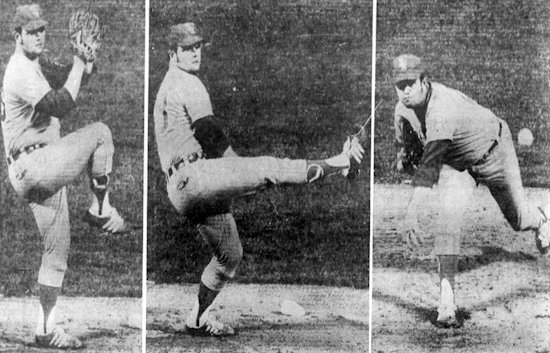 Source: The Boston Globe, June 17, 1973.
The White Sox activated Wood in April 1977. His first few appearances were awful, but he showed enough of his old form that he returned to the starting rotation in mid-June. New manager Bob Lemon used a pretty strict rotation, so Wood pitched less often on short rest. But he still shut out the Minnesota Twins on July 3 and came back on the 6th to throw a complete game win against Seattle. Wood’s 7-8 record and 4.99 ERA were far off his norm, but his good outings contributed to an exciting season for White Sox fans in 1977. It was the year of the South Side Hitmen, when owner Bill Veeck went all in on his team and brought in a host of sluggers. It nearly worked, as the team finished third in the AL West with 90 wins. The team, once divested of all those power hitters, lost 90 games in 1978, and Wood had a pedestrian 10-10 record and 5.20 ERA. It was the final year of his contract with Chicago, and the team let him leave as a free agent. That offseason, free agents were put into a “draft,” the the players could negotiate only with the teams that drafted them. Wood was drafted by just two teams, Milwaukee and Pittsburgh. Milwaukee signed free agent Jim Slaton instead and lost interest in Wood, and Pittsburgh made a 1-year deal for $30,000 when he had been making $140,000 with the White Sox. Eventually, there were other nibbles, but nothing led to a contract. Wood nearly agreed to a 1-year deal with Oakland, but he failed to meet the arbitrary 1-hour deadline set by A’s owner Charlie Finley. As spring training began in 1979, Wood was back at home in Massachusetts for the first time in 20 years. He was 37 years old and still interested in playing for a few more seasons, but the league had moved on.
Wood pitched for parts of 17 seasons, with a 164-156 record and 3.24 in 651 games. He started 297 of those and had 114 complete games and 24 shutouts, along with 57 saves. Wood struck out 1,411 batters in 2,684 innings, and he had a career WHIP of 1.232 and an ERA+ of 114. Baseball Reference credits him with 50 Wins Above Replacement — 52.1 if you remove his batting totals, as Wood was a career .084 hitter. Wood was on the Hall of Fame ballot 6 times and reached a high of 7% in 1988 before getting 3.1% the following year and falling off the ballot. Maybe he didn’t get enough wins or have a long enough peak for the Hall, but he had more than a couple HOF-worthy seasons.
In a 1985 interview, Wood acknowledged that the broken kneecap essentially ended his career. “I just couldn’t do what I could do before I got hurt. That took the fun out of it,” he said. “It was something you knew wasn’t going to last forever anyway.” By then, he had put the game behind him and was capitalizing on a lifelong love of fishing by owning and operating Meister’s Seafood in Belmont, MA. In an interview with the Globe, he was much more interested in his seafood party platters and chowders than his baseball career — not out of bitterness, but because he was done with that part of his life. “Baseball was good to me. It was great while it lasted. But ballplayer, celebrity or whatever, I’m not better than anybody else.” Wood also had a career in pharmaceutical sales before his retirement. In later years, he appeared as a signer at card shows and made occasional visits to Chicago for special events at U.S. Cellular Field. Wood also kept his Red Sox fandom alive and well and paid particular interest to that team’s resident knuckleballer, Tim Wakefield.
Wood is survived by his wife, Jan, children Wendy, Derron and Christen, and many extended family members.
For more information: Bedford Funeral Home
Discover more from RIP Baseball
Subscribe to get the latest posts sent to your email.