
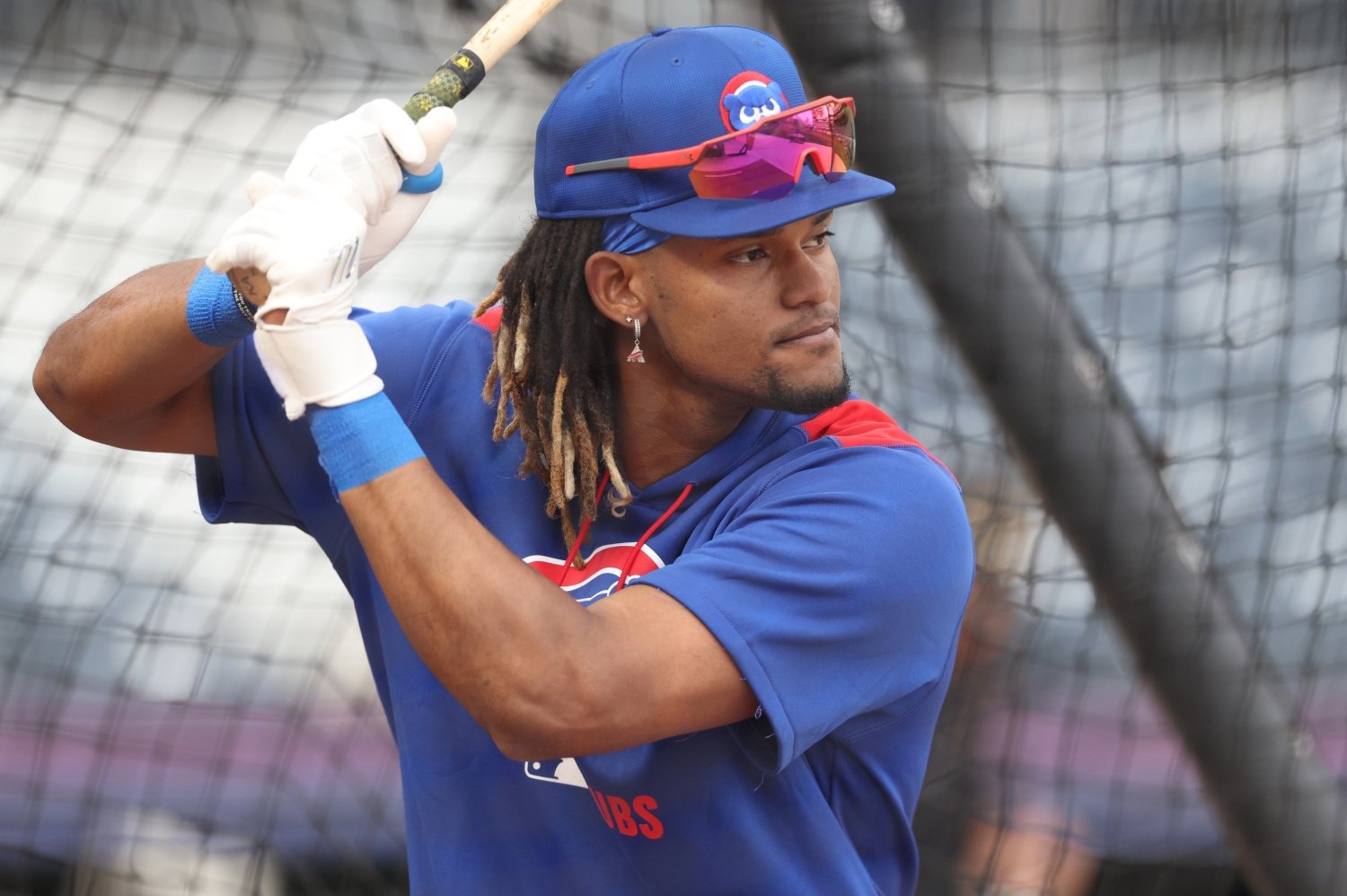
Who will the Cubs’ right fielder of the future be? With the Los Angeles Dodgers signing former Cub Kyle Tucker to a 4-year deal worth $240 million, the carousel at the 9-spot will take another spin. Fans at The Friendly Confines have seen their fair share of personnel chase balls toward the big yellow ‘353’ in the last several years. Tucker, Cody Bellinger and Seiya Suzuki have taken turns since the start of 2022. Before that, there was Jason Heyward, but Kris Bryant and Ben Zobrist each also spent lots of time there. The position is important to the team, historically, going back to the likes of Andre Dawson and Sammy Sosa.
Who will it be in 2026? The answer seemed clear. Even before Tucker inked a deal with the Dodgers, the writing was on the wall that he wouldn’t be coming back after his one-year stint in the Windy City. Owen Caissie seemed like the lay-up answer, until the Cubs dealt him to Miami in a big swing for rotation piece Edward Cabrera.
That leaves Chicago in murky waters for the future of their right field position, but there are four players who can separate themselves from the rest this upcoming season.
Kevin Alcántara
I didn’t think this guy had a snowball’s chance in you-know-where to get meaningful playing time before Caissie packed his bags for Miami, but now, the window of opportunity seems wide open for him. Acquired from the New York Yankees in 2021’s Anthony Rizzo trade, Alcántara has all the tools to be the next superstar to guard the right-field foul pole.
He’s 6-foot-6, an athletic 188 pounds, and he flies like the wind. The 23-year-old worked his way through Chicago’s pipeline with a lanky grace in center field. After logging 14 home runs and 61 runs batted in across the top two levels of the minors, Alcántara made his big-league debut late in 2024, going 1-for-10 with a run scored. In 2025, ‘The Jaguar’ spent 102 more games in Iowa before registering 4 hits in 11 at-bats with the parent club.
The intangibles are there; he’s long, rangy, and can spark a rally if he gets on base. His power upside is clear, and while he hasn’t been a high-volume runner in the minors, you can see how Quintin Berry might make him one in the majors. The most pressing issue? Strikeouts. The former Yankees prospect has hovered around a 30% strikeout rate in the minors. He does have time on his side, both in age and big-league control time, but the plate discipline needs to come around, and that means making contact and getting the ball in the air consistently, despite his size.
Seiya Suzuki
Suzuki offers the most proven offensive production of anyone on this list, and it isn’t even close. He’s upped his home run total every year, topping out at 32 long balls and 103 runs batted in 2025. He was a marvel in terms of contact quality last year, ranking in the top decile in barrel rate and launch angle sweet spot and the top quintile in hard-hit rate. Arguably, he should’ve had a spot on the National League All-Star roster. Despite a much quieter second half, he punished opposing pitchers all season long.
As an anything “of the future,” though, he’s a tricky fit. This is the fifth and final year of Suzuki’s contract, and his glove has been suspect at times. The Cubs couldn’t help but keep his bat in the lineup, so 102 of his 150 games were out of the DH spot last year. It doesn’t seem very likely, though, that he and the Cubs will re-up for another five years after this.
Ethan Conrad
From the player with the largest body of work in this set, we go directly to a pipeline talent who has no professional baseball experience. Conrad was the Cubs’ first-round pick in the 2025 Draft, but it may be awhile until we see him don Cubbie blue. However, he’s a well-rounded talent with star-caliber upside.
Taking a look at Conrad’s college numbers, he had an unreal season with Marist in 2024. The 6-foot-3, 220-pound outfielder logged an NCAA Division I-best 13 triples that year, before transferring to Wake Forest (and the more robust competition of the ACC) for 2025. He hit well there in a brief stint, before shoulder surgery ended his season,
The Cubs took Conrad because they saw an opportunity. He was considered a candidate to go in the top half of the first round before getting hurt, so by being willing to roll the dice on him after the injury, they gave themselves a chance to find that right fielder of the future. Between having transferred from a small school and having gotten hurt before getting drafted, though, he’s not as polished as most college hitters taken in the first round. It’ll be a couple of years before he knocks on the door.
Who Will Be the Cubs’ Right Fielder of the Future?
After surveying these options, it feels like Alcántara’s job to lose. Suzuki’s contract status raises too large of a question mark. Conrad’s ETA is too far away for him to jump “The Jaguar,” and while Matt Shaw is taking reps in the outfield, he doesn’t profile as a useful corner outfielder. If he can iron out the whiff issues and stay on the field, Alcántara could emerge by the end of this year as the long-term solution. Of course, that’s a big ‘if,’ but there are no perfect answers here.