
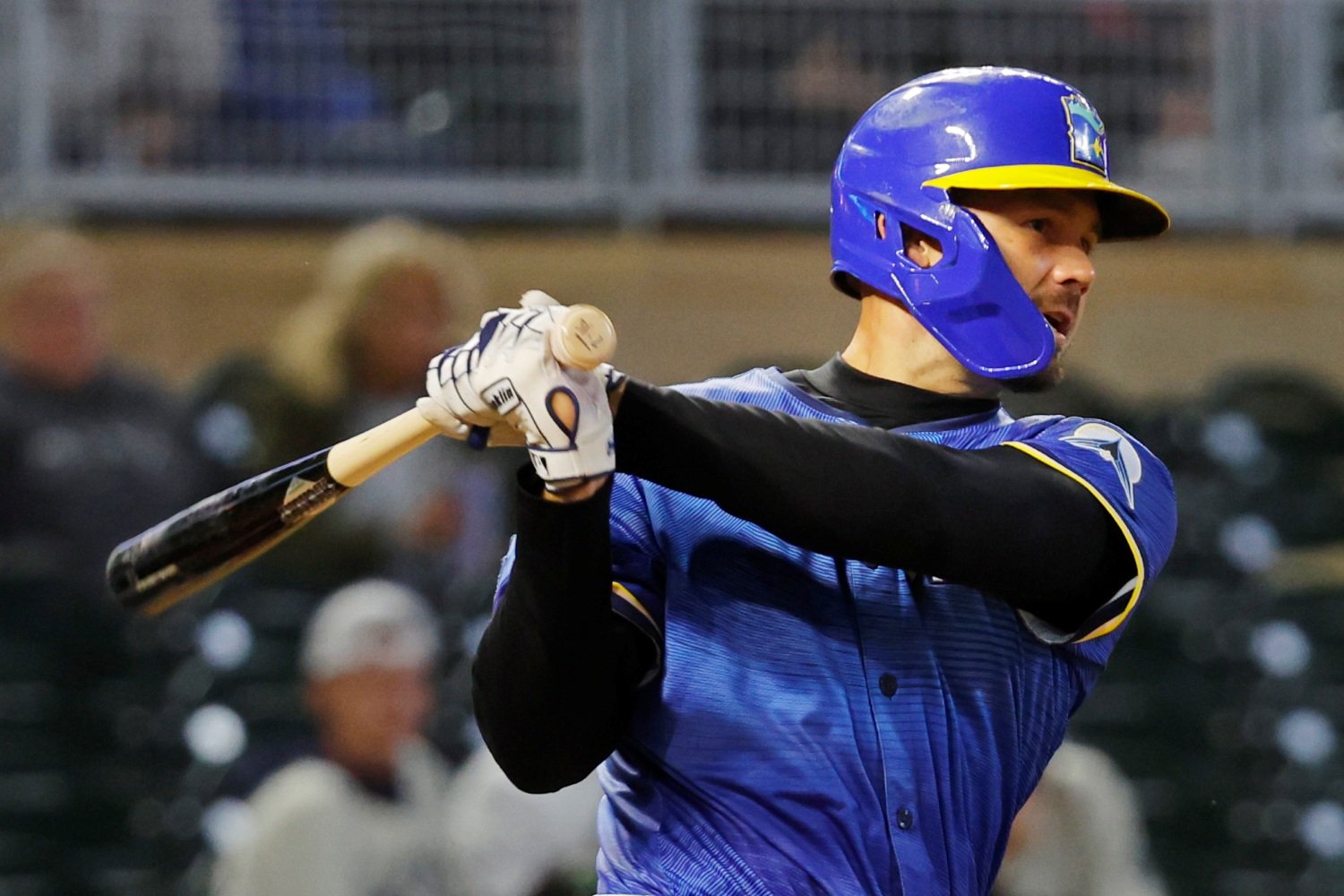
Entering the offseason, those who follow the Minnesota Twins expected corner outfielder/designated hitter Trevor Larnach to part ways with the organization, either by being non-tendered in mid-November or traded sometime before spring training. Instead, they tendered him a contract in the fall, and agreed to a one-year, $4.475-million contract to avoid arbitration earlier this month. With less than three weeks until pitchers and catchers report to the Lee Health Sports Complex in Fort Myers, Larnach remains with the club.
Larnach appears set to enter his sixth major-league season still a member of the Twins. However, his role in 2026 could differ from any he’s occupied in previous seasons, due to the 26-man roster’s projected construction. Right now, Larnach is projected to platoon with Austin Martin in left field, with Larnach starting games against right-handed starting pitchers and Martin starting games against left-handed starting pitchers. At first glance, Larnach would be slated to receive more opportunities at the position, given that major-league clubs face right-handed starting pitchers about three times as often as southpaws. Yet, given how Minnesota’s 26-man roster is currently constructed, the club could possess the positional flexibility necessary to avoid playing Larnach in the field altogether.
Fellow left-handed hitting corner outfield options Kody Clemens and Alan Roden (or James Outman, depending on who performs better during spring training) are also projected to hold roster spots come Opening Day. Clemens and Roden are superior defensive options to Larnach. The trio of Clemens, Roden, and Martin could operate in left field interchangeably, providing Minnesota with a plus defensive option in every platoon scenario. Any of the three players could also back up Matt Wallner in right field, providing the club with quality defensive flexibility in both corner outfield spots. Larnach would thus operate as the club’s primary designated hitter against right-handed starting pitchers, with switch-hitting DH options Josh Bell (first base) and Victor Caratini (catcher) playing in the field.
On the surface, that looks like a minimal role, especially for a player earning almost $5 million. As noted earlier, however, major-league clubs face right-handed starting pitchers far more often than left-handed starting pitchers. Minnesota could maximize Larnach’s skillset on a game-to-game basis, potentially leading to the Oregon State product producing at an unforeseen rate in his age-29 season. In 2024, Larnach hit .259/.338/.434 (a 119 wRC+) over 400 plate appearances, marking what has been his best season in the majors. Larnach excelled against right-handed pitching in 2024, hitting 15 home runs and posting a 123 wRC+ over 377 plate appearances. He struggled against same-handed pitchers, however, posting a lousy 63 wRC+ in the tiny sample of 23 plate appearances.
Larnach performed well against right-handed pitching last season, too, generating a 110 wRC+ over 449 plate appearances. However, the team elected to provide him more opportunities against lefties, which worked to his detriment. Larnach generated a similarly brutal 71 wRC+ against lefties. That time, however, he garnered 118 plate appearances against same-handed pitchers, a fivefold increase from 2024. His apparent performance dip last year was the result of Minnesota forcing him into 95 additional plate appearances against left-handed pitchers, due to a lack of corner outfield and DH depth.
With Martin, Clemens, Roden (or Outman), Wallner, Bell, and Caratini all projected to be on the Opening Day roster, Minnesota could shield Larnach from his weaknesses and maximize his strengths. Hitting almost exclusively against righties, Larnach could again post a wRC+ in the 120-130 range, though that would put more pressure on Martin, Bell and Caratini to be productive hitters against southpaws. Again, Larnach is not a platoon-proof left-handed hitting bat in the same ilk as Kyle Tucker or Tyler Soderstrom. Still, he could supply value in the right role.
The final question, then, is whether the right role for Larnach is one the roster can accommodate, as a whole. The Twins will have 13 roster spots for position players at any given time. Ryan Jeffers and Caratini are locks. So are Bell, Luke Keaschall, Brooks Lee, Royce Lewis, Byron Buxton, Wallner and Clemens. That makes nine. Roden, Martin, Tristan Gray, Ryan Kreidler and Eric Wagaman can all be optioned to the minors, which gives the team flexibility, but that still leaves Outman, Edouard Julien, and Alex Jackson to sort through.
The nine players listed as locks don’t include a backup shortstop or third baseman, so one of the final four spots must be held for that player, with Gray being the leading candidate. Whether keeping Larnach (and using him in the role we’ve discussed) makes sense could come down to which of the out-of-options trio sticks around, if any. Julien is almost certainly out the door. Should the team elect to carry three catchers by keeping Jackson, though, they’d also be more likely to use Jeffers and Caratini at DH on occasion, pinching Larnach. Outman is the closest thing to a true center fielder in the mix, other than Buxton, so he could stick around mostly for his glove—but even if that’s why he lands on the roster, him landing there would complicate keeping Larnach.
If the Twins trust Larnach in left field (something that wasn’t true in 2025), he has a fairly clear path to sticking around and making a positive impact. If not, though, he’s still in a precarious position, because the role the team would most like to give him might not suit the rest of their roster construction. He just needs the right opportunity, but whether that right opportunity exists in Minnesota isn’t clear yet.