
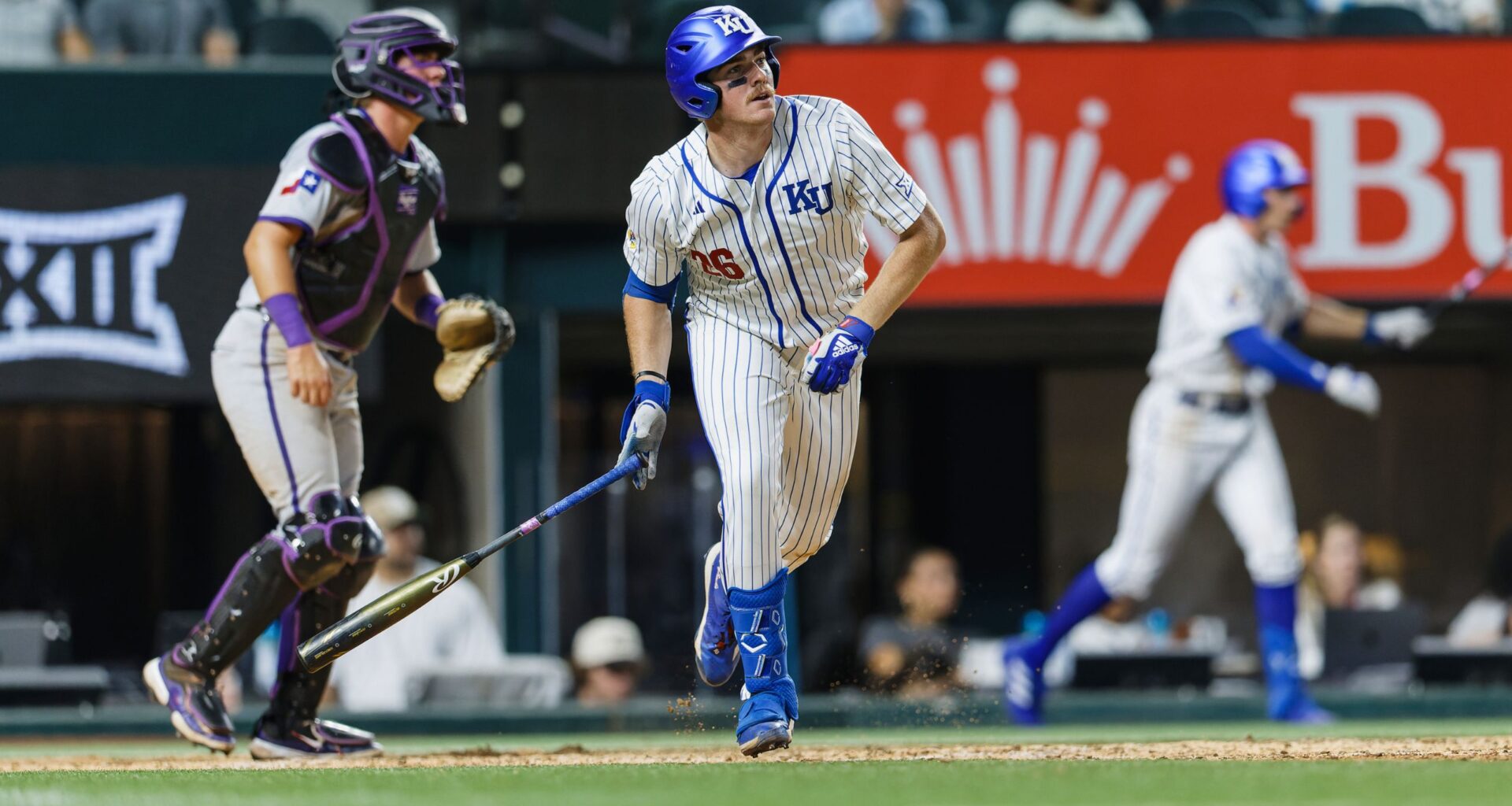
Image credit:
Brady Ballinger (Photo by Eddie Kelly/ ProLook Photos)
Predicting the College World Series field is never as simple as identifying the eight most talented teams in the country and penciling them into Omaha. The NCAA Tournament does not reward linear logic or chalk-heavy forecasts.
The eight teams reaching Omaha have not all been regional hosts since 2013, and last season’s field included just the fourth No. 4 seed ever to make the trip in Murray State.
In hindsight, the Racers’ path made sense. They were experienced, connected and built with intention. They had the right mix of roster balance, belief and timing. Murray State never viewed itself as a Cinderella so much as proof that there are multiple viable ways to win in college baseball, particularly in the transfer portal era.
In identifying potential CWS sleeper teams for 2026, we wanted to highlight teams cut from that same cloth. Programs that don’t project as national-title favorites in January and might not even look like regional hosts come May, but show early signs of possessing the ingredients required to make a run: experience, depth, adaptability and a roster that allows for variance rather than punishes it.
Teams ranked in our preseason Top 25 were not eligible for consideration. We view that ranking as a snapshot of the teams we believe are most likely, in order, to win the national championship. This exercise is about everyone else. The teams that will need to bend the tournament to their will rather than dominate it outright.
With that in mind, here are our eight Omaha sleepers for 2026. Teams are listed alphabetically.
Alabama
I can feel the eye roll already. You opened the story, started to scroll and the first team that appears is from the SEC. Eye roll away. In context, though, Alabama belongs here.
Whether you want to acknowledge it or not, the SEC remains college baseball’s deepest and most punishing league. It shattered the record for NCAA Tournament bids in 2024, then broke its own mark a year later after absorbing Texas and Oklahoma into an already-stacked conference. A league capable of landing 13 bids and opening the season with 11 teams in the Top 25 can also produce sleepers, because the path to simply reaching the postseason is so unforgiving.
That reality might only intensify with a new selection committee chairman in place. How the committee weighs middle-of-the-pack SEC resumes remains to be seen. Finish 10th or lower and nothing is guaranteed, even with a roster that looks the part.
Alabama has the ingredients to push through that chaos. It starts with shortstop Justin Lebron, who enters the season as one of the top 2026 draft prospects in the country. Lefthander Zane Adams and righthander Tyler Fay return to anchor the rotation and give the Crimson Tide a level of experience and stability that matters in May and June.
The question is whether it all clicks, particularly on the mound. If it does, Alabama has enough talent and depth to be dangerous deep into the tournament.
You could make similar cases for Kentucky and Texas A&M in the SEC and NC State and Wake Forest from the ACC. All have ample depth and high-end talent. They’re mentioned here only to avoid turning this exercise into an SEC-ACC preseason list. Alabama will carry the flag for the group.
Dallas Baptist
Dallas Baptist is a postseason constant, but the program’s ceiling has been harder to crack. Since moving to Division I in 2004, the Patriots have reached just two super regionals (in 2011 and 2021) despite routinely fielding rosters that look capable of more. Dan Heefner’s teams are almost always talented, organized and uncomfortable draws in May. The question is whether one finally breaks through.
The lineup has the shape of one that could. Chayton Krauss returns after emerging as one of the hardest hitters in college baseball in 2025, providing legitimate middle-of-the-order thump. Keaton Grady gives the offense a reliable contact bat and on-base presence at the top, and several other regulars are back alongside portal additions that add depth and flexibility.
The variable is the pitching staff, where turnover is heavier than usual for the program. James Ellwanger, Micah Bucknam and Mason Peters are all gone after accounting for two-thirds of the weekend rotation and the top bullpen role. Ryan Borberg, Luke Pettitte and Athan Kroll return to form a foundation, and the staff is optimistic about newcomers Jared Shaeffer and Russ Smith.
If the pitching coalesces, Dallas Baptist has enough offensive punch and institutional consistency to finally push past its familiar ceiling.
Kansas
Dan Fitzgerald has taken Kansas to new heights in a remarkably short window. Since taking over ahead of the 2023 season, he has turned one of the Big 12’s least-resourced programs into a legitimate postseason contender.
In 2025, Kansas set a program record with 20 conference wins and tied its second-highest overall win total at 43, earning its first NCAA Tournament berth since 2014. This season, the Jayhawks have a chance to make back-to-back tournament appearances for the first time since 1993-94.
The foundation is clear. Kansas returns first baseman Brady Ballinger, a bat with real preseason draft helium, along with frontline starter Dominic Voegele. Around that core, Fitzgerald has once again assembled a roster built through multiple lanes, blending Division I transfers, junior college additions and internal development. The Jayhawks’ rise has been fueled in part by a deliberate push toward older, physically mature rosters that can withstand the grind of the Big 12 and the postseason.
If it comes together again, Kansas has the profile of a team capable of lingering deep into June. The margin is thin, but the experience, roster balance and competitive confidence are real. A return to the Big 12 race feels likely. A run that pushes the Jayhawks into the Omaha conversation is no longer too far-fetched.
Lamar
Lamar’s recent trajectory suggests a program closer to breaking through than its 13-year regional drought might imply. The Cardinals are coming off consecutive 40-win seasons and a 2024 Southland Conference regular season title—tangible markers of momentum even if the postseason payoff has yet to follow. The opportunity in 2026 feels tied less to continuity than to reinvention.
Few teams were more aggressive in the transfer portal, and Baseball America was high on the Cardinals’ incoming class. Seventeen newcomers give Lamar both volume and optionality, with multiple bats capable of reshaping the lineup immediately. Braden Benton and Balin Valentine arrive from Northwestern State after productive offensive seasons, and Jake Wagoner brings experience behind the plate following a sophomore breakout at Seattle. The group gives Lamar a different offensive ceiling than it has carried in recent years.
On the mound, the program’s identity remains intact.
This is not a team relying on one or two outcomes to go right. It is one betting on the idea that adding this much usable talent can finally push Lamar through the door it has been knocking on for years.
Mercer
Mercer’s odds are long by any historical measure. The program has reached the NCAA Tournament just four times in its 62-year history and has never advanced to a super regional. That context matters. So does what is quietly forming in Macon.
The Bears’ case starts on the mound. Righthanders Collin Ewaldsen and Kai Decker, paired with lefthander Jess Ackerman, give Mercer a trio of arms with legitimate upside and differing looks. It’s the kind of foundation that can shorten games and keep a team alive in a volatile postseason setting.
There is also more support offensively than Mercer teams of the recent past have carried.
Mercer does not need to overpower the field to matter. It needs to remain competitive into May, get the right draw and lean on a pitching staff that can punch above its weight. If that happens, the Bears are equipped to linger far longer than history would suggest.
Oregon
Oregon again projects as one of the more reliable offensive teams in the Big Ten, with shortstop Maddox Molony positioned to drive a lineup that should consistently pressure opposing staffs. Molony brings established production to a group that profiles a tier above most of the league in run creation, giving the Ducks both a clear identity and a high offensive floor.
The uncertainty sits almost entirely on the mound. Former ace Grayson Grinsell is gone to the draft, and while Oregon has no shortage of arm talent, there is limited proof it can hold up against power-conference lineups. San Diego transfer Cal Scolari and Gonzaga transfer Miles Gozstola have flashed internally, and Will Sanford offers premium stuff, but his freshman season came with significant command issues after walking more hitters than innings pitched.
If the pitching stabilizes, Oregon has the makeup of one of the league’s most difficult postseason draws, with only UCLA clearly stronger on paper. Whether that jump materializes will determine if the Ducks move from offensive standout to legitimate Omaha threat.
UC Santa Barbara
There are few pitching staffs in the country capable of dictating terms the way UC Santa Barbara’s can. This is not just a strength. It is a defining advantage and one that gives the Gauchos a path to beat almost anyone they draw, regardless of how loud the bats are.
It starts with Jackson Flora, who returns as the ace and will spend the spring building a case to be the top starting pitcher in the 2026 draft, a possibility several evaluators have already told Baseball America is realistic. He is backed by lefthander Cole Tryba and righthander Calvin Proskey, both of whom offer real follow-up quality and top 200 draft upside. Sophomore Nathan Aceves gives the rotation another premium option and is capable of handling weekends or overpowering midweek opponents. Taken together, it is a group with depth, variety and swing-and-miss that few programs nationally can match.
That level of pitching is enough to shape an entire season. It positions UC Santa Barbara to contend in a competitive Big West and, more importantly, gives it a postseason profile that travels. In a three-game series, the Gauchos can shorten games, neutralize offensive environments and force opponents to win in uncomfortable ways.
The lineup remains the variable. This is neither a powerful nor a proven offense, and infielder Jonathan Mendez profiles more as a steady, contact-oriented presence than a true engine for run production. That imbalance has been a familiar theme for recent UCSB teams. The difference now is that the pitching is strong enough to carry the load on its own.
UTSA
UTSA is no longer sneaking up on anyone. The Roadrunners pushed to a super regional last season and return enough from that group to make the run feel repeatable rather than anomalous.
The offensive losses are real. Mason Lytle, Norris McClure and James Taussig are gone after driving much of last year’s production. But the cupboard is far from bare. Jordan Ballin, Andrew Stucky, Drew Detlefsen, Nathan Hodge, Caden Miller and Tye Odom give UTSA a veteran position player core that understands how to navigate the postseason and does not need to reinvent itself stylistically.
The pitching staff provides another throughline from last year’s run. Robert Orloski, Conor Myles, Connor Kelley and Christian Okerholm all return, giving UTSA experience across roles and enough depth to absorb the grind of another conference race. That continuity matters for a team whose confidence now comes from having already proven it can handle the moment.
UTSA might not look identical to the group that surged last June, but the structure is intact.