
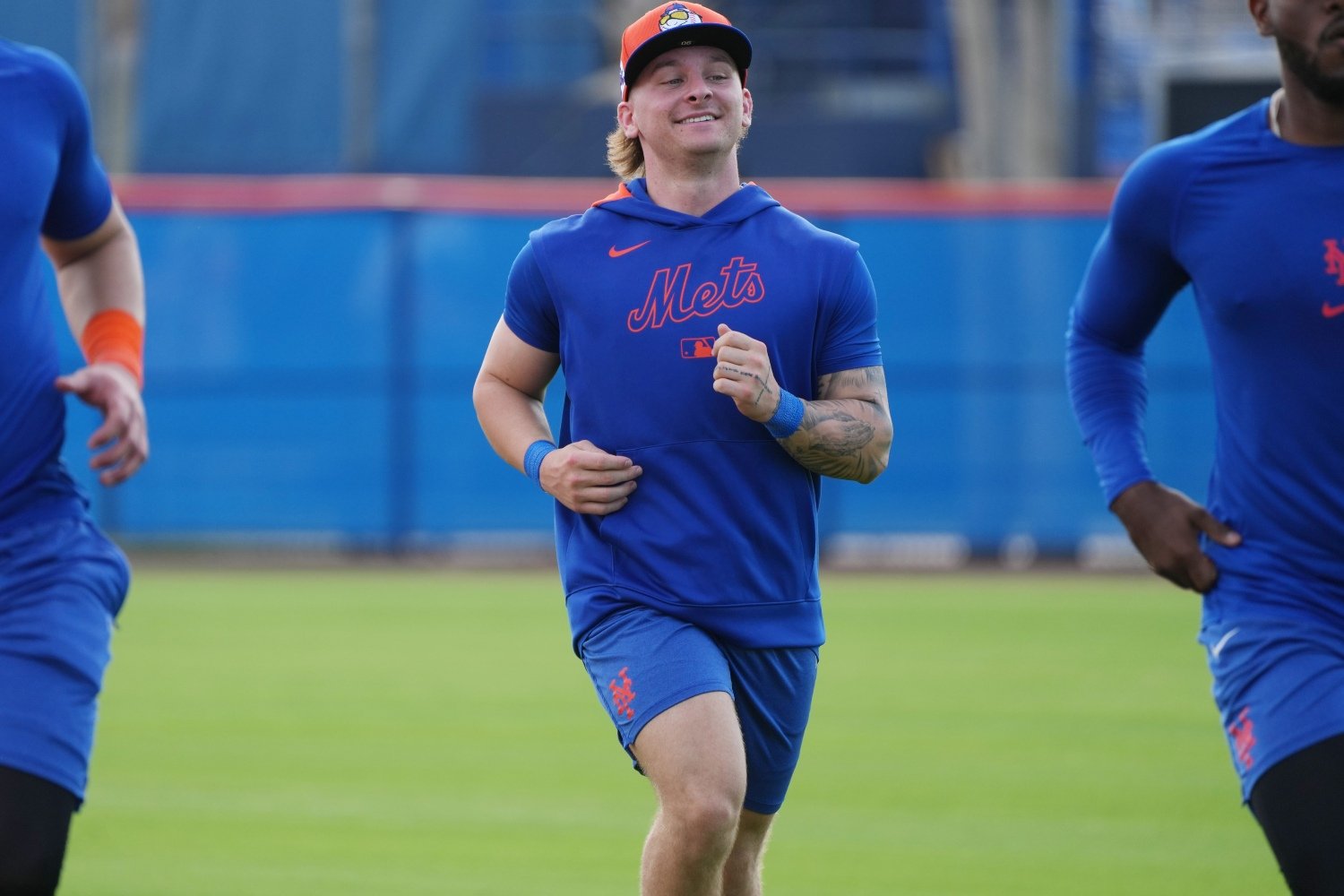
The focus on Jett Williams’s height has already become a bit tiresome, but it’s unlikely to fade anytime soon.
Listed at 5-foot-7, the 22-year-old isn’t even the shortest player on his new team, which he described on Monday as “a bunch of short guys who are a little bit scrappy.” According to Stathead, the 2025 Brewers featured 17 position players under 6 feet tall, tying them with Atlanta for the second-most in baseball.
In many ways, Williams’s brand of baseball matches his scrappy teammates, too. The Brewers emphasize swing decisions, swinging less than any other team as part of an on-base-centric approach. According to Baseball Prospectus, Williams’s 43% swing rate ranked in the 13th percentile of qualified minor-league hitters last year. A 13.3% walk rate helped him post a .363 on-base percentage. Tagged by FanGraphs with 60-grade speed, he stole 34 bases in 130 minor-league games last year.
However, Williams’s approach when he does swing diverges from most of Milwaukee’s smaller hitters, who have below-average raw power and hit plenty of ground balls. Williams has frequently pulled the ball in the air, with average raw power. None of his peers had that combination last year.
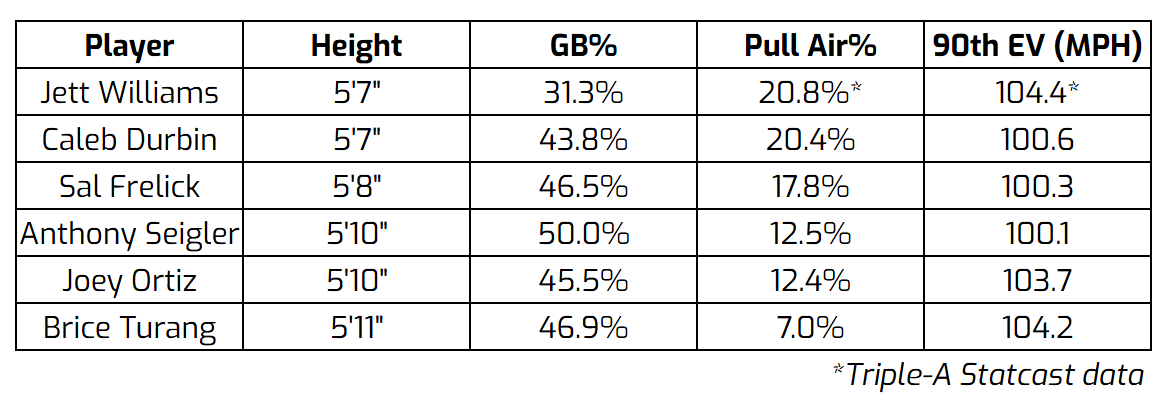
Williams’s closest comparators in size, Caleb Durbin and Sal Frelick, pulled enough fly balls to hit 11 and 12 homers in 2025, respectively. Durbin excelled at it in the minor leagues, too. However, due to their low 90th-percentile exit velocities, both appear to have maxed out their power. Without dramatic changes to their physiques and approaches, regularly hitting double-digit homers is unlikely.
That’s where Williams separates himself. His 90th-percentile exit velocity in Triple A effectively tied him with Brice Turang, who is four inches taller and went on a second-half power binge despite a low pull-in-the-air rate. FanGraphs assigned Williams 50-grade raw power, and he hit seven home runs in 151 Triple-A plate appearances.
Watching Williams hit reveals that, unlike other short Brewers, he’s not looking to slap the ball around the field at low trajectories. Like Durbin, he loads with an early leg kick and keeps his weight on his back leg as the pitch comes in. He then unleashes that energy with a faster and steeper swing than Durbin’s, with his barrel meeting the ball at an upward trajectory in front of the plate.
The downside is that this approach could make Williams’s hit tool less reliable against big-league pitching. Early leg kicks and steep bat paths make some hitters vulnerable against velocity at the top of the zone. Williams whiffed on 28.4% of swings against four-seam fastballs in Triple A, where his 78% in-zone contact rate ranked in the 19th percentile. The Brewers, meanwhile, have failed to successfully develop hitters with faster and steeper swings, with Keston Hiura and Garrett Mitchell among those to be eaten alive by high fastballs in the big leagues.
Opinions of Williams’s bat-to-ball ability vary. Baseball America and MLB Pipeline gave it a 55 grade in their most recent updates; FanGraphs, citing those potential concerns with high velocity, gave it a present grade of 30 and a future grade of 40. Much of his future value may hinge on whether the Brewers can get him to make enough contact.
While Williams’s profile features plenty of the scrappiness the Brewers are known for, he’s not just another Pat Murphy favorite with a high floor and a low offensive ceiling. He has more raw power, and an approach geared toward hitting more home runs. Those traits create a wider range of potential outcomes for his development, but it was time that Milwaukee rolled the dice on a riskier hitter with more upside. Williams gives them the best of both worlds: more pop, but still plenty of grit.