
There are a few things, perhaps two things, so potent in their nostalgia that I feel discomforted by them. I can’t quite pin down the emotion. Or emotions. And I don’t know that I can explain it, either. Perhaps what is so uncomfortable to me about them is the contradictory nature of the sensation. Bittersweet, brimming with memories and emotions, but empty. So vivid in the mind, but not in the world. It’s one of the most unique feelings I’ve ever felt. I still don’t quite know if I like it or not.
One of these antecedents, if you will, is Pokémon. Particularly, the original anime. That was, perhaps, my very first hyperfixation, which in hindsight makes it unsurprising that I allegedly learned how to read by playing Pokémon Blue. Watching the original anime always makes me flashback to childhood, and gives me that ineffable feeling I’m struggling to describe. And that other thing, or antecedent? It’s, of course, the Mariners.
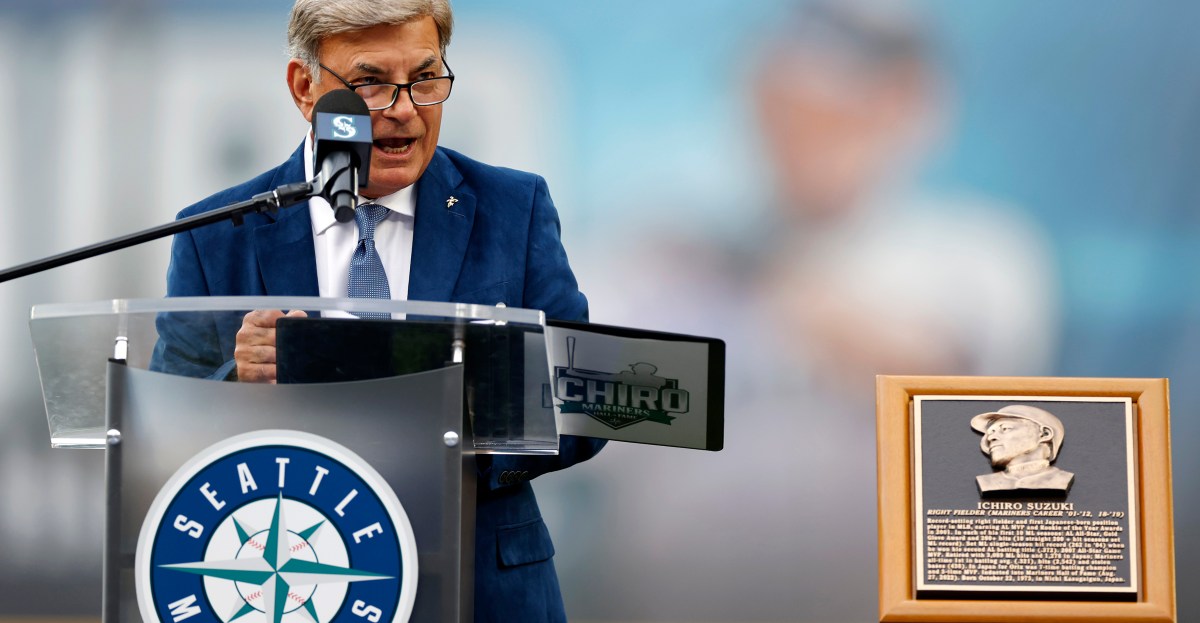
Yesterday, the Mariners announced that their longtime radio voice, Rick Rizzs, would be retiring following the 2026 season. It’ll mark his 41st year with the Mariners, and the 50th season for the franchise. That means that 82% of the Mariners’ existence has been commentated by Rizzs, and that he’s done the same for 100% of my life. The Mariners quoted Rizzs as saying, “Calling Mariners has been the highlight of my life.” Little does he know, it’s been the highlight of mine, too.
Given what I’m piecing together, I figure that the beginning of my sports consciousness was around 2000. As far as timing goes, it doesn’t hurt to spawn in for a playoff season, and one season before what is the first- or second-best single season of all-time. My first memory at then-Safeco Field is being up in the nosebleeds when Alex Rodriguez got a concussion and sprained his knee trying to break up a double play where, ironically enough, Joey Cora kneed him in the face jumping over him. I figure that Rizzs was somewhere right below me, calling the game from the booth.
Most of my early memories are sports-related – many of which occur in the context of my living room. And almost all of them include my dad. When I first started writing for Lookout Landing, Matthew Roberson had me on the podcast, and one of the things I told him was that my single-favorite memory (really, a collection of memories) from my childhood was a near-daily ritual with my dad. One in which he would get home from his job after making the long commute to and from work, where he would toil for 10 or 12 hours as a welder. He’d get home and plop onto the couch, and I’d wrench off his heavy work boots. We’d turn on the Mariners game, and he’d scratch my back until he’d inevitably fall asleep, which, unless John Halama was pitching, usually wasn’t before the exit of a Mariners starting pitcher. In the background would be the reliable cadence of Rizzs, or Dave Niehaus.
My dad and I would pile into his 1990-something gold Toyota 4Runner on brisk autumn mornings on my way to preschool. I remember the way that he would masterfully balance a full mug of piping hot coffee while managing to juggle between the steering wheel and shifter. As steam billowed from his mug, the smell of hazelnut Coffee mate creamer and the sound of Seattle talk radio would both permeate the cold air of the 4Runner. There would inevitably be a soundbite from one of Rizzs’ signature calls from the previous night, in which he was likely borrowing a Niehausism, or using one of his own catchphrases. At night, on the way home from family events or working at our family shop, I remember the slow crawls from Georgetown in my dad’s Toyota T100. There was always the red hue of brake lights filling up the car, and the crackle of Rizzs’ steady, familiar voice over the radio, hissing in tunnels and under bridges.
I suppose it wasn’t until writing this that I realized that my fondness for the Mariners is, of course, intertwined with Rick Rizzs, but also with my dad. Some of the fondest memories of my life have been spent at the ballpark, on my couch, and in the 4Runner or T100. All with my dad, and most, or all of them, with Rizzs. There’s a beginning and an end to everything. You only notice the best and worst of them, and Rizzs’ retirement represents the end of something really special. It makes me think about mortality, and the impermanence of everything. Therein lies the contradiction, and what this ineffable, nostalgic feeling derives from: cherishing all of the good moments and memories, while also mourning them, and also the ones that won’t come, after 2026.
During the pandemic, I wrote about Félix Hernández and grief. I reflected on how Félix and I had both changed quite a bit over the years. Things continue to change. After the biggest year-to-year jump on a Hall of Fame ballot of all time, now it seems like a matter of when, not if, he’ll be in the Hall.
For Rizzs, I figure we ought to have the same sort of conversation. There’s no Hall of Fame for announcers. The highest honor a baseball announcer can receive is the National Baseball Hall of Fame’s Ford C. Frick Award, given to broadcasters for their “major contributions to baseball.” The list of Ford C. Frick Award recipients could probably double as a list of the greatest MLB announcers of all time. Our beloved Dave Niehaus won it in 2008, and fellow GOATs Vin Scully and Bob Uecker are on the list too, though, if you ask me, its merits are certainly watered down by the likes of Hawk Harrelson – and, as of a month ago, literally Joe Buck – receiving the award. I digress.
In many ways, the Mariners are one of the most unfortunate sports franchises of all time. But with Rizzs and Niehaus, we were spoiled with two people who could make the most fucked up of rosters not only watchable, and not only enjoyable, but cherishable. And for the entirety of their careers, that they did. We never got to give a proper goodbye to Dave, because he passed away at the age of 75, in between seasons he was meant to commentate full-time. At the age of 72, after 51 years of calling professional baseball, and 40 years with the Mariners, we have the opportunity to do what I would say we never got to do with Dave. Rizzs can get his farewell tour, and we can give him his flowers. And though we’ll miss him, he can enjoy the rest of his storied life with his family, rather than prepping meticulously for games and spending two to three hours a day creating the most vivid imagery of a baseball game that even the dullest of minds can conjure.
If we’re to consider Rizzs’ major contributions to MLB, they are many. He, of course, can be considered on his own merits, but no one has continued the legacy of Dave Niehaus more than Rizzs. Every grand slam, and many home runs, have become an homage from Rizzs to Niehaus, but with his own flair and, of course, with his own catchphrases of his own.
There’s also that, as the longest-tenured broadcaster in franchise history, Rizzs has truly, genuinely become the voice of the Mariners. I suppose in some ways, what I’m writing now isn’t different from what I wrote about Félix. Félix had been part of my life since I was in fourth grade. But Rizzs has been part of my life before I even knew he was. Perhaps in part because of Niehaus’ greatness, and in part because of the Mariners’ badness, Rizzs has sparsely been able to shine under the bright lights that we know he’s capable of. Luckily, this recent crop of rosters has lent itself to more playoff-caliber baseball, and that’s meant more opportunities for Rizzs to shine, and an environment much more suitable for him to leave on: on top.
To Rick Rizzs: I know I speak for all of Seattle Mariners fans when I say that you, along with many others, have made our fandom. Know that you’ve made us, and your good friend Dave, very, very proud, and we’re excited for you to make the most of your final season, and to have more of your cherished time spent with your grandkids. Congratulations on retiring on such a high note, and thanks for everything. Thanks for being the sound of my childhood.