
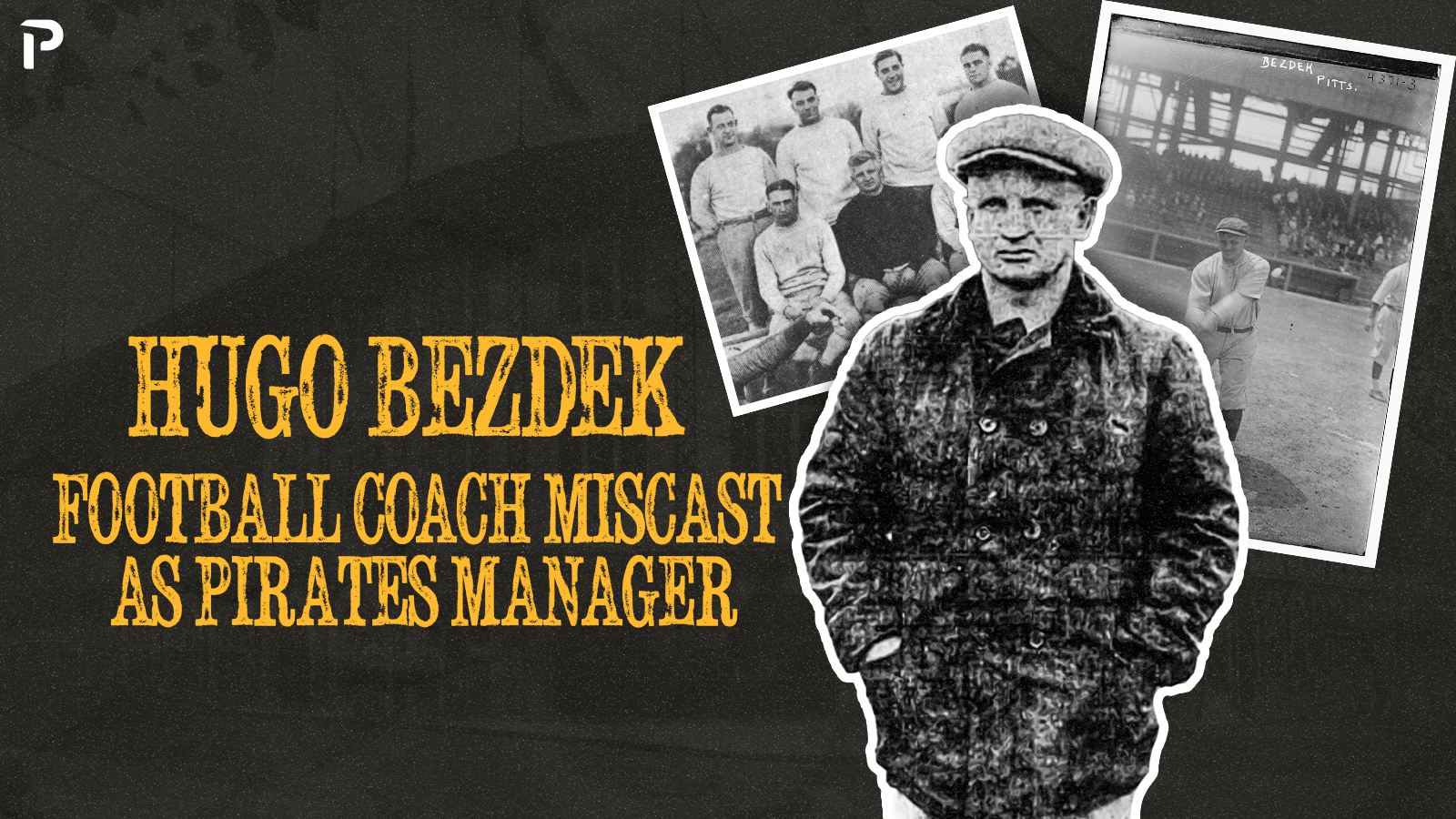
As of the end of the 2025 baseball season, 23,615 men have played major league baseball, but only 66 of them have also played NFL football. The most recent to have played both sports professionally were Bo Jackson, Brian Jordan, and Deion Sanders. In earlier times, the most prominent names to do both were George Halas, who played 12 games in right field for the New York Yankees in 1919 before becoming a legendary Chicago Bears player/coach, and Chuck Dressen, best known as the manager of several major league teams.
However, only one man, Hugo Bezdek, managed a major league baseball team and served as the head coach of both a college and a professional football team. As if that weren’t astounding enough, he was the manager of the Pittsburgh Pirates while also serving as the head football coach at the University of Oregon and later at Penn State University. There is no record of how he juggled his dual duties, such as when he was present in the dugout or on the gridiron. The media didn’t follow a sports figure’s every move in those days.
As a manager, Bezdek had some strange theories about baseball and got into a bloody brawl with one of his pitchers. But before we get there, let’s start at the beginning.
Young Hugo
Bezdek was born in Prague of the present-day Czech Republic on April Fools Day, 1883, but he was nobody’s fool. He was six years old when his family emigrated to the United States and settled in Cleveland. He attended the University of Chicago, where he was the star fullback on the football team. He loved and participated in other sports as well. In 1904, when he still had two years’ eligibility remaining at Chicago, charges were brought against him by the University of Illinois. Specifically, they charged that he had been a “prize fighter” under the name “Young Hugo” and accepted a $12.50 purse for participating in a bout in 1900, which would have disqualified him from college athletics.
Nothing came of those charges, and in 1905, Bezdek, who also played baseball at Chicago, received an offer from Jimmy Callahan of the Chicago White Sox to play for a semi-pro baseball team Callahan was organizing. Bezdek turned it down, but Callahan would later play a significant role in his future.
In 1906, Bezdek left Chicago before graduating. A brutally honest missive in the Pittsburgh Weekly Gazette stated that he was no longer eligible to participate in sports due to “flunks.” Instead, Bezdek, then 23, accepted a job as the athletic director at the University of Oregon. Desiring to finish school and earn his degree, Bezdek returned to Chicago the next year, where he was named assistant football coach for the freshman team. That December, when AD and baseball coach Amos Alonzo Stagg decided he needed a three-month vacation in Florida (a fireable offence today), he put Bezdek in charge of the baseball team.
Bezdek moved on to the University of Arkansas, where he served as the head coach for baseball and football in 1908 and remained until 1912. He would return to Oregon to coach football in 1916. His team won the Rose Bowl over Penn on New Year’s Day, 1917. By 1918, he was the football coach at Penn State. During these years, he was also a scout for the Pirates and developed a friendship with owner Barney Dreyfuss.
The Scout
The earliest year that any newspaper mentions Bezdek as a Pirates scout is 1911. Exactly how Bezdek got into scouting for a major league baseball team is lost to history. The guess here is that, judging from the frequency with which Bezdek hopped from one gig to another, he was an ambitious man who was always in search of opportunities, and somehow learned about this one. Bezdek’s presence in Pittsburgh always created a buzz in the local papers whenever he was in town to meet with Dreyfuss.
As a scout, Bezdek’s most prominent discovery was outfielder Carson Bigbee, who played in the majors from 1916-26, all with Pittsburgh, while slashing .287/.345/.369 for his career. Bigbee had starred in baseball, basketball, and football for Bezdek at Oregon. A few other discoveries for which the local press gave Bezdek credit made much of an impact in baseball. Among the others, only Jesse Altenburg and Roy Wood played in the majors, but their careers were brief and without distinction.
The Manager
Dreyfuss didn’t like what he was seeing from his 1917 Pirates. Callahan became their manager in 1916 and led them to a 65-89, sixth-place finish in the National League. However, after 60 games in 1917, Pittsburgh was 20-40, buried in eighth place in the eight-team league, and Callahan was fired. At first, Dreyfuss considered installing himself as manager. Finally, he named Pirates legend Honus Wagner, then 43 and playing first base, as his player/manager. Wagner hit .265 in 1917 and wasn’t the same player he was when he was a shortstop who won eight batting titles.
Dreyfuss also sent for Bezdek, who came east to become the Pirates’ business manager. Wagner never wanted the job as manager and protested to Dreyfuss. After five games, of which the Pirates lost four, Wagner stepped down, and Bezdek was named field manager on July 3, under an arrangement that permitted him to continue coaching football at Oregon. The July 5 edition of The Pittsburgh Press ran a photo of the new manager, eyes cast sideways, looking stern in a light-colored suit and hat, appearing like he had no neck beneath his tight collar. The accompanying article expressed concern that he’d lose weight, which was estimated to be over 200 pounds, while managing the Pirates.
The press largely absolved Callahan of any blame for the Pirates’ failures, pointing instead to a rag-tag roster. “HOW LONG WILL HUGO BEZDEK LAST AS MANAGER OF PIRATES?” blared the headline in the July 8 sports section of The Press in bold capital letters. “NOT LIKELY TO SUCCEED” read the subheading in type of the same size. The New York Herald opined, “The Pirates had a manager, but no ball players, so the manager was fired, and they still have no ball players.”
Indeed, the roster was weak. Besides Wagner, it boasted three other all-time greats in pitchers Wilbur Cooper and Burleigh Grimes and speedy center fielder Max Carey. But they had little else, and as a team, they would hit just .238 in 1917. The pitching staff also included Al Mamaux, who the papers reported was fonder of singing in hotel foyers (I’m guessing under the influence of certain beverages, although the media didn’t go there in those days) than pitching.
Ed F. Balinger of The Pittsburgh Post described Bezdek thusly: “The new manager is built along the lines of (New York Giants manager) John J. McGraw. . . Bezdek is a powerful man, and although aggressive, does not approve of the bullying methods of the New York leader. He is an advocate of clean athletics and will not countenance questionable tactics either on or off the field.”
Bezdek was no more eager to take the managerial reins than was Wagner. Bezdek confessed that he knew little about baseball. But Dreyfuss thought highly of him, and Wagner persuaded him to take the job, promising to be on hand to advise him whenever a decision needed to be made. However, the first time the new manager sought Wagner’s advice, Wagner told him, “Use your own best judgment, Bez!”
Indeed, Bezdek had some bizarre ideas about baseball. He once instructed his ball club to bunt if they thought they were going to strike out. On another occasion, he told them to hit line drives to right field, where he perceived the opponent had a weak right fielder, as though it were that simple. The Pirates were 30-59 for the remainder of the season, unable to stay out of last place. But by September 15, the headline in Balinger’s article read, “Bezdek Begins to Look Like Capable Manager For Major League Team.”
The Fight
The best-known incident involving Bezdek was his celebrated brawl with Grimes on September 14, 1917. It wasn’t reported in the press. At the time, the press kept such matters private. In later years – like, 30 years later – many versions of the story appeared in print. The most credible seems to be the eyewitness account of Sam Watters, the Pirates’ travelling secretary at the time, as relayed by Chilly Doyle’s “Chiily Sauce” column in the December 2, 1946, Pittsburgh Post-Gazette.
The club was in a Pullman car headed to Cincinnati for the next day’s game. Grimes, who would go into the Hall of Fame when his playing days were over, had lost 12 straight decisions. Grimes and other players gathered in the washroom, complaining about ownership not providing good players, a refrain familiar to today’s Pirates fans who have the same lament regarding Paul Skenes. When Bezdek entered the washroom, all fell silent except for Grimes, who kept his tirade going.
Bezdek growled at Grimes, “You’re getting paid every payday, aren’t you?”
Grimes shot back, “What I say about the owners goes for you, too!”
Bezdek struck the 24-year-old pitcher with a right cross in the chin. The two wrestled on the floor of the narrow corridor for around 10 minutes as dozens of players tried desperately to separate them. Bezdek got his finger inside Grimes’ mouth and tried to tear his cheek. Grimes bit hard, and Bezdek’s blood squirted on the carpet. When they were finally separated, Grimes’ shirt was in shreds.
The former “Young Hugo” shouted, “For a thousand bucks, I’ll fight you to a finish!” Grimes pulled all of his money out of his pocket and started toward Bezdek, but his teammates intervened before the brawl could be restarted. Watters wanted Grimes thrown off the train. Instead, Bezdek announced that Grimes would be pitching the next day against the Cincinnati Reds. Grimes, who had to wear a pyjama top for the rest of the trip, entered the September 15 game in the fourth inning, but lost his 13th game in a row. He finished the season at 3-16. After the season, the Pirates traded Grimes, Mamaux, and Chuck Ward to the Brooklyn Robins in a deal that brought Casey Stengel and George Cutshaw to Pittsburgh.
The Decision
Meanwhile, Bezdek’s Oregon squad finished the 1917 season at 4-3, after which he jumped to Penn State to take the reins as its football coach.
Bezdek’s 1918 Pirates finished the year in fourth place with a record of 65-60, in a shortened season that was discontinued after September 2 due to the United States’ involvement in World War I. Wagner had retired, but Bezdek reportedly relied on the advice of other players. There exists no record of which players he leaned on, but he now had two future Hall-of-Fame managers on his roster in Stengel and Billy Southworth.
The Official Baseball Guide for 1919 speculated that the Pirates would have finished in first place in 1918 had not Uncle Sam drafted their best pitcher, Earl Hamilton, after just six starts. Indeed, Hamilton was 6-0 with a 0.83 ERA and 1.111 WHIP when he was drafted in May. The publication went on to note that the Pirates lost 15 other players to the military that season.
The war also caused a late start to the 1918 football season, during which Bezdek’s Penn State Nittany Lions went 1-2-1.
In 1919, with their players back from the war, the Pirates were 71-68 for another fourth-place finish. By this time, Bezdek was also Penn State’s AD and a member of its faculty. When Penn State was in Pittsburgh for a Thanksgiving Day game against Pitt, Bezdek was seen visiting the Pirates’ offices amid speculation that he would be resigning as manager. He now had more duties at State College, and given that he had to choose one or the other, he did what any financial advisor would have told him to do, i.e., make money at what you know.
The Coach
Bezdek’s Penn State team finished 7-1 in 1919. He was still so highly regarded as a football coach that his former employer, Oregon, asked him to return for one game and coach their team in the Rose Bowl. (That must have made their coach, Shy Huntington, feel terrific.) Bezdek declined. Oregon lost to Harvard, 7-6, on New Year’s Day 1920.
Finally staying in one place for a long time, Bezdek coached the Nittany Lions through the 1929 season. He stepped down with a 65-30-11 record and a Rose Bowl appearance and remained at State College as AD and Director of the School of Physical Education and Athletics through 1937. That same year, he became the first coach of an NFL expansion team, the Cleveland Rams, and remained until the third game of the 1938 season. After spending a few years as a chicken farmer, he came out of retirement to become the first head football coach at the National Agricultural College. Bezdek passed away in 1952.