
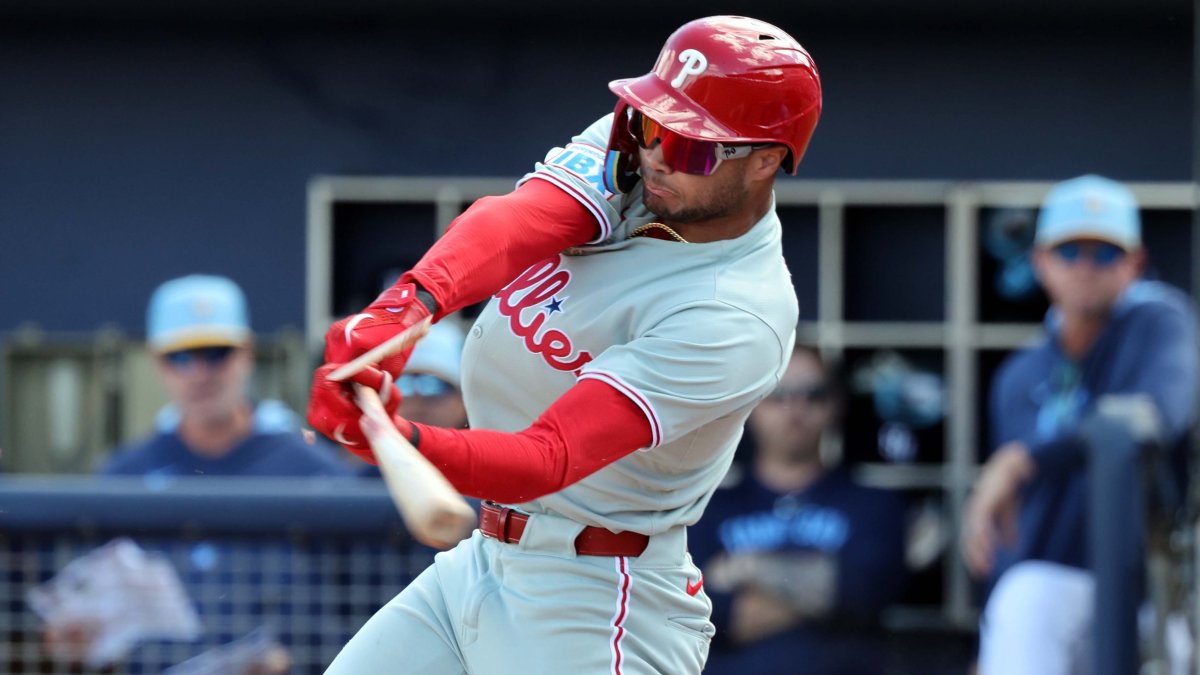
The commentary around the Phillies making marginal changes to their club this winter has created a cloud. One that blurs the prospective rookie season of Justin Crawford.
The 22-year-old is set to be the club’s everyday center fielder in 2026. The son of former big leaguer Carl Crawford — a four-time All-Star who compiled more than 1,900 hits and 480 stolen bases across a 15-year career — Justin is one of the more intriguing young players in the organization.
His tools alone should make Philadelphia eager to see him play on a daily basis. His advanced bat-to-ball skills and elite speed add an element to the Phillies’ outfield that has been largely absent since fellow left-handed hitter Ben Revere hit .303 and stole 95 bases from 2013–15.
All offseason, the organization has voiced its confidence in Crawford.
“From everybody I’ve talked to, the makeup is really good, the intangibles are really good,” manager Rob Thomson recently told reporters. “If [Crawford] makes the club, we’re going to let him go. We’re going to let him play. And hopefully he’ll have some success — and we think he will.”
That confidence stems from yet another dominant season at the plate for the Phillies’ 2022 first-round pick. In 2025, Crawford spent the entire year at Triple-A Lehigh Valley, where he slashed .334/.411/.452 (.863 OPS), collected 34 extra-base hits, and swiped 46 bases.
It marked his third consecutive full professional season with at least a .310 batting average, an .800 OPS, and 40 stolen bases.
On the surface, the numbers jump off the page. But Crawford’s underlying offensive profile helps explain why the Phillies believe his game will translate.
The best way to describe Crawford in the batter’s box is safely aggressive. According to Prospect Savant — which tracks advanced metrics at Single-A and Triple-A ballparks — Crawford posted a 50.5% swing rate in 2025, while carrying an 18% swing-and-miss rate.
Those numbers tell two stories. Crawford is aggressive — his chase rate sat at 33.6% — but he still makes contact with the vast majority of pitches he swings at. If you apply those thresholds to the Major League level, Crawford would have been the first left-handed hitter since 2023 to combine a swing rate of at least 50% with a swing-and-miss rate of 18% or lower.
Since the Statcast era began in 2015, only 11 single seasons by left-handed hitters have met that same criteria.
While Triple-A numbers don’t translate cleanly to the big leagues, Crawford’s batted-ball profile offers insight into the type of hitter he projects to be.
One of the most translatable aspects of his game is his ability to use the entire field. In 2025, Crawford pulled the ball just 31.7% of the time, went up the middle 25%, and hit it to the opposite way 43.3% of the time.
For Major League context, that would have been the highest opposite-field rate of any hitter since DJ LeMahieu’s batting champion 2020 season (43.4%), and the highest by a left-handed hitter since batted-ball tracking began in 2002.
Interestingly, that 43.3% mark represented a professional low for Crawford, further underscoring how consistently he’s used the opposite field throughout his career.
With the 17th overall selection in the 2022 MLB Draft, the Phillies have selected outfielder Justin Crawford from Bishop Gorman HS (NV). Crawford is the son of former All-Star Carl Crawford.
If you couldn’t already tell, Crawford is a pest in the batter’s box — regardless of the matchup. In left-on-left situations this past season, he slashed .376/.411/.518. That level of composure against same-handed pitching is rare for a lefty. Since 1974 in the Majors, only six left-handed hitters have produced a single season batting .375 or higher against lefties with at least 90 plate appearances.
When Crawford puts the ball in play, it tends to find grass at an extreme rate. His .407 batting average on balls in play (BABIP) placed him among rare company. Over the past 20 years, per FanGraphs, only two left-handed hitters at the Triple-A level have posted a BABIP of .400 or higher in a single season.
The last left-handed hitter to do so in the Major Leagues? Rod Carew in 1977 — one of his seven batting-title seasons.
There is, however, a trade-off. Crawford’s game is built heavily on ground-ball contact. Last season, he posted a 59.4% ground-ball rate — a career low, but still extremely high. That figure would have led all Major League hitters in each of the past two seasons and would have been the highest by a left-handed hitter since Raimel Tapia in 2021 (67.4%).
This has long been a known part of Crawford’s profile. His swing path has been a point of focus since he entered professional baseball, and adjustments late in 2025 hinted at growth.
Over his first 383 plate appearances last season, Crawford hit just three home runs. In August, that changed. He struck out more that month (21) than in any other, walked fewer times than any (8), but hit four home runs in 113 plate appearances while slugging .553.
Unfortunately, Crawford played just three games in September after colliding with teammate Otto Kemp. The Phillies ultimately shut him down.
Still, the takeaway from Crawford’s most notable offensive concern is clear: there is a concerted effort to lift the ball more. Given how frequently he puts the ball in play, even modest gains in launch angle could unlock gap-to-gap power and elevate his overall impact.
This offseason, those swing-path adjustments have continued. Crawford has appeared taller in his stance — something that surfaced on social media — as he continues refining his approach.
Defensively, the Phillies are banking on Crawford’s speed and instincts in center field. He has logged just under 2,200 professional innings at the position, and while Citizens Bank Park presents a unique challenge, Crawford did gain experience in left field last season. Brandon Marsh’s extensive center-field experience also provides an insurance policy.
Aidan Miller, the Phillies top position prospect, showed off his defense on Friday, and Justin Crawford, the Phillies third ranked prospect, showcases his speed with a triple.
So what should Phillies fans expect in 2026?
Despite being the youngest player on the projected roster — the only one born in 2004 — Crawford will break camp as one of the most polished pure hitters the organization has debuted in years.
He’s expected to slot toward the bottom of the lineup, offering stability against both left- and right-handed pitching. If he sticks in center field full-time, it opens additional flexibility — including the potential for a platoon in left field that maximizes Brandon Marsh and Otto Kemp.
Crawford’s contact rate — a professional-high 85.3% in 2025 — also addresses a recurring postseason issue for Philadelphia. Over the past three Octobers, the Phillies’ 7–9 hitters have combined for a .176/.241/.324 slash line (.565 OPS) with a 30.8% strikeout rate, the worst among teams with at least 100 plate appearances in those spots.
Crawford’s ability to pressure defenses with speed — a 75-grade tool out of 80 according to MLB Pipeline — and contact fills a void the club has otherwise relied on Trea Turner to address.
There are still questions about his discipline. For a contact-first hitter, Crawford does strike out at a relatively high rate. But his natural feel for the barrel and his ability to put the ball in play give him a strong foundation.
Crawford, currently ranked No. 53 on MLB.com’s 2026 preseason list, also carries the seventh-best odds to win National League Rookie of the Year.
A rookie line hovering around a .270–.285 average, 30–35 extra-base hits, an OPS near .730, and 25–30 stolen bases is well within reach — and would represent a strong return for the Phillies’ newest everyday outfielder.