
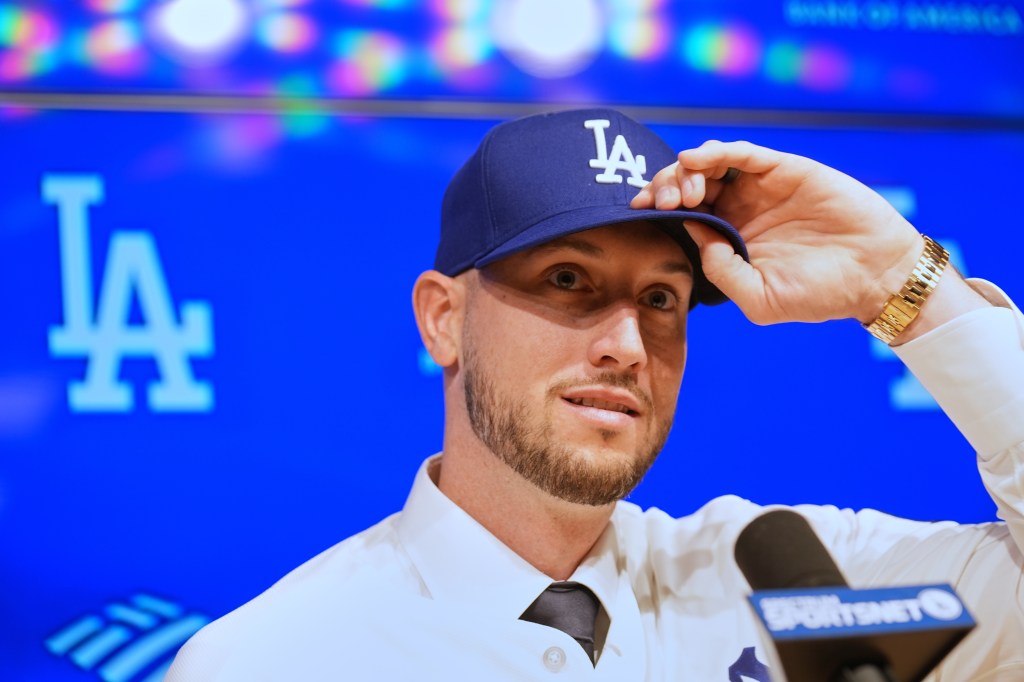
Sixty million dollars per year for four years.
That’s how much money the Dodgers guaranteed Kyle Tucker this month.
Certainly, every other team in Major League Baseball would love to have Tucker, 29.
That is, for a lot less than $60 million per year, unless it’s another big-market mega-spender, like the Mets, writing the checks.
Tucker is a fine player. The lefty’s strike-zone judgment is keen, making him a safe bet to reach base at a high rate. Pencil him for a sixth season of 22 to 30 home runs in 2026. Not much can be done to improve the outfielder’s so-so defense, but he’s playing an offensive position.
For the Dodgers, tucking another $60 million into their annual payroll was just the cost of doing business at their rarefied level.
They’re aiming to win a third consecutive World Series title before MLB’s contentious labor negotiations crank up.
When your financial margins are fatter than a prize hog at the county fair, why not pig out on the margins?
The Dodgers do a lot right. Their players handle the pressure of high expectations. Their scouts find great value in the amateur draft. Their immense drawing power makes a lot of money for MLB, not just themselves.
MLB’s economic system does them big favors.
Compared to the NFL, which sees several franchises from small, even tiny markets win trophies and sustain above-average win rates across several seasons, MLB does not look after its little guys in the small markets.
There’s no salary cap or franchise tag. Nor does MLB’s revenue sharing compare to the NFL, where each team gets the same massive slice of the revenue pie in media rights fees.
None of MLB’s small and mid-sized markets can hope to compete with the large-market Dodgers’ $8.35-billion TV deal — a 25-year pact that runs through 2038.
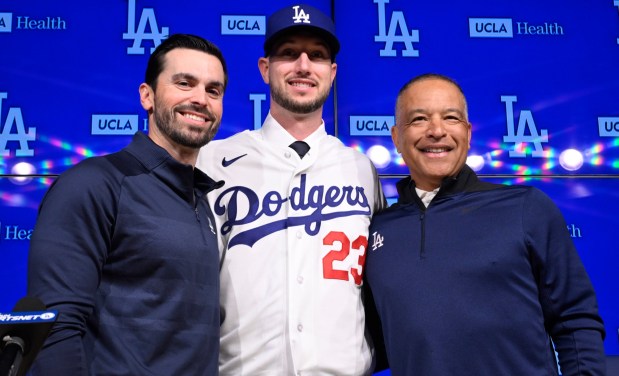 New Dodgers outfielder Kyle Tucker poses for photos with Dodgers general manager Brandon Gomes, left, and Dodgers manager Dave Roberts during his introductory press conference on Wednesday, Jan. 21, 2026, at Dodger Stadium. (Photo by Keith Birmingham, Pasadena Star-News/SCNG)
Tucker’s contract seems an inflection point. MLB’s collective bargaining agreement is set to expire in December.
Not even Aaron Judge, the Yankees great, comes close to matching Tucker when it comes to average annual value.
In his nine-year deal, Judge got almost $20 million per year less in AAV — a large factor in luxury-tax calculations.
When Judge cashed on his free agency three winters ago, he was 30 and coming off an all-time season.
The center fielder amassed 62 home runs, 131 RBIs and 111 walks.
Judge’s adjusted rate for on-base and slugging percentage was more than double MLB’s average.
Tucker played for the Cubs last year, arriving in an offseason trade with the Astros.
Limited to 136 games by injuries and swing issues, he made his fourth All-Star team and assisted Chicago’s run to a wild-card berth.
He finished with 22 home runs, 88 walks and an adjusted OPS that was 43% above the MLB average. But at 4.6 win shares, per Fangraphs, Tucker was miles from Judge’s 11.1 wins share in his contract year.
Though other teams reportedly offered more years, Tucker’s decision seemed a no-brainer.
He’s joining a stacked roster. And Los Angeles will be well-positioned to make any needed upgrades before the summer trade deadline.
Plus, with the Dodgers willing to take on downside risk, Tucker can opt out after the 2027 and 2028 seasons.
Now, we come to the Padres’ perspective on the latest Dodgers’ upgrade.
Once again, it’s wild card or go home.
The Padres, more so than anyone else, understand that beating the Dodgers in a postseason series is much more possible than winning the 162-game race against them.
Fortunately for Padres fans, A.J. Preller saw where things were headed long ago.
“The reality is, the Padres are never going to be able to compete financially and roster-wise completely with the Dodgers,” Preller told ESPN in November 2020, soon after top-seeded L.A. beat San Diego in a second-round playoff series.
“So what’s your next best option?” Preller asked. “Let’s do the best we can and if we get there, we can beat them in a seven-game series.”
The Padres have continued to go hard after the Dodgers.
Their player payrolls of 2021-2023, approved by team chairman Peter Seidler, finished seventh, fifth and third among MLB’s 30 teams.
The outlays approved by interim control person Eric Kutsenda and current control person John Seidler, respectively, ended up 11th and sixth.
Now, FanGraphs.com projects the Padres’ payroll at ninth overall.
So the 2026 Padres indeed have a fair shot at earning one of the league’s six playoff berths. Their fans are again doing their part. The team has sold out all of its season tickets, a year after trailing only the Dodgers in home attendances.
But because the Padres have the misfortune of having the Dodgers in their division, the first-round playoff bye isn’t a realistic option.
Peter Seidler referred to the Dodgers as the dragon up north.
I’m partial to the Death Star metaphor.
The difference this year is that Padres fans are rooting for MLB folks beyond the Padres.
They’ll be cheering for the lawyers and club owners who’ll be negotiating with MLB’s players’ union.
Here’s hoping baseball’s little guys get a fair shake — one that’s long overdue.