
With last week’s trade of right-handed starter Freddy Peralta, the message from the Milwaukee Brewers was clear: No one is safe from being traded.
Peralta was dealt to the New York Mets as he entered his final season of team control. It happened to right-handed closer Devin Williams last offseason, and with right-handed starter and 2021 NL Cy Young Award winner Corbin Burnes two offseasons ago. Memorably, they also dealt closer Josh Hader at the 2022 trade deadline. Only shortstop Willy Adames was not moved before his final season with the Crew, in 2024. (Brandon Woodruff‘s injury took him out of this equation and offered the team a different dilemma about him between 2023 and 2024, instead.)
Who is next in the spotlight? There are three candidates for the same treatment next winter: catcher William Contreras, right-handed closer Trevor Megill and first baseman Andrew Vaughn. All will be entering their final season of arbitration eligibility, with free agency looming after 2027.
Thus, trade speculation on all three can commence. Contreras and Megill have the most value, with Vaughn probably still needing a productive full season with the Brewers to boost his stock.
Let’s take a look at all three, what their value is, and why they would be traded.
WILLIAM CONTRERAS
Contreras is the Crew’s second-best player, after outfielder Jackson Chourio. When the Brewers swooped in to acquire Contreras from Atlanta in a three-team trade that included the Oakland A’s, Contreras was an offense-first catcher who wasn’t that good defensively.
My, how times have changed. Thanks to the Brewers’ ability to develop catchers, mainly under the tutelage of Charlie Greene, Contreras is still a good hitter but is now a pretty decent defender, too. That’s made him one of the top overall catchers in the majors, a position that traditionally lacks consistent offensive production.
In his three seasons in Milwaukee, Contreras has been a middle-of-the-order bat. While there has felt like there was more power available, Contreras has hit 17, 23 and 17 homers in the three seasons since the trade. He hit 20 homers in 97 games in his final season in Atlanta, when he mainly was the designated hitter, but he was also much of an all-or-nothing slugger back then. Contreras has become a more disciplined hitter, increasing his walk rate from 10.3% to 11.5% to 12.7% with the Crew, while his strikeout rate dropped from 20.5% in 2024 to 18.2% in 2025.
Due to a broken middle finger on his catching hand that affected him the entire 2025 season, Contreras’s slash line was down from his first two seasons in Milwaukee. After posting slash lines of .289/.367/.457 in 2023 and .281/.365/.466 in 2024, he dropped down to .260/.355/.399 last year. That dropped his fWAR from 5.8 to 5.5 to 3.6. Contreras had a procedure following the season to address the injury, which occurred during the 2024 season, so he should be at full strength entering 2026.
That will allow Contreras to author what is likely his final chapter in a Brewers uniform. At a minimum, he will see his salary rise to $8.55 million, the figure the Brewers submitted for an arbitration hearing and the current record for a second-year arbitration-eligible catcher. Contreras is seeking $9.9 million. Whether the two sides will settle, as they did last year, is up for debate. Even another chunky raise next offseason makes him an affordable trade target to other teams, as the Brewers churn their roster without continual long-term investments.
Providing he puts up similar offensive numbers to his first two years with the Crew, the return for Contreras should rival what the Brewers got for Peralta. If the right suitor emerges, they might even top it.
TREVOR MEGILL
Megill is a different animal. While Contreras was a well-known prospect, Megill has been a player who was waived, signed a minor-league contract, and was dealt for a player to be named later. However, he has found a home with the Crew. Following a 5.62 FIP and 8.37 ERA in 28 games with the Chicago Cubs in 2021 and a 3.29 FIP and 4.80 ERA in 39 appearances with the Minnesota Twins in 2022, the Brewers acquired him on Apr. 30, 2023.
After a good first season in which he had a 2.13 FIP and 3.63 ERA in 2023, Megill grew into a late-inning role and took over as closer when Williams got hurt. He converted 21 of 24 save opportunities in 2024 and was the easy choice as closer entering 2025, when he had 30 saves in 36 tries. He increased his ERA+ from 119 in 2023 to 153 in 2024 and 168 last year.
Megill’s value has been built on his consistency as a back-end reliever. He did have an elbow injury late in the 2025 season that cost him a month, but he was back for the postseason—although right-hander Abner Uribe handled the closing duties.
The Brewers are unlikely to move on from Megill, who will make $4.7 million in 2026, while in contention during the season, but with Uribe primed to be the next closer, the writing is on the wall. Megill doesn’t have the credentials that Williams and Hader established during their Milwaukee careers, but his steadiness and the sturdy demand for a reliable right-handed reliever will bring back at least one good prospect, should he be traded.
ANDREW VAUGHN
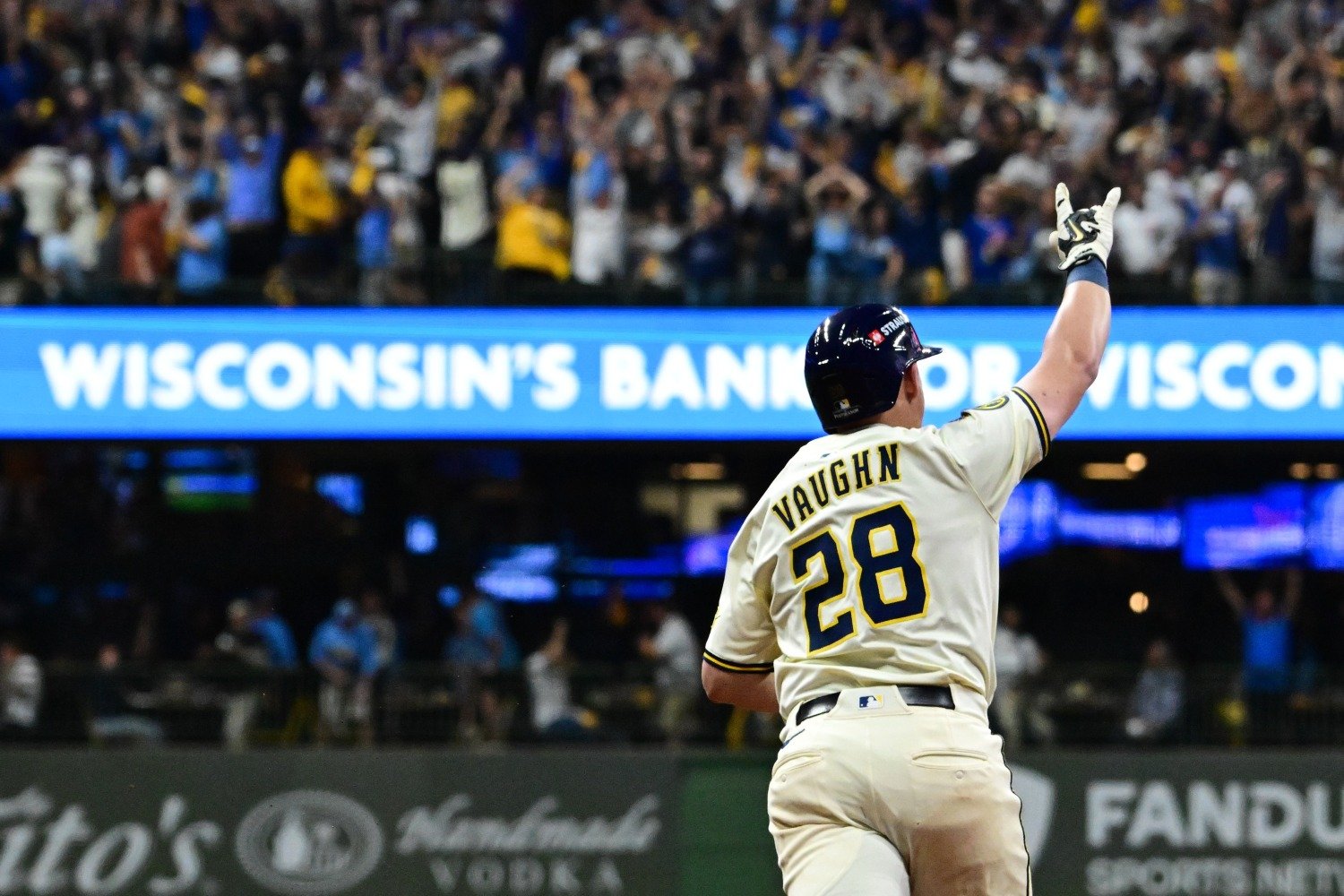
We all saw what a change of scenery did for Vaughn. His July was electric. Following a June trade with the Chicago White Sox for right-hander Aaron Civale and a couple weeks at Triple-A Nashville, Vaughn hit the ground running with a homer in his first plate appearance and put up a .365/.426/.731 slash line in 16 July games, with five homers and 21 RBIs. Conversely, Vaughn logged a .189/.218/.314 slash line with five homers and 19 RBIs in 48 games with the White Sox before the No. 3 overall pick in the 2018 draft was sent to Triple-A Charlotte.
He cooled off a bit, but still finished the regular season with a .308/.375/.493 slash line for the Crew, with nine homers and 46 RBIs in 64 games and a 99 wRC+.
Vaughn has a career slash line of .253/.310/.414, with his best season before 2025 being 2022, when he had a slash line of .271/.321/.429 with 17 homers and 76 RBIs. Another season like that would restore Vaughn’s luster, but it would also likely price Vaughn out of any sort of future with the Brewers. He’s making $7.65 million and would probably bump up to around $11 million in 2027. Only outfielder Christian Yelich ($24 million and change) and right-handed starter Brandon Woodruff ($22.025 million) make more than $10 million on this year’s roster.
The question will be whether Vaughn can replicate the final three months of 2025, or whether there will be regression. Any prolonged slump could see Vaughn off the Crew’s roster in one form or the other. But a successful season will make him a commodity that the Brewers can cash in next offseason—unless, by then, they’ve locked him up on an under-market medium-term deal.
If Vaughn does come back to Earth (even to the aforementioned 2022 level) in 2026, he’ll be a non-tender candidate next winter. To avoid that risk and secure generational wealth now, might he consider a three- or four-year deal that offers the Brewers a club option or two and some cost certainty? We’ll see. The team isn’t averse to extensions, but they need leverage to get the terms that make such deals make sense for them.
With Contreras and Megill, that leverage is lacking. With Vaughn, it’s there. All three of these players are trade candidates next winter, unless and until something major happens to change that.