
Day 1 is in the books, and it started off with a bang, with the Rangers tipping the whole table over by taking Kumar Rocker with the third pick. It only got more fun from there — at least when we actually heard the picks between all the interviews of players my age about how they had to walk uphill in the snow to get the telegram saying they’d been drafted. We had a bunch of surprising picks in the first round, and a lot of teams zagging when they used to zig, which makes it much more interesting if you’ve followed the draft for a few years, even just for a single club.
Some general observations:
• The Mets did really well. They had more scrutiny on them after they didn’t sign Rocker last year, but made up for it, using the compensatory pick they got for the Rocker selection to take Kevin Parada, a top-10 talent and in my view the best player in college baseball this year. They had four picks on Sunday and took four players ranked in my top 50, including a “gut feel” guy of mine, D.C. high school centerfielder/infielder Nick Morabito.
• I also like the Blue Jays’ draft quite a bit, even though they took a high school arm in the first round — which historical data does not support — because 1) they did take a really, really good high school arm and 2) they backed it up with three solid position players who have a chance to stay up the middle and have reasonable floors.
• We saw a lot of presumed tough signs drafted on Sunday, including just about all of the top high school pitchers in that category. Forty-one of my top 42 players were selected, with Brock Porter, a Clemson commit from a Michigan high school, the one exception. I’m going to assume that once we got past pick No. 15 or so, he wanted well over slot in order to sign. But a number of other high school pitchers with what I’d heard would be big price tags ended up drafted, and I assume they’re all going to sign – Ian Ritchie (committed to UCLA), Noah Schultz (Vanderbilt), Jacob Miller (Louisville), the “Vanilla Missile” Walter Ford (Alabama), Owen Murphy (Notre Dame) and Jackson Cox (Oregon). Sure, we generally get a lot of big-ticket high school pitchers drafted ever year, but almost none of them are left at this point. After Porter, you have to get to No. 54 on my list, Bradley Loftin (Mississippi State), and then it’s No. 73 Tristan Smith (Clemson). That’s a good thing – we should be paying these kids, and the fact that they were drafted on Day 1 says to me they’ll get paid. Although Clemson must have had some kind of recruiting pitch this year.
• This happens every year, but Vanderbilt was hit hard. Druw Jones was never setting foot on campus, and I don’t think Dylan Lesko or Brandon Barriera were either, but Sal Stewart and Noah Schultz had a chance to end up in Nashville.
• Only four catchers drafted in 80 picks seems a little light, but I think that reflects the draft class, which wasn’t strong overall at the college or high school levels behind the plate.
• Did Atlanta tie Alex Anthopoulos up and throw him in a closet? While he was GM of Toronto, the Blue Jays took high school pitchers in the first round twice, but didn’t sign either guy. He hadn’t done it at all with Atlanta; the team’s first high school pitcher selection last year came in the seventh round, it didn’t take one in 2020, and its first one in 2019 came in the 13th. So this year, of course, the team took high school pitchers with its first three picks.
• I am not picking up what the Rays are putting down here. They had four picks, and two of them were not just off my top 100, but well off it – Xavier Isaac, a power-hitting high school first baseman (a bad demographic in the draft, historically) with a bad body (a worse demographic); and Chandler Simpson, one of the fastest players in the draft but one with 20 power. They did take two toolsy, higher-ceiling college outfielders in Brock Jones and Ryan Cermak, both risky guys with low floors (Jones has to cut his swing and miss down or he’s not a big-leaguer) but more than enough ceiling to make up for it.
• The strength of what’s left seems to be college pitching. I don’t know if any of these pitchers had something pop up that steered teams away from them, but I see quite a few pitchers available who at least have a chance to stick as starters long term, enough that I would think they’d all come off the board in the next two rounds on Monday.
For more analysis, check out all of the highlights and news from Day 1 of the MLB Draft.
1. Baltimore Orioles: Jackson Holliday, SS, Stillwater (Okla.) High
No. 6 on Keith Law’s Big Board
The Orioles take Jackson Holliday, son of Matt, one of the small handful of players worthy of the No. 1 pick in this jumbled year. I don’t think this will be an under-slot deal, given Holliday’s talent, college commitment and advisor (Scott Boras). My guess is Holliday — who is the first high school player the Orioles have taken with their first pick under Mike Elias — gets something near slot, and the Orioles get creative later on, as they have two extra picks. As for Holliday, he projects to stay at shortstop, and he reworked his body and his swing last offseason to get stronger and substantially improve scouts’ opinions of his future hit tool and potential for power. He went from “maybe he gets into the first round” to the first pick. And he has two younger brothers, in case you want to start scouting for 2025 and beyond.
Scouting report: I’m not sure anyone helped himself more than Holliday this spring, notably during his team’s spring break trip to Arizona in March, where Holliday showed incredibly well in front of a lot of decision-makers in town for spring training. He has one of the best swings in the draft, even with a slight bat wrap, with strong plate coverage and above-average power, more likely to be a high-doubles guy with 15-20 homers than a 30-homer guy even at his peak. He’s been hard to strike out as an amateur, only showing occasional weakness against fastballs up, and so far his pitch recognition has been strong for his age and experience level. He’s improved his defensive skills at shortstop, although there’s also been talk of him moving to centerfield to take advantage of his speed if he can’t stay at short, rather than moving him to second or third. It also hasn’t hurt that his father, Matt, was a longtime big-leaguer and seven-time All-Star, and that scouts have been just as impressed by Jackson’s younger brother, Ethan, who may become a top-5 pick in the 2025 draft. Jackson’s heading for the same range this year.
2. Arizona Diamondbacks: Druw Jones, OF, Wesleyan School (Norcross, Ga.)
Arizona gets the No. 1 player on most draft boards, the more or less consensus top guy, Druw Jones, son of Andruw. Druw is a true centerfielder who shows a lot of his father’s habits in the field and can show you plus power and speed, just as his dad did before his knees went. There are some questions about where Druw’s hit tool is currently, although if he didn’t have those concerns he would have been No. 1 everywhere and ranked among the best draft prospects of the past decade. He’s still got huge upside and gives Arizona a troika of elite high-ceiling hitting prospects, along with Corbin Carroll and Jordan Lawlar.
Scouting report: Jones’ game bears many resemblances to his father’s, not least in the outfield, where Druw is already a plus defender and could work his way up to an elite level with experience. At the plate, he shows 70 power thanks to the strength in his wrists and forearms, with more power possible as he fills out further. And he has shown some bat control against amateur competition, with some understanding of when to pull the ball and when to try to go the other way. He’s a plus runner right now but may lose some of that down the road as he gets bigger, as his father did by age 24-25. The real question on Druw is whether he’ll hit – if he does, he’s a superstar, with 30/30 potential and a glove that should save 10 or more runs a year in center. If he’s more of a 45 bat, he still has plenty of major-league value due to the secondary skills, so he could be worth several WAR per year even with a .300ish on-base percentage. He’d have to be a worse hitter than even that to be something less than a regular, and the unlikeliness of that outcome combined with his very high ceiling make him the top prospect in this year’s draft class.
3. Texas Rangers: Kumar Rocker, RHP, Tri-City ValleyCats
Well, the Rangers just threw a metaphorical grenade into this draft, selecting Rocker with the third pick – so Rocker is probably going to end up with more money this year than he would have gotten had he signed with the Mets last year. Rocker threw a few times for the Tri-City ValleyCats this June, sitting 95-98 mph in his best outing with an above-average slider, working from a lower arm slot than he had at Vanderbilt. This gave his fastball more life, but also at least raises the question of whether this is a result of the shoulder surgery he had in September. Now he joins former Vanderbilt rotation-made Jack Leiter in the Rangers system. If you’d said to pretty much anyone in baseball in March 2021 that one organization would end up with both of those pitchers, they would have laughed maniacally in your face.
Scouting report: Rocker was the 10th-overall pick last year, selected by the Mets, but the team declined to offer him a contract after finding something they didn’t like in his post-draft physical. Rocker left Vanderbilt to pitch for the independent Tri-City ValleyCats in upstate New York, where he was 95-98 in his first outing with two above-average breaking balls and an adequate changeup, showing a lower arm slot than he had last year. Rocker has shown a plus-plus slider at times in the past, and there’s no reason to think his fastball is back but his slider isn’t. He has always had better control than command, and while he’s shown incredible competitiveness in some games — like the no-hitter he threw in 2019, when he was pushed to 131 pitches — he’s also had outings where he seemed to struggle to adjust mid-game. He has No. 2 starter upside, if healthy, but the risk associated with his medicals may make him a better bet for some team’s second pick.
4. Pittsburgh Pirates: Termarr Johnson, 2B/SS, Mays High (Atlanta)
The Pirates love players who can hit – even with the change in general managers three years ago, they still focus on guys who put the ball in play a lot in the draft. Nobody in the draft earned more raves for his pure hit tool than Johnson, with one scout telling me it was the best hit tool he’d seen on a high school kid in at least 10 years. Johnson is just 5-foot-8 and almost certainly has to move off shortstop in pro ball, but he has the speed for center and certainly has the hands for second base if necessary.
Scouting report: Johnson has the best pure hit tool in the draft class, with scouts saying it’s the best hit tool they’ve seen on a high school kid in a decade or more. Despite a small hitch in his swing, he does hit all pitch types and controls the zone, with outstanding hand-eye coordination and great bat speed, making good quality contact but with only average power. He’s a shortstop now but will move to second base in pro ball, with good hands but not the footwork to handle short. I think the present hit tool is a 60, at best, rather than a 70, although perhaps it will get there in time, but he’s swung and missed enough against good competition that the higher grade doesn’t apply just yet. He has exceptional makeup in every evaluation, from his feel for the game to the way he acts as an additional coach on the field to the interviews he’s had with scouts and team executives, so there’s greater confidence that he’ll reach his ceiling than there is for just about any high school player. That ceiling is tied to just how good his hit tool can become.
5. Washington Nationals: Elijah Green, OF, IMG Academy
There’d been a lot of talk that the Nats were dealing with an internal debate between taking a sure-thing college player (likely Kevin Parada) and going for upside, as they did last year, with the best high school position player available. They did the latter, taking the very athletic Green, who on pure upside probably beats even Jones. But Green has more questions about his present hit tool, especially his pitch recognition, than Jones, Holliday or other peers in this class. In 2021, the Nats took Brady House, who had extremely high exit velocities, even with questions about his hit tool and his future position, and the early returns have been very good, so perhaps this encouraged them to stick with that philosophy.
Scouting report: Green looks the part of a future star in size, frame, and especially tools, with a strong, athletic 6-3 build, explosive speed, and plus power already that projects to 70 in the future. It’s easy, easy power, with fantastic hand acceleration after a quiet start, and when he gets his arms extended the ball jumps off his bat. All his power comes on pitches on the middle or outer thirds, although he can still make contact on the inner third, just without the same sort of impact. The concern on Green has always been his tendency to swing and miss, especially on stuff in the zone; he doesn’t chase fastballs, but will miss fastball strikes, especially up, and can expand for breaking stuff down and away. He has the most pure upside of the high school position players in the class, with 30/30 potential in a true centerfielder who throws well enough to play right, with a bit more risk than some of the other hitters in the top echelon.
6. Miami Marlins: Jacob Berry, OF, LSU
The Marlins were supposedly locked in on Johnson, but had to switch to plan B when the Pirates took him at No. 4. They went with Berry, one of the more divisive prospects in this draft. His fans among scouts thought he had the best combination of hit and power among college bats; while his detractors (waves hand furiously) pointed to his lack of a position – he’s likely to end up at DH – and less than stellar exit velocities for LSU. This feels like a reach to me. If Berry’s a designated hitter, or a bad left fielder, his upside is capped and he has to really reach his ceiling as a hitter to be worthy of a top 10 selection. That said, there were other teams drafting up here with strong interest, including the Rockies at No. 10.
Scouting report: Berry has one of the best pure hit tools in the draft class, with an exceptional combination of contact and power — at the end of the regular season, he had the fewest strikeouts of any hitter with at least 15 homers. He transferred from the University of Arizona to LSU for his junior year, and in the process cut his strikeout rate substantially, with less power on contact (perhaps also a result of moving from 2,400 feet above sea level to 56 feet above it). He has a very simple approach from both sides of the plate, with no stride and just average bat speed, but despite that he’s had no trouble getting to good velocity. Berry has no position — the Tigers have tried him at third and both outfield corners, and he’s been bad everywhere, reminiscent of current Diamondbacks DH Seth Beer when he was at Clemson. That lack of a position limits how valuable he can be, and if he doesn’t hit, there’s no floor. But someone will take him for the potential OBP/power combination he offers, perhaps with the hope he can handle first base.
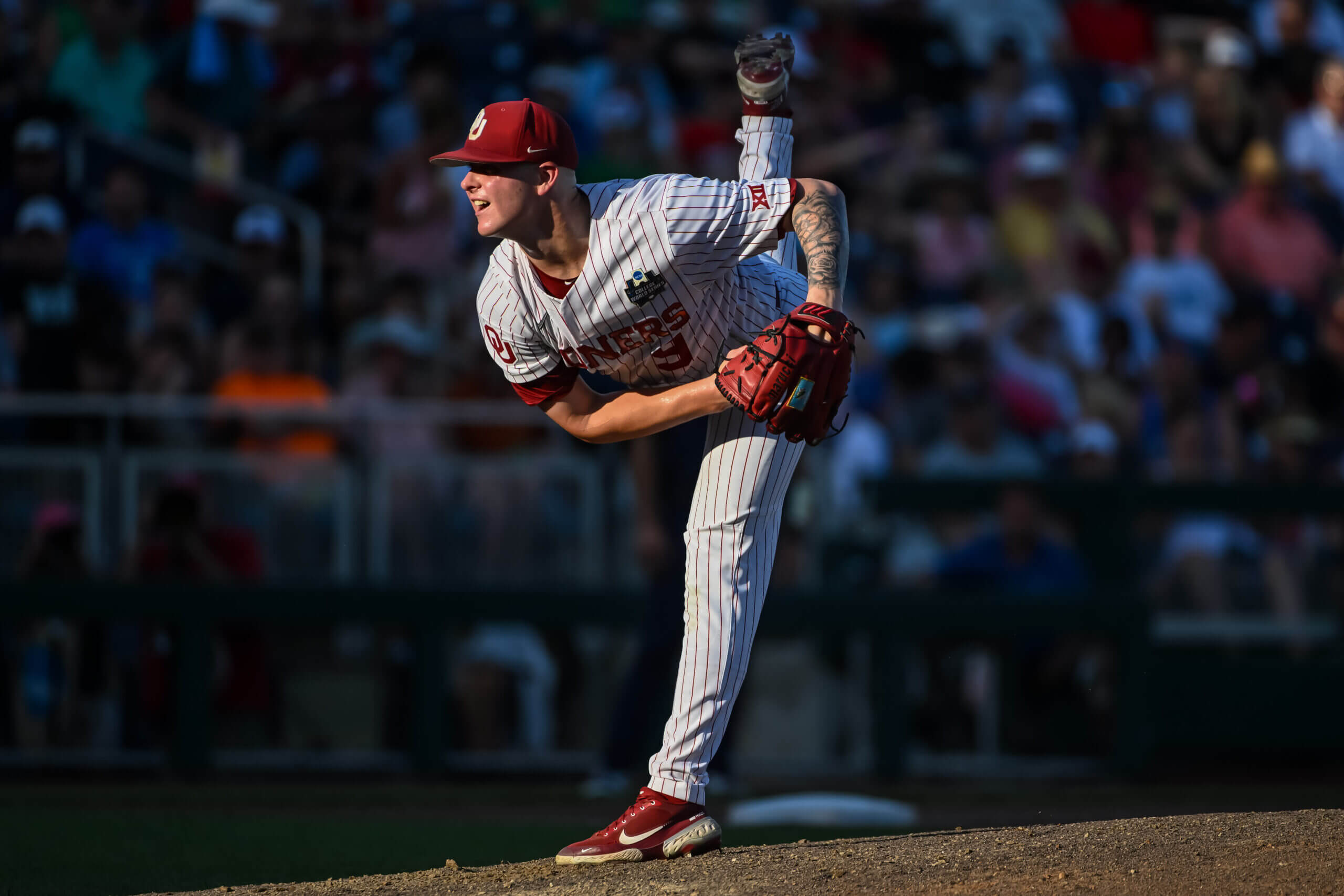
Cade Horton (Steven Branscombe / USA Today Sports)7. Chicago Cubs: Cade Horton, RHP, Oklahoma
No one’s stock rose more in the last month of the amateur season than Cade Horton, who changed the shape of his breaking ball and went on a tear in the postseason with a two-pitch combo. He missed 2021 with Tommy John surgery, and is primarily a two-pitch guy with limited experience as a starter – he was a two-way guy, playing short and pitching in relief, until moving into Oklahoma’s rotation partway through this season. He could be just a very late bloomer, or this could be recency bias, favoring what we saw in the last six weeks over everything that came before. Horton is also a draft-eligible sophomore, giving him a lot of leverage to ask for a top-10 bonus, although I’m sure the Cubs will meet it.
Scouting report: Horton is an age-eligible sophomore (he’ll turn 21 in August) who missed 2021 after Tommy John surgery but has been a key part of the Sooners’ run to Omaha this year, working with two pitches that have helped him dominate right-handed batters. Horton sits 94-96 mph, touching 98 mph, and has a wipeout slider up to 89 mph that breaks downward so sharply that it doesn’t just fall off the table, it takes the tablecloth and all the dishes with it. He has no changeup to speak of and allowed an on-base percentage near .400 to lefties this year, and that’s the main thing keeping him from projecting as a starter. If you think there’s a third weapon in there somewhere, he would be a second-rounder; if not, he’s in the big bucket of good college pitchers who project as relievers and fit in rounds 3-5.
8. Minnesota Twins: Brooks Lee, SS, Cal Poly
Lee was in the mix to be the first pick, and while there was no consensus on this, I think he was the best college player in the class. He has elite contact skills, makes hard contact and will stay on the dirt, probably at second or third. The Twins have to be ecstatic that he was there at pick No. 8, but some of the surprises so far, like Rocker and Horton, have pushed the consensus talents from earlier in the spring down a bit. I’m sure this isn’t part of why the Twins took him, but Lee does project to move pretty quickly through the low minors and could see the majors while this Twins core is still competitive.
Scouting report: Lee has been the best pure hitter among college prospects this year, running a walk-to-strikeout rate over 2.00 all season and punching out well under 10 percent of the time. He controls the zone well and rarely misses fastballs within it, thanks to exceptional hand-eye coordination. His swing is unorthodox and kind of noisy, with some evident effort, but with all that hip and torso rotation he doesn’t always make the high-quality contact teams are looking for in elite prospects. I don’t think Lee is a shortstop long term; he has outstanding hands that will play anywhere on the field, but his ankles are thick and he’s a 40 runner, so the lateral agility that position demands may just be beyond his physical ability. Put him at third base and he should be fine. It’s a bet on the bat, and that a pro department can take this foundation of contact skills and help him get to more consistent contact quality; it’s easier to teach someone to hit the ball harder than it is to teach him to hit the ball in the first place. Lee should be a strong regular who makes some All-Star teams as a third or second baseman, but probably doesn’t project to be a superstar.
9. Kansas City Royals: Gavin Cross, OF, Virginia Tech
The Royals did end up going college, after a lot of talk all spring that they were going to go for an upside guy like Justin Crawford or even Brock Porter. It makes sense for them to take someone safer after a draft in 2021 that was high-risk/high-reward, built around three high school pitchers, all of whom have had their ups and downs in pro ball this year. Cross is a traditional power bat who’ll move to the corner outfield, with a solid approach, good left-handed swing and 20-25 homer power. Given the success they’ve had with developing hitters in the last two years, I could see him advancing very quickly in their system.
Scouting report: Cross is an advanced hitter with above-average power and the potential for more with some swing adjustments, rising thanks to a thin crop of advanced college hitters in this year’s class. He’s improved his approach significantly this year, walking more than he’s struck out in conference play through May 19th, and improving his ball-strike recognition over 2021. He’s an above-average runner who can steal a bag but isn’t fleet enough to stay in center in pro ball. He strides too far at the plate, without transferring his weight as he does so, which cuts off some of his power potential and can leave him unable to drive anything on the outer half. He hasn’t faced much left-handed pitching this year, with a mild platoon split in the sample he’s had, which is just something to watch when he moves into pro ball rather than an immediate concern. He should be a solid regular in an outfield corner, thanks to his hitting and on-base skills, but I’d like to see some swing changes that might unlock more power.
10. Colorado Rockies: Gabriel Hughes, RHP, Gonzaga
I can’t argue with the Rockies taking pitching in the first round. I like this a lot better than the rumor that they would take Berry, who seemed like the worst fit for a home ballpark where defense matters so much. Hughes has some risk for the same reason, though, as he relies pretty heavily on a slider that won’t break quite the same way at altitude. He’s a two-pitch starter who needs to improve his command and develop his seldom-used changeup.
Scouting report: Hughes took a big step forward in command this year even as his stuff ticked up, all of which has put him into first-round consideration. He’s sitting 93-94 mph now, touching 97 mph, up almost 2 mph from last year, with a hard slider in the low to mid 80s that misses a lot of bats. He’s huge, 6-5 and 225 pounds already, with a workhorse frame but a longish arm action that he has a hard time repeating. He has a changeup that he barely uses, although it’s been effective when he has. There’s some reliever risk here from the delivery, and the fact that his command is still probably a soft 45, but there’s also big upside given the frame and the two pitches he already has.
11. New York Mets: Kevin Parada, C, Georgia Tech
This is a best-case scenario for the Mets, getting the player I voted to win the Golden Spikes Award this year. Parada can really hit, has plus power and is good enough to stay behind the plate – although there are some scouts who think he will eventually have to move to another position. He’s very disciplined as a hitter and, despite a weird start – holding the bat over his back shoulder like it’s annoying him – he shows quick wrists and has hit better-quality pitching while at Georgia Tech. I know the Mets have one of the very best prospects left in the minors in Francisco Álvarez, but there is no such thing as having too many catching prospects. To go from not signing Rocker a year ago to landing a top-five talent this year is a complete 180, and Mets fans should feel very good about ending up here.
Scouting report: Parada has been one of the best hitters in college baseball this year, tying for sixth in Division 1 with 26 home runs while walking nearly as often as he struck out on the season (32:30 K:BB), despite one of the more bizarre setups you’ll see in a hitter and while handling the most difficult position on the diamond. Parada sets up at the plate with the bat slung over his shoulder like a bag of golf clubs, but gets the bat to the zone on time, even against better velocity. His plate discipline and pitch recognition are both advanced for an amateur and he’s shown some ability to make adjustments in-season already. Behind the plate, he’s adequate as a receiver with fringy arm strength, good enough to stay there because he hits so well. With 20-25 homer power and a potential 60 hit tool at a position of permanent scarcity, he offers some of the best pure value in the draft class.
12. Detroit Tigers: Jace Jung, 3B, Texas Tech
I’d heard the Tigers mostly on college bats this spring, and had them more than once with Gavin Cross, who went ninth to the Royals. Jung, brother of Rangers prospect Josh Jung, was one of the best performers among college hitters in this draft class, and most of the spring teams in the teens told me they thought he’d go in the first 10 picks. This seems like a great value pick for the Tigers and gives them another prospect who projects to move through the minors quickly, so he can see the lineup while Riley Greene and Spencer Torkelson are there. He also offers some certainty, as he has a long track record of hitting. He’s not great at second base and might move to an outfield corner, and it’s an unusual setup at the plate, something that hasn’t affected him so far but could become an issue as the pitching gets better.
Scouting report: Jung has one of the weirdest setups you will ever see in a hitter above Little League, holding the bat so far behind his back shoulder that you’d think it was covered in a toxic fungus. Or perhaps cooties. Yet he hits — he hit well enough as a sophomore in 2021, with a .337/.462/.697 line and more walks than strikeouts, that he probably would have gone in the top half of the first round last year had he been eligible. The younger brother of Rangers prospect Josh Jung, Jace gets the bat head into the zone in plenty of time to make consistent, high-quality contact, including power, with 21 homers as a sophomore and 14 this season. His position is still the main question; he’s mostly played second base in college, not that well, but doesn’t have the arm for the left side of the infield or the speed to play anywhere else but left field or first base. There’s enough reason to buy his bat that he’s going to go in the top-10 picks even with such a huge unknown in his profile.
13. Los Angeles Angels: Zach Neto, SS, Campbell
The Angels took only pitchers last year, and to be honest, I never heard them linked to any position players this spring. But Neto wasn’t supposed to get to this pick, so maybe he was just too good a prospect to pass up. It’s also worth pointing out that the Angels need hitters as much as they need pitching at this point. Neto destroyed mid-major pitching this spring, with twice as many walks as strikeouts, and nearly as many homers (15) as strikeouts (19). He projects as a high-average doubles hitter who has a good chance to stay at shortstop. I’d say the Angels need that, but they need almost everything.
Scouting report: Neto is a definite shortstop who should be a plus defender in the majors and has a plus arm, but he’s really made himself some money this spring with his performance, including just a mere 7.6 percent strikeout rate for the Camels. He’s got the extraneous movement that you need to have to be a top hitting prospect in this year’s draft, although he calms it down with two strikes; despite that, he’s short to the ball and makes high-quality contact, even hitting for some home-run power that may not persist into pro ball with wood bats and better pitching. He’s spent a little time on the mound, but his future is on the dirt, and with his propensity for putting the bat on the ball and enough power to project as a 30-doubles guy, he should go in the top half of the first round.
14. New York Mets: Jett Williams, SS, Rockwall-Heath (Texas) High
The Mets were rumored to be on Williams all spring, and who can blame them? He’s short, but does everything you’d want as a hitter. He almost never whiffs; he has a clean, efficient swing; and he runs well enough that he should end up an asset on defense at second or center, as he’s probably not staying at shortstop. I remember a lot of questions about Alex Bregman in high school because he was undersized and had no chance to stay at shortstop, and he turned out OK. I think Williams has a chance to surprise people with power as he gets a little stronger, and his feel to hit right now is among the best in the class. That’s a great 1-2 punch for the Mets with their two picks, and they won’t have to go over slot for either guy, leaving room to do something creative in the second round.
Scouting report: Williams is the other 5-8 high school shortstop in this draft class, behind Johnson because of the latter’s elite hit tool … but how far behind, really? He’s a right-handed hitter with a clean, efficient swing, and his hand-eye coordination rivals Johnson’s; Williams almost never swung and missed last summer on the showcase circuit and didn’t show any trouble with velocity when he faced it. He’s an above-average to plus runner, quick enough for shortstop but lacking the arm strength or footwork for the position in the long term, so it’s more likely he’ll move to second base or possibly centerfield. There’s always some trepidation around undersized high school hitters, but I remember a similarly sized right-handed high school shortstop who rarely struck out and hit everything hard — Bregman.
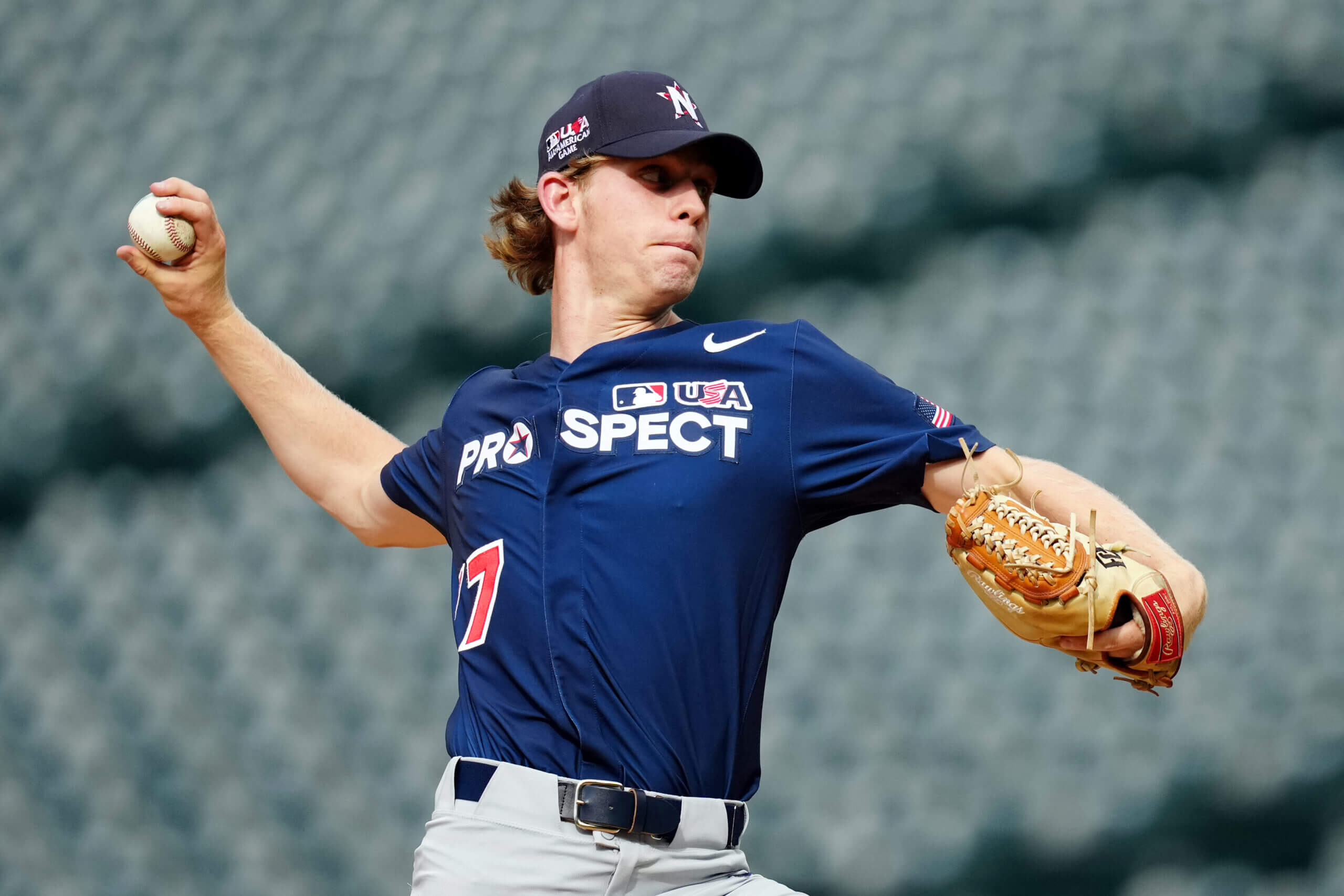
Dylan Lesko (Daniel Shirey / MLB Photos via Getty Images)15. San Diego Padres: Dylan Lesko, RHP, Buford (Ga.) High
The Padres and Lesko seem so obvious a fit in hindsight. AJ Preller has done this before, taking a Tommy John guy in the first round in Cal Quantrill and signing him under slot to go get a bunch of over-slot guys with later picks. Lesko was a top-five talent in this draft before his elbow gave out in April, which happened during a start at the NHSI tournament with a ton of directors and national guys watching him throw a plus-plus changeup and high-spin breaking ball that might have been the best he’d ever thrown. If the Padres get that at the 15th pick, we will all wonder with the power of hindsight why other teams passed on him.
Scouting report: Lesko is one of the best high school pitching prospects in the last 20 years, and has one of the best changeups anyone can remember seeing a high school kid throw. He’s 90-96 mph as a starter already, but that’s just the appetizer to the main course of his changeup, which looks just like his fastball out of his hand and finishes with hard tailing action to his arm side. He started throwing an improved curveball this past spring with hard downward break and a very high spin rate, which answered one of the major questions facing him coming into the spring. He takes an enormous stride toward the plate to generate that velocity and seems to repeat the delivery well, with no obvious red flags in his mechanics. Lesko stopped pitching after the mid-April NHSI tournament due to a sore forearm, and underwent Tommy John surgery at the end of that month. The best historical comparison for him might be Lucas Giolito (16th overall in 2012), who suffered an elbow injury during his senior year but didn’t have surgery before the draft, blowing out after one pro inning that summer. Giolito was in the running to go first overall and was a definite top-five selection before the injury, which seems like a good comparable for Lesko, who now seems primed to go somewhere in the middle of the first round.
16. Cleveland Guardians: Chase Delauter, OF, James Madison
The Guardians taking Delauter shouldn’t surprise anyone. They’re one of the most model-heavy teams, and Delauter grades out well by a lot of advanced metrics, as well as performing very well on the Cape last summer against better pitching than he typically faced in the spring for JMU. Scouts questioned the swing and the way he opens his hips early, and he struggled the few times he faced better lefties this spring before a concussion and broken foot ruined his season. He’s one of the younger college players in the class, turning 21 this October, which the Guardians also favor.
Scouting report: Delauter had about as bad a spring as any of the players who came into 2022 as first-round candidates — he was dominated by the two left-handers in the Florida State rotation in a series that was very heavily attended by scouts, and just a few weeks later broke his foot, ending his season after 24 games. His gaudy stat line this spring was boosted by a comical 13-for-22 performance with five homers and 10 walks in midweek games against inferior opponents. Delauter opens his front side way too early as he tries to cheat to get to velocity, and thus becomes vulnerable to offspeed stuff moving away. Florida State’s lefties just attacked him with fastballs and he struck out six times in those two games, giving teams the book on how to approach him. There could be more here with a lot of swing and mechanical work, but scouts are concerned he just can’t get to velocity consistently without that early move. He’s played mostly center for the Dukes but will end up a corner in pro ball.
17. Philadelphia Phillies: Justin Crawford, OF, Bishop Gorman High (Las Vegas)
The Phillies indicated they weren’t going to take a high school pitcher in the first round for the third year in a row, and they didn’t, but they stuck to the same philosophy of accepting big risk for big upside. Crawford is an 80 runner with bat speed, but physically underdeveloped, with most of his man strength ahead of him, and he needs to work on his defense in center beyond what he can do with his elite speed. The Phillies’ system doesn’t have a lot of hitter upside right now, so he does give them something they lack.
Scouting report: The son of Carl Crawford — yes, Carl Crawford is old enough to have a son in the draft, and nothing in this draft year has made me feel any older than that one fact — is quite similar to his dad as a player. He’s at least a 70 runner, with good bat speed, but not much present power or even hard contact yet, although his frame is very projectable and he could get to average power. He sets up with an extremely wide stance, and strides about as far as he can, which may be why he has trouble adjusting to changing speeds. He’s a better defender than Carl was and throws well enough to stay in centerfield. He has above-average regular upside, but may require more time in the minors than the typical first-round high school position player.
18. Cincinnati Reds: Cam Collier, 3B, Chipola College
Collier was second on my rankings, in large part because he went to junior college as a 17-year-old and performed very well against some of the best juco competition in the country. He’s younger than everyone drafted ahead of him and would otherwise have been eligible in 2023, and where you put him depends more than anything on how much you think that’s worth. He’s a third baseman with a strong arm and the footwork to stay there, while he has shown he can hit better pitching, both for contact and doubles power, at an age when most kids are a year away from getting scouted seriously. I love this pick and the fact that the Reds are still willing to shoot for upside.
Scouting report: Collier is one of the youngest players in this draft class, as he won’t turn 18 until November, but he pulled a Bryce Harper by leaving high school after his sophomore year to attend Chipola College, one of the best junior college baseball programs in the country. It is paying off, as he’s hitting for average and getting on base this spring with solid power production despite being the youngest player on the Chipola roster and younger than every pitcher he’s faced. Collier, whose father Lou played in the majors for several years as an extra outfielder, is 6-foot-2 and may still grow a little with a ton of room to fill out. He’s a third baseman now and good enough to stay there with a 70 arm and the agility to handle the position as the game speeds up. At the plate, he’s more than held his own against much better pitching than what he saw in high school; he’s had some expected issues with breaking stuff but also shown he can adjust to some of those pitches and stay back to take them the other way. He needs to add some more strength to better control the barrel as well as make harder contact, as his hands work well enough at the plate for him to be a plus hitter with average power. He’s committed to Louisville but should be a top-five pick in the draft.
19. Oakland A’s: Daniel Susac, C, Arizona
Susac is a pretty good value pick here, maybe Oakland’s safest first-round pick since AJ Puk six years ago — and I’m not saying that as a criticism, as I think they could use some certainty as they build the system back up. Susac is a power-over-hit guy who has enough contact skills, including some ability to hit bad balls, to be a regular. And he’s a good enough receiver to stay back there — probably a little better than Parada, with much more arm but a lot less hit tool. If Susac is just a solid regular behind the plate, that’s a great pick at No. 19. It also is kind of interesting for a team that has a young major-league catcher with three years of control left in Sean Murphy, and a top catching prospect in Triple A in Shea Langeliers.
Scouting report: Susac has actually had a slightly worse sophomore year than freshman year, but the weak draft and the value of his position has moved him up into the top half of the first round. Susac, whose older brother Andrew was a second-round pick in 2014 and has played 114 games in the majors, is a solid-average receiver at worst with a plus arm, giving no doubt that he’ll stay at the position. At the plate, he starts out with an interpretive dance sequence that involves a huge step forward and then erases it with the same move backwards, but of more concern is that his swing is long, and he’s been far more dangerous against fastballs than anything else because adjusting once he’s committed to the swing is difficult. He has produced well enough in a Power 5 conference for two years to be a first-rounder, with a similar projection to Joey Bart’s out of college — low-OBP with power and solid defense.
20. Atlanta: Owen Murphy, RHP, Riverside (Ill.) Brookfield High
Atlanta takes the first player in this draft who wasn’t on my top 100, although I had a scouting report on him in my column of “extra” guys who didn’t make the cut. Needless to say, I don’t love this pick, not just this specific player but a high school pitcher in the first round, given the high failure rate of that entire class of players. Murphy is a 6-foot right-hander with a fastball that plays right now between its velocity and ride, but lacks projection and doesn’t have an average second pitch yet. I also didn’t love the delivery, although I think that a good player development group can help him there. The Notre Dame commit could probably handle the low minors now with his fastball alone, but his potential to be a starter requires improvement in multiple areas.
Scouting report: Murphy has one of the better fastballs among high school pitchers in the class, low to mid 90s but with very good ride on the pitch so that he misses bats with it even in the zone. His secondary stuff isn’t as good yet, with a low-80s slurve that has some tight downward break and a below-average changeup, along with a curveball that looks like a spike and that he doesn’t command. His arm is quick but he spins badly off his front heel at landing, which will inhibit his command of everything, not just the curveball. Murphy is a good athlete, without much projection left in his 6-foot frame, although he has enough present stuff to go into pro ball and hold his own.
21. Seattle Mariners: Cole Young, SS, North Allegheny High (Wexford, Pa.)
Young was projected for much of the spring to go somewhere in the teens, but being almost 19 years old obviously hurt him with some draft models. He made some adjustments to his stance and swing that helped him hit better this spring, while he also showed the speed and footwork to stay at shortstop in the long term. He’s less risky than last year’s first-rounder Harry Ford, but still offers reasonable upside of an above-average bat at shortstop.
Scouting report: Young has surged up draft boards with a strong showing this spring in the Pittsburgh suburbs. Last summer he would often overstride, and since he nearly bars his lead arm, he was left off-balance enough that he couldn’t adjust to stuff spinning away from him, although he’s quieted all of that down somewhat this spring and scouts have reported seeing better quality contact from him. He’s at least a 55 runner who has the speed and arm to stay at shortstop, but he’ll need some adjustment with his footwork to remain there in the majors. The Duke commit will turn 19 a few weeks after the draft, which will hurt him with certain teams that weigh age more heavily, while teams that focus more on tools and athleticism are likely to push him into the first 15 picks.
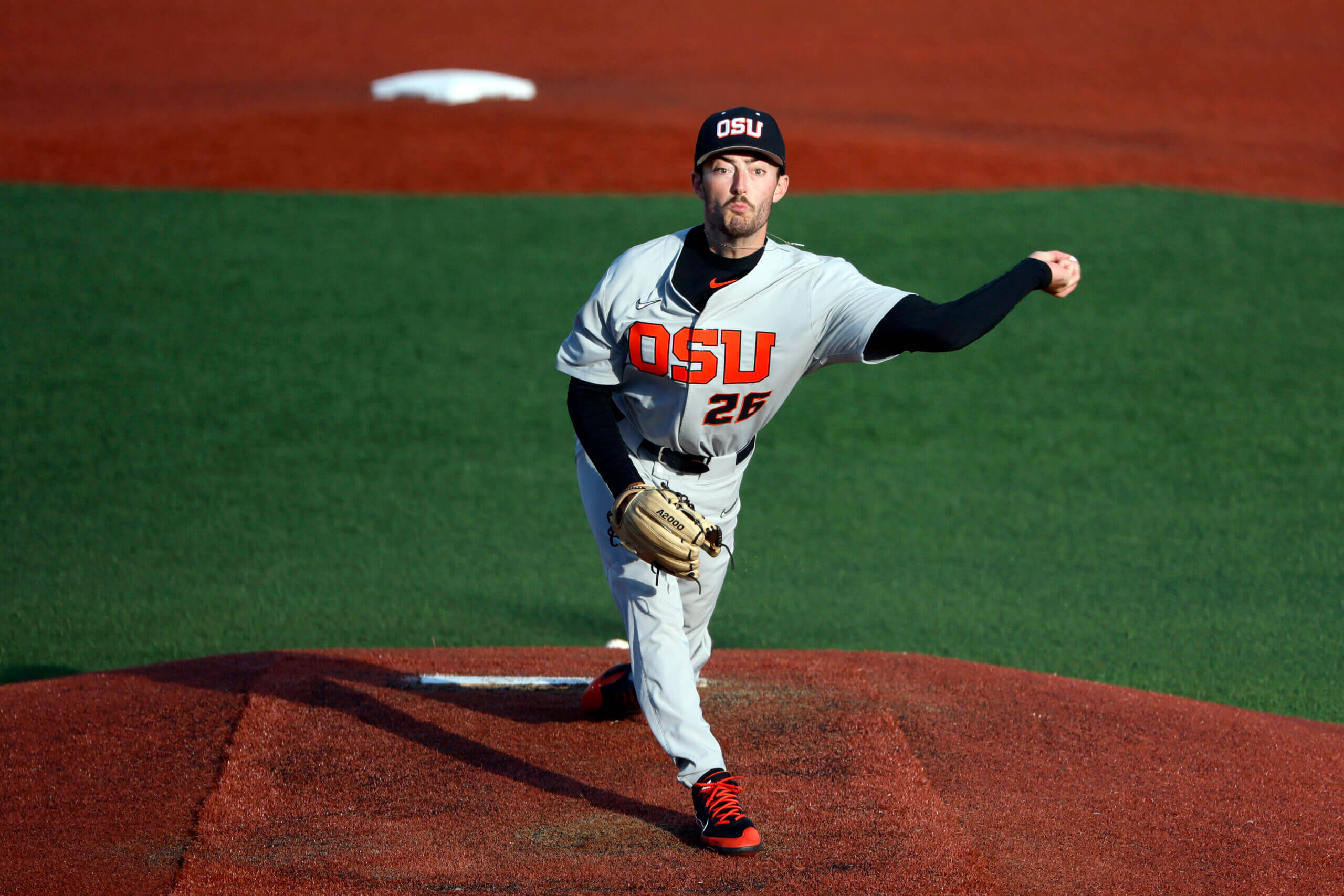
Cooper Hjerpe (Soobum Im / USA Today Sports)22. St. Louis Cardinals: Cooper Hjerpe, LHP, Oregon State
The Cardinals take a very Cardinals guy in Hjerpe, a lefty from Oregon State who could show two plus secondary pitches from a low slot that make him extremely tough on left-handed batters. He works with just average fastball velocity and his delivery takes him way across his body, more than any current big-league starter I can think of. As a reliever, he could move quickly and be extremely effective once through an order. I have a hard time seeing him holding up and being effective enough against righties to be a starter in the long term.
Scouting report: Hjerpe had eye-popping numbers this spring for the Beavers, with a Division I-leading 161 strikeouts and a strikeouts-per-nine-innings rate that ranked second, behind only a 23-year-old sophomore at FIU. Hjerpe does it with two potentially plus secondary pitches in his slider and changeup – the former getting big sweeping action from his low slot, while the latter is helped by the deception in his delivery. The delivery is one of the main concerns, however, as Hjerpe cuts himself off and comes way across his body, while he delivers the ball from a very low slot not far above sidearm. The other concern is that his fastball is ordinary, 88-93 mph now, with multiple scouts saying they fear it’ll go backwards in pro ball when he’s asked to pitch every fifth day. He may be able to start thanks to those two secondary pitches, but there is no big-league starter in recent memory who was this cross-body, so Hjerpe may have a lot more upside in the bullpen instead.
23. Toronto Blue Jays: Brandon Barriera, LHP, American Heritage High (Plantation, Fla.)
The Blue Jays haven’t taken a high school pitcher in the first round since 2013, and they haven’t signed a high school pitcher they took in the first round since Dustin McGowan in 2000, so it was a mild surprise to hear them take Barriera, the best lefty in the high school class this year. Barriera can show a plus fastball and changeup with good feel for two distinct breaking balls. While he doesn’t have much projection, he doesn’t need it, with a starter’s build already and the potential for front-line starter stuff. It’ll be more about command and control, as well as just staying healthy. Given where he was thought to be going, I imagine he’ll get an over-slot deal.
Scouting report: Barriera ended his season early, choosing to make his final start before his team’s schedule was over, which may become more common going forward (Hunter Greene did this as well) as pitchers try to avoid getting hurt right before the draft. He’s been up to 98 with a very fast arm and shows two very sharp breaking balls, both of which can touch plus, along with a plus changeup. He doesn’t offer much projection, but he also doesn’t need it given his present stuff, and his build right now seems sufficient for him to stay a starter. I don’t think he gets great extension over his front side, but it’s a minor quibble. It’s premium stuff, and he’s aggressive on the mound. If he gets to consistent strikes, he’s an above-average starter.
24. Boston Red Sox: Mikey Romero, SS, Orange Lutheran
The Red Sox take a California high school infielder for the third draft in a row, after Nick Yorke in 2020 and Marcelo Mayer last year. Romero was well-liked by scouts for his ability to hit and overall feel for the game, while there were some questions about his upside. He did start to show more impact later in his senior year, and he’s always had good ball-strike recognition. He might have to make some small mechanical adjustments to better adjust to pro pitching, especially changing speeds, given his no-stride approach and soft front side. He is a polished hitter for his age and could be a regular even without another grade of power.
Scouting report: Romero is a bat-first high school position player who probably gets hurt a bit by the presence of similar guys with standout hit tools like Termarr Johnson in this draft. He recognizes pitch types and balls/strikes well, with a tiny stride and compact swing that produces contact without power. He’s a solid defender at short with enough arm to stay there. For a team that believes they can unlock power in a player who already has feel to hit, he’s an ideal candidate, but I do wonder about his ability to adjust to better offspeed stuff given the lack of any stride and the way his front foot rolls over through contact.
25. New York Yankees: Spencer Jones, OF, Vanderbilt
The Yankees were the one team in the first round rumored to be on Spencer Jones, which I mentioned in my last mock, and you can sort of understand why, as the last time they took a 6-foot-7 college outfielder in the first round, he put up 30.5 WAR (and counting) in the nine years since he was drafted. I don’t think Spencer Jones is Aaron Judge – he doesn’t have the same kind of selectivity or ball-strike recognition. But he does make extremely hard contact, has more raw power than his collegiate homer totals indicate, and as a former two-way player before Tommy John surgery, he’s a good athlete for his size. The history of 6-7 position players is not favorable, though, and he’ll have an uphill battle when he gets to the high minors.
Scouting report: Jones was a two-way prospect in high school but hurt his arm as a senior and ended up undergoing Tommy John surgery in July 2020, ending his pitching career. Fortunately for him, he has upside as a position player, showing doubles power and hard contact but with a fair amount of swing and miss due to his size. Jones is 6-7, and the history of position players that tall is not great; only 16 hitters that tall have ever appeared in the majors, only five have played in at least 300 games, and all but two of them have had above-average strikeout rates relative to their leagues. He has brought his strikeout rate down from last year, when it was 30 percent, but still swings and misses in the zone too often. The Aaron Judge comp is obvious; both are huge, athletic outfielders who make very hard contact and run well for their size. If Jones can get his plate discipline to where Judge’s is – he’s behind Judge when comparing the two at the same age – Jones has clear All-Star upside, but he’s a ways from that right now.
26. Chicago White Sox: Noah Schultz, LHP, Oswego (Ill.) East High
The White Sox were the only team I ever heard on Schultz, a 6-9 lefty from the Chicago area who was presumed to be going to Vanderbilt, especially after a spring when he barely pitched after a bad case of mono. If you saw Eury Pérez in the Futures Game, you have some idea of what Schultz looks like, except from the left side – huge, but with a low slot and some extension out front, along with a sweepy slider that plays up because of where his arm finishes. He’s very projectable, low 90s now but with a ton of velocity upside. That said, there have been very, very few pitchers this tall who lasted as starters, and two of them, Randy Johnson and Chris Young, were unicorns.
Scouting report: Schultz missed almost the entire spring after contracting mono in March, but did return in mid-May and appeared to have recovered fully from the illness. He’s 6-9 and very projectable, coming from a very low 3/4 slot that will, of course, elicit comparisons to Randy Johnson and Chris Sale. The slot alone gives him deception against left-handed batters, and his height gives him some natural extension to further that. He has a sweepy slider that projects to plus. He should end up throwing comfortably in the mid-90s given his frame and the way his arm works, with his changeup a clear third among his current offerings. He’s considered a very tough sign due to his Vanderbilt commitment. Bear in mind, history is working against Schultz becoming a durable starter: Only five pitchers in MLB history 6-9 or taller have thrown at least 500 innings, and only three have topped 1,000. One of them is in the Hall of Fame, though, and I’m sure any team making a run at Schultz this spring will have Randy Johnson on their minds.
27. Milwaukee Brewers: Eric Brown, SS, Coastal Carolina
The Brewers went for athleticism again in the first round. They’ve taken speedy guys in the first round three straight years now, with Garrett Mitchell, Sal Frelick and now Brown. Brown is a fleet-footed shortstop who has very quick wrists, and is able to hit for contact and some power even with a very noisy approach. He should stay at shortstop. I wonder if the Brewers can simplify his setup and load to maximize the quality of the contact he makes. He’s a college guy but a bit more of an upside play than most college bats.
Scouting report: Brown is a toolsy shortstop with running speed and quick wrists, producing in college and on the Cape despite a very unusual, noisy approach that makes it hard for him to get his bat to the zone on time. He starts with his hands in front of his face, waggling the bat, so he never really comes set, succeeding because his hands are fast, but with enough extraneous movement that scouts question how well he’ll hit with this same approach once he’s in pro ball. Part of his success is very strong ball-strike recognition – he doesn’t chase out of the zone much at all, and almost never does so on fastballs. He’s a plus runner with the footwork and arm to stay at shortstop, so he has a fairly high floor – and even with the noisy approach, he has hit, .330/.460/.544 this year for Coastal with more walks than strikeouts. I don’t love how he does it, but he gets it done.
28. Houston Astros: Drew Gilbert, OF, Tennessee
Houston gets very good value here in Gilbert, the Tennessee centerfielder who was a serious prospect as a pitcher out of high school. He’s a left-handed hitter with a great eye and strong contact skills, lacking only power out of the five tools as he runs well and plays plus defense in center. As is, I think he’s a regular in center. But if the Astros can find a way to get him to more power — which would include just getting some more muscle on him — he could be more than that.
Scouting report: Gilbert was a two-way prospect out of a Minnesota high school but had a strong commitment to Tennessee, so he wasn’t drafted until the hometown Twins took him in the 35th round in 2019. He’s only thrown 16 innings for the Vols, none this spring, but he’s turned into a premium defensive center fielder with a strong eye at the plate and ability to hit for average. Gilbert rarely swings and misses, staying back even through contact, with minimal weight transfer — possibly an avenue for a player development group to try to get another half-grade of power out of him. In center, he’s a 6 defender with a 6 arm, doing it more with reads and instincts than pure speed, as he’s just a tick above average as a runner. The defense and contact skills give him a good chance to be a regular, although there’d have to be something more — more power, greater patience — to make him a star.
29. Tampa Bay Rays: Xavier Isaac, 1B, East Forsyth High ( Kernersville, NC Kernersville, N.C.)
If there’s a worse demographic in the draft than high school pitching, it’s high school first basemen. The Rays took Isaac, who didn’t only miss my top 100 — he didn’t even make my just-missed list, and wouldn’t have made a ranking of the top 150 players in the draft. He’s a first base-only guy with a bad body, but he does have a good swing and huge raw power. If a power-over-hit first baseman doesn’t hit enough to get to the power, you have nothing. I don’t get this in the first round.
Scouting report: Isaac missed all of last summer and fall due to injury, and as a high school first baseman he was never going to fit for some teams, especially with his commitment to Florida. He’s a bad-bodied first baseman who may very well end up a DH. At the plate, his swing can get pretty long, but he knows the zone well and puts the ball in the air very often, even the other way, which is what a hitter of this sort has to do to have any chance to produce. He reminds me quite a bit of Guardians first baseman Bobby Bradley at the plate, although Isaac is three inches taller and already listed at 240 pounds by MLB.
30. San Francisco Giants: Reggie Crawford, LHP, Connecticut
The Giants took the first college Tommy John guy in this draft, which is loaded with them … but it wasn’t Connor Prielipp, or even Peyton Pallette. Reggie Crawford is a two-way guy at UConn who hit 99 mph for Team USA last summer before he blew out. He’s pitched just eight innings for the Huskies, plus 8.1 more in two different summer leagues, so this is a huge bet on potential because we have no real idea what he is right now, even if he comes back completely healthy. The Giants announced him as a two-way player, and he was an actual prospect as a hitter, just a better one on the mound. He’s super athletic and has power, but was mostly a dead fastball hitter before he got hurt.
Scouting report: Crawford is the biggest wild card among the wild cards of the pitchers who’ve had Tommy John surgery in this draft class because he’s barely pitched, with just 20.1 innings in total across two springs with UConn, and two summers in collegiate leagues and with Team USA. He did strike out exactly half of the batters he faced in that span, sitting 94-97 mph and touching 99 mph, occasionally mixing in a fringy slider. He spent more time as a power-hitting first baseman for the Huskies who couldn’t hit a breaking ball, so the mound is probably his best bet for a big-league career. But even with the athleticism of the typical two-way player, how can you project him to start with just a huge fastball and very little track record?
Still want more? Check out Keith Law’s thoughts on picks Nos. 31-40, taking you through the Dodgers’ first pick.
(Illustration: John Bradford / The Athletic; Photos: Jamie Scwaberow / Getty, Mark J. Rebilas / USA Today, Team USA)