
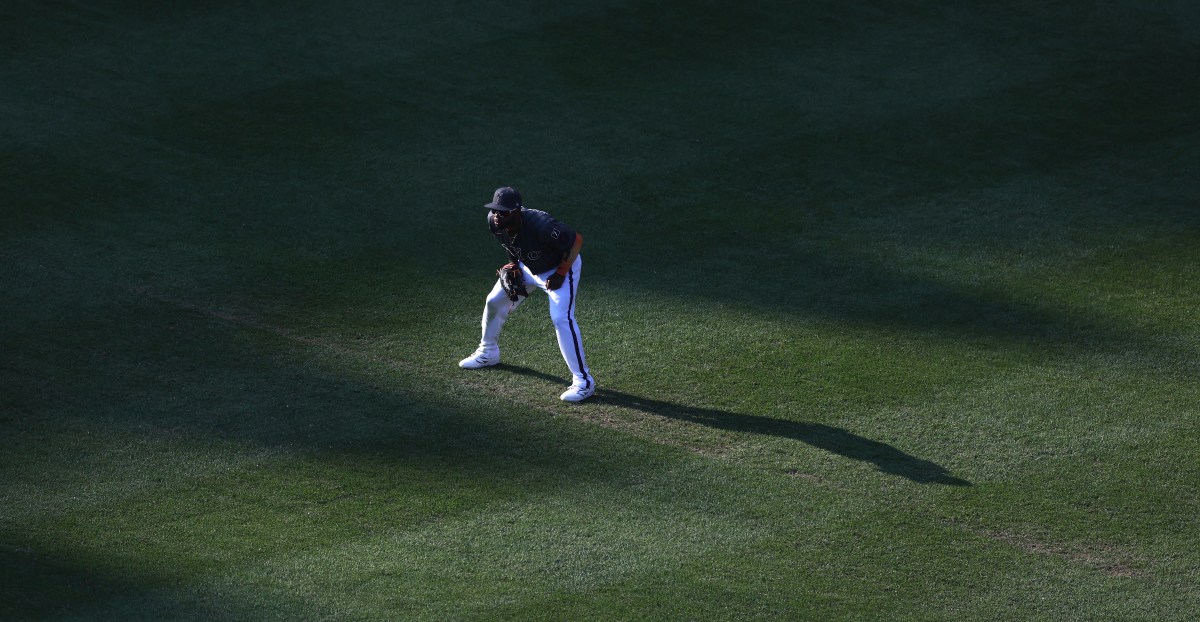
It is never fair to blame a team’s collapse on a single player, let alone one as otherwise likeable as Cedric Mullins, who ultimately was a pretty small cog in the grand scheme of the spectacular failure that was the 2025 season. But if there is a player who came to symbolize—justly or not—that failure, it’s Mullins. After Jose Siri spent most of the season sidelined by injury and Tyrone Taylor underperformed, the Mets were desperate to upgrade at the center field position at the deadline and landed on Mullins as the solution, dealing three minor league arms to Baltimore in exchange for his services.
As a Mets fan who lived in Baltimore for much of the 2010s and saw the passing of the torch from Adam Jones to Cedric Mullins firsthand, I admit that I was probably higher on the trade at the time than most. I knew the dynamic and fun player Mullins was capable of being when he was on. But that is not the version of Cedric Mullins that Mets fans were exposed to and it is hard to classify the trade any other way except as an unambiguous failure.
A lifelong Oriole until that point, Mullins had to leave the organization where he had spent a decade of his life and come to a team in the midst of a playoff run in one of the biggest markets in the country. Mullins recently admitted on “Foul Territory” that it was a difficult adjustment for him. “It hit pretty hard, having to uplift your entire life,” he said. “Especially out in New York, where things can get hectic on a day-to-day basis. It was definitely a lot of changes and adjustments that had to be made, along with trying to perform at your best.” He also spoke about the challenge of trying to complement an already talented roster and putting pressure on himself to perform.
Of course, it is impossible to know how much these mental challenges contributed to his subpar output on the field. Understanding the context of his struggles can make one sympathetic to the player, but unfortunately it does not change the reality of the numbers. I don’t need to repeat them here to anyone who watched the 2025 Mets in the second half, but I will for the sake of completeness. In 143 plate appearances for the Mets, Mullins hit .182/.284/.281 with a 66 wRC+. He logged just seven extra-base hits, scored 16 runs, drove in 10 runs, and stole eight bases (while not getting caught once; that is one thing that was promised on which he delivered). But even seeing these disastrous offensive numbers doesn’t tell the full story. A normally at least capable center fielder, Mullins also made several costly mistakes on the field that were magnified by being on a team struggling with run prevention where every run mattered.
Mullins’ hardships were so profound, in fact, that by September he was more or less relegated to the bench in favor of a resurgent Tyrone Taylor, who had a strong August and September. We all remember what happened after that. The Mets fell just short of the playoffs and Mullins absorbed an outsized amount of ire for it from the fanbase. Now, Mullins and the Mets go their separate ways—hopefully to the benefit of both. The Mets now turn to Luis Robert Jr.—another player who had spent his entire career with another organization until this point who the Mets had their eye on at the deadline last season—to try to solve their center field problem. If healthy, Robert probably has a better chance to recapture his past performance than Mullins ever did; he is younger, he has better tools, and underlying indicators of his athleticism remain present. As for Mullins, he returns to the familiar AL East with the Tampa Bay Rays on a one-year, $8 million deal. His role will not be in question and the pressure he experienced in New York will certainly be alleviated to some extent. Unfortunately, Cedric Mullins’ New York Mets tenure becomes a footnote that both the player and the team would likely rather forget.