
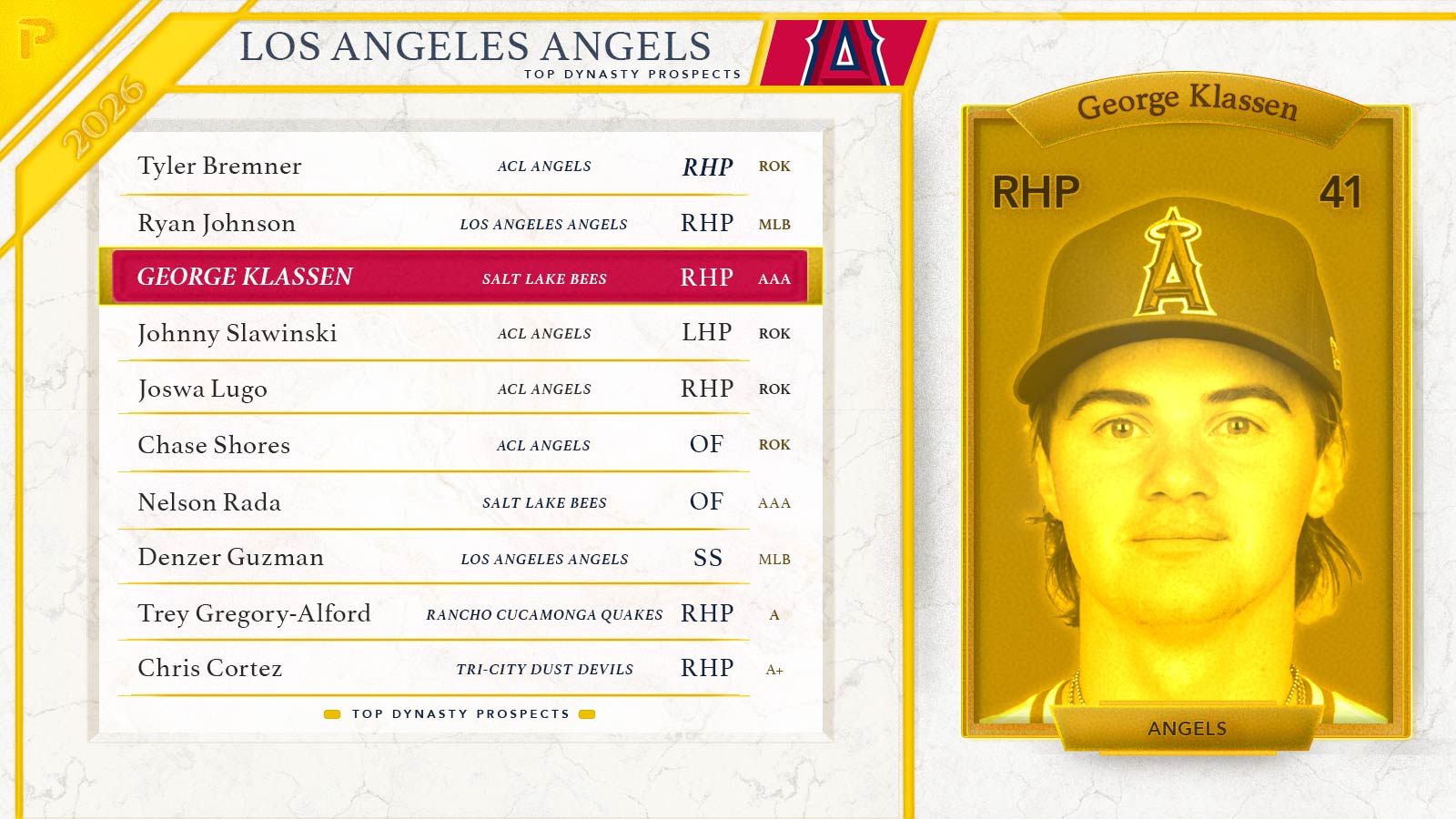
The Angels are a roster built via their early-round draft picks over the past two decades. Five of their nine (projected) starting hitters were first-round picks, including one of the best players ever to play the sport in Mike Trout. To help him, they’ve relied on the emergence of Zach Neto as a breakout star and the late blossoming of Jo Adell, first-rounders in 2022 and 2017, respectively.
On the pitching side, only Reid Detmers (4.77 Career ERA), Jose Fermin (-0.5 WAR in 2025), and Chase Silseth (4.68 Career ERA) can be considered homegrown pieces. The Angels are trying to change that, though. 68% of their draft selections since 2021 have been pitching, and over 80% of those 100 selections have been collegiate/junior college selections. In 2024 and 2025, 28 of their 40 selections were pitching prospects. Due to that shift in strategy, there is plenty of pitching on this list.
This list is part of a series in which Pitcher List reviews each MLB team’s system ahead of the 2026 season. You can check out the rest of the series here.
Top Angels Prospects
The Top Tier
1) Tyler Bremner, 21 Y/O, RHP
MiLB Stats: N/A – 2025 Draftee
In a weak farm system, Bremner is the standout talent. The Angels surprised much of the baseball world when they selected the UCSB star with the second overall pick, ahead of other arms such as Kade Anderson and Liam Doyle. That’s not to say Bremner was a bad pick by any means. He has (arguably) three plus pitches that give him an advanced repertoire to rely on early in his career. His fastball sits comfortably in the mid-90s with decent life, but his offspeed offerings will give professional hitters fits.
His changeup is an outlier. He utilizes a near “screwball” action to get sharp vertical and horizontal movement on it, and can keep it in the mid 80s despite the amount of “drop” the grip creates. The slider isn’t quite as developed, but it’s still upper 80s with sharp, late horizontal action. That mix helped him strikeout 35.8% of the batters he faced last year while keeping his walk rate in check. His 29.7% K-BB% ranked sixth in Division I last year, albeit just behind Doyle and Anderson. Bremner has the potential to take over the top spot in the Angels’ rotation, and given the team’s attitude towards aggressive promotions, could see starts in 2026.
2) George Klassen – 24 Y/O, RHP
MiLB Stats: 108.2 IP | 5.22 ERA | 27.7% K% | 9.7% BB%
No, your eyes don’t deceive you. The Angels’ #2 prospect had an ERA over five last year. However, that seems to be at least somewhat down to luck. Klassen’s FIP (3.29) and xFIP (3.19) were both over two points lower, and his BABIP jumped 60 points compared to his 2024 mark. That jump came despite a decrease in fly-ball rate and a lower pulled batted-ball rate, although his line-drive rate jumped nearly eight points. Still, Klassen generated a solid amount of whiffs (14.6% swinging-strike rate) and has the repertoire to back it up.
In his one AAA appearance, Klassen’s slider dominated, generating 13 whiffs on 26 swings. The shape is gyro-esque, although he gets it below the vertical zero-line with a good late horizontal break. He backs it up with an upper-90s fastball that explodes up into the zone with 12+ inches of run. At ~14″ induced vertical break (iVB), there’s a legitimate concern that the pitch could get hit by better competition, but the velocity will play. His changeup plays well off of the fastball, with similar levels of run with eight inches of vertical drop between the offerings. Klassen’s stuff is good enough to stick as a starter, although there are still some things to clean up.
3) Chase Shores, 21 Y/O, RHP
MiLB Stats: N/A – 2025 Draftee
I’m taking a big swing on the former LSU Tiger in this spot. Shores is a “boom-or-bust” prospect. He has an electric arm that can get up to 100+ miles an hour, and his frame is one that you’d be more likely to find on a basketball court than on the mound (6’8″, 245). At the same time, he didn’t translate his raw talent into on-field production in college (5.09 ERA, 24.6% strikeout rate). Like many other power arms, he struggles to consistently find the strike zone, which got him into trouble before the draft (10.9% walk rate).
The reliever risk for Shores is legitimate. If that does become the case, he has the outlier frame and electric arm to be effective in short stints. However, that dramatically lowers his fantasy value. In this spot, I’m betting on him utilizing his electric fastball and wipeout slider (low 90s, plus horizontal action) to better attack professional hitters and stick in the rotation. Given his pedigree as a second-round pick, he’ll be given the chance to do that in his professional debut season.
4) Ryan Johnson, 23 Y/O, RHP
MiLB Stats: 57.1 IP | 1.88 ERA | 29.7% K% | 4.6% BB%
MLB Stats: 14.2 IP | 7.36 ERA | 22.2% K% |6.9% BB%
If Shores is the “high ceiling” type of prospect, Ryan Johnson is the “high floor”. He made headlines in his first professional season, as the Angels promoted him to the big-league roster before he’d ever pitched in a professional game. That move paid off overall. Outside of his first and last starts, Johnson had a 2.77 ERA with a 20.3% K-BB% and a 4.9% barrel rate. After being sent back to High-A, he dominated as a starter, allowing a .196 AVG against and a 0.89 WHIP.
Johnson’s unusual mechanics and pitch plot were key to his success. Despite average velocity (~94 on his sinker), he manipulates the ball on the horizontal plane well with a five-pitch mix. That’s amplified by a unique throwing motion that gets little extension from his giant 6’6″ frame and relies almost entirely on a whippy throw. Four of those pitches move glove side, including a sweeper/slider/cutter combination that are all separated by a matter of inches. There are three distinct velocities, and therefore timing windows in that mix, which leaves hitters guessing and unable to make hard contact (25.7% hard-hit rate, 5.7% barrel rate). Johnson’s unique motion, pitch plot, along with a track record of success as a starter in the minors, make him a player to track in 2026.
5) Joswa Lugo, 18 Y/O, SS
MiLB Stats: .271 AVG | .375 OBP | .372 SLG | 2 HR | 1 SB | 26.3% K% | 12.5% BB%
This is the clear start of the second tier of the Angels’ system. The four names above will likely at least contribute to a future team at Angel Stadium. The same cannot be said about the rest of the list for one reason or another. Lugo is about as volatile a profile as they come. He put together a 122 wRC+ in the DSL as a 17-year-old with five home runs and a .166 ISO. At the same time, he had a contact rate just above 50% and a swinging-strike rate of 34.3%. Given that amount of swing and miss, it’d be easy to assume that Lugo failed to make an impact in his stateside debut in 2025.
That wasn’t the case. Lugo ranked 27th of 62 hitters his age or younger with a 105 wRC+, which was second in the organization at the Complex (more on #1 later). Oh, and he improved his contact rate by ~20%. The quality of that contact will be the next thing for Lugo to work on. His swing passes the eye test and is remarkably polished for a player his age. However, Lugo can roll over, as evidenced by his near 50% ground-ball rate. There’s room for Lugo to add size to get to more of his power potential, too. There’s plenty of volatility to worry about for Lugo, but there’s plenty of promise, too.
6) Trey Gregory-Alford – 19 Y/O, RHP
MiLB Stats: 78.2 IP | 2.86 ERA | 20.7% K% | 10.0% BB%
The Angels made a splash in the middle rounds of the 2024 draft, securing the services of a 6’5″ right-hander with an electric fastball in the 11th round. They had to pay $1.8 million over slot to secure his services, but the early returns indicate that it will be well worth it. Gregory-Alford had the 12th-best ERA among teenagers (min. 70 innings) in 18 appearances (16 starts). The highlight stretch was his six-game stint in Single-A. Gregory-Alford posted a ludicrous 1.42 ERA, holding hitters to a .178 AVG. His expected stats (4.73 xFIP) indicate there was some luck involved, though his repertoire likely coaxed hitters into uncomfortable swings either way.
The headline offering in his arsenal is the blazing fastball. Gregory-Alford’s fastball clocked in at 101+ mph before the draft, and he’s shown an ability to sit in the upper 90s deep into starts. The shape doesn’t appear to be great, though, which can limit his ability to get whiffs. A more whiff-oriented shape could unlock the rest of his rotation, and in turn increase his ability to retire hitters via the strikeout. With his frame and age, there’s plenty of time to refine Gregory-Alford’s pitch shapes, but the raw tools are those of a mid-rotation arm.
7) Hayden Alvarez – 18 Y/O, OF
MiLB Stats: .340 AVG | .435 OBP | .430 SLG | 2 HR | 33 SB | 16.5% K% | 13.8% BB%
For now, Alvarez is a hit-over-power prospect with solid speed and defense. In real life, that’s more than enough to be excited about. In a dynasty, not so much. However, Alvarez has the potential to be a much more valuable asset in the future. At 6’3″, 190, Alvarez has a physically imposing frame, although he doesn’t use it to get the ball in the air. He pulls the ball at a 43% clip, but had a fly-ball rate of just 28.6% in 2025, with a 16.4% infield fly-ball rate. If he can rework his swing to get to more of his natural power, his value could inflate dramatically in 2026.
The good news is that Alvarez already possesses the bat-to-ball tool to build on. Alvarez was promoted to Single-A for a 20-game stint to end the season, and wasn’t overmatched despite his tender age. His contact rate approached 90%, with a swinging-strike rate under 5%. That existing ability to get the ball in play, along with his speed and athleticism, should allow him to continue producing even if the power tool isn’t prominent. There’s a lot to be excited about with Alvarez, even if he’s a ways away from the big leagues.
Prospects Dynasty Managers Should Know
8) Johnny Slawinski – 19 Y/O, LHP
MiLB Stats: N/A – 2025 Draftee
The Angels drafted Slawinski in the third round of the 2025 Draft, and he’s yet to debut. It’s easy to see why Los Angeles took a gamble on the southpaw in this spot. At 6’3″ with a lean build, Slawinski’s frame is as projectable as they come. He’s already up into the 90s with his fastball, with three average-to-solid offspeed offerings. The change is the best of the bunch, getting good arm-side action that separates well, but the slider/curveball tandem could be something the Angels unlock as well. It’s still too early to tell what kind of professional Slawinski will be, but there are tools for the Angels to mold him into a legitimate rotation weapon.
9) Nelson Rada – 21 Y/O, OF
MiLB Stats: .292 AVG | .398 OBP | .360 SLG | 2 HR | 54 SB | 19.9% K% | 12.7% BB%
Rada is a strange profile. He possesses solid speed and should be a threat for 30+ steals at the big league level. Outside of that, there are a lot of question marks. His bat-to-ball ability is great (90% Z-Con rate), and his OPS improved by over 130 points once he reached AAA. On the flip side, the quality of the contact is not good. He averaged an 83.4 mph exit velocity over 134 balls in play, and his 17.9% hard-hit rate isn’t much better. He’ll provide value as an OBP + steals asset, but there’s little else to be excited about with his profile
10) Gabriel Davalillo – 18 Y/O, C
MiLB Stats: .302 AVG | .408 OBP | .518 SLG | 7 HR | 3 SB | 12.4% K% | 13.6% BB%
Davalillo made quite the impression in the Dominican Summer League this year. He was one of four 17-year-olds with a .900+ OPS, .200+ ISO, and a walk-to-strikeout ratio over 1. He possesses a strong mix of bat-to-ball skills (84.4% contact rate) and power, while keeping his strikeouts in check due to plus plate discipline for his age. He’s got a strong build, and his bat speed looks to be a plus asset. Young catchers are volatile, and he may not stick behind the plate. However, his raw tools look impressive, and he should get a chance to experience Single-A this season.
11) Denzer Guzman – 21 Y/O, SS
MiLB Stats: .247 AVG | .343 OBP | .426 SLG | 17 HR | 14 SB | 25.4% K% | 11.5% BB%
MLB Stats: .190 AVG | .209 OBP | .356 SLG | 2 HR | 0 SB | 51.2% K% | 2.3% BB%
Guzman’s 119 wRC+ between AA and AAA earned him a cup of coffee in the big leagues. Unfortunately, the flaws in his game were quickly exposed. Guzman’s bat-to-ball ability in AAA was okay, posting a 71% contact rate and 13% swinging-strike rate, but those numbers plummeted in the majors. The good news is Guzman does have power potential. In a small sample size, Guzman posted a 15% barrel rate and 45% hard-hit rate in the majors. He has average bat speed and a lean frame, so these numbers may regress next season. At 21, Guzman has plenty of time to adapt to big league competition, a task he may be given as a member of the Opening Day roster.
12) Chris Cortez – 23 Y/O, RHP
MiLB Stats: 113.2 IP | 4.28 ERA | 22.2% K% | 16.4% BB%
There’s a growing trend in the Angels’ system: their pitchers can’t throw strikes. Cortez is another electric arm that just hasn’t been able to keep the ball in the strike zone. The organization took Cortez in the second round in 2024 largely due to his 26.7% strikeout rate and 100+ mile an hour sinker, which pairs perfectly with a wipeout sweeper. The Angels have used him as a starter, and the arsenal has been effective at limiting hits (.222 AVG, 11.4% swinging-strike rate), but the walks boosted his ERA up to above four. The electric arm still has value and could grow into a solid starter. A lot has to go right for that to happen, though.
13) Raudi Rodriguez – 22 Y/O, OF
MiLB Stats: .281 AVG | .372 OBP | .470 SLG | 14 HR | 38 SB | 23.2% K% | 11.3% BB%
Rodriguez’s 130 wRC+ was the fifth-highest in the organization last year, with his OPS (.842) and wOBA (.397) also cracking the Angels’ top 10. He was one of two players in the system with 10+ homers and 20+ steals, and did so in his age-21 season in Single-A. He’s shown an ability to hit to all fields, and cut his ground-ball rate by 13% while increasing his line-drive rate by 8%. There’s work to be done in terms of bat-to-ball ability and approach, but he’s a player to keep an eye on as he climbs into the higher levels of the minor leagues this season.
14) Barrett Kent, 21 Y/O, RHP
MiLB Stats: 35.1 | 2.04 ERA | 20.3% K% | 13.7% BB%
Kent doesn’t have high strikeout upside, and there’s work to be done with his command. However, anytime a player drops his ERA at Single-A by over four runs in one season, it should be considered impressive. That’s exactly what Kent did this year. His 1.98 ERA in six starts was a far cry from his 6.21 mark the year before. His sinker/slider combination is filthy. Both have solid horizontal action, and the fastball can get into the upper 90s. There are walk issues to address, but Kent generates a solid ground-ball rate and keeps the ball in the ballpark. Another solid year could propel him into back-of-the-rotation conversations in the future.
15) Juan Flores, 19 Y/O, C
MiLB Stats: .207 AVG | .283OBP | .341 SLG | 10 HR | 0 SB | 27.5% K% | 5.3% BB%
Hear me out before you call me crazy. I’m betting on upside here. Flores’ defense will keep him behind the plate in the future, and he threw out 21 runners (17% caught-stealing rate) last season. He did that while posting ten home runs, one of five teenagers to do so in High-A. The downside? He is last in every offensive category in that group. His bat-to-ball skills are lackluster (68% contact rate, 16% swinging-strike rate), and his home-run-per-fly-ball rate is an outlier compared to his other stateside numbers (11.1%). Flores’ quality of contact looks good (44.8% pull rate, 43.7% fly-ball rate), though his infield fly-ball rate is very high (31%). Flores is a volatile player. He has the potential to be a 15+ home run backstop. He could also never get close to the majors.
The Next Five
Although these prospects do not crack the top 15, dynasty managers should keep their eye on these five players.
Peyton Olejnik – Outlier frame at 6’11” with 25 starts last season (4.20 ERA). Velocity isn’t dominant, and he doesn’t generate a ton of whiffs, but the frame alone makes him worth a follow.
Walbert Ureña – Electric arm (100+ mph fastball) without the high strikeout profile. Briefly reached AAA last year. Lower swing-and-miss potential than other names listed.
Talon Healy – Overcame lymphoma and Tommy John just to make it to pro ball. Topped out at 97 on showcase circuits and has a developed frame for his age.
David Calabrese – One of seven players with 10+ home runs and stolen bases in the Angels’ system. Decent contact rates with an average power and speed tool. Projects as a fourth outfielder in the future.
Dylan Jordan – 0.94 ERA in 7 Single-A starts as a 20-year-old. Nothing outlandish in the arsenal, but good fastball and slider with the ability to get down the mound well. Low release point makes it tough on hitters. Could be a big riser