
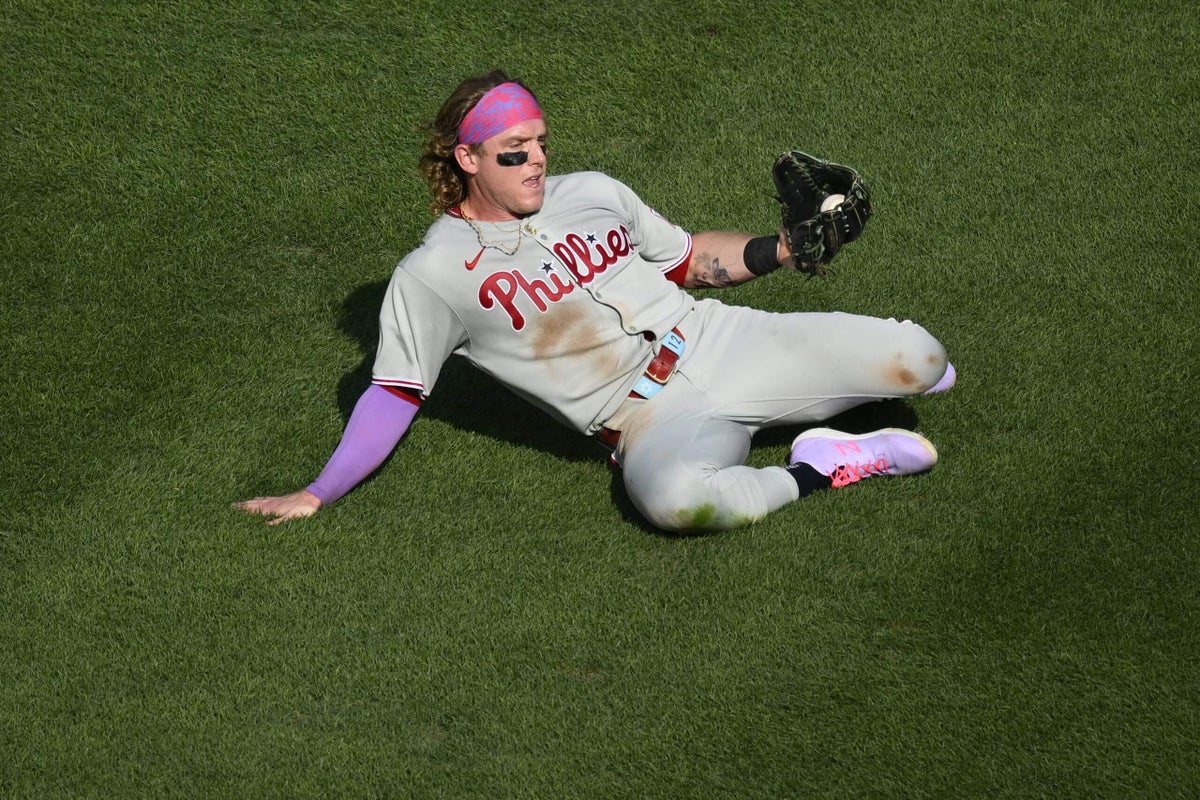
Harrison Bader credits hard work and determination with becoming one of the game’s best defensive outfielders this decade. He also credits the bad hops, the gopher holes and the crab grass.
Bader grew up in Bronxville, N.Y., a leafy suburb just a few miles north of Yankee Stadium, and like most athletically gifted youngsters, he was assigned to play shortstop for his team in the Eastchester Little League. He did not stay at the position for long. Bader said his father, Louis, watched his otherwise fearless son play tentatively on one ground ball after another and “ripped an infield glove out of my hand.”
“All the fields in New York City, they’re unkempt and there’s crab grass everywhere and the fields suck,” said Bader, appearing on a teleconference with reporters on Friday after the San Francisco Giants announced his two-year, $20.5 million contract. “I was always scared of ground balls, so at a young age, I shifted to the outfield. … I was playing that position when everyone wanted to be Derek Jeter as a shortstop.”
He learned to love the nuances of playing center field. He loved the communication aspect and the agency that the position required. When playing pickup football games, he always preferred the defensive backfield where he could diagnose the entirety of the action as the play unfolded in front of him. He adopted that same mentality when his pitcher would coil into his windup, using all his intuition to shade a step or anticipate where the ball was headed. When he reached the major leagues with the St. Louis Cardinals in 2017, he was able to blend that intuition with all the information that his analytics staff could supply to him.
It’s resulted in outlier defensive skills. Bader, a Gold Glove winner with the Cardinals in 2021, has been worth 77 Outs Above Average over his nine-year major league career with the Cardinals, New York Yankees, Cincinnati Reds, New York Mets, Twins and Phillies. Since Bader debuted, only four-time Gold Glove winner Kevin Kiermaier has posted a higher OAA among center fielders. And Bader, 31, is coming off the best offensive season of his career. He joined the Phillies at the trade deadline and provided a spark with the bat in addition to a pair of home run robberies.
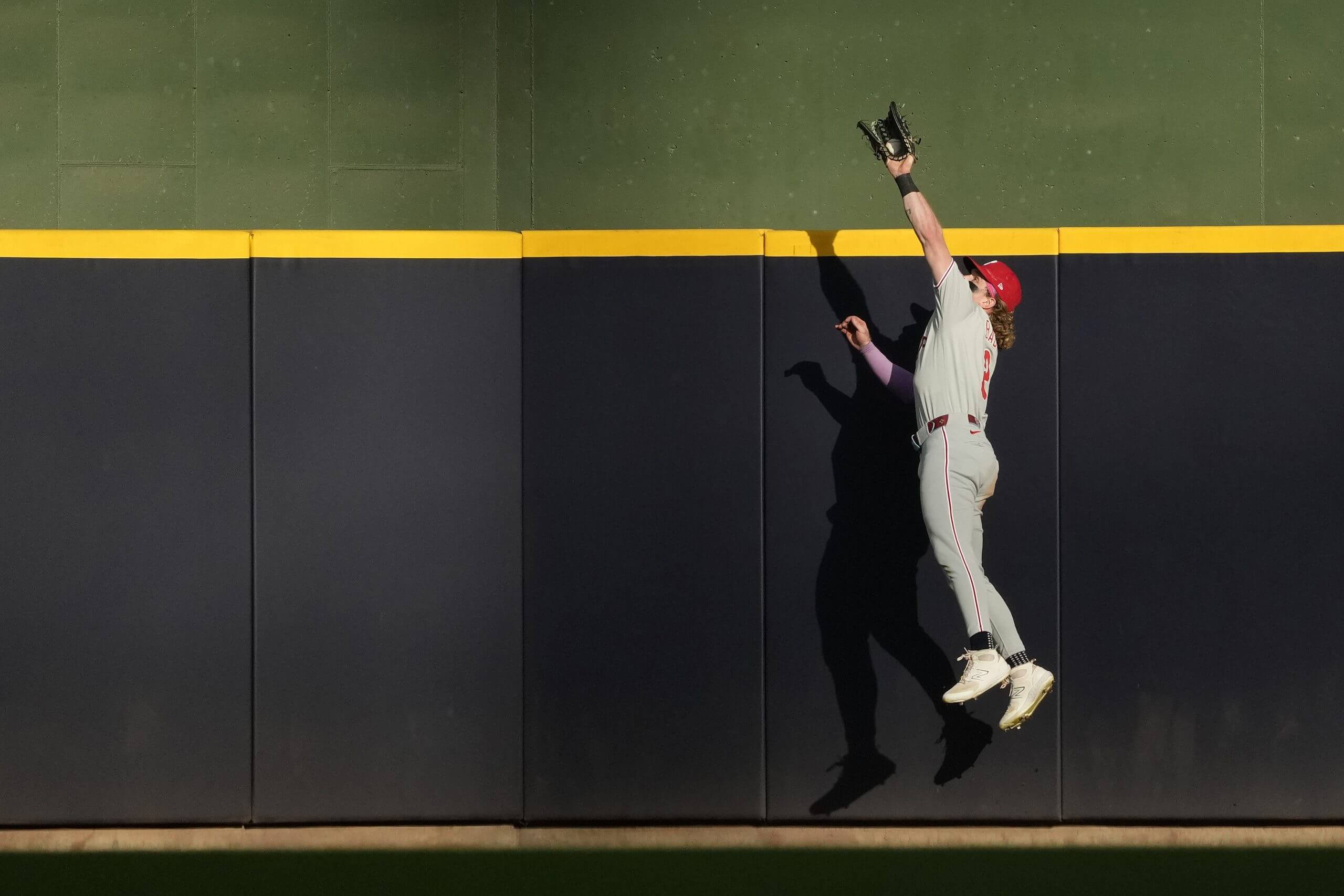
Harrison Bader leaped to catch a ninth-inning fly ball hit by Andruw Monasterio of the Milwaukee Brewers on Sept. 4, 2025. (Patrick McDermott / Getty Images)
Bader might play with an old-school edge, but it became clear on his conference call Friday that he is every bit the modern baseball player. He discussed the “fantastic biomechanist” he works with in the offseason. He might have been reciting from Gray’s Anatomy when he described his hernia surgery at the end of 2023 as fixing “an adductor tear off the pelvic floor.”
In a virtual interview environment that results in so many sterile questions and responses, Bader gave detailed and thoughtful answers: from his reasons for signing with the Giants to explaining his increased bat speed over the past two seasons to describing his New York upbringing that is at least partly responsible for his live-life-out-loud personality.
“I don’t know, I just … I see, like, the other side of this entire thing, you know?” Bader said. “I see how fortunate we are to play a game. I know it has a shelf life. I know my life will be different in however many years when I’m done playing. I knew that from the beginning, so I think I just tried to maximize every single instant, every single moment, the best I can, because I truly love it more than anything.
“The best route to that energy, that passion, is just by waking up every day and knowing how fortunate you are. And I’ve gotten more mature in it. I’ve realized the sacrifices my family’s made, and they support me endlessly, which at times, has been a bit challenging, so …”
Bader flashed a bit of that confidence when asked about playing for new manager Tony Vitello, who is making a direct leap from the University of Tennessee to his first job in professional baseball.
“I know these dudes do their homework because they signed me, right?” Bader said with a grin. “They obviously did their homework with Tony. … I’m excited for him. It’s a fantastic opportunity for us all. I just can’t wait to be in the dugout with him.”
Giants president Buster Posey is known to appreciate players who carry themselves with confidence, but he said Bader’s demeanor wasn’t the primary reason that the team targeted the center fielder early in free agency. It’s because Bader has the skills the Giants glaringly lacked while fielding arguably the worst defensive outfield in the majors last season. It’s a group that Posey and GM Zack Minasian expect to improve by literal leaps and bounds this year, both because they have a take-charge asset in center and because Jung Hoo Lee’s attributes figure to play up with a shift to right field.
Lee is expected to get some reps this spring at the team’s Papago Park complex, where one of the practice fields features the exact dimensions of the Giants’ waterfront ballpark. No, the wind patterns won’t be the same and no, the ball won’t carom off a chain-link fence like it would against the brick arcade in San Francisco. There’s also the unspoken acknowledgment that Lee hasn’t been the defensive center fielder that the previous administration envisioned when they signed him out of the Korea Baseball Organization to a six-year, $113 million contract. But Posey and Minasian said they have spoken to Lee about the shift to right field and he is on board with the change. Lee also played a fair amount of right field for Kiwoom in Korea.
“We looked at Jungy relative to center fielders in terms of jumps and routes and arm strength and where he ranked there, and then we also looked at him relative to right fielders,” Minasian said. “A lot of that came back really positive about how he would transition to right field and where he would rank relative to other right fielders. We think he’s going to be very good out there.
“And then the other part two is the eye test of watching him last year. I think we feel like just watching him, there is an instinct to play the outfield. (It was) his (first) full season in the big leagues and as he gets more and more comfortable with his teammates, he’s going to be really good at it as he goes to right.”
As long as Bader is healthy, he will be the center fielder. The health factor is no trifling qualifier for a player who has missed time with shoulder and oblique injuries, in addition to that unfortunate incident with his pelvic floor. Bader said one reason his numbers at the plate ticked up was because he was no longer battling the nagging groin injury. He described his approach at the plate in flowery terms that could be reduced to “educated guess hitter.” That’s part of the reason his bat speed ticked up. He wasn’t taking nearly as many tentative swings. It’s also a reason why the right-handed hitter posted a career-high 27 percent strikeout rate last season.
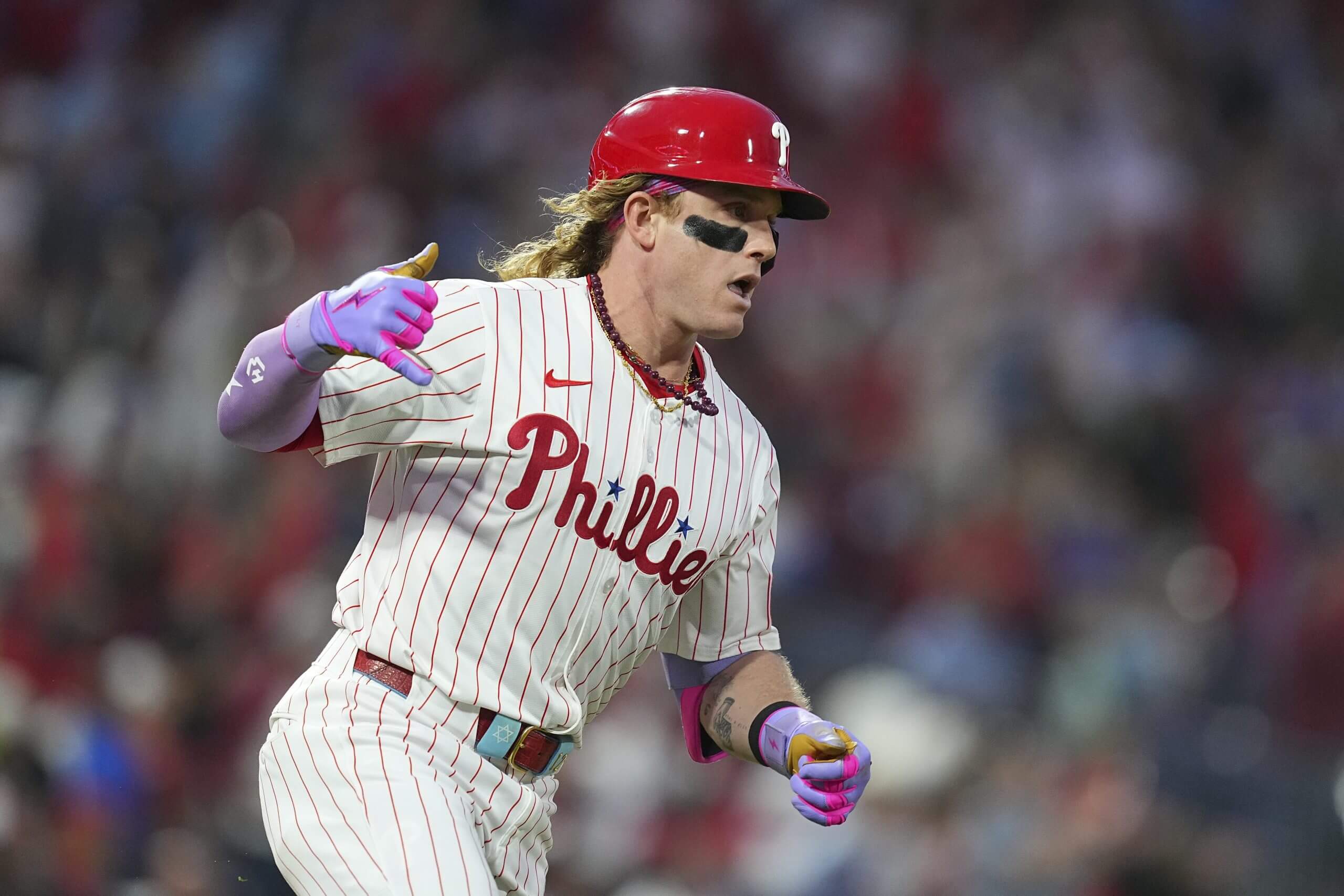
Harrison Bader hit .305/.361/.463 in 50 games with the Phillies. (Mitchell Leff / Getty Images)
“I’d rather be 100 percent correct or 100 percent incorrect,” said Bader, adding that he can be at peace with that kind of offensive approach because he knows he’ll be doing something to help his team on defense. “I’ve done it long enough. I’m gonna get hot. I’m gonna stay hot. I know how to stay hot. It’s just those periods where you’re kind of in between, maybe getting pitched to a little bit better: I’d rather just be sold on one thing I’m looking for, you know, within reason. And a lot of that has to do with studying, with preparation and a lot of the data I’m getting from my team.”
There will be times when Bader guesses right and takes a good pass and hits a lineout. In those moments, he does not need to manufacture consolation. He knows that he could be a half-inning away from taking away someone else’s extra-base hit.
“I love taking fly balls,” Bader said. “I love running balls down. I love sprinting in on a line drive and stealing a hit. I love throwing the ball. … On defense, you have so many factors you can control ahead of time, before the pitch is thrown, that will set you up for success consistently — knowing your pticher, knowing what your catcher and pitcher are trying to do to the hitter, knowing where your outfielders are, shading in a certain direction based on the swings you’re seeing. … It’s not 100 percent accurate but I think it’s gotten me through because I just pay attention to the little details.”
Like many premium defenders, Bader’s value with the glove bought him time in the big leagues for his bat to develop. He’s joining the Giants at what appears to be the apex of his confidence — and that’s no small resource for a team that, despite its share of star talent on the roster, will be in the position of throwing smooth stones at the archrival Los Angeles Dodgers. A little bit of Bronxville certainly can’t hurt, even if the grass can be a little rough around the edges at times.
“It’s the best thing about me,” said Bader, asked about his New York edge. “And … I wouldn’t say it’s the worst thing about me, but it can be the most fiery thing about me. You know people (in New York). People talk a lot. And the only way they stop talking is if you do something about it in terms of action. You show them instead of talking about it.”