
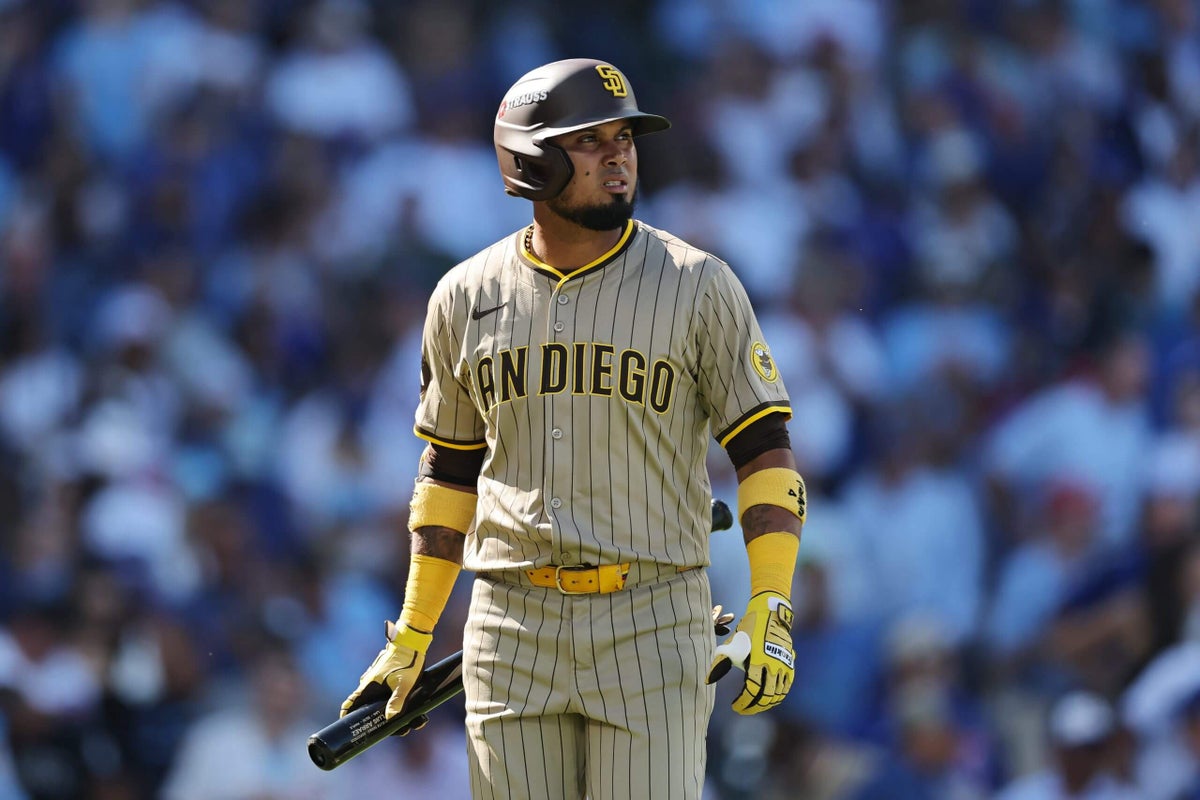
Luis Arraez led the National League with 181 hits last season. He struck out in just 3.1 percent of his plate appearances. Some players are throwbacks. Arraez is a time warp.
Truly, there is no player like him in today’s game. Load his page on Baseball-Reference.com and look under “similar players” and you’ll encounter names like Taffy Wright, Jo-Jo Moore and Lew Fonseca, all of whom finished their careers around the time the New Deal was still new.
It’s important to note that Arraez won three consecutive batting titles from 2022 to 2024. It’s instructive to note that he won them for three different teams. With contact skills suited for the Roaring ’20s, along with an almost total lack of power and defensive abilities that come with a blindfold sold separately, Arraez is both a star player and a liability. And there’s absolutely no agreement among major-league executives, coaches and pundits at how to value him.
The San Francisco Giants boldly pegged a value to Arraez on Saturday. They reached an agreement with the 28-year-old contact-hitting savant on a one-year, $12 million contract, a club source confirmed. They intend to make him their everyday second baseman.
New infield coach Ron Washington will earn whatever the Giants are paying him.
The Arraez signing, which was first reported by ESPN’s Jorge Castillo and is pending a physical, would bump Casey Schmitt off second base and appear to complete an offseason in which the Giants bypassed the most expensive players on the open market, experienced frustration on the trade front and turned to second-tier free agents to address their roster deficiencies.
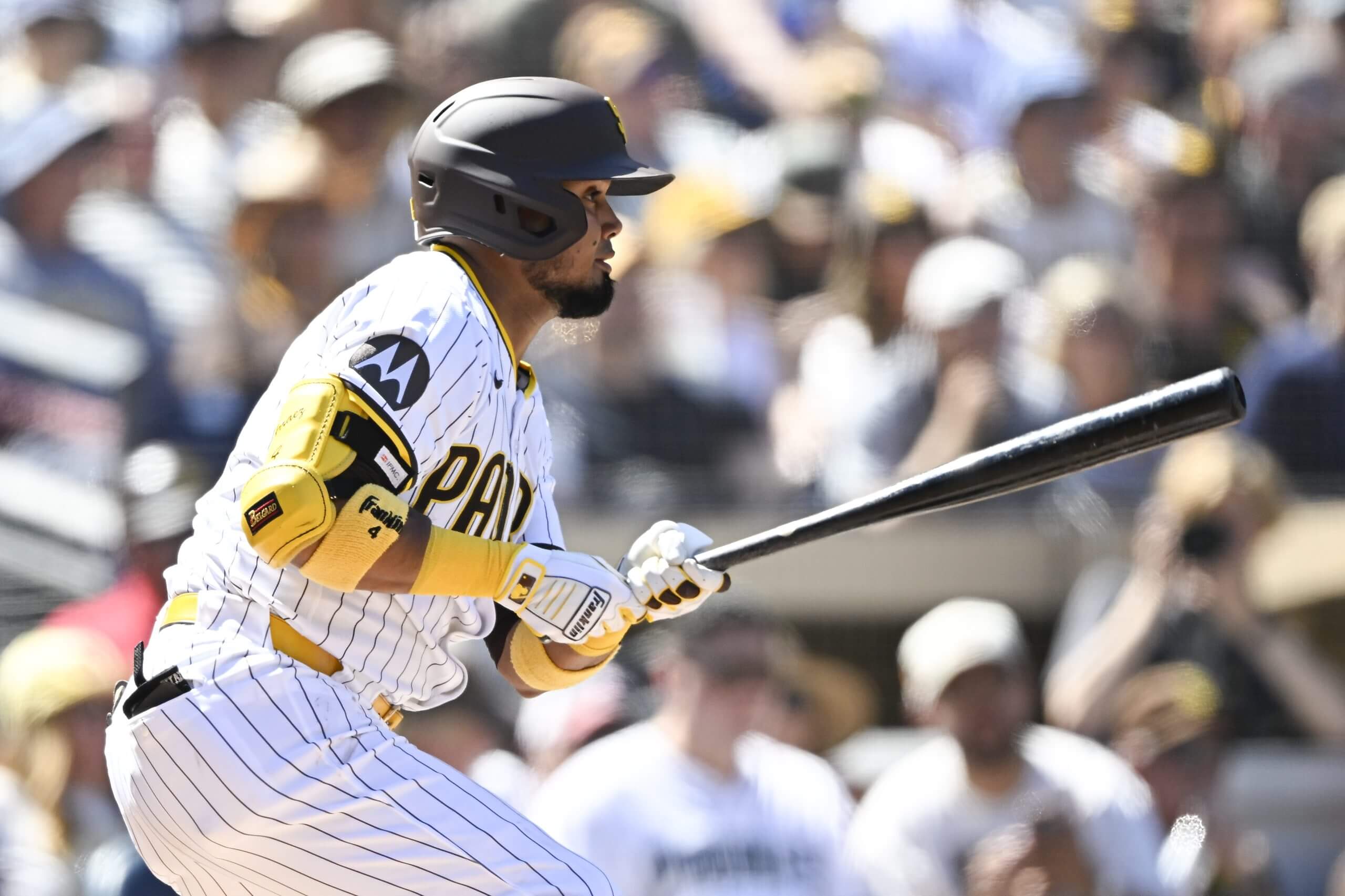
Luis Arraez led the National League with 181 hits in 2025. The Giants will be his fourth team in the last five seasons. (Denis Poroy / Imagn Images)
That’s not to suggest that the Giants didn’t spend money. They gave out eight-figure deals to Arraez, outfielder Harrison Bader (two years, $20.5 million), right-hander Tyler Mahle (one year, $10 million) and right-hander Adrian Houser (two years, $22 million plus a $12.5 million club option). The Arraez contract would put them on the doorstep of the first luxury-tax threshold of $244 million, too.
The Giants’ offseason was the best that president of baseball operations Buster Posey and general manager Zack Minasian could do while operating under an ownership prohibition to stack another long-term contract on top of their core of Rafael Devers, Willy Adames, Matt Chapman and Logan Webb.
As a result, concessions were made and messages were mixed. A day after Bader appeared on a conference call with reporters and pledged to upgrade an outfield defense that was the worst in the National League last season, the Giants appeared to trade defensive value for Arraez’s contact-hitting abilities. Offering second base to Arraez might have been a prerequisite to an agreement; Arraez mostly played first base for the San Diego Padres last season, and multiple reports indicated that he expressed a desire to return to the middle infield, where he made All-Star teams with the Minnesota Twins, Miami Marlins and Padres.
Arraez is a .317 lifetime hitter in an era .300 hitters have sustained massive habitat loss. But even he couldn’t reach that mark last season. He batted .292 with 30 doubles, four triples and eight home runs while accumulating just 1.2 bWAR. He has never scored as many as 90 runs in a season or driven in 70. He also struck out just once per 29.5 at-bats — the lowest strikeout rate by a major-league hitter since Hall of Famer Tony Gwynn (35.7) in 1995. Arraez, Gwynn and Bill Buckner are the only players in the post-expansion era (1969 to the present) to post an AB/SO rate of better than 29.5 at-bats.
Yet Arraez’s one-year deal is well below the two-year, $30 million contract that The Athletic’s Tim Britton projected in November.
It’s not a surprise that the Giants valued his contact skills. Ever since Posey took over in October 2024, the organization has made a concerted effort to pack its minor-league system with contact hitters, spending high draft picks on collegians such as Gavin Kilen (Tennessee) and Trevor Cohen (Rutgers), who posted high averages and low strikeout rates.
Posey knows firsthand what kind of impact those skills can make. He watched Marco Scutaro spark the World Series championship team in 2012, hitting .362 following a midseason trade from the Colorado Rockies and then hitting .500 while winning MVP honors in the National League Championship Series against the St. Louis Cardinals.
It will be up to new manager Tony Vitello to determine where Arraez slots in a lineup that appears well balanced with four left-handed hitters (Arraez, Devers, Jung Hoo Lee and perhaps Bryce Eldridge), four right-handed hitters (Adames, Chapman, Bader, Heliot Ramos) and switch-hitting catcher Patrick Bailey. If the Giants determine that Eldridge isn’t ready to begin the season in the big leagues, the presence of Arraez as a DH would make it easier to start their 21-year-old power-hitting prospect at Triple-A Sacramento.
Who knows? Maybe the Giants will even bring back the ol’ hit-and-run play.
It’s reasonable to assume that Schmitt, if he isn’t traded, would get starts at second base against left-handed pitching. On those days, Arraez would loom as a potentially interesting bench bat.
How valuable will that bat be? One stat might capture the dichotomy of thought better than any other: OPS+, which controls for park and league, is rated on a scale that assigns a value of 100 to a league-average offensive player. Last season, despite rapping out more hits than any other National League player, Arraez’s OPS+ graded out as 99.