
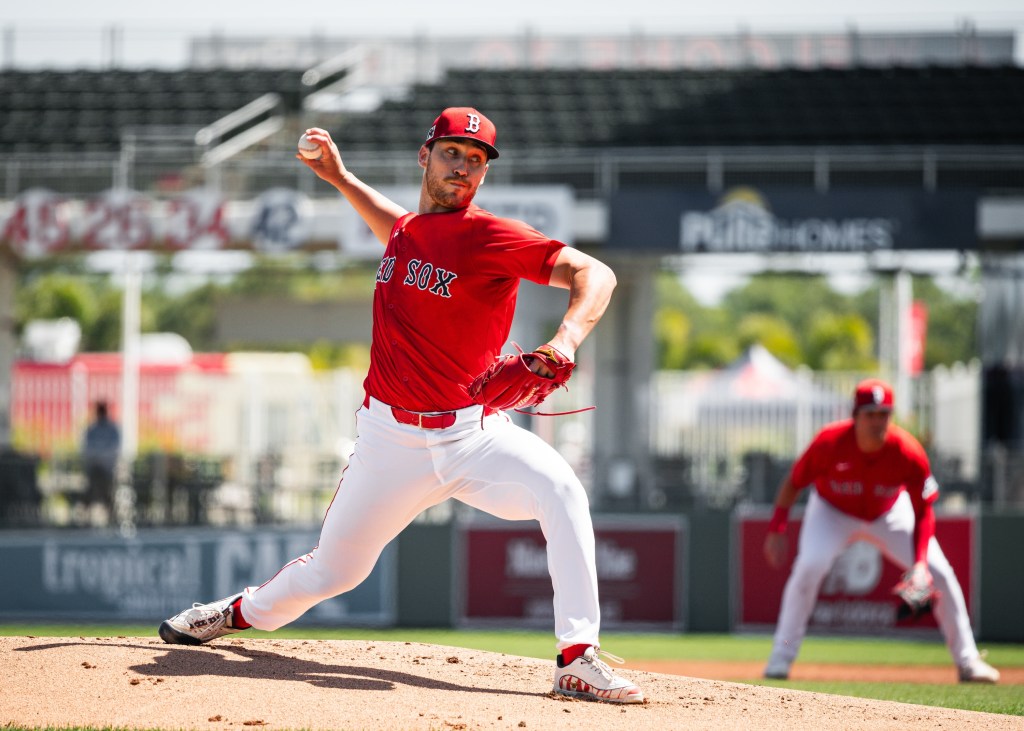
Jordan Hicks arrived in Boston as part of a salary-dump trade last June, and departed the same way Sunday, when the Red Sox dealt him and pitching prospect David Sandlin to the Chicago White Sox for pitching prospect Gage Ziehl.
The clear benefit for the Red Sox is getting under the second competitive balance threshold (CBT), by approximately $3 million. The San Francisco Giants signed Hicks, 29, to a four-year, $44 million contract for the 2024-27 seasons, and he’s guaranteed $12.5 million for each of the remaining two years. The terms of Sunday’s trade reduce the righty’s impact on Boston’s luxury tax payroll to $4 million per year.
Hicks also struggled mightily after the Red Sox acquired him, lefty Kyle Harrison, and prospects Jose Bello and James Tibbs III from the Giants for Rafael Devers last June. The Red Sox pursued the hard-throwing righty reliever in free agency before the ‘24 season, and were co-finalists with the Giants to sign him, with both clubs interested in moving him to the rotation.
Starting didn’t work out for Hicks, who owned a 6.47 ERA over nine starts and four relief outings totaling 48.2 innings – and was on the injured list – at the time of the Devers trade. Hicks subsequently pitched to a 8.20 ERA over 21 relief appearances and just 18.2 innings before the Red Sox placed him on the injured list in early September. Though one of the game’s hardest throwers, with a 92nd MLB percentile in fastball velocity last year, he statistically ranked among the worst in pitching run value, walk and strikeout rates, and a slew of other key metrics.
Thus, unloading Hicks and the majority of his contract should benefit the Red Sox, who now have two open spots on the 40-man roster as well. (Ziehl, 22, does not require a roster spot as he only made his professional debut last year.)
Yet two things can be true at once. The Red Sox may very well be better off without Hicks, but have they been better off since trading Devers, which is what spawned the Hicks problem in the first place?
Is this another case of addition by subtraction, or simply a reminder that the Red Sox are still attempting to clean up last year’s mess? And are their efforts not only costly, but thus far somewhat in vain?
The Giants were willing to take on the entire remainder of Devers’ behemoth contract, in part because the Red Sox agreed to do the same with Hicks.
But San Francisco also gained a powerful slugger with postseason chops, exactly what they were looking for after missing out on several free agency snafus, including Aaron Judge and Carlos Correa. Devers looked like a lock for his fourth career All-Star selection and was leading the Red Sox with 15 home runs. Through 73 games before the trade, he batted .272, slugged .504, and got on base at a .401 clip that was 40 points better than his single-season best in ‘19. (Even though he posted a .347 OBP with the Giants, his Red Sox mark cushioned the blow and he finished the year with a new career-high .372.)
Devers may have underwhelmed in his first half-season with the Giants, but he has plenty of time to redeem himself there. Meanwhile, it took seven months for the Red Sox to ship out two-fourths of the players they received for him. Tibbs went to the Los Angeles Dodgers for Dustin May, whose time with the Red Sox went about as well as Hicks’.
Moving Hicks cost the Red Sox $8 million, Sandlin, and a pair of players to be named later. Chicago will send Boston a PTBNL in return, but Boston comes out of the exchange another man down regardless. Those are the breaks when salary-dumping a struggling player versus a bonafide superstar.
Baseball American ranked Ziehl Chicago’s No. 21 prospect, while Sandlin was Boston’s No. 11. The Red Sox valued the latter highly, though he struggled when they attempted to move him to the bullpen in Triple-A late last summer. So do the rebuilding White Sox, who feel Sandlin can be an impact arm for them as early as this season. Even if gaining him required assuming the majority of Hicks’ salary and the task of resetting him.
So many roads, so many Red Sox issues, lead back to Devers. The lineup was power-deficient without him last year. As the Red Sox fell to the New York Yankees in a three-game Wild Card series, thoughts of Devers, who always dominated them and in their Bronx stadium, were inescapable.
The ripple effects of trading Devers will continue for years to come. They’ve certainly come in waves this offseason, as the Red Sox continue seeking infield and offensive upgrades, and especially as they failed to re-sign Alex Bregman, Devers’ unwitting co-star in this saga.
The Red Sox have discussed trading Masataka Yoshida, which would create flexibility in the designated hitter spot. Yet if this is what it took to complete a Hicks trade, imagine the stipulations of a Yoshida trade. He’s owed $18.6 million for each of the final two years of his five-year, $90 million contract, and $18 million on the luxury tax payroll. Though a strong hitter when healthy, a shoulder injury in ‘24 and overcrowded outfield last year forced him into a bat-only role; he’s played six defensive games over the last two seasons.
Salary dumps can be extremely beneficial for a team. But in the case of Devers, and thereby Hicks, the Red Sox are a long way off from looking like they came out on top.