
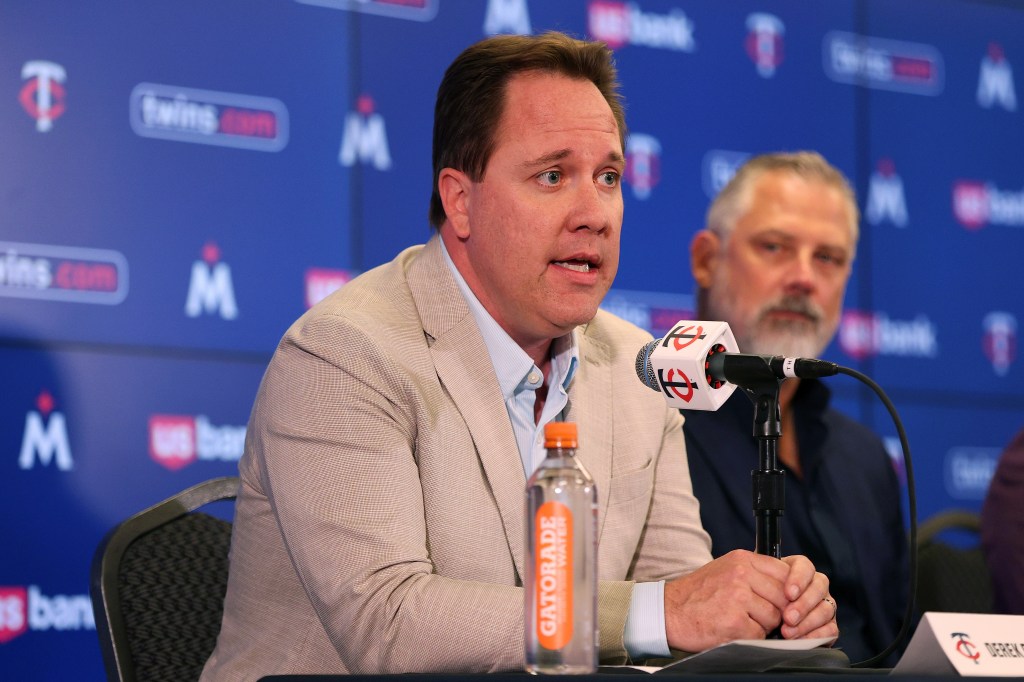
As Derek Falvey began his last media availability as a member of the Minnesota Twins organization — a Zoom call with a gaggle of reporters — midday Friday, he couldn’t help but think back to his first in November 2016.
Falvey, then 33, remembers nervously sitting at a table alongside owner Jim Pohlad and general manager Thad Levine and team president Dave St. Peter when late newspaper columnist Sid Hartman, then in his mid-90s, set down his old-time recorder. Falvey then remembers Hartman asking a question that essentially amounted to “What makes you such a genius?”
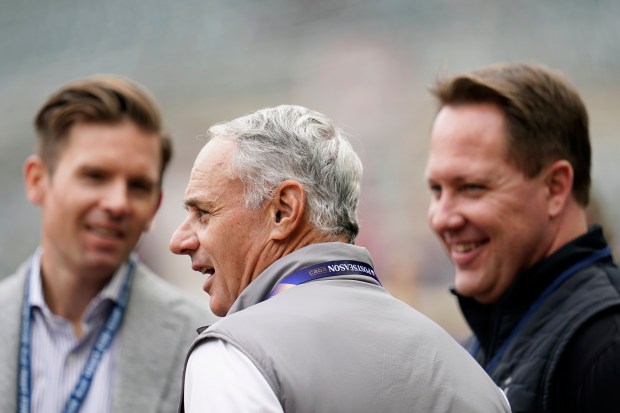 FILE – MLB Commissioner Rob Manfred, center, talks with Twins executive chair Joe Pohlad, left, and president of baseball operations Derek Falvey before Game 2 of an AL wild-card baseball playoff series between the Twins and the Toronto Blue Jays Wednesday, Oct. 4, 2023, in Minneapolis. (AP Photo/Abbie Parr)
Only time would tell.
Falvey had just been coming off a run as the then-Cleveland Indians assistant general manager where he had helped construct a roster that reached the World Series. Hired by the Twins to take over their baseball operations department, the ensuing nine years would be a mixed bag for Falvey, who oversaw four playoff teams and three division titles while leading the organization through some turbulent times, especially of late.
Falvey departed the Twins organization on Friday, a mutual decision between him and Tom Pohlad, who took over as the Twins executive chair from his brother, Joe, six weeks earlier.
“I hope I came in and I made it better and I leave it better than I found it,” Falvey said.
At the time Falvey stepped into the role, the Twins were coming off of a dreadful 103-loss season, one which earned them the No. 1 overall pick, which was used to draft Royce Lewis.
Falvey and co. quickly started the process of modernizing the Twins’ baseball operations department. They turned the team around, nabbing a Wild Card before a quick postseason exit. The Twins finished in second place but under .500 in the second year of the Falvey regime, which led to the dismissal of manager Paul Molitor.
First-time manager Rocco Baldelli was quickly hired to replace him, forming a bond with Falvey and leading the Twins to a 101-win season. But the Bomba Squad, which set the record for the most home runs in a single-season at the time, was quickly swept out of the playoffs by the New York Yankees.
“Playing the type of baseball we did with some fantastic players and staff and everybody around, that was awesome,” Falvey said. “Then you kind of hit a screeching halt.”
The 2020 season forced Falvey to lead through many unknowns, beginning in March when COVID-19 forced spring training to shutdown. That same summer, some of the largest protests in United States history started in the Twins’ backyard after George Floyd was killed by a Minneapolis police officer.
Major League Baseball picked back up again months later, playing a 60-game shortened season. The Twins won their division but, again, met a quick playoff demise, swept by the Houston Astros.
“That was the moment you really learned how to lead through real difficult circumstances,” Falvey said. “Link arms, figure out how to navigate through it.”
The 2021 season saw the Twins miss the playoffs again, selling players like José Berríos and Nelson Cruz at the deadline. The Cruz deal ended up being likely the best in Falvey’s time with the Twins, as he acquired all-star starter Joe Ryan, then a minor leaguer, for the veteran slugger, who was just months from free agency.
Falvey had taken a big swing for Josh Donaldson before the 2020 season, signing the former MVP to the largest free agent contract in team history. The deal didn’t work out as planned and the Twins dumped the final two years of the polarizing third baseman’s contract on the New York Yankees, eventually using some of that money to surprise everybody in the middle of the night about a week and a half later by inking shortstop Carlos Correa to a deal.
That same March, the Twins swung a trade for all-star pitcher Sonny Gray, who, along with Pablo López, acquired the next winter for Luis Arraez, would help lead the Twins back to the postseason in 2023. With Correa back in the fold after failing physicals with two other teams, the Twins captured yet another division title, this time snapping an 18-game postseason skid — longest in major league history — and won a playoff series for the first time in 21 years.
“When we had that series against Toronto here, I’ll never forget the way the fans made me feel inside this park,” Falvey said. “(It) reminded you of every reason you do it. … This ballpark, it was absolutely on fire, and I’ll never forget that.”
But the years after that have been an exercise in “what could have been.” Ownership slashed payroll by about $30 million that offseason in response to its growing debt. With fan morale at its highest, the Twins let Gray walk in free agency and did not invest in a roster that had gone further in the playoffs than any Twins team since 2002.
“I’ll always regret not doing more and not finding a way for us to win more with the group that we had,” Falvey said. “I felt it was talented. There were real players on that team that could make an impact, not just in the regular season, but in the postseason, and we didn’t. That will hang with me for too long, because … when you don’t achieve what you think the group is capable of, it just beats you up.”
The next season saw the Twins completely fall apart in the final six weeks, at the end of which an emotional Falvey choked back tears and vowed to figure out “how we never let that happen again.” That same day, then-executive chair Joe Pohlad defended the “very difficult business decision” that he had made before the season to cut payroll.
An offseason last winter with little financial investment from ownership — which at the time was exploring a sale of the club — led to some uncertainties while roster building and, ultimately, another fourth-place finish. Included in the 2025 season was a massive selloff: 10 major leaguers were shipped out of town as the Twins dumped Correa’s salary and stripped their bullpen to the studs.
The Twins fired Baldelli in October and introduced new limited partners and moving Tom Pohlad into the leadership role. And though they’ve made some modest additions this offseason, the payroll is yet again expected to be around $100 million, and the bullpen still has major question marks 10 days before pitchers and catchers report to Fort Myers on Feb. 12.
But now, instead of Falvey leading the Twins through those obstacles, it will be Jeremy Zoll’s responsibility.
“There have been some challenging times along the way. Everyone has challenges in the game, though. No one feels sorry for you,” Falvey said. “You just keep going forward, and I think we did, collectively as an organization, the best we could do in all kinds of different circumstances.”