

In less than two weeks, pitchers and catchers will report to the Lee Health Sports Complex in Fort Myers, serving as the unofficial start to the 66th season of Minnesota Twins baseball. Understandably, angst, uncertainty, and pessimism will be the forefront emotions of many who follow the club. Still, reasons for optimism will manifest this spring, with the club’s starting rotation being the most likely source to bring that trait to light. Barring injury or an unforeseen trade, Pablo López and Joe Ryan will operate as co-aces of the five-pitcher unit, creating one of the most formidable frontline duos in baseball. Experienced righties Bailey Ober and Simeon Woods Richardson will likely occupy the third and fourth spots, respectively. Interestingly, the club has four more starting pitchers with major league experience on its 40-man roster. However, only one of those four arms will win the final rotation spot, creating one of the more fascinating Spring Training competitions in recent Twins history.
Taj Bradley, Zebby Matthews, David Festa, and Mick Abel are the four arms set to compete for the fifth rotation spot. Luckily, all four pitchers have minor league options remaining, meaning Minnesota won’t need to make any drastic 40-man roster decisions before flying to Baltimore in late March. Still, deciding which arm to hand the fifth rotation spot to will be an incredibly consequential decision as the Twins try to avoid starting their 2026 campaign on the wrong foot, as they did in 2024 and 2025. As noted earlier, Twins decision-makers could demote the three pitchers who lost the camp competition to Triple-A St. Paul, with that trio headlining the Saints’ rotation. Interestingly, one of the four rotation hopefuls could still make an immediate impact on the major league club, just not in the role he entered Spring Training vying to win.
David Festa’s Stuff
Making his major league debut with Minnesota in 2024, Festa has struggled during his first two seasons, generating a 5.12 ERA and 4.27 FIP over 117 2/3 innings pitched. The primary reason behind Festa’s struggles in the majors, so far, is that his four-seam fastball has been ineffective. Thrown a combined 36% the past two seasons, hitters have generated a .344 batting average against the 25-year-old’s fastball. Alongside hitting the pitch often, batters have also done a meaningful amount of damage with the pitch, evidenced by the pitch surrendering a .609 slugging percentage last season. On average, major league fastballs thrown by right-handed pitchers move eight inches toward same-handed hitters while dropping 15 inches. Festa’s moves only two inches while dropping 13 inches. His fastball is flat, so hitters can see it clearly as it enters the zone. A lack of four-seam shape and movement can work if a pitcher generates above-average velocity (i.e., Paul Skenes). Yet, given that Festa’s average four-seam velocity is below-average alongside being flat, hitters are able to tee off on the pitch, despite him being able to consistently locate it high in the zone.
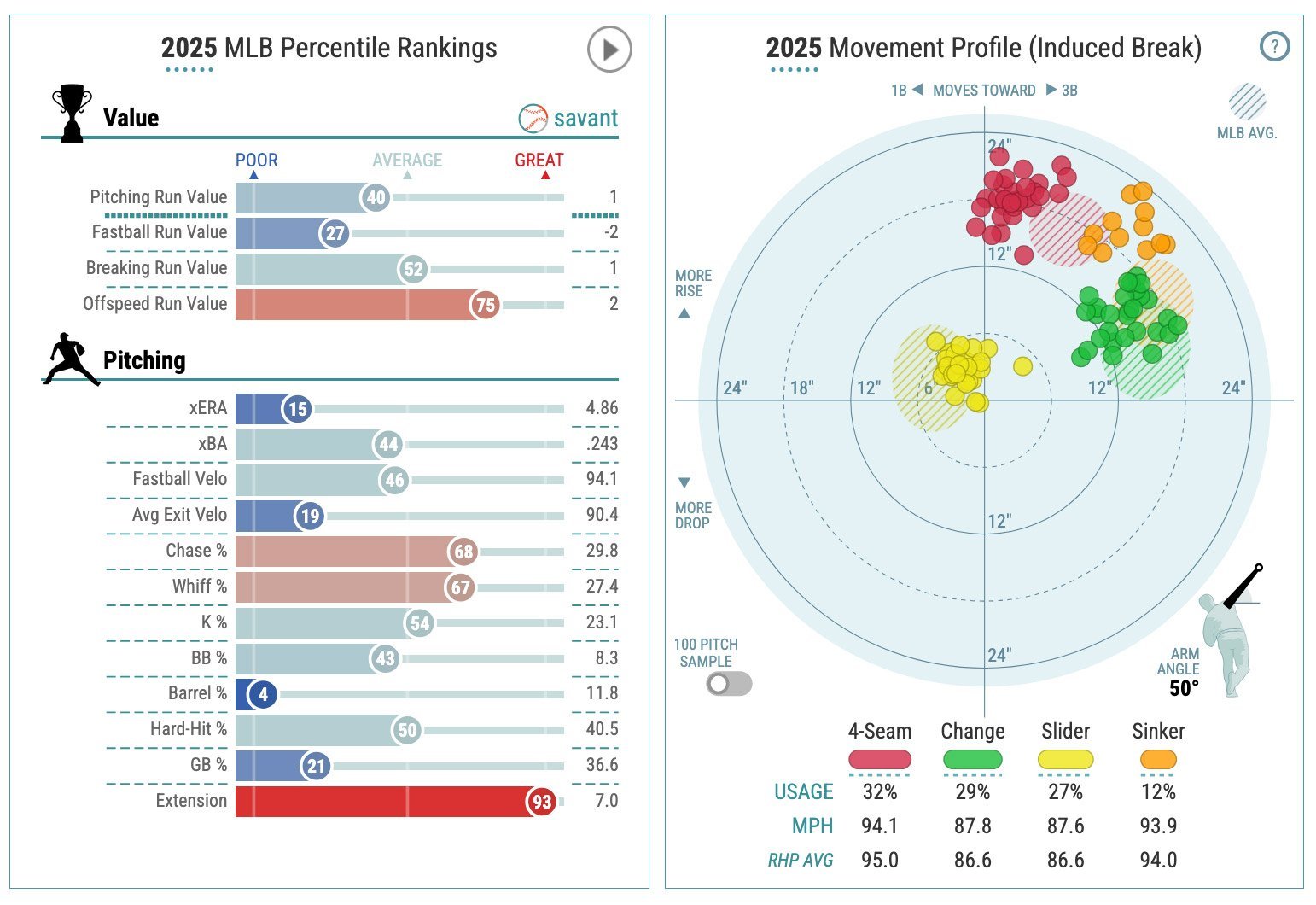
Fortunately, the Seton Hall product’s breaking and offspeed pitches are far more effective, functioning as driving forces in the minimal success he has generated in the majors. Last season, Festa threw his change 29% of the time, nearly matching his four-seam usage rate. Unlike his four-seam, however, the right thrived with his change, posting a .113 batting average against while throwing it 256 times. Festa primarily threw the pitch low in the zone against left-handed hitters. Lefties often swung over the pitch, often whiffing or dribbling the ball to the right side of the infield, evidenced by his impressive .274 slugging percentage against. Festa’s change also functioned as his put-away pitch, evidenced by him generating 26 strikeouts and a 23.2% put away rate.
David Festa’s Pitch Arsenal
His slider (thrown 27% of the time) was similarly effective. However, he primarily threw his breaking pitch to right-handed hitters. Festa generated a .231 batting average against and a .423 slugging percentage against with his slider. Yet, underlying metrics undermine his success with the pitch, evidenced by his generating a .550 expected slugging percentage against (xSLG) and a .359 expected weighted on-base average (xWOBA) with the pitch. For reference, his four-seam manufactured a .568 xSLG and .418 xWOBA. Festa often caught too much of the plate with his slider when throwing it to right-handed hitters. Similar to his four-seam, Festa’s slider lacks horizontal movement, meaning hitters can see it well as it crosses the plate. That being the case, right-handed hitters generated a lot of damage against his slider, making it an ineffective secondary pitch.
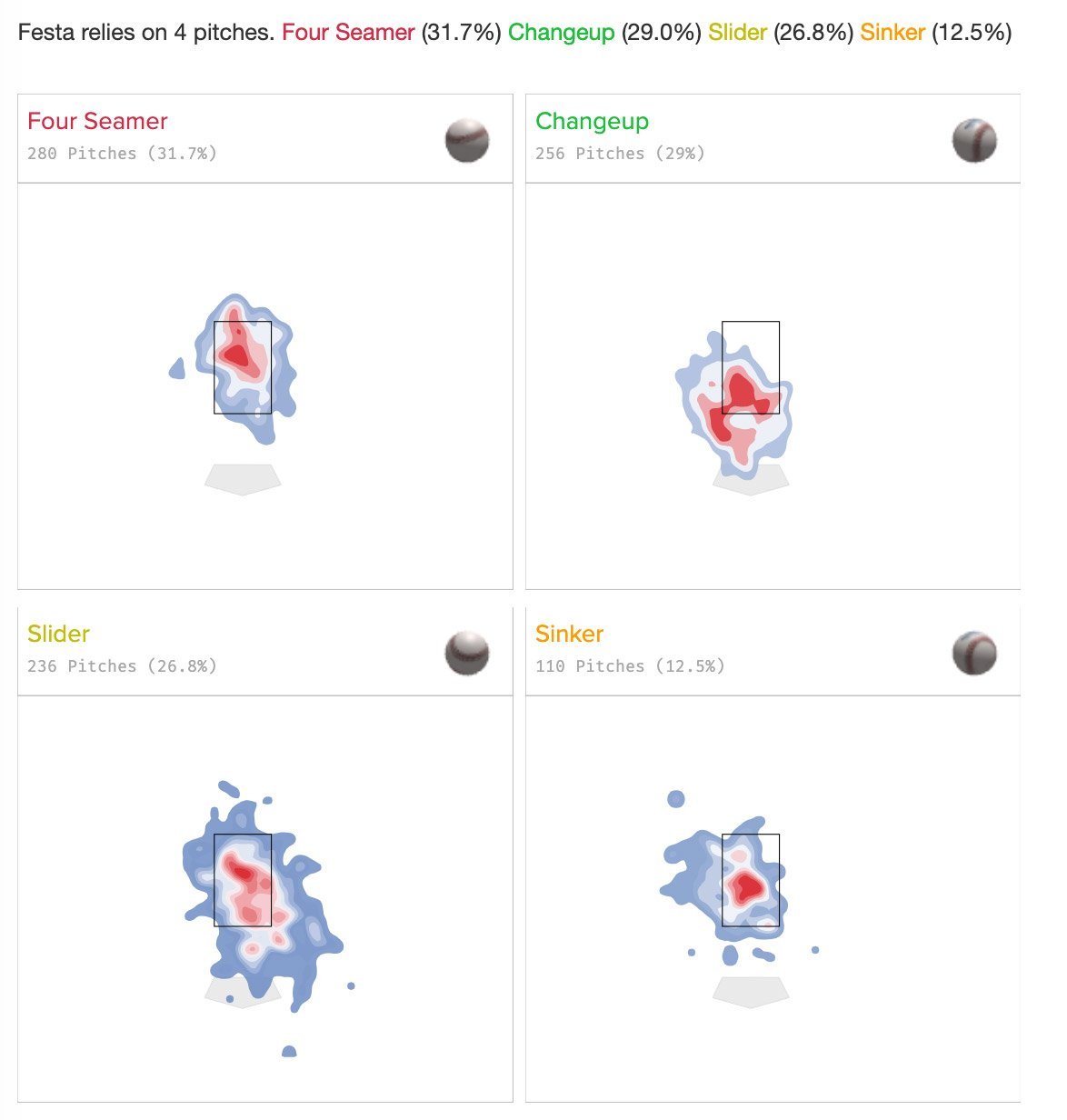
Given the plus nature of his change, Festa has somewhat surprisingly been more effective against left-handed hitters of the course of his career, evidenced by lefties generating a combined .305 wOBA the past two seasons compared to righties posting a .322. Being 6’6”, Festa has one of the highest release points in baseball, releasing the ball six feet from the ground on average. Given his lanky frame, Festa also sports one of the highest extension rates in the sport, shortening the distance between him and the batter. Unfortunately, the lanky righty’s height-driven advantage has been nullified by his throwing at a 50-degree angle, one of the highest release points in baseball. As noted earlier, Festa often throws his four-seam high in the zone. Throwing the pitch high in the zone from a high arm slot is what makes the pitch flat and, therefore, ineffective. Also, releasing breaking pitches from a high arm slot creates less horizontal movement, explaining the ineffectiveness of his slider. Interestingly, his high arm slot is likely the driving factor in his change being so effective, given that he can drop the pitch in from such a high release point.
Year
Pitch Type
#
# RHB
# LHB
%
MPH
PA
AB
H
1B
2B
3B
HR
SO
BBE
BA
XBA
SLG
XSLG
WOBA
XWOBA
EV
LA
Spin
Ext.
Whiff%
PutAway%
2025
Four Seamer
280
120
160
31.7
94.1
76
64
22
13
5
0
4
9
56
.344
.309
.609
.568
.447
.418
90.1
26
2416
7.0
14.1
16.1
2025
Changeup
256
91
165
29.0
87.8
67
62
7
3
1
0
3
26
36
.113
.134
.274
.302
.201
.221
85.7
19
1758
6.9
44.0
23.2
2025
Slider
236
154
82
26.8
87.6
55
52
12
8
1
0
3
16
36
.231
.263
.423
.550
.300
.359
91.3
19
2595
6.9
32.2
20.5
2025
Sinker
110
73
37
12.5
93.9
31
26
8
8
0
0
0
2
25
.308
.301
.308
.435
.319
.365
92.2
7
2297
7.0
13.0
25.0
2024
Four Seamer
442
242
200
40.2
94.7
93
79
24
13
7
0
4
23
56
.304
.265
.544
.514
.410
.385
91.3
18
2349
7.0
19.4
21.3
2024
Slider
349
244
105
31.8
86.1
97
92
19
13
3
2
1
26
66
.207
.236
.315
.394
.246
.292
90.2
13
2564
6.8
29.1
20.2
2024
Changeup
308
116
192
28.0
88.4
87
80
19
10
4
1
4
28
53
.238
.203
.463
.329
.319
.262
85.9
13
1839
6.8
39.4
23.0
What Should Be David Festa’s Role In 2026?
Given Minnesota’s surplus of starting pitching depth and Festa’s struggles the past two seasons, the lanky 25-year-old would be best used in a short-relief role, with the Twins’ pitching development staff working with him to lower his arm slot to maximize his four-seam and slider. If converted into a short relief role, the 25-year-old could add velocity to his four-seam, potentially bumping the pitch up to 96-97 MPH. As mentioned earlier, pitchers can make flat four-seams work with increased velocity. Festa would likely be able to sustain increased four-seam velocity pitching in a one-inning role. Also, minimizing his workload would allow him to maximize his slider, adding more break and velocity to the pitch. If he is able to refine his four-seam and slider while continuing to sport an elite change, Festa could quickly become Minnesota’s most effective reliever, given how little high-end talent presently resides in the club’s bullpen.