
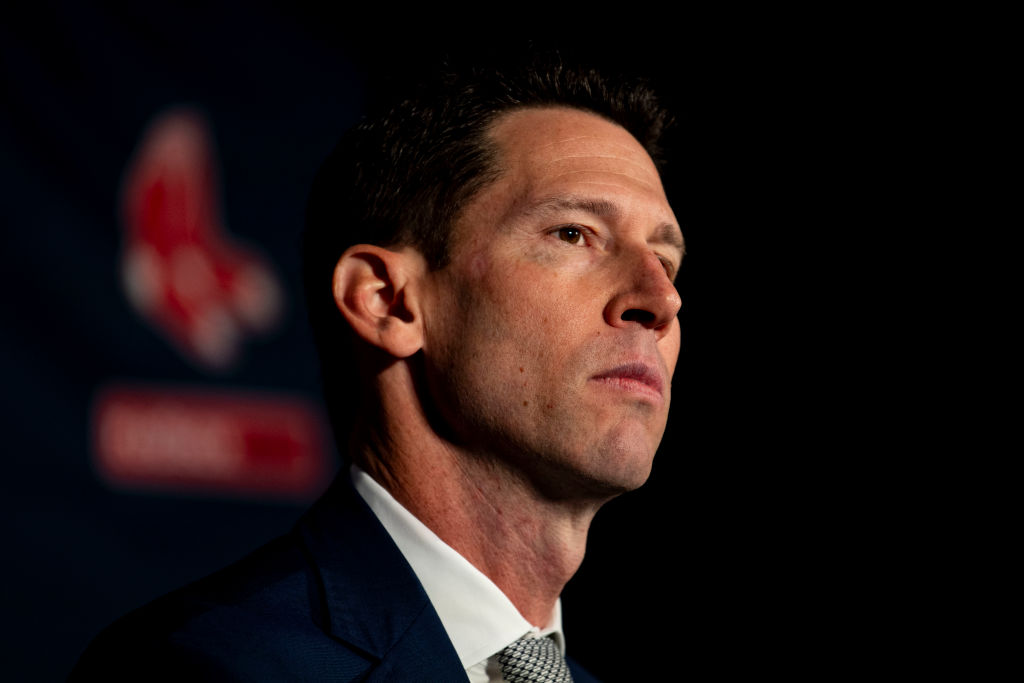
The Red Sox and White Sox have made five trades between them since Craig Breslow and Chris Getz have been running their respective front offices.
The latest came on Sunday, when the Red Sox foisted the salary of Jordan Hicks, along with pitching prospect David Sandlin and two players to be named later, to the White Sox in exchange for pitching prospect Gage Ziehl and a player to be named later. The Sox are also sending $8 million to the White Sox as part of this trade.
Boston had been looking around the league for a team willing to take on the remaining two years and $24 million of Hicks’ contract, which they acquired from the Giants in the Rafael Devers trade last Father’s Day. For all intents and purposes, it was a salary dump for the Giants, who took on all of the remaining money owed to a disgruntled Devers.
Hicks’ only season in Boston was a disaster. The high-octane reliever posted an 8.20 ERA over 18 2/3 innings with the Sox, after recording a 6.47 ERA across 48 2/3 innings with the Giants. Boston had long been enamored with Hicks, dating back to when he was a free agent two offseasons ago. The Red Sox were one of many teams pursuing the right-hander before he signed a four-year, $48 million deal with the Giants and received the opportunity to start.
To unload Hicks, the Sox had to part with pitching prospect Sandlin, whom they acquired back in 2024 during spring training in a trade with the Royals for reliever John Schreiber. At the time, Boston’s pitching pipeline was still in its infancy stages, and Breslow was intent on adding young arms with high upside.
When the Sox acquired Sandlin, Breslow immediately identified him as someone who had the makeup to become a big-league starter.
“We had identified (him) early on as someone that we think is on the rise and has the makings of a legitimate starting pitcher,” Breslow said after the trade back in Feb. 2024. “Loved the stuff, loved the makeup and we’ve seen the stuff take a pretty significant step forward. Anytime you make these trades, you have to recognize that we’re trading a really talented pitcher over there and that was difficult. Certainly wasn’t an easy decision. But like I said, I feel like my job is to do what is best for the organization. And I think this is a chance to do that.”
Since then, Sandlin has been a mixed bag when it comes to results. Boston added him to the 40-man roster this winter, protecting him from the Rule 5 Draft. While in the Red Sox’ system, Sandlin was used as both a starter and a reliever. He was mainly used out of the bullpen to piggyback on starters in the minors before being moved to the bullpen for the WooSox, in hopes his power fastball would play similarly to the path Zach Penrod took to the big leagues with Boston.
Sandlin made 13 starts (17 games) for Double-A Portland and posted a 3.61 ERA with 86 strikeouts before earning a promotion to Worcester. His time with the WooSox wasn’t memorable, as he recorded a 7.61 ERA in 15 games, including one start.
There’s a lot to like about Sandlin’s makeup on the mound. He offers a four-pitch mix led by a fastball that sits between 96–99 mph, a slider that sits 90–93 mph, an 85–88 mph sweeper, and an 88–91 mph splitter. His heater is his bread and butter, and with it topping out at 100 mph, offering plus life and the ability to miss bats, the White Sox could have a real late-inning threat. He’s been one of the more fascinating arms to watch over the last few years, because the floor looks like a late-inning reliever while the ceiling could still point to a mid-rotation starter.
“We view that [with] Sandlin, we get an opportunity to get six years of a controllable starting pitcher, one of the Red Sox’s top prospects. [It] was an opportunity that we didn’t want to pass up,” said Getz.
Chicago is looking at Sandlin as a starter, and Getz believes he’ll contribute to the White Sox starting rotation in 2026.
“When it comes to David Sandlin, he’s a guy we believe has mid-rotation, if not better, type arsenal and stuff,” Getz told reporters following the trade this weekend. “Time will tell. He’s just worked his way up to the upper minors, and he’s going to come into spring training and compete for a spot. Most importantly, he’s got a chance to really impact our starting rotation this year.”
With five trades between them, Breslow and Getz are quite comfortable negotiating with one another and have a strong understanding of each other’s farm systems. The two sides will continue to talk over the course of the season as they decide the final pieces of this trade, with the White Sox set to receive two additional players to be named later and the Red Sox set to receive one.
Ziehl is a mid-level pitching prospect who has now been traded twice early in his career. Drafted by the Yankees in the fourth round out of Miami in 2024, he was dealt to the White Sox at the 2025 trade deadline for outfielder Austin Slater. Ziehl made his professional debut in 2025, starting 16 games primarily at Low-A before finishing the season with six starts at High-A Winston-Salem, where he posted a 4.01 ERA with a 20-to-5 strikeout-to-walk ratio over 24.1 innings. On the year, he recorded a 4.12 ERA, 1.26 WHIP, 90 strikeouts, and 19 walks across 22 outings (21 starts) between Low-A, High-A, and one Double-A appearance.
The Sox’ new pitching prospect doesn’t bring the same velocity profile as Sandlin, but he does offer a 6.5 extension on the mound. Once prospects enter Boston Red Sox’ pitching program, the organization immediately places them on an individualized development plan. Based on how the Red Sox have successfully increased velocity for pitchers like Payton Tolle, Connelly Early, and even Quinn Priester, each hurler saw measurable gains as a direct result of Boston’s developmental approach.
MLB Pipeline has ranked both Ziehl and Sandlin as the No. 14 overall prospect in each of their respective organizations following the trade.
Let’s examine the other four trades that Breslow and Getz have made with one another over the last three offseasons.
Red Sox acquire Garrett Crochet
The most notable trade between the two sides was the Red Sox acquiring future ace Garrett Crochet for four prospects: catcher Kyle Teel, outfielder Braden Montgomery, infielder Chase Meidroth, and pitcher Wikelman Gonzalez.