
The second-to-worst system in baseball did get a big infusion of talent from the 2025 draft and the Angels have quite a bit of talent on this list from the international side, but I hope they look at all of these teenagers and decide to slow things down rather than rushing guys up to the high minors before they’re ready, as they have done with similar prospects in the past.
(Note: Tools are graded on a 20-80 scouting scale; ages as of July 1, 2026.)
1. Tyler Bremner, RHPHeight: 6-2 | Weight: 190 | Bats: R | Throws: R | Age: 22
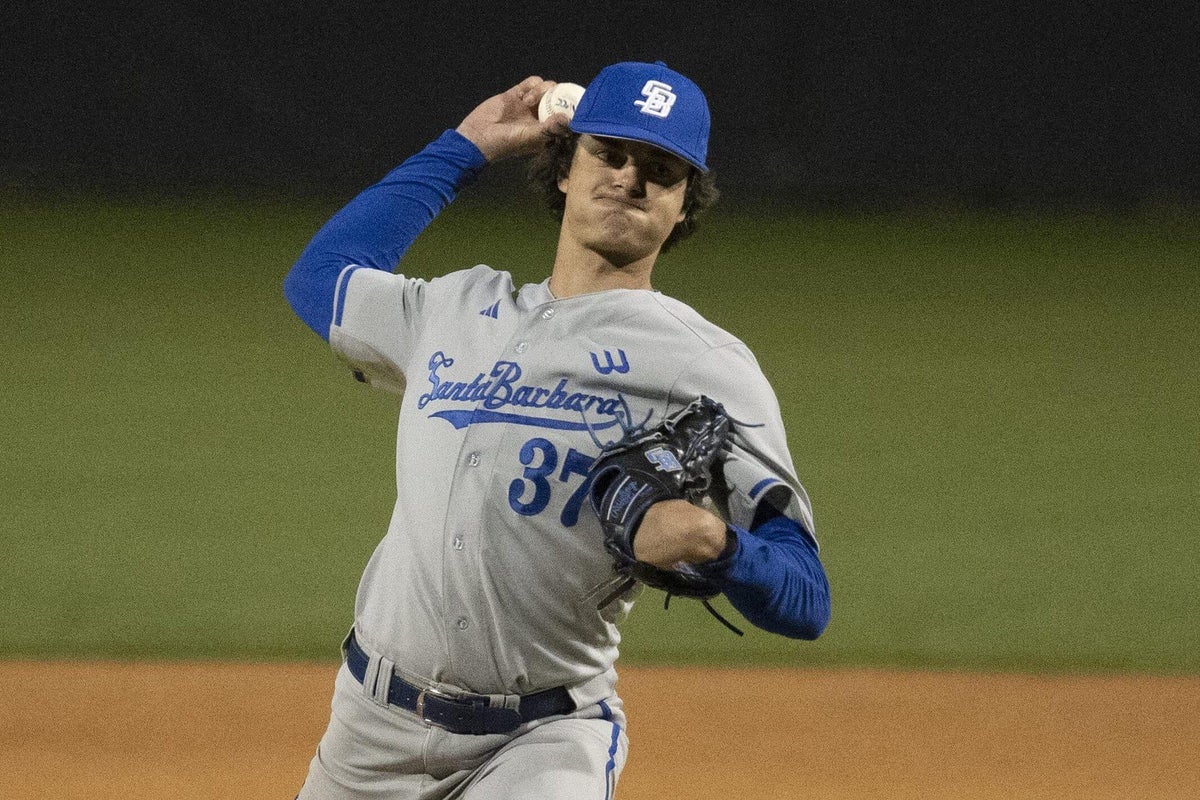
The No. 2 pick in the 2025 draft, Bremner had a rough start to his draft year, getting tagged for seven runs in three innings in one outing by Seattle University, but he finished on an up note, striking out 10 or more in six of his final seven starts. He’s 94-96 with a somewhat flat four-seamer that he needs to locate to the edges of the zone, and his changeup is probably a true 70 already, getting left- and right-handed hitters to whiff. He cuts himself off in his landing enough that he doesn’t finish his slider out front, and generally doesn’t locate anything as well to his glove side. He has plus control already, walking 6.1 percent of batters over his last two years at UC-Santa Barbara.
Bremner also had some true off-field adversity, as his mother had terminal cancer and died last June, which I’m sure affected him on some level on the field, as it would any human. He’s a high-probability big-league starter who doesn’t have a lot of ceiling beyond a No. 3 starter as he currently is; he needs a more effective breaking ball and probably some mild tweaks to the delivery to be a No. 2 starter or better.
2. Nelson Rada, OFHeight: 5-9 | Weight: 185 | Bats: L | Throws: L | Age: 20
Rada started the year in Double A and reached Triple A before he turned 20 in August, making him the only teenage position player to play in more than six games at the minors’ top level in 2025. He’s a plus defender in center with plus speed, stealing 54 bags in 72 attempts (75 percent) on the season, and he showed really good plate discipline despite being too young for his levels. He has no power and barely makes any hard contact right now, with a hard-hit rate of just 18.3 percent in his time in Triple A. He should gain some strength as he gets older, although it’s maybe 45 power as a ceiling.
He could be an everyday player because of the center-field defense, speed and solid on-base skills, profiling as a classic leadoff hitter. If he doesn’t get strong enough, he could still be a No. 9 hitter who doesn’t do much at the plate but is still a 1-2 WAR player thanks to the glove.
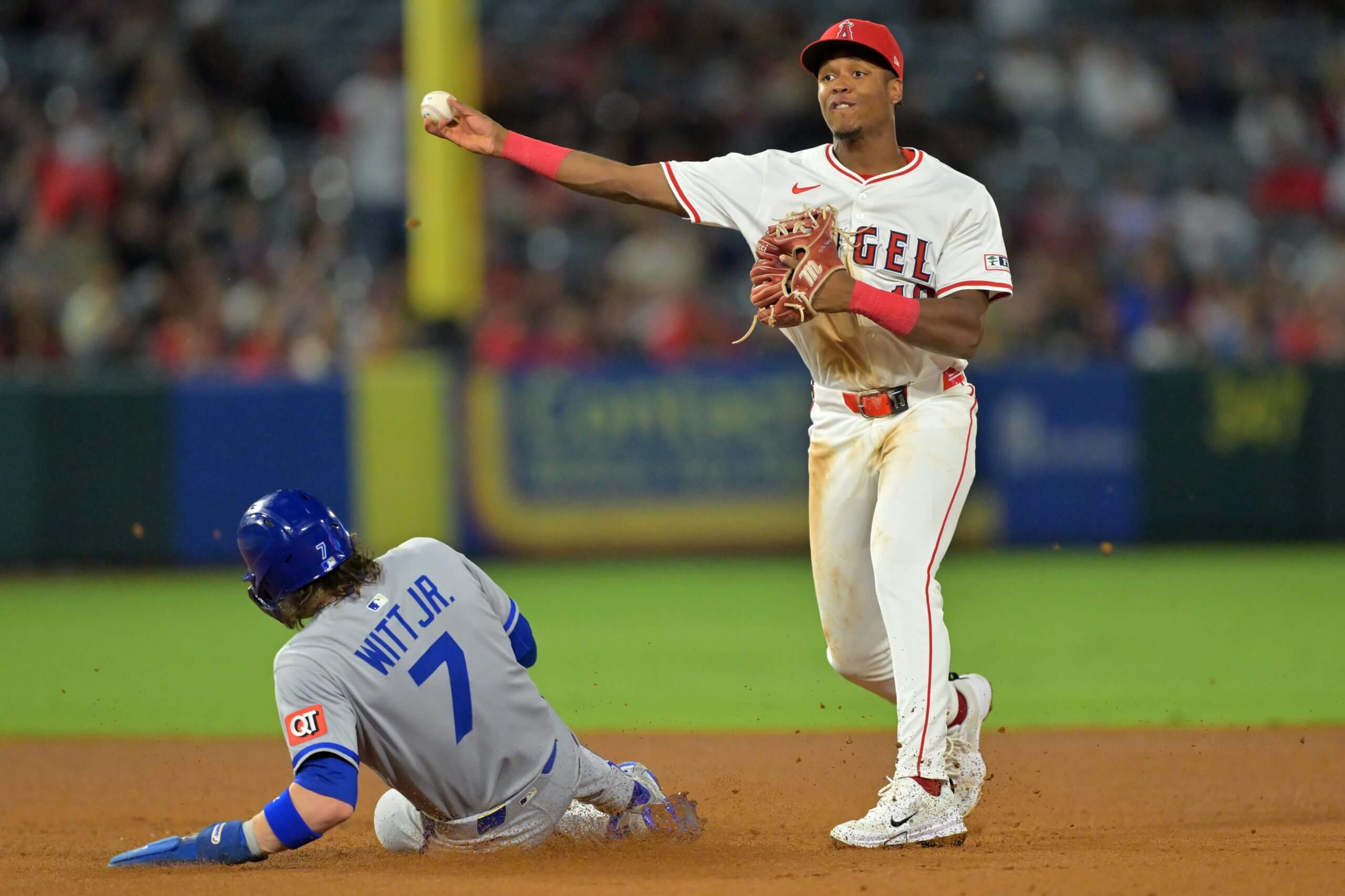
Denzer Guzman (throwing) reached the big leagues ahead of schedule. (Jayne Kamin-Oncea / Getty Images)
3. Denzer Guzman, SSHeight: 6-1 | Weight: 190 | Bats: R | Throws: R | Age: 22
Guzman didn’t belong in the big leagues last year, as he’s really still more projection than present ability; a hitter who strikes out 29.4 percent of the time in the hitter’s environment of Triple-A Salt Lake isn’t going to suddenly make more contact in the majors. He projects as a plus defender at shortstop, and he’s already shown good strike zone awareness, but like a lot of young hitters at higher levels, he doesn’t pick up offspeed pitches very easily and the faster game at Triple A and the majors exposed him a bit on both sides of the ball. He’ll be 22 in February, so the odds of him getting much stronger aren’t high. He should get to about 45 power from about 40 now and be able to hit enough that his defense plays at shortstop, making him a soft regular who could start for maybe half the teams in baseball.
4. Joswa Lugo, SSHeight: 6-3 | Weight: 187 | Bats: R | Throws: R | Age: 19
Lugo had a leg injury that ended his season after 35 games in the Arizona Complex League, although he flashed some explosiveness at the plate and could end up a big-time power bat if he hits his peak physical projection. He’s a shortstop now but he’s going to get big enough that a move to a corner, likely third base, is the probable outcome. In his limited time in the ACL, he did show some feel for the strike zone, with a hilarious .552 OBP off lefties in 29 PA (seven hits, nine walks). He turned 19 in January and has only 88 pro games under his belt, so he should get close to a full year in Low A this season to work on his approach against right-handers and learn to be a hitter for contact first before the power really comes in another year or two.
5. Johnny Slawinski, LHPHeight: 6-3 | Weight: 180 | Bats: L | Throws: L | Age: 19
The Angels pivoted in the draft this year, going for high school pitching after they took Bremner in the first round, a welcome shift from their previous approach that has added some upside to the bottom rungs of their system. Slawinski, their third-round pick last year, was the best prospect of the group, a highly athletic lefty with three pitches, including a low-90s fastball with good carry and a slider that projects to plus. His delivery works and he comes from a lower release height for some added deception. He was a multi-sport guy in high school who may improve simply by playing only baseball, and he’s already started to add some muscle to help him handle a starter’s workload. I thought he was the best pick of their draft class, given where they took him.
6. Chase Shores, RHPHeight: 6-8 | Weight: 245 | Bats: R | Throws: R | Age: 22
The Angels’ second pick last season was the guy who closed out LSU’s College World Series win, and I bet we see him in the majors this year. Shores hits 100 mph with his sinker and has a power slider up to 91, but has nothing for lefties, which is how he lost his rotation spot in Baton Rouge in the first place. The Angels intend to start him, which could be good for his development regardless of his future role — how can you look at a 6-foot-8, 245-pound pitcher pumping 100 mph two-seamers and not want to see if you can craft a starter out of him? If that doesn’t take, he really could help any team in a middle relief role right away.
7. Ryan Johnson, RHPHeight: 6-6 | Weight: 215 | Bats: B | Throws: R | Age: 23
Johnson made the Angels’ Opening Day roster last season and promptly gave up five runs in 1 2/3 innings in his first outing. He stuck around for a month as a reliever, then went to High A and began the first day of the rest of his career by working as a starter for the remainder of the season, posting a 1.88 ERA there in 12 starts with a 4.5 percent walk rate and a 29.7 percent strikeout rate. He had a 12-strikeout shutout — like, nine innings, I saw someone let a pitching prospect throw nine entire innings in a single game and I said, it’s the big one, I’m coming for you Elizabeth — and then the Angels mostly shut him down for the year, other than two short relief appearances after a seven-week gap. His repertoire is almost all fastball/slider, with the slider at least a 55, filling up the zone, with nothing for lefties and a huge platoon split on the season. His arm action is one of the shortest I’ve ever seen, but for now, it works for him. As long as he can find a changeup, splitter or literally anything to neutralize lefties, he can be a starter. Otherwise, he’ll be back in the Angels’ bullpen in a year or so, although with better results.
8. Trey Gregory-Alford, RHPHeight: 6-5 | Weight: 235 | Bats: R | Throws: R | Age: 20
The Angels took Gregory-Alford in the 11th round in 2024 out of high school and paid him over slot, getting him on the mound in games for the first time last year with very promising results. He was 97-100 with the four-seamer, although it’s very straight, and he is working on developing the rest of his arsenal, showing a slider, curveball and changeup already, with a two-seamer probably coming this year. He’s a strong, tall kid with a great frame and he does try to go right after hitters, pitching more with power than feel, probably because his velocity is his best attribute. He’s a long way off, probably four to five years, with high-end upside if it all clicks — the offspeed stuff, the command, the feel and so on.
9. Raudi Rodriguez, OFHeight: 6-0 | Weight: 190 | Bats: R | Throws: R | Age: 22
Rodriguez spent two years in the ACL and did nothing, then moved up to Low A last year as a 21-year-old and hit .281/.372/.470 with 38 steals in 44 attempts, a good showing for a guy who was a touch old for the level, but clear progress over his previous results. Then he went to the Arizona Fall League and hit .433/.514/.650, and while the AFL is a hitter’s league with inherently small sample sizes, Rodriguez gets credit for going from Low A to the desert and hitting better against better arms. He’s twitchy and athletic, playing aggressively on all sides of the ball, with some bat speed but just 45 raw power right now. The most likely outcome is that he’s a solid fourth outfielder who can play all three spots reasonably well and has value on the bases. There’s a small, non-zero chance he’s just a late bloomer who’ll get a little stronger and end up a regular.
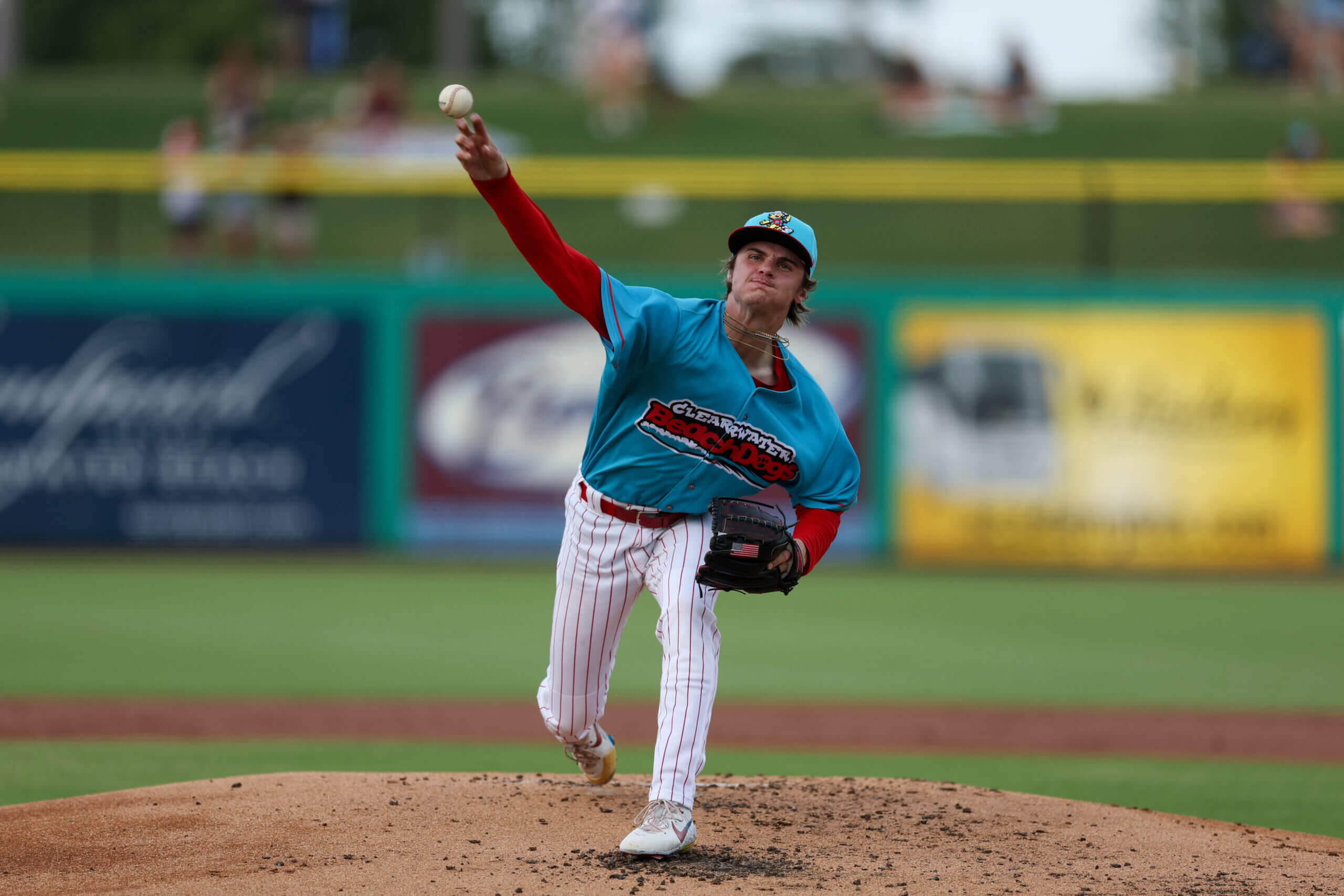
George Klassen, who came over from the Phillies, has plus velocity but has struggled with command. (Nathan Ray / Clearwater Threshers)
10. George Klassen, RHPHeight: 6-2 | Weight: 195 | Bats: R | Throws: R | Age: 24
Klassen was half of the return from the Phillies for Carlos Estévez at the 2024 trade deadline. Klassen has continued to work as a starter, posting a 5.35 ERA in Double A last year while striking out 27.4 percent of batters he faced. He throws 97-99 with a very hard, sharp slider, along with 40 command and no third pitch — although he had a large reverse platoon split in 2025 that is probably a fluke. He allowed a .362 BABIP last year, some of which is a function of his poor location and fairly straight fastball. He’s probably a two-pitch reliever in the end, maybe as soon as this year, as he’ll go to Triple A and continue to start but his command will have to improve post haste for him to have any more success in Salt Lake.
11. Hayden Alvarez, OFHeight: 6-3 | Weight: 190 | Bats: R | Throws: R | Age: 19
Signed for $685,000 in January 2024, Alvarez raked at two stops last year with a combined line of .340/.435/.430 between the ACL and Low A. He’s a four-tool guy right now with very good feel to hit, 55 speed and the ability to play center field, while his power lags behind and he hasn’t begun to fill out yet physically. His swing decisions were excellent last year with very low whiff and chase rates even after the promotion to Low A.
12. Dylan Jordan, RHPHeight: 6-3 | Weight: 205 | Bats: R | Throws: R | Age: 20
The Angels’ fifth-round pick in 2024 out of a Florida high school, Jordan has a long, slingy arm action with plus extension, giving him a very unique look and allowing him to work primarily with his fastball, which he threw about 80 percent of the time last year. He’s around the plate, with a walk rate under 9 percent in his stint in Low A before he walked six in his final start of the year, so he should be able to miss some bats in the zone even without elite velocity. He has a slider and a changeup that are both works in progress. The delivery isn’t typical, but the rest of him is your standard projection high school right-hander package, with the added benefit that he already throws strikes.
13. Samuel Aldegheri, LHPHeight: 6-1 | Weight: 210 | Bats: L | Throws: L | Age: 24
Acquired with Klassen in the Estévez deal, Aldegheri became the first Italian-born and raised pitcher to reach the majors in over 70 years when he debuted in 2024. His follow-up in 2025 wasn’t great, as he wasn’t ready to go when he showed up in spring training and his velocity on all pitches was down for much of the year. He’s got a pair of average breaking pitches, with a fringy fastball and changeup, showing a low-effort delivery that maybe could use a little more effort — he doesn’t get out over his front side well at all and he needs another tick on the fastball for it to be playable. There’s a back-end starter package here with multiple adjustments, but he has a good foundation of strikes and feel for using his breaking stuff.
14. Juan Flores, CHeight: 5-10 | Weight: 215 | Bats: R | Throws: R | Age: 20
Flores is an outstanding defensive catcher across the board, including receiving, throwing and game-calling, but so far hasn’t done enough at the plate to profile as more than a backup. The Angels had him start in High A last year at age 19 and he was atrocious for half the year, with a .159/.258/.217 line at the end of June. They worked with him to get him looser and moving more in the box, and he started driving the ball far more after that, hitting .259/.304/.476 the rest of the way with eight of his 10 homers on the season, followed by a strong showing in the AFL where he was still young for the league (and probably tired from a full year of catching). The most likely outcome is still that he’s a backup catcher in the big leagues, but there’s a path for him to be an everyday guy now as he’s coming into power and just needs to get his swing decisions to a point where the power will play.
15. CJ Gray, RHPHeight: 6-2 | Weight: 205 | Bats: R | Throws: R | Age: 19
The Angels took Gray in the fifth round last season and paid him over slot as part of their overall strategy of using some of their savings on the bonus for No. 2 pick Tyler Bremner to load up on high school pitching. Gray is an elite athlete who was a three-sport star in high school and has a very rudimentary delivery that he doesn’t repeat at all, unsurprising given how little of his year was spent on baseball (and that’s not in any way a bad thing). He comes from a lower slot, usually, with good velocity at 92-96 and an above-average slider. I noted at the draft that he may not throw strikes right away, at least not until the Angels can help him build a sustainable delivery, and of all the main high school pitchers they took, he is the one who probably most needs to stay back in the ACL this year. He might have the highest upside of the group, and the lowest probability.
16. Talon Haley, LHPHeight: 6-2 | Weight: 200 | Bats: R | Throws: L | Age: 20
Haley had non-Hodgkins lymphoma while he was in high school, and also underwent Tommy John surgery and later an internal brace procedure, even pitching right-handed at one point so he could continue playing while rehabbing. The Angels took him in the 12th round last year and paid him over slot to get his two-seamer/curveball combination and widely praised feel to pitch as well as, of course, his competitiveness. He’s 91-94 right now and does have an occasional changeup, enough to hope for a starter down the road even with the two UCL injuries. The Angels also see some potential to get him more rhythm to the delivery so that there’s less effort and more power from his lower half. He’s obviously a guy to root for.
17. Marlon Quintero, CHeight: 5-9 | Weight: 175 | Bats: R | Throws: R | Age: 19
Quintero is the next catcher after Flores on the Angels’ minor-league depth chart, with a 70 arm that helped him throw out 49 percent of runners in the ACL and again in Low A last year. He’s a contact hitter who swings early and often, averaging just 3.3 pitches per PA in that stint in full-season ball, and can get to almost any fastball already. He’s got a good catcher’s build, lacking much projection but probably strong enough to get to double-digit homers even though he has exactly one (1) so far as a pro in 79 games. He turned 19 in November and should spend the year in Low A, where we’ll get a better read on the approach and present hit tool. He might be a stealth prospect in this system who offers everyday upside.
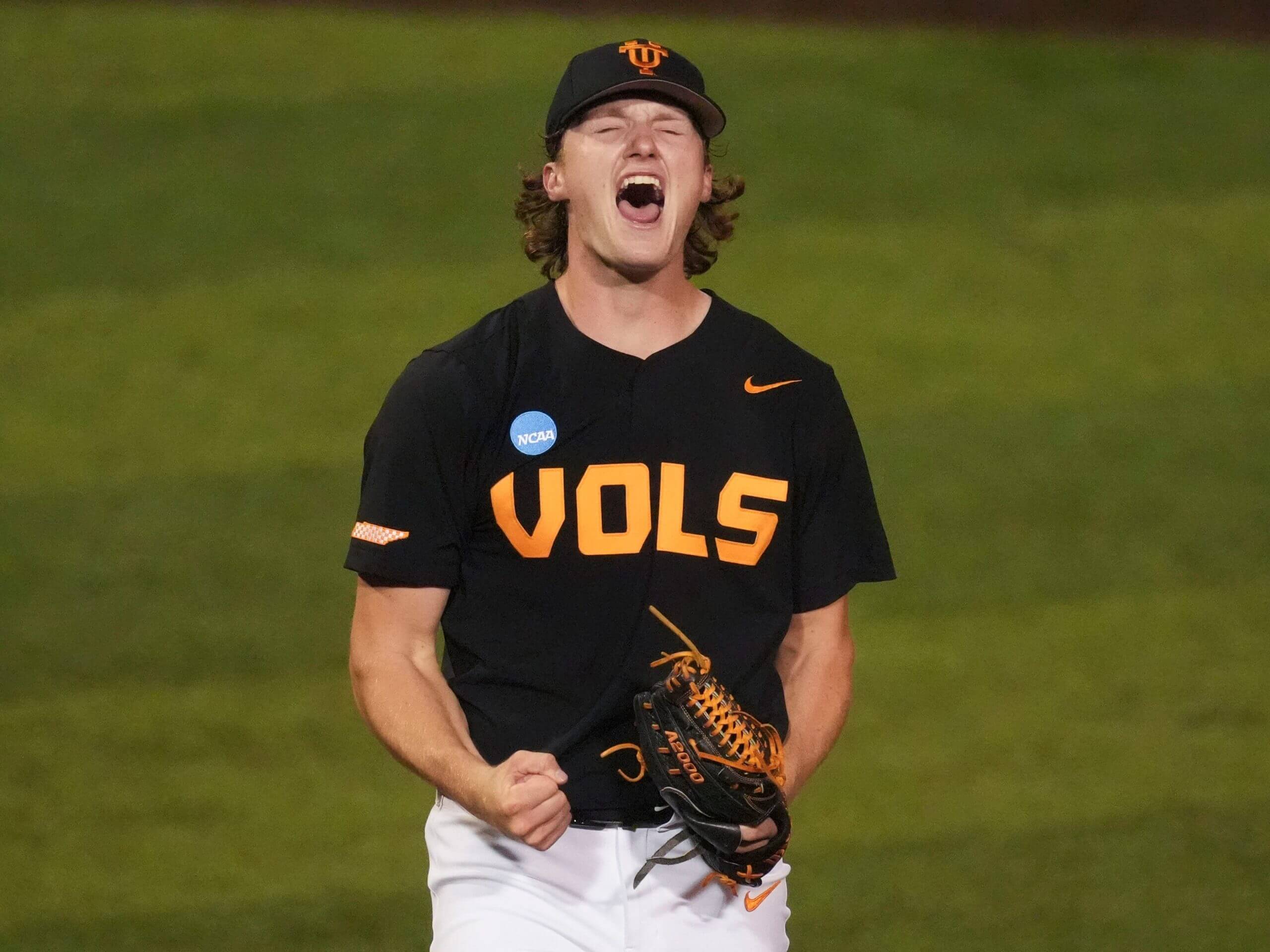
Nate Snead pitched as a reliever for Tennessee collegiately. (Saul Young / News Sentinel / USA Today Network via Imagn Images)
18. Nate Snead, RHPHeight: 6-2 | Weight: 212 | Bats: R | Throws: R | Age: 22
Snead was a power reliever for Tennessee last spring who hit 100 in the College World Series and has a very sharp curveball at 82-85, but saw his command and control regress from his sophomore year. He needs something for left-handed batters, at which point he could be a good seventh inning guy.
19. Gabriel Davalillo, CHeight: 5-11 | Weight: 210 | Bats: R | Throws: R | Age: 18
Davalillo flashed power and plate discipline in his 41 games in the Dominican Summer League last year, his pro debut after signing in January 2025 for $2 million, and that’s probably a good thing, as it seems very unlikely he’s going to stay behind the plate. He’s a hit-first guy with a thicker body who doesn’t necessarily want to catch, according to scouts who saw him last year, and who could end up at first base, with third base probably the intermediate option. The bat might play at any position, though, so he’s still a prospect, as opposed to fellow Angels catcher Dario Laverde, who didn’t hit at all last year and didn’t catch a game after the All-Star break.
20. Chris Cortez, RHPHeight: 6-1 | Weight: 210 | Bats: R | Throws: R | Age: 23
The Angels’ second-rounder in 2024, Cortez walked 16.4 percent of batters he faced in High A last year and was particularly bad against lefties. He’s all fastball/slider with a super-short arm action that doesn’t get much power from his legs. He has to be a reliever, but the stuff could play up enough there for him to have value.
2026 impact
I bet Shores and Bremner throw meaningful innings for the Angels this year, and Johnson might as well. I don’t think Guzman is ready for a job, so he might get playing time without making much of an impact.
The fallen
Alberto Rios was supposed to be a bat-first guy out of Stanford who needed a position, but he hasn’t hit at all since the Angels took him in the third round in 2023, with a .173/.271/.259 line in 63 games in Low A and High A last year as a 23-year-old. He has just six pro home runs in two and a half seasons.
Sleeper
Alvarez is really interesting with a combination of tools, production, and a really good frame. If he’s a real center fielder, even as the game speeds up at higher levels, he’s a GUY.