
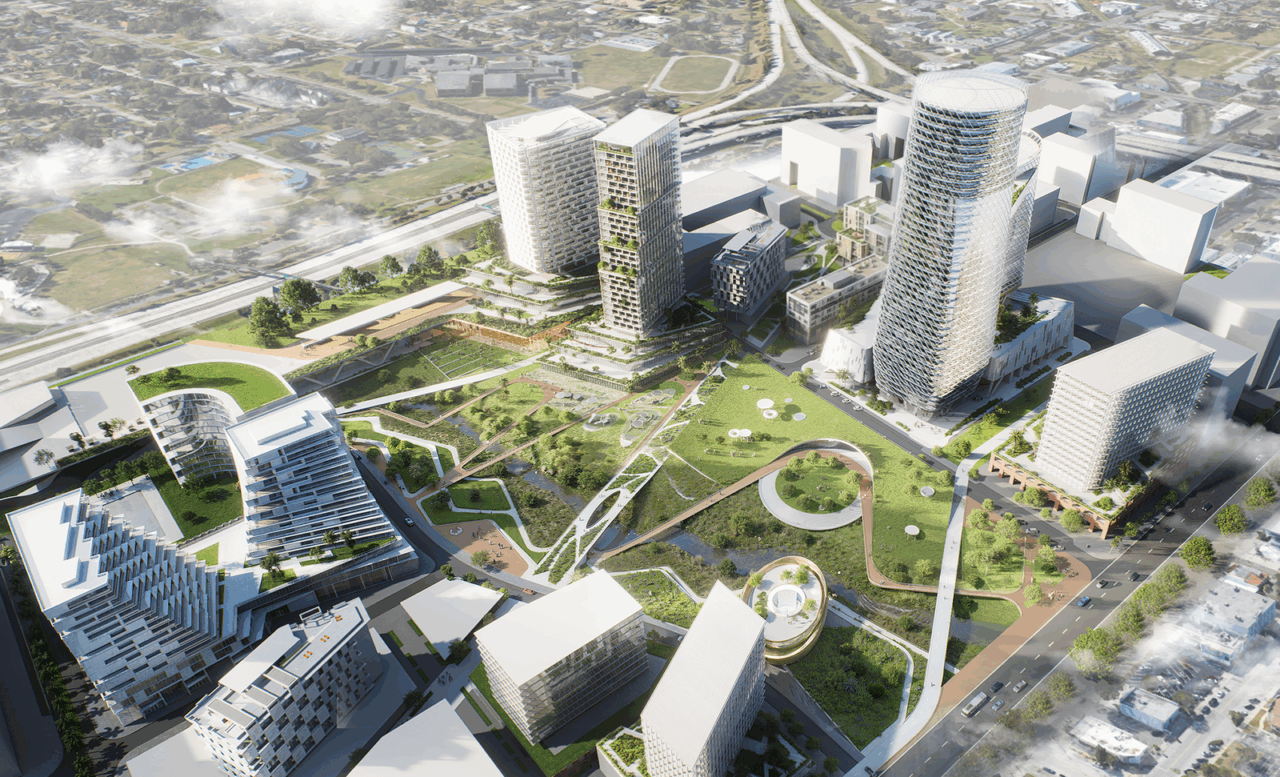
The City of St. Petersburg received nine redevelopment proposals by Tuesday’s deadline for the Historic Gas Plant District, setting the stage for a competitive review process that will shape the future of the land surrounding Tropicana Field.
The submissions range from multibillion-dollar master-planned districts backed by national developers to smaller housing-focused concepts emphasizing affordability and community ownership. Several proposals include nine-figure land purchase offers, while others focus on more targeted redevelopment without a defined price.
Tuesday’s deadline coincides with a news conference held by Gov. Ron DeSantis in Tampa, declaring his support for a proposal to relocate the Tampa Bay Rays ballpark away from the Historic Gas Plant District in St. Petersburg to the Hillsborough Community College Dale Mabry campus in Tampa within the next few years.
Most of the proposals do not include a Tampa Bay Rays ballpark.
The Burg Bid LLC submitted the largest financial offer, proposing to purchase 58 acres for $275 million in cash. Blake Investment Partners led the development team with Related Group as a co-general partner and Elliott Investment Management as an investor.

The proposal outlines an estimated $8 billion mixed-use redevelopment and states that it would not rely on new public subsidies beyond CRA funds for infrastructure and park improvements. The group says it would post a $20 million deposit “at project commencement.”
The plan includes thousands of residential units, including more than 3,600 units of income-restricted housing, as well as office, hotel, retail and entertainment space. The group would develop the project in three phases.
The first phase would include the Woodson African American Museum, a workforce training and small business success center called The Collaboratorium, a multimodal transportation hub, and a pedestrian-only corridor called the Legacy Link.
Phase 2 includes a new mixed-income neighborhood, integration with the Warehouse Arts District, The Deuces, and Low Line Park, and planned participation from higher education and health care partners.
Phase 3 includes a Resilience Event Center, a Discovery Center Museum and education facility, and the St. Pete Surf Wave — described as the only surf wave of its kind on Florida’s West Coast.

ARK Ellison Horus LLC, a partnership of ARK Investment Management, Ellison Development and Horus Construction Services, submitted a proposal offering $202 million for the site.
The group’s bid includes a $50 million community benefits contribution to the city and $12 million earmarked for demolition of Tropicana Field, with the remaining $140 million going to land acquisition.
The proposal envisions a large-scale innovation district featuring more than 3,700 residential units, including affordable, workforce and senior housing, along with hotels, office space and cultural amenities.
They propose development in four phases. Phase 1 includes the Woodson Museum, 446 affordable homes, 15,000 square feet of street-level retail space, and upgrades to the 16th Street corridor and infrastructure.
Phase 2A includes 1,332 housing units, 927 hotel keys across multiple properties, an Arts & Cultural Center and a music and entertainment venue, 500,000 square feet of incubation space and a 200,000-square-foot innovation hall, 108,500 square feet of retail space, and 17.82 acres of open space.
Phase 2B includes an elevated park connection across I-75, and upgrades to Dr. Martin Luther King Street S and 7th Avenue.
Phase 3 includes an academic cluster, 1,923 housing units, a 421-key hotel, 85,000 square feet of retail space, and Pinellas Trail enhancements.
Foundation Vision Partners submitted a proposal focused on the phased redevelopment of the district, keeping the property under city control.
The proposal emphasizes long-term community engagement, mixed-income housing and commercial development tied to job creation, but does not specify a land purchase price. Instead, Foundation Vision Partners is proposing a “Master Plan & Infrastructure-First Strategy” that gradually makes residential, cultural and public-realm improvements. The proposal emphasizes local participation, inclusion of minority-owned businesses, and acknowledgment of the Gas Plant community’s history.
According to the proposal, the “City retains full ownership and decision-making authority, avoiding ceding control prematurely to a single master developer and eliminating ‘all eggs in one basket’ risk.” The group would offer master plan placemaking advisory services and Infrastructure Development Services.
Freedom Communities Company submitted a proposal to redevelop a portion of the Historic Gas Plant District into a “transformative, mixed-use, affordable housing-anchored community” called “The Sanctuary St. Pete.”
The proposal does not include a purchase offer for the land. Instead, the group requests 1 to 1.5 acres of land within the Historic Gas Plant district to build 100 mixed-income residential units, ground-floor mixed-use space and grocery-serving retail, as well as community cultural amenities and walkable public space. Redevelopment cost is estimated at $300,000 per unit. The group indicates that future phases would be subject to city approval.
Logical Sites Inc. submitted a concept proposal responding to the city’s solicitation for alternative redevelopment ideas. The proposal does not identify a purchase price for the property, nor its partners, nor the exact plans.
However, the proposal includes workforce housing, senior housing, housing for people with disabilities, a convention center option, and other City options. However, it indicates that the more these options are exercised, the fewer housing units will remain.
The group indicates it is starting with a vision of “100% affordable housing” on the site, a park and playgrounds.
The Pinellas County Housing Authority proposes the “$1 plus other consideration” purchase of the city-owned parking lot located at 1659 3rd Avenue South for the development of a seven-story affordable housing community for seniors with 80 units.
The Reparations Land Trust and Development Authority submitted “a plan to secure reparations in the form of the 86 acres of land under the Tropicana Field, which was at one time a Black community with over 800 residents and 100 businesses.”
The plan does not include a traditional purchase offer. Instead, it proposes placing land into a trust model designed to preserve long-term affordability and ensure community control.
The Tampa Bay Boom Inc. submitted a proposal that would combine the redevelopment of the Historic Gas Plant District with a push to acquire the Tampa Bay Rays. The proposal calls for fee-simple acquisition of the site rather than a long-term ground lease, followed by a phased mixed-use redevelopment of the Gas Plant site.
The proposal indicates that the site “provides the opportunity to leverage the relocation of Tropicana Field with the addition of a new arena and entertainment district.” It also outlines plans to bring a Women’s National Basketball Association team and a facility to the district, and presents an option without a stadium.
Tempo Novus proposes redeveloping the Historic Gas Plant District into a mixed-use neighborhood built with mixed-income housing, neighborhood-serving retail and publicly accessible open space, with Booker Creek repositioned as the “spine of the neighborhood.” Their proposal calls for low- to mid-rise development no more than three to four stories tall rather than high-rise towers, with buildings designed to support walkability, local businesses and shared public spaces. Housing would be mixed-income by design, with a minimum commitment of 35% of units affordable.
Rather than submitting a fixed master plan, Tempo Novus proposes a phased, community-driven development process. Phase 1 would include a “public charrette” workshop meant to allow residents, city staff, engineers and architects to contribute to the design of the project, master plan development, community agreements and entitlements.
The charrette would determine Phase 2 projects; Phase 3 would focus on residential, retail, and commercial expansion, small-business incubation, and infrastructure completion; and Phase 4 would complete the district buildout.