
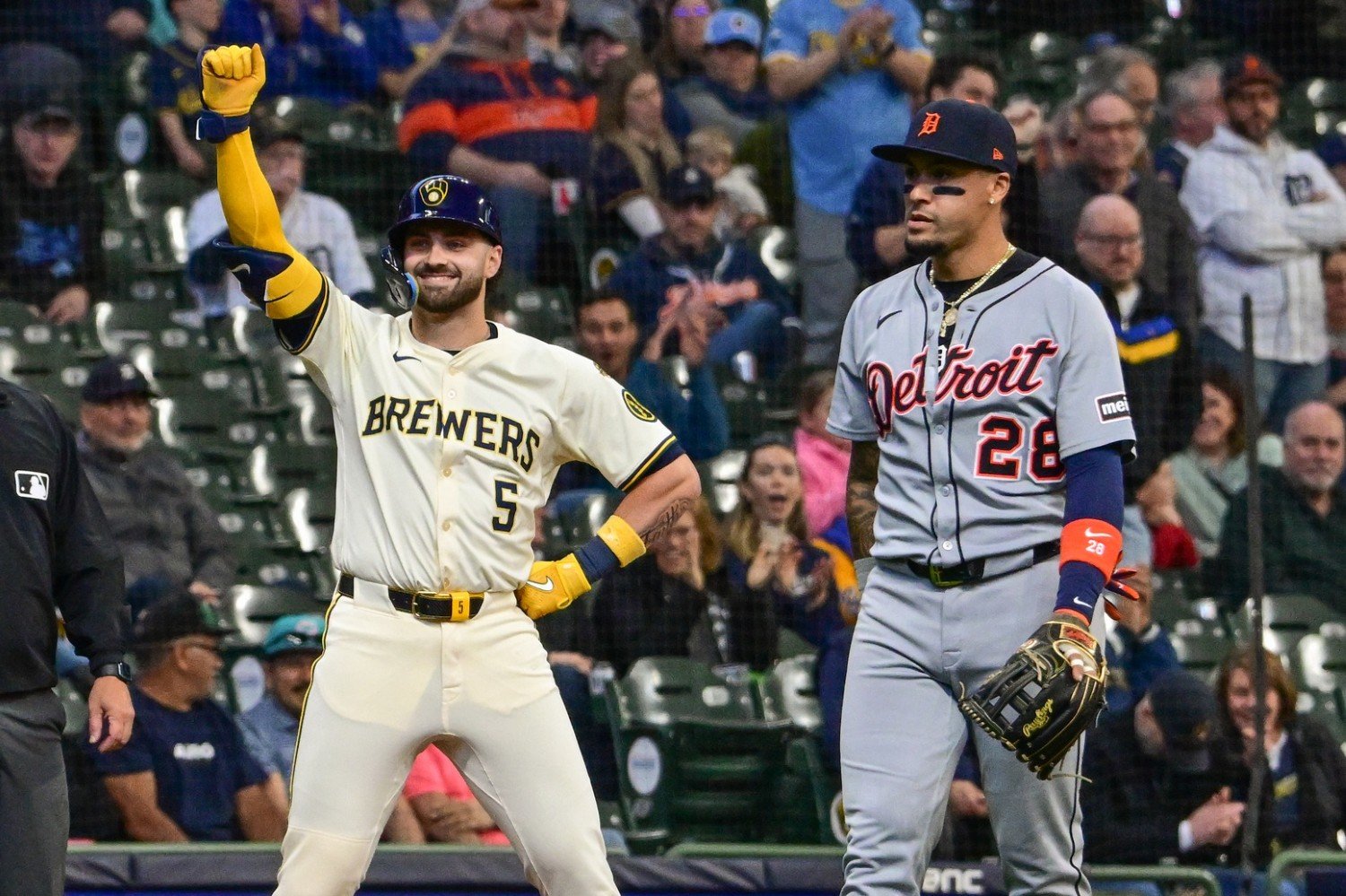
Garrett Mitchell is the epitome of a tantalising baseball player. With incredible athleticism, a feel for the big moments, and raw power to all fields, there is very little he couldn’t achieve on the baseball field. To answer some under-the-hood concerns with his swing path (centered around conquering the high fastball), Mitchell made some changes in the 2024-25 offseason, with the goal of a more rounded, consistent profile and the ability to make better contact across the strike zone.
I covered some of the changes he needed to make here in November 2024—soon after which we saw a video of Mitchell from Driveline. There, he worked on creating a flatter plane to the ball, staying tight and working behind the ball. It seems he didn’t lose any of his pop in doing so:
How Did He Handle The High Fastball In 2025?
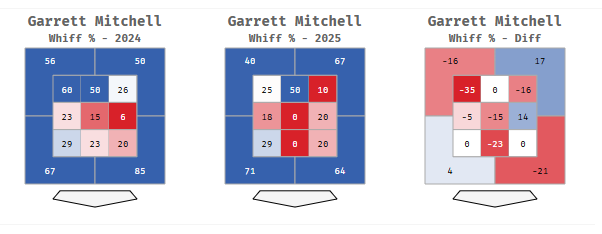
It’s important to remember this is a very small sample—just a month’s at-bats—but there were some notable changes in his whiff rates from 2024 compared to the 2025 season, especially in the upper third of the strike zone:
Let’s restrict our focus to four-seam fastballs only, and include just the middle and upper portions of the strike zone, to see how Mitchell fared. Again, this is a small sample due to Mitchell’s season-derailing injuries, but the changes are significant.

Mitchell’s quality and quantity of contact against four-seam fastballs soared in this small sample of 25 qualified offerings, with an improved attack angle in his swing bearing proof of a changing process. His exit velocities were up, his whiff rates were way down, and his expected batting average and slugging metrics showcased his output well. If we limit this sample to just the top of the strike zone (again, an even smaller size), Mitchell’s whiff rate dropped from 48% to 33%, with an average exit velocity of 95.0 mph.
If we include sinkers and cutters in these locations to increase the sample size, the same story repeats itself: Mitchell is whiffing less and finding better launch angles, thanks to improved attack angles in his swing.

With Mitchell’s keen eye at the plate, he doesn’t need to do damage on pitches in the upper third of the zone; he just needs to be able to make contact and stay in an at-bat. He made real strides here in 2025, and it should hold him in good stead for 2026, if he can maintain that new swing path after another shoulder surgery last summer.
The Timing Trade-Off
This was a large change to Mitchell’s swing—the type of change that’s been the downfall of many others with swing-and-miss concerns (see: Joey Wiemer). While working in cages and at Driveline was beneficial to bed in his adjusted swing path, it’s likely that his focus on breaking and off-speed pitches took a back seat.
Mitchell was still adjusting to his timing on non-fastballs as spring training rolled around and continued in season, which reduced some of the damage we’ve become accustomed to. While Mitchell did struggle with high fastballs in 2024, you threw breaking pitches inside the strike zone at your peril. Thankfully, nobody warned Phil Maton about that:
Interestingly, this is where Mitchell took a step back. With the majority of his off-season work centered around the high fastball, Mitchell struggled to time up anything off-speed. Only three of his 13 batted balls against breaking pitches inside the strike zone had a launch angle between 0° and 30°, and not one was between 5° and 25°. He was late getting to pitches, but this appears more of a timing issue than a mechanical one.

His attack angle was largely similar to his production in 2024, and his hard-hit rate was still quite productive; he just wasn’t catching these offerings out in front of him with the same regularity. Mitchell’s timing should have improved with playing time, a boon painfully removed from his 2025 season in May, but all the indicators are there for Mitchell, if he can just stay on the field, to break out in a big way during 2026.
His bat speed was higher. He was making contact with high fastballs, and punishing those that missed over the heart of the plate. We saw those under-the-hood developments from Mitchell that we’ve been itching for, even though the surface results didn’t quite match up to those indices. If he can stay on the field, Mitchell’s ceiling is still as high as anyone on this team.