
The Cardinals’ system is definitely on the upswing, with many players making real improvements last year, several going from off their top 20 in 2024 to making the list this year — including one prospect I’d written off. The improvement was somewhat tempered by a rash of injuries to some of their most promising prospects, mostly pitchers.
(Note: Tools are graded on a 20-80 scouting scale; ages as of July 1, 2026. EV = exit velocity.)
Height: 5-10 | Weight: 190 | Bats: L | Throws: R | Age: 23
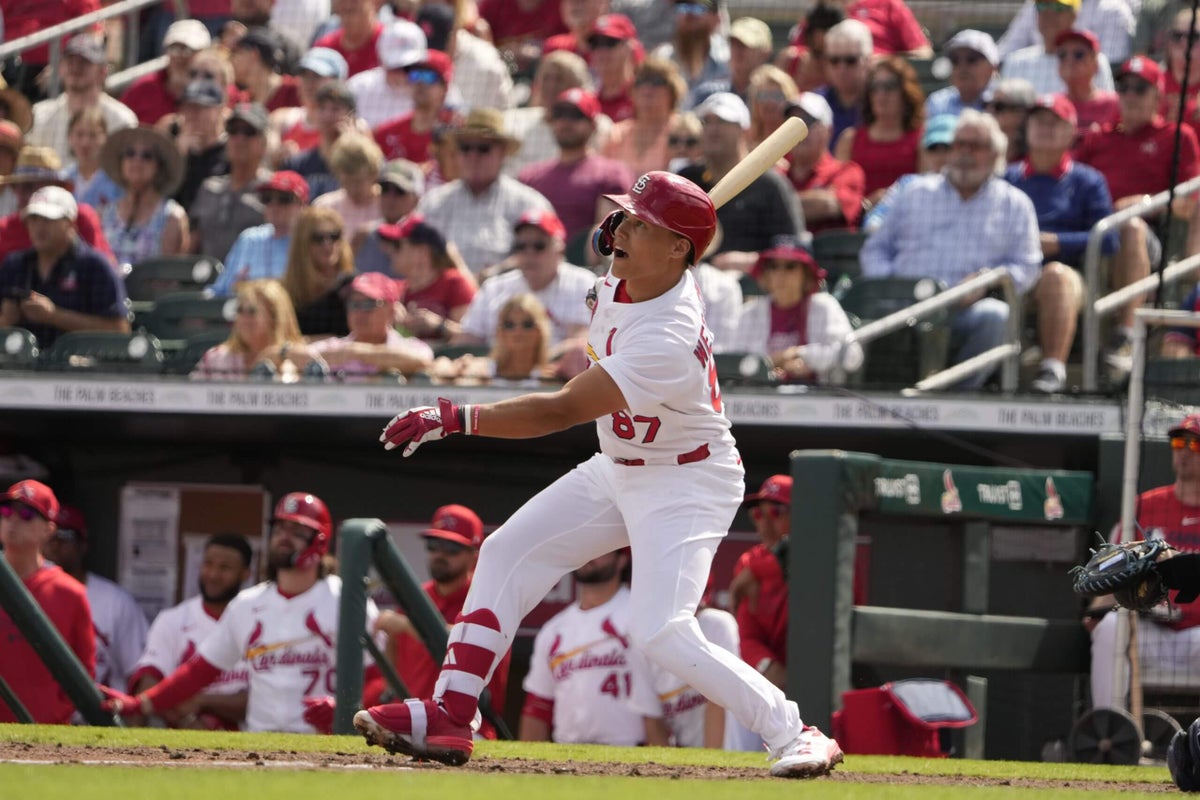
The Cardinals couldn’t believe their luck when they landed Wetherholt with the No. 7 pick in the 2024 draft, as the West Virginia shortstop had missed a big chunk of his junior season with a recurring hamstring injury that often limited him even when he was able to play. St. Louis skipped him over High A and had him start his first full pro season in Double A, where he hit .300/.425/.466 with more walks than strikeouts, and he hit even better after a promotion to Triple A just before the All-Star break, hitting .314/.416/.562. He’s not going to play shortstop, definitely not with Masyn Winn in front of him, but has the hands and instincts to play second or third and will stay on the dirt.
Wetherholt doesn’t have huge raw power, much closer to average than plus, but he squares the ball up very consistently and his hard-hit (49 percent) and Barrel (12.6 percent) rates were well above the median in Triple A, so he might end up with more in-game power in the end. I wouldn’t want to change anything about his approach, as he benefits by using the whole field and is very selective until he gets to two strikes, when he expands the zone more than a hitter with his hard-contact profile should. Of all the NL prospects, I’m most confident he’ll win a batting average title someday.
Height: 6-2 | Weight: 220 | Bats: R | Throws: L | Age: 22
The No. 5 pick in the 2025 draft out of Tennessee, Doyle had the best fastball in the class, sitting 96-99 all spring and living up at the top of the zone with the pitch, missing bats over 40 percent of the time that hitters tried to offer at it. He has four pitches, with a plus splitter, an average to above-average slider and a potentially plus cutter. He throws everything for strikes, working well to both sides of the plate and getting some added deception from his delivery. Some teams were concerned about his ability to repeat his delivery as a starter, which I didn’t share, and the biggest issue I could see about his ability to stay a starter is that he throws so hard all the time — several miles an hour above where he was the year before, while he was at Mississippi. He moves well on the mound and should be able to make some small adjustments to try to tighten up the slider and separate it more from the cutter, beyond which I don’t think he has much left to do before he would be ready to pitch in some role in the majors. He’ll probably start in Double A, but don’t be surprised if he debuts this year as long as he stays healthy, with at least No. 2 starter upside.
Height: 5-10 | Weight: 197 | Bats: R | Throws: R | Age: 19
The one other Cardinals players know as “Hulk” got the nickname through his physique, but more than earned it with 20 homers in 84 games last year, all of which came before his 19th birthday in January. Rodriguez is an offense-first catcher who projects to stay behind the plate, although he’ll need time back there. That said, there’s always a chance his bat is so advanced that the Cardinals move him to another position to get him to the big leagues sooner. He hits the ball extremely hard, already topping 111 mph with an EV50 of 91.3 in the Florida State League, and pairs that with strong contact skills and feel for the strike zone. He does it with strength and bat speed, with a swing that’s short to the ball with a big finish, pulling the ball in the air at a high rate already, even though he does have power the other way. He’s going to need work behind the plate, but has the hands and athleticism to stick there, and his brick house build suits the position well. If he stays a catcher, he’s an All-Star, and if he doesn’t, he might still be one because he’s going to have so much impact with the bat. He’ll be 19 all of this year and if he plays a full season, I think he’ll lead all minor-league catchers in homers.
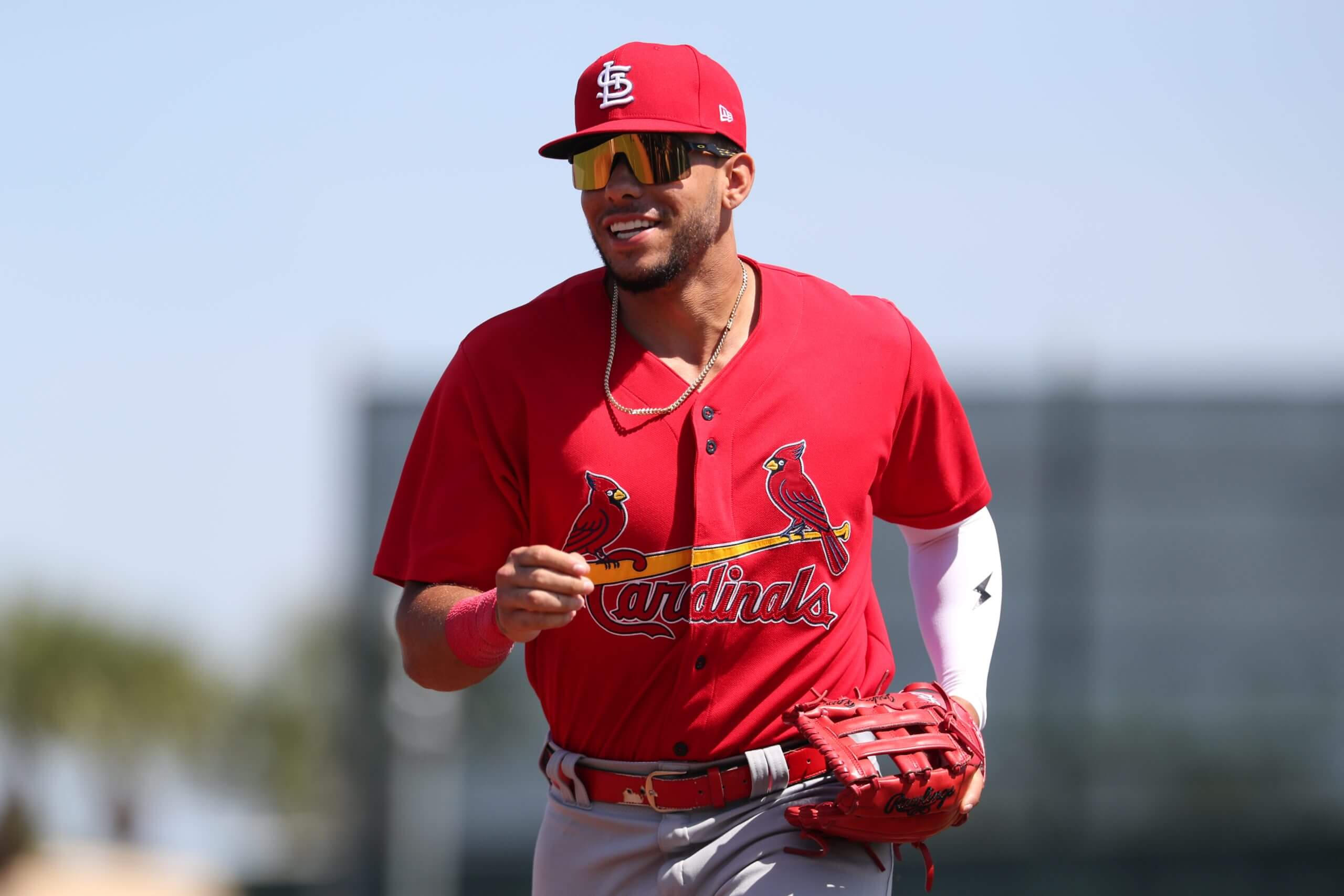
Joshua Baez’s career took a complete 180 after mechanical adjustments led to a breakout 2025 season. (Jared Blais / MLB Photos via Getty Images)
4. Joshua Baez, OFHeight: 6-3 | Weight: 220 | Bats: R | Throws: R | Age: 23
How bad was Baez before this past year? He wasn’t on my Cardinals top 20 at all a year ago, instead appearing as my “fallen” prospect after he struck out in 37.3 percent of his PA in High A when he wasn’t young for the level. He’s now the biggest success story to date for St. Louis’ new player development regime, as the staff worked with him starting last offseason to improve his posture and movement at the plate while also helping him develop a plan for at-bats that included recognizing pitches and locations. His swing decisions improved markedly, of course, and he hit .317/.404/.483 in his return to High A, then moved up to Double A and hit .271/.374/.509 in 79 games at the higher level with just a 20.2 percent strikeout rate. He even stole 54 bases in 63 attempts on the season, even though he’s a 55 runner who’s typically 4.25-4.3 down the line. He looks like an everyday bat in right field who’ll hit 20-25 homers and get on base at an above-average rate, probably an above-average player if this newfound approach and contact skill holds up over a larger sample and against better pitching.
5. Jurrangelo Cijntje, BHPHeight: 5-11 | Weight: 200 | Bats: B | Throws: B | Age: 23
Cijntje was Seattle’s first-rounder in 2024 who was traded to St. Louis in the Brendan Donovan deal. He was born in the Netherlands, grew up in Curaçao, went to Mississippi State and is a switch-pitcher, at least in the sense that he throws pitches with both arms in actual games. He needs to give it up, unfortunately, as he is killing his own effectiveness when he throws left-handed: He allowed a .564 OBP last year from the left side, walking 19 and striking out nine. His strength right now is right-on-right, as he’s been up to 100 with life and has a hammer slider. He has an average changeup but doesn’t have great feel for or command of the pitch, since at least some of the time he’d just switch to his left arm when facing a left-handed batter. He’s athletic with a very, very quick arm, and his right-handed half looks like a future starter. He needs to focus on developing Dr. Jekyll and put Mr. Hyde away.
6. Tanner Franklin, RHPHeight: 6-5 | Weight: 225 | Bats: R | Throws: R | Age: 22
The Cardinals’ third pick (Competitive Balance Round B) in the 2025 draft, Franklin was a reliever for Tennessee last spring, although he probably would have started for most clubs, as he was up to 102 in short bursts, sitting 98-99 with a plus cutter and an occasional slider. After the draft, he was still hitting 98 even in longer stints, and the slider was sharper and sitting 90-92. He has a short delivery but it’s repeatable, and he did throw far more strikes last spring for the Vols (5.5 percent walk rate) than he had the year before at Kennesaw State (20.5 percent!). There’s obviously risk in stretching out someone who throws this hard and is probably used to airing it out, but the ceiling here is enormous.
7. Leonardo Bernal, CHeight: 6-0 | Weight: 245 | Bats: B | Throws: R | Age: 22
Bernal’s a switch-hitting, bat-first catcher who has improved behind the plate in the last year or so, notably with his arm strength. Yet another product of the Cardinals’ Panamanian catcher pipeline, Bernal hit .247/.332/.394 last year with a very strong 16.9 percent strikeout rate, continuing to make harder contact when he squared the ball up. He’s still better from the right side, although he had some bad luck on balls in play batting left-handed that widened his platoon split. He projects to 20-odd homers if he continues improving his approach. He showed closer to a plus arm last year, up from 50/55 a year ago, and his receiving was better, albeit still probably not where it needs to be for everyday status. (Somehow he won a minor league Gold Glove last year, which … he’s not that kind of defender, not yet, at least, and nobody should pay any attention to those awards.) He’ll turn 22 in February and should go to Triple A to start the year, with a floor right now as a high-quality backup and a very good chance to become an everyday catcher.
8. Tink Hence, RHPHeight: 6-1 | Weight: 195 | Bats: R | Throws: R | Age: 23
Hence was on the top 100 for several years because of the potential he offered as an above-average starter with his out-pitch changeup atop a three-pitch arsenal, good feel to pitch and athleticism, but he had yet another injury-plagued year in 2025 and threw just 21 innings around a rib cage strain and shoulder inflammation. He’s never thrown 100 innings in any of his five pro seasons, and it’s very unlikely he’s going to magically stay healthy as a starter now. He’ll sit 94-95 and touch 98 with a grade-70 changeup and average slider when he’s healthy, and he should still be valuable in relief, whether it’s as a swingman or a high-leverage guy, assuming he continues to struggle to hold up as a starter.
9. Tekoah Roby, RHPHeight: 6-1 | Weight: 210 | Bats: R | Throws: R | Age: 24
Roby was at his best in July and on the verge of a major-league call-up when he tore his UCL, undergoing Tommy John surgery that will probably take him out until this fall or more likely 2027. The Cardinals’ new player development group reworked his pitch mix, giving him a two-seamer, switching him to a kick-change from a traditional one, and helping him throw a harder, more horizontal-breaking slider to go with his existing curveball, which was plus. He had missed a good bit of 2024 with elbow trouble, so the injury wasn’t a complete surprise, just unfortunately timed, as he had dominated Double A and pitched very well in Triple A all season with a career-low 6.0 percent walk rate. If he comes back at 100 percent, he’s a mid-rotation starter.
10. Quinn Mathews, LHPHeight: 6-5 | Weight: 188 | Bats: L | Throws: L | Age: 25
Mathews’ follow-up to his breakout 2024 season was a disaster, starting with health. He had a back injury coming out of spring training, couldn’t throw strikes at all, then hit the IL with shoulder soreness that was at least partly caused by him compensating for the back pain by tilting further back in his delivery and raising his release point. He returned at the end of May and pitched the rest of the year, but wasn’t good, walking 16.1 percent of batters he faced and striking out 27.2 percent. The silver lining in all of that is that his plus changeup was still there, and he still sat 93-94 after he returned, with a slider that doesn’t grade out that well by pitch models but grades out much better from the hitters who swing over it. His ranking here is about 80 percent about health and 20 percent about control; I think if he’s fully healthy, and thus has his “true” mechanics, he’ll throw more strikes, but he was also worked very heavily at Stanford, and his usual delivery put some stress on the shoulder, so there’s reliever risk around his health and control.
11. Chen-Wei Lin, RHPHeight: 6-7 | Weight: 188 | Bats: R | Throws: R | Age: 24
Lin spent more of the 2025 season on the shelf than on the mound, missing the start of the year with a forearm injury and then hitting the IL for a month in the summer with an oblique strain, but he did return to pitch in the Arizona Fall League, hitting 98 and sitting 94-96. He throws both a changeup and split-changeup along with a gyro slider that has sharp downward break. Like Roby and Mathews, Lin’s main question right now is health; he has the highest upside of the three but is the furthest away from the majors in his development.

Ryan Mitchell was the Cardinals’ 2025 second-round pick. (Chris Day / The Commercial Appeal / USA Today Network)
12. Ryan Mitchell, IF/OFHeight: 6-2 | Weight: 185 | Bats: L | Throws: R | Age: 19
Mitchell had one of the best pure hit tools in the 2025 high school class before going in the second round, making outstanding swing decisions and staying back on the ball well to maximize his contact rates, with some cost to his power. He was a shortstop in high school and will continue to get reps there; he showed a below-average arm as an amateur but had never received any instruction on throwing or developing arm strength, so there’s a chance he can surprise everyone and stick there. He’ll also probably get some time in center, which is how the Cardinals announced him in July, as well as second and third. He’s an above-average runner who should end up with average power, getting most of his offensive value from high walk and contact rates. There’s above-average everyday upside here at any of those positions.
13. Jimmy Crooks, CHeight: 6-0 | Weight: 230 | Bats: L | Throws: R | Age: 24
St. Louis’ fourth-round pick in 2022, Crooks had a big breakout season in 2024 but was undone by his approach issues in Triple A last year (as well as his cup of coffee in the majors, with 17 Ks and no walks). He’s a dead fastball hitter, whiffing over 40 percent of the time he swung at sliders, curveballs and changeups in Triple A, which isn’t helped by his huge leg kick and late landing. He’s an average defender across the board, maybe a little thick-bodied to handle catching every day, but more than capable of handling heavy backup duties. That’s probably what he is, with some small chance for more if his ability to handle offspeed stuff turns around.
14. Yhoiker Fajardo, RHPHeight: 6-3 | Weight: 181 | Bats: R | Throws: R | Age: 19
Acquired in that trade with the Red Sox — no, the other one — Fajardo gained some velocity last year thanks to Boston’s pitching development, adding to his frame to sit 93-94 with good spin on the curveball and slider. He added a kick-change last year that helped him avoid any platoon split on the season, which he split between the Florida Complex League and Low A. His four-seamer gets a little flat and I’m not sure his 50 percent ground-ball rate or his 0 percent home-run rate are going to hold up against better competition. He only turned 19 in October, so the first priority is keeping him healthy, and the second is working on command, as he’s going to end up throwing quite hard once that broad frame fills out.
15. Brandon Clarke, LHPHeight: 6-4 | Weight: 220 | Bats: L | Throws: L | Age: 23
Clarke came over in the Sonny Gray trade after a weird year in the Red Sox system. He was the hottest pitcher in their organization in April, striking out 24 in his first four outings for a 45 percent strikeout rate. Then he developed a blister on his throwing hand, and was kind of a mess the rest of the year. He sits 97-98 with an above-average slider, working with a long arm action that he doesn’t repeat well. He comes around with a low three-quarters arm slot that gets tilt on his slider, but leaves the fastball kind of flat coming in. I think he’s a reliever in the end, but I’d start him for at least a full season or two before making that call.
16. Brycen Mautz, LHPHeight: 6-3 | Weight: 190 | Bats: L | Throws: L | Age: 24
Mautz picked up over 2 mph on his fastball and both breaking balls while cutting his walk rate in 2025, having a strong year as a starter in Double A where he struck out 28.6 percent of batters and walked just 7.1 percent. He went from a 5.18 ERA the year before in High A to 2.98 last year in Double A. There’s more life and rhythm to his delivery now, with the same lower three-quarters arm slot that makes him so tough on lefties and lets righties see the ball too well. He had a sizable platoon split last year and his changeup is still a nonfactor, so he’s more likely a reliever, although if he finds a real pitch to get righties out, he could be a back-end starter.
17. Ixan Henderson, LHPHeight: 6-2 | Weight: 200 | Bats: L | Throws: L | Age: 24
Another beneficiary of the Cardinals’ new development regime, Henderson boosted his velocity last year, sitting 93-94, coming from a three-quarters slot with good deception. He’s got an average slider and changeup, enough to see him as a back-end starter if he tightens up the control and command, along with an occasional two-plane curveball that’s more of a show-me pitch. He looks like he’s barely breaking a sweat even on his fastballs, so there might still be more in the tank, and I’m kind of surprised he walked 9.6 percent of batters given how low effort the delivery is. It’s not a huge ceiling, but a year ago, he was an org player, so this is a huge improvement.
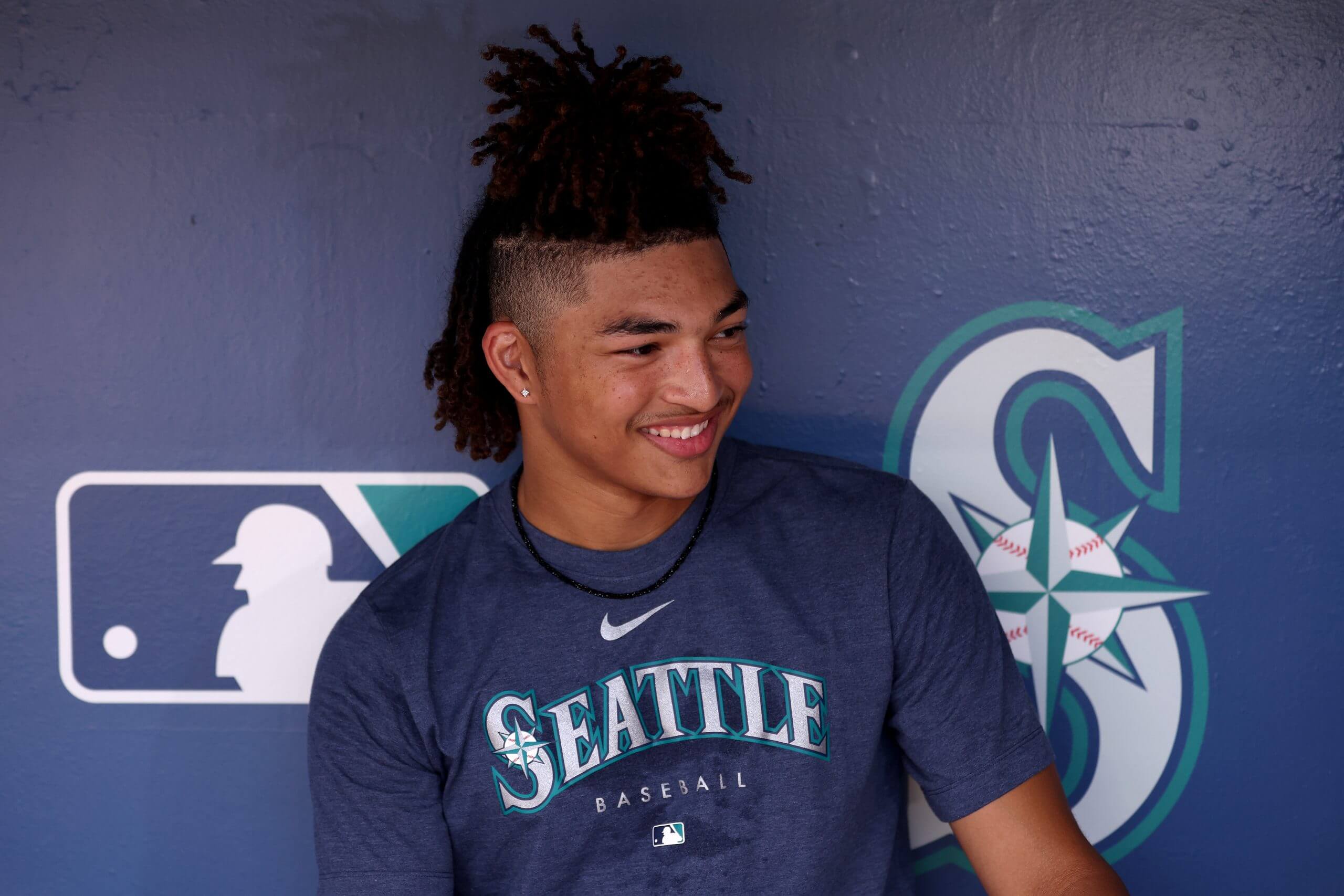
Tai Peete has started hitting for power but still struggles to make regular contact. (Steph Chambers / Getty Images)
18. Tai Peete, OFHeight: 6-2 | Weight: 193 | Bats: L | Throws: R | Age: 20
Peete, a Competitive Balance Round A pick in 2023, hit a measly .219/.288/.404 in High A last year, so he’s barely hanging on to prospect status, keeping it because he only turned 20 in August (making him young for that level) and he started to really drive the ball, going from seven homers in 2024 to 19 last year. He really did the thing: He pulled the ball in the air way more than ever before, and in his case it paid off, with no cost in contact as he actually held his strikeout rate steady at a too-high 30 percent. He’s in center field now, where his plus speed helps him and his inconsistent throwing in the infield is no longer an issue. The odds are very long here, but he did enough to show that the possible upside is still … well, possible. Peete was part of the Cardinals’ return for Brendan Donovan.
19. Blaze Jordan, 3B/1BHeight: 6-0 | Weight: 220 | Bats: R | Throws: R | Age: 23
Acquired from Boston — which is where half the Cardinals’ system seems to be from — in the Steven Matz trade, Jordan was in the midst of a solid season at the plate at the time of the deal, then flopped in his first month-plus as a Cardinal, hitting .198/.242/.366 with very little hard contact. He’s better at first than at third and can flash plus power, getting to 19 and 18 homers in the last two seasons, but his usual swing is geared way more toward contact than power. His best skill is his approach, as he swings at strikes and doesn’t chase or whiff much at all. It’s possible he can end up a regular, especially if he can stick at the hot corner, but I think it’ll require a change in his swing mechanics to get him to pull the ball in the air more.
20. Yairo Padilla, SSHeight: 6-0 | Weight: 170 | Bats: B | Throws: R | Age: 19
Padilla has already grown since he signed, as he’s close to 6-foot-3 with a frame to fill out somewhat and get to at least average power. It’s a ways off, as he has one career home run in 73 games in the Dominican Summer League and FCL, hitting for contact from both sides so far in the minors with plus speed and potentially plus defense at short. He hit .286/.390/.370 in the FCL last year with 22 steals in 25 attempts, playing in just 38 games. The lack of power is a matter of his youth, as he swings hard and should be able to drive the ball, just lacking the strength to do so at age 18.
Others of note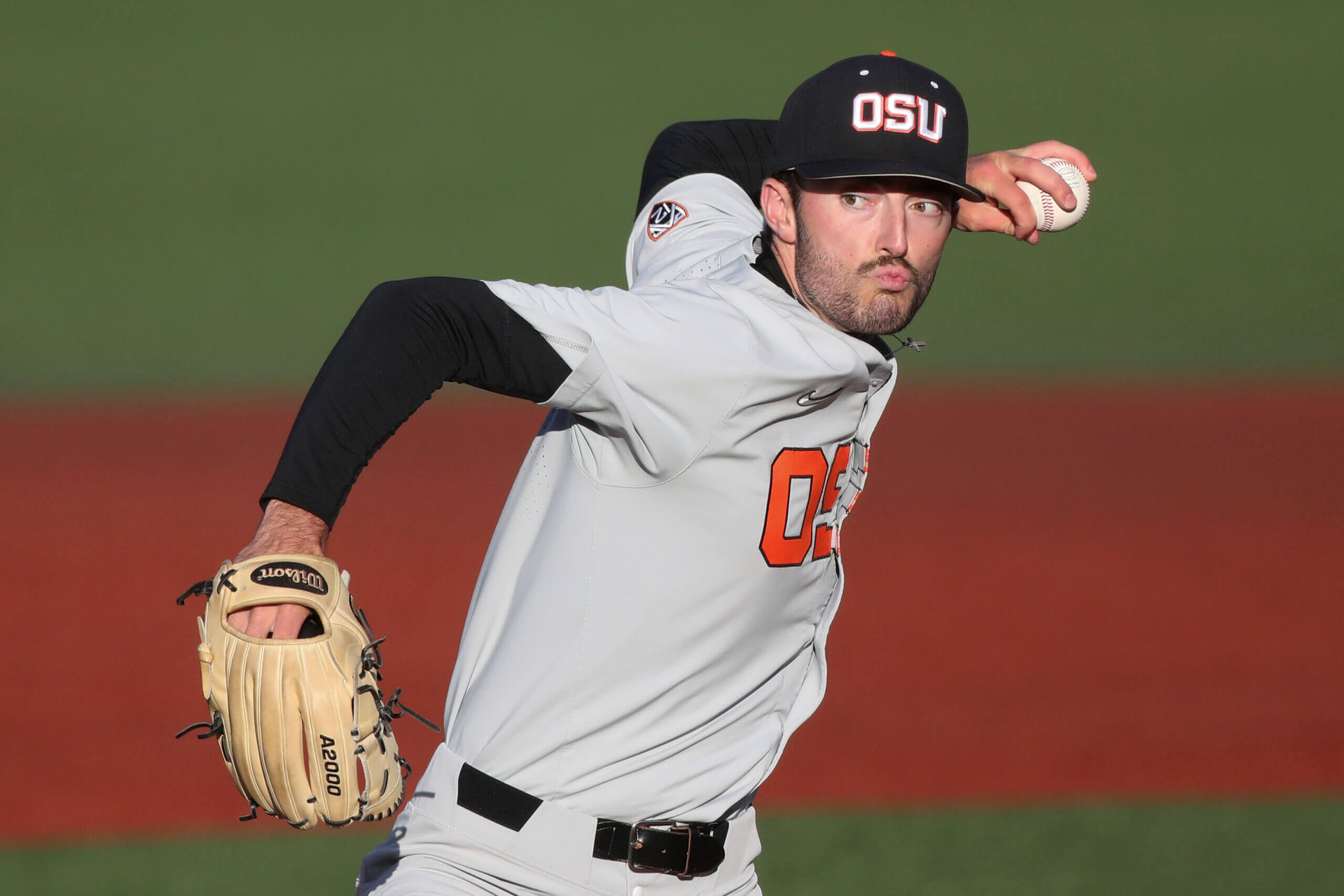
Cooper Hjerpe was a first-round pick out of Oregon State in 2022. (Amanda Loman / Associated Press)
Left-hander Cooper Hjerpe had Tommy John surgery last spring and won’t return until some time this summer, a disappointing but hardly shocking development given his IL stints for elbow pain in 2023 and 2024. He comes from a very low slot with a cross-body delivery that is very deceptive but hard to repeat, sitting 90-92 with a very sweepy slider and an above-average changeup. I’ve thought he was a reliever since his draft year in 2022, given the delivery and fringy velocity … I wrote when the Cardinals acquired infielder Jesus Baez from the Mets in the Ryan Helsley trade that I didn’t think he was a good baseball player despite excellent tools. That’s still true, although he will turn 21 this February and has time to turn it around. He has excellent bat speed and should end up with plus power when he fills out. I saw him multiple times before the trade, while he was with the Mets’ High-A affiliate in Brooklyn, and he was consistent: He didn’t play hard on either side of the ball, including running balls out (the easiest thing to do as a player), and his approach to at-bats was awful. He also showed up out of shape last spring, helping the Mets decide to move him. He is a prospect because he has physical ability, but he has to grow up — and stop swinging at high fastballs all the time — to have any chance to become a big leaguer … Outfielder Nathan Church is a 70 runner who makes a ton of contact with no power, a very good fourth outfielder who can back up all three spots but lacks the bat to play every day … Right-hander Brian Holiday had Tommy John surgery in early May, a disappointing outcome for their 2024 third-rounder. Prior to the injury, he showed plus control of a four-seam/slider/curve combo, needing to improve or alter his changeup to stay as a starter … Outfielder Travis Honeyman missed time again in 2025, this time with a hamstring injury, and has yet to see Double A even though he’s already 24. He had shoulder surgery when the Cardinals drafted him in 2023 and in his infrequent time on the field, he hasn’t been able to drive the ball as he did before. He’s athletic and has excellent hand-eye coordination, with high contact rates everywhere he’s played, and I’d like to see what he can do when healthy … Left-hander Cade Crossland, the Cardinals’ fourth-round pick last year, transferred from a two-year college to Oklahoma but had a disappointing spring, with his velocity down thanks (probably) to a preseason back injury. He has a plus changeup and a slider that should be enough to make him a starter if he’s healthy. He’s a perfect candidate for the Cardinals’ player development team to help.
2026 impact
Wetherholt could make the Opening Day roster as the second baseman if they trade Brendan Donovan. Crooks should get some run as the backup catcher.
The fallen
The Cardinals’ 2023 first-rounder, outfielder Chase Davis, hit .242/.358/.353 in Double A with a 29.6 percent strikeout rate. He hasn’t hit since he signed and his power output has been very disappointing, with nowhere near the bat to profile as even a good backup.
Sleeper
Franklin could blow up as a starter if he holds most of that stuff as the Cardinals stretch him out.