
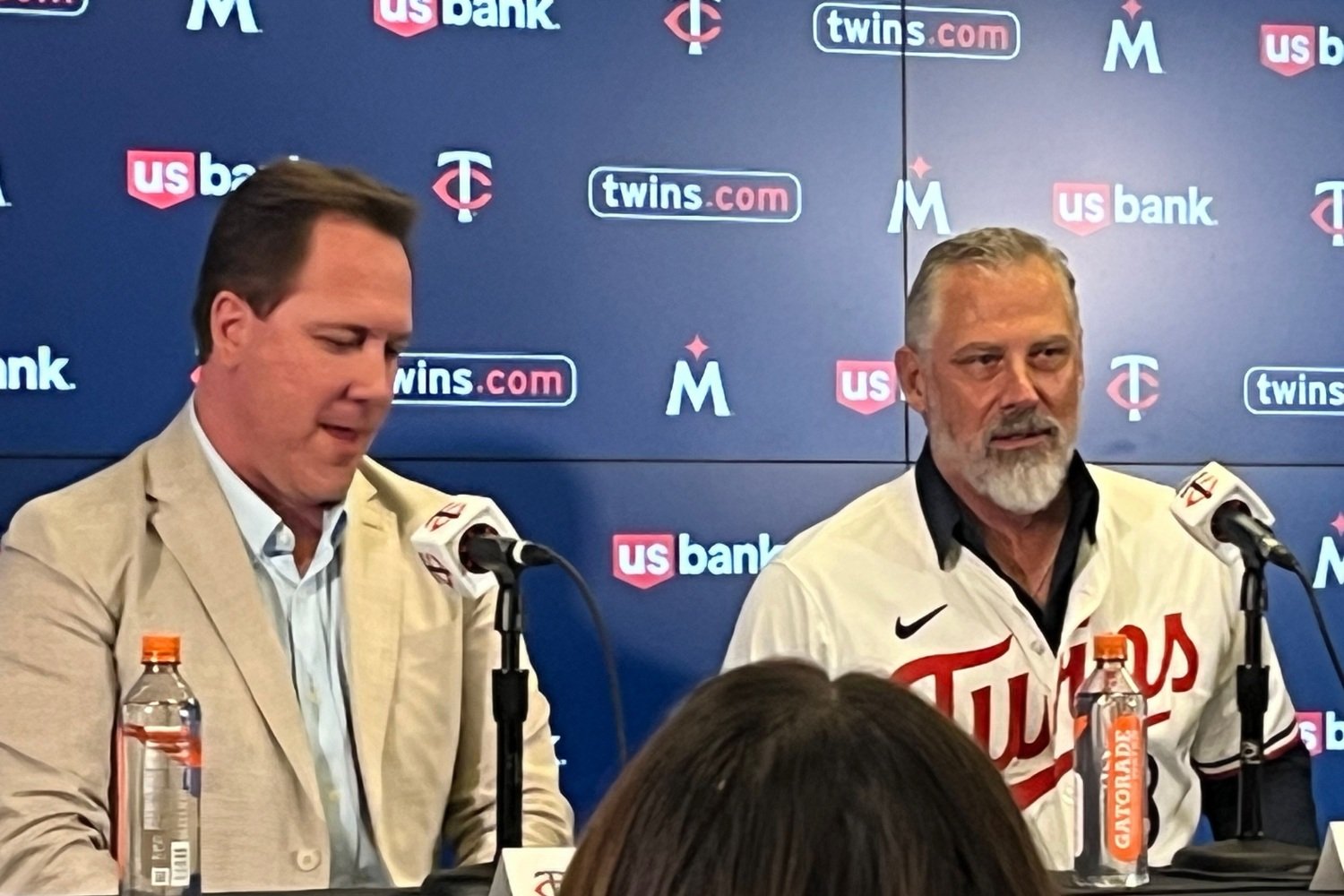
There is still much we don’t know about the specific events that led to the Twins and Derek Falvey parting ways. One thing we do know, though, is that Falvey was set up to fail in three key ways. That makes it easy to see why he wanted out, and perhaps why he chose not to let another losing season be hung around his neck as he seeks his next, greener pasture.
The Correa Signing
The first way in which ownership misled Falvey was Joe Pohlad’s green-lighting of Carlos Correa’s second signing. To be clear, the approval itself was sound, and theoretically, it was a great move. A good owner, when sensing that his team’s window of contention is wide-open and that the team is one big splash away from having a chance at a deep playoff run, should approve signing a superstar.
After the signing, The Athletic’s Dan Hayes reported the following:
“While he didn’t mention a specific number, Pohlad didn’t hesitate to suggest the Twins could increase payroll significantly if everything was properly aligned … Would something like $180-200 million be out of the question?
“I think that there are a number of factors that you need to consider,” Pohlad said. “Where your team is, where your division is, where your business is at. And I don’t think something like that is ever out of the question. I really don’t.”
Fast-forward eight months, and you know the rest. A good owner should not approve a signing like the Correa if he knows it will reduce the ability to add supplemental pieces, or worse, to slash payroll by nearly 20% the following season—then again, and again for good measure.
One might choose to be charitable, and argue that perhaps Pohlad didn’t know that the family would be “losing” significant money. That’s a watery defense, though. An owner’s imprimatur on a signing should signal a commitment to the spending required to justify it, which means either knowing for sure that it won’t limit the team, or being willing to stretch and accept the pain when it comes. Either way, allowing Falvey to take on a $200-million contract and then slashing payroll eliminated Falvey’s ability to sign quality depth pieces that would insulate the team against injuries, player regression, or the failure of prospects to develop into quality regulars. In short, the Pohlads forced Falvey to immediately thread a needle if he wanted to succeed.
Ownership Communication and Decision-Making
The second way the Pohlads made Falvey’s job harder is through their public-facing ineptitude. Whether it was Joe’s ill-advised “rightsizing the payroll” comment immediately following the first playoff success in 20 years, or his comments following the 2025 trade deadline firesale, ownership hung the front office out to dry.
“I’m confident because we have got all the right pieces, and we have the resources we’re ready to invest when needed,” he said in July. “The goal is not to compete. The goal is to win a World Series.”
That’s just so out of touch with the reality of the situation, and unfortunately for Falvey, it makes it appear as if he’s the one choosing not to improve the team.
One can also point to the travails of watching Twins games on TV as the RSN model died its slow and ugly death, and the public promise they allowed Cory Provus to give (on the record) that there would be no more blackouts—after which they chose to re-up with the same bankrupt organization that was preventing fans from watching. That created a feedback loop of frustration among fans that led many to tune out. Of course, with his promotion, Falvey had to try to figure out how to pick up the pieces. This is just one example of ownership hurting their own earning power, which led to the reductions in payroll.
Then, of course, there was the sale that wasn’t, leading to Falvey stating as late as December’s Winter Meetings that he still wasn’t sure what he would be allowed to do this offseason, at a time when other teams were deep in their planning processes—and, indeed, executing those plans.
Unrealistic, And Constantly Changing Expectations
The final, perhaps irreconcilable way that the Pohlads made Falvey’s job impossible was to issue mutually exclusive, diametrically opposed dictates. The first: to win, despite needing four good bullpen arms, a backup catcher, and at least two above-average hitters. The second: do this for, say, $20 million in offseason spending, leaving the team with one of baseball’s smallest payrolls. They issued this unfunded mandate, by the way, after Falvey had already made the sensible choice to rebuild at the deadline last season, based on the financial constraints placed on him and the underperformance of the core.
That came after the whiplash Falvey had received from ownership pivots over the prior two years. It has looked something like this:
2023: Go all in! Sign Correa! Break the curse! There’s more money where this came from!
2024: So close…but you gotta cut payroll. By a lot. Hopefully it’ll be fine. You’ll figure it out. Also, why are fans mad?
2025: Keep cutting. It’s a good core, we can still do this. Actually, the team isn’t quite performing… You know what? Maybe let’s actually burn it down. Seriously, why are fans mad? It’s a nice ballpark.
2026: Oh, fans are mad because they want to win. Ok. We aren’t rebuilding. You better win. Also, there’s no money. Trust me, payroll doesn’t matter. Vibes matter.
Falvey acted the politician throughout his Twins tenure, to the point that he consistently took heat for decisions that weren’t, strictly speaking, his. I’m sure signing Ty France to play first base in 2025 was not his first, or even second, choice. I’m sure he would have preferred not to eliminate the 2025 bullpen at the deadline. This is, after all, the guy who was in tears following the 2024 season because of how upset he was that the team failed down the stretch. There was never an indication that he didn’t want to field a great team, but he was handcuffed at every point since the 2023 playoffs ended.
However, the fact that he consistently chose to carry water reflected an accurate understanding of the reality he was living. Ownership found themselves in significant debt, however it was accrued; he had a good relationship with his bosses; and he liked the role he was in. So, he dealt with it and made the best of it.
When the boss with whom he’d had a good relationship was replaced by an intransigent dilettante, he realized that he no longer liked the role as much as he once had. The debt is being reduced or eliminated, but Falvey realized that wouldn’t matter if he was to be overseen by a similarly miserly but less engaged and less flexible Pohlad sibling.
I can’t say I blame him.