
Tom Pohlad has been consistent in one message this winter: He believes the Minnesota Twins will be in contention in 2026. Projection systems have been far less optimistic, and Pohlad has shown little interest in revisiting the organization’s second straight offseason of payroll cuts. Teams with higher payrolls buy margin for error through veteran depth and midseason flexibility. The Twins do not have those luxuries. What they might have, instead, is something harder to quantify and easier to overlook.
Underrated players do not make a loud impact in national conversations. They are often hidden behind strikeout totals, injury histories, or the simple crime of playing in medium-sized markets on underachieving teams. Yet, those players can quietly carry a roster when things break right. MLB Network recently ran through its Top 100 Players Right Now, and MLB.com followed that with Anthony Castrovince’s 2026 All Underrated Team. The criteria were strict. No recent major award winners. No former All-Stars. No nine-figure contracts. No young players who are still in their honeymoon phase. What remained was a list of players who consistently help teams win without much recognition.
Two Twins landed on that list, and both point toward how this roster might outperform expectations.
Ryan Jeffers continues to exist in the strange space where solid production at catcher somehow feels replaceable. Catching is brutal on the body and harder on the bat. League-average offense at the position is valuable, and Jeffers has been better than that. Over the past three seasons, he has been one of only four catchers with at least 335 plate appearances and a league-average or better OPS+ each year. His OPS+ in that stretch sits 13% above league average. The names around him are William Contreras and Will Smith, players who are spoken about very differently.
Jeffers is not marketed as a franchise cornerstone. What he does is show up, take quality at-bats, lead the pitching staff, and provide offense from a position where many teams accept far less. The Twins also expect that he will catch 100 games or more this season, his last year under team control. That kind of stability behind the plate has ripple effects through a pitching staff, especially one that relies heavily on command and sequencing. Jeffers being quietly good is exactly the kind of thing projection systems tend to flatten out.
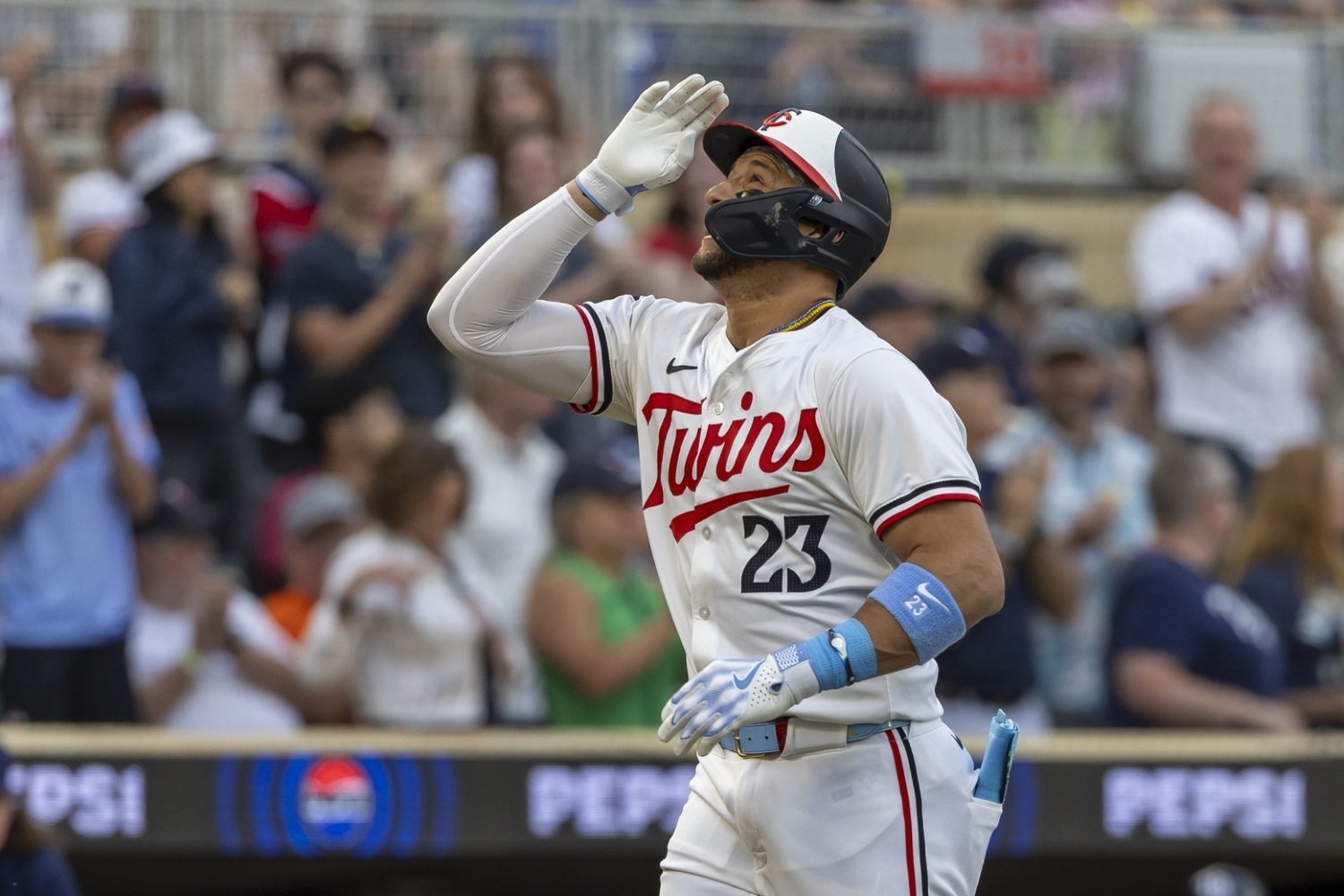
Matt Wallner is a more chaotic version of underrated. As MLB.com pointed out, his 2025 stat line does not look normal, and that’s because it was not. Forty-one extra-base hits with only 68 total hits is an absurd distribution, something that has barely happened in modern baseball. The easy explanation is that he strikes out too much. The harder truth is that Wallner actually made real progress there, cutting his strikeout rate by more than seven points while maintaining a walk rate in the 84th percentile.
The underlying data suggests the power is real. His average bat speed was among the quickest in the league, and he ranked in the 85th percentile in barrel percentage. When he makes contact, it is loud. Injuries have kept him from stacking full seasons, but over the past three years, he has an OPS+ that is 29% better than league average. That is the same neighborhood as James Wood and Pete Alonso over similar stretches. Wallner does not need to become consistent in the way stars are consistent. He just needs to stay on the field and keep doing damage.
Beyond those two, the Twins roster has several other players who could be quietly critical if things break right. Here’s one underrated player in each player group (position players, starting pitchers, and relief pitchers).
Royce Lewis is no longer a mystery. He is also not what he was at his peak a few seasons ago, as he finished last season with an 85 OPS+. That gap between expectation and recent reality has pushed him into underrated territory. Lewis still has impact tools, and his ability to change a game with one swing or one defensive play remains intact. The question is health and rhythm, not talent. ZiPS projects him to have a 97 OPS+ with a 1.4 fWAR. If he can simply get back to being himself, even at a slightly reduced level, the lineup gains a presence it has sorely lacked.
Bailey Ober sits in a similar space on the pitching side. Injuries disrupted his 2025 season and dulled the conversation around him as he ended the year with a 5.10 ERA and a 1.30 WHIP. When healthy, Ober has shown he can miss bats, limit walks, and give length. Those are traits that age well and travel well. For 2026, ZiPS projects him to produce 2.0 fWAR with a 102 ERA+. The Twins do not need him to be an ace. They need him to be reliable, to show that last year was an interruption and not a trend.
In the bullpen, Cole Sands may be the most interesting name. His stuff has played in a variety of roles, but the late innings are where reputations are made and tested. Sands has the chance to become one of those relievers who perform in high-leverage spots. ZiPS projects him to have a 110 ERA+ with a 23.5 K%. If he proves he can handle save opportunities, the Twins suddenly have an internal solution that would otherwise cost real money.
The Twins may not have the payroll cushion Tom Pohlad wishes he could ignore, and projection systems may not see the upside baked into this roster. But baseball seasons are not won on paper. They are won by players who outperform their labels. If enough of these underrated pieces click at the same time, Minnesota’s path to contention may not be as far-fetched as it looks.
Do the Twins have other underrated players? Leave a comment and start the discussion.