
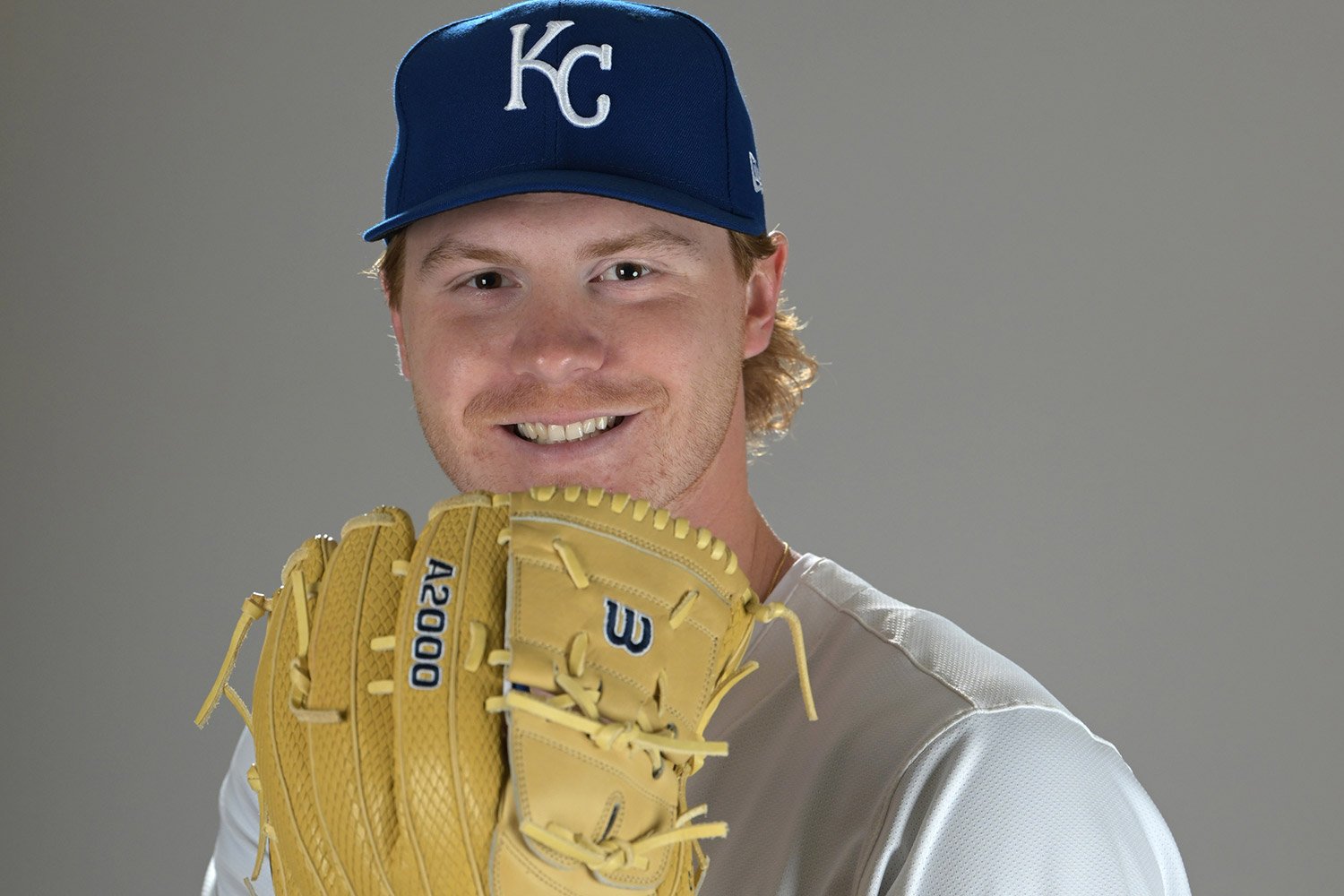
The Royals’ farm system remains a work in progress, ranking in the lower half of the league according to most publications and prospect analysts. That said, it’s come a long way since JJ Picollo took over as President of Baseball Operations in 2023. With the help of Brian Bridges, the Royals’ Scouting Director, and Daniel Guerrero, who leads International Scouting, the Royals have added a lot of talent who could make the farm system even more prestigious in 2026.
When it comes to top prospects, I wrote about 20 who could have a major impact on the Royals’ farm system or Major League squad in some capacity next season and beyond. However, there are many other prospects in the Kansas City organization worth watching, even if they are not on the Royals Keep list.
In this post, I am going to highlight five pitching prospects who may not be getting much “prospect hype” but could make serious progress in the Minor Leagues this season. I consider these five “sleeper” pitching prospects and will identify them from different levels of the Royals’ farm system. There will also be a companion post highlighting five “sleeper” position player prospects for 2026.
Any graphics or tables are courtesy of TJ Stats.
Eric Cerantola, RHP (Projected Starting Level: Triple-A)
The Royals added Cerantola to the 40-man roster last offseason after posting a 2.97 ERA and 31.4% K rate in 72.2 IP with the Northwest Arkansas Naturals (Double-A) and Omaha Storm Chasers in Triple-A. The 2021 5th round pick primarily pitched in Triple-A last year and made 38 appearances and pitched 49 innings. In that sample, he saw his ERA rise to 4.04 and his K rate drop to 29.6%.
Even though he didn’t see any time with the Major League squad in 2025, Cerantola made some promising progress that could hint at his readiness for a MLB debut in 2026.
While his ERA was higher last year than in 2024, his 3.64 FIP was actually better than the 5.38 FIP he posted in Omaha in 14.1 IP. He also lowered his HR/FB rate from 13.6% in 2024 (with NWA and Omaha) to 7.8% with the Storm Chasers last year. Considering Omaha is considered the fifth most hitter-friendly ballpark in Triple-A, according to park factors, this kind of ability to minimize the long ball was an impressive feat.
In addition, he still struck out batters in bunches (29.6% K rate) while still maintaining decent control (18.3% K-BB%). The zone rate was pretty erratic, but he still was able to generate plenty of chases and whiffs last season, according to TJ Stats.
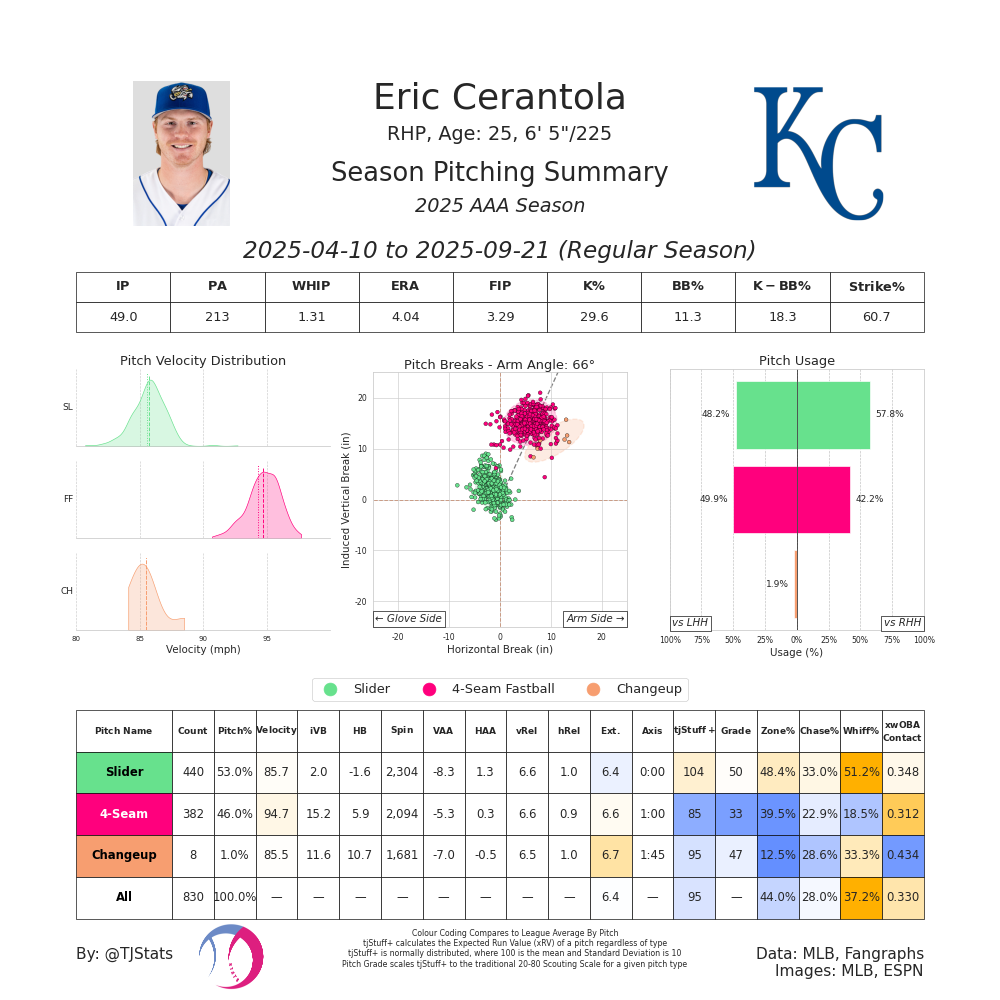
Cerantola posted a 28% chase rate, which was around league average. That said, he had a strong 37.2% whiff rate and a slightly above-average xwOBACON of .330. Those are promising signs that Cerantola developed a better feel for his pitches out of the bullpen in Triple-A last season.
The only issue is that Cerantola’s pitches didn’t profile well on a TJ Stuff+ end. His slider, his primary pitch, which he threw 53% of the time, was an above-average offering with a 104 TJ Stuff+ and 51.2% whiff rate. However, his four-seamer was mediocre, to put it nicely. It had an 85 TJ Stuff+ and 18.5% whiff rate, both poor marks.
For Cerantola to solidify a spot in the Royals’ bullpen in 2026, developing his changeup should be a key priority. Even though he threw it only 1.0% of the time, it still had a 33.3% whiff rate. Making the changeup a bigger part of his arsenal could help him lessen his four-seam usage and thus make him a more effective reliever overall who could be better prepared for Major League hitters.
Dennis Colleran, RHP (Projected Starting Level: Double-A)
Colleran mostly pitched in Low-A Columbia and High-A Quad Cities a season ago. He started the season with the Fireflies, posting a 4.06 ERA, 3.31 FIP, and 29.8% K rate in 31 IP. However, it was his tenure with the River Bandits that got prospect analysts to pay closer attention to him.
In 21 outings and 34.1 IP in the Midwest League, he posted a 1.69 ERA, a 25% K rate, a 14.4% K-BB%, and 0.82 WHIP. What made Colleran such an effective reliever for Quad Cities was not just his ability to limit runners on the basepaths (via base hit or walk), but his propensity to induce hitters to keep the ball on the ground (43% groundball rate) and in the yard (9.4% HR/FB rate).
A seventh-round pick in the 2024 MLB Draft by the Royals, Colleran showcased some solid command in Quad Cities, resulting in some impressive strike metrics. He posted a 48.5% F-Strike%, an 11.4% Swinging Strike rate, and 28.6% CSW. While those aren’t elite by any measure, they are still impressive and encouraging, especially combined with his groundball rates.
The former Northeastern product pitched in Surprise in the Arizona Fall League and held his own over 7.2 IP, as seen below in his TJ Stats summary.
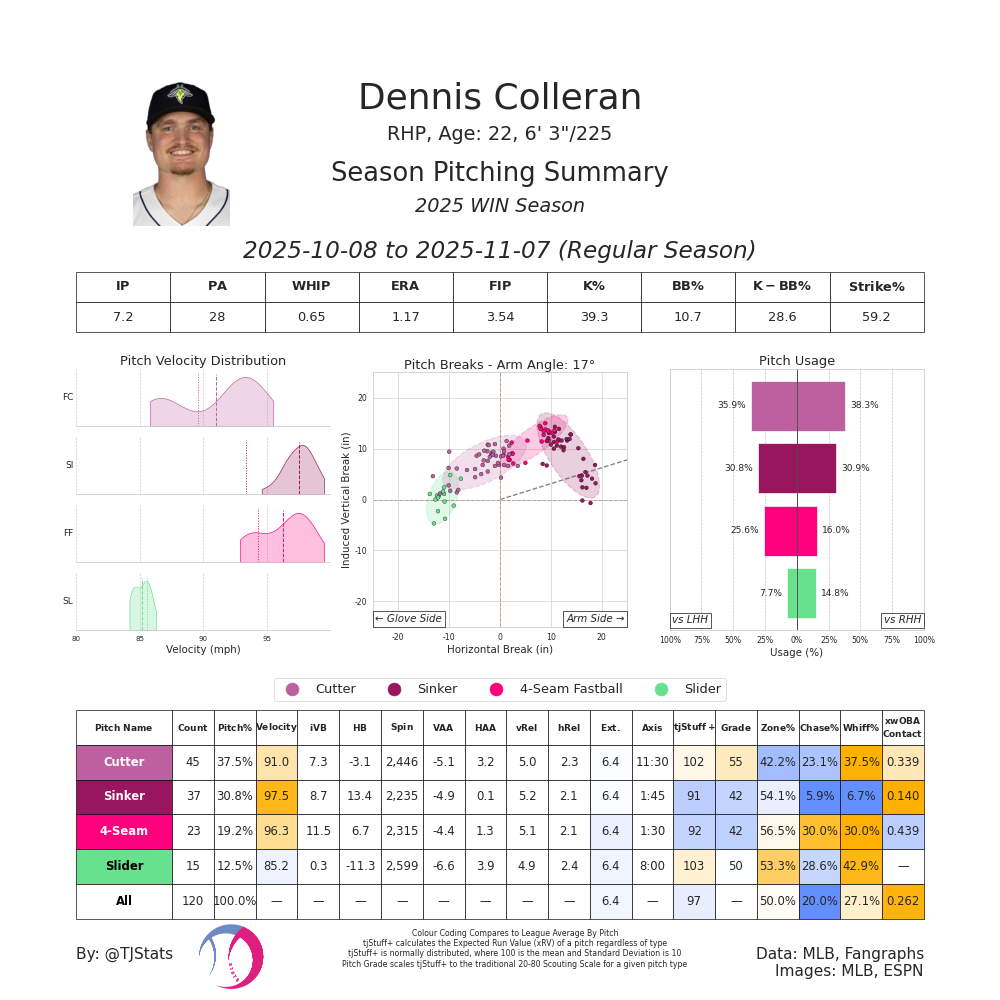
Colleran posted a 1.17 ERA, 0.65 WHIP, and 28.6% K-BB% with the Surprise Saguaros. His FIP was a little higher at 3.54, but that’s still a solid number, especially considering the small sample. Like his time with Quad Cities, Colleran’s ability to limit productive contact was on full display in Arizona, as illustrated by his .262 xwOBACON.
The TJ Stuff+ metrics this fall were mixed. In addition to a 97 overall mark, his sinker had a 91 TJ Stuff+, and his four-seamer had a 92 TJ Stuff+, both below average. That said, both pitches still succeeded in different ways. His sinker only allowed a .140 xwOBACON, and his four-seamer induced a 30% whiff. His cutter also had a 102 TJ Stuff+, and his slider had a 103 TJ Stuff+, showing that he has plus pitches in his arsenal. Hence, if Colleran can be successful in specific ways with his fastball pitches, he may be able to get better results with those pitches long-term than his stuff metrics would indicate.
Colleran received a non-roster invite to Major League camp this spring. While he is a long shot to make the team out of camp, he could impress the Royals coaching staff and leverage that Spring Training experience into a successful Minor League campaign in 2026.
A.J. Causey, RHP (Projected Starting Level: Double-A)
Causey was another 2024 Royals Draft pick (5th round) who pitched with Colleran in Quad Cities and in Surprise in the AFL. However, the former Tennessee product eventually matriculated to Northwest Arkansas, where he saw far more innings (33 IP) than Colleran (1.0 IP).
In 48 appearances and 73.1 IP with the River Bandits and Naturals, Causey posted a 1.72 ERA, 2.28 FIP, 0.90 WHIP, 26.5% K rate, and 20.5% K-BB%. He was particularly effective in Double-A ball, posting a 1.91 ERA, 2.39 FIP, and 18.9% K rate in 33 IP with the Naturals.
Like Colleran, the atypical-throwing righty (15-degree average arm angle) earned an invite to the AFL this past fall. Unfortunately, the stats weren’t as sterling as his draft classmate, as seen below.
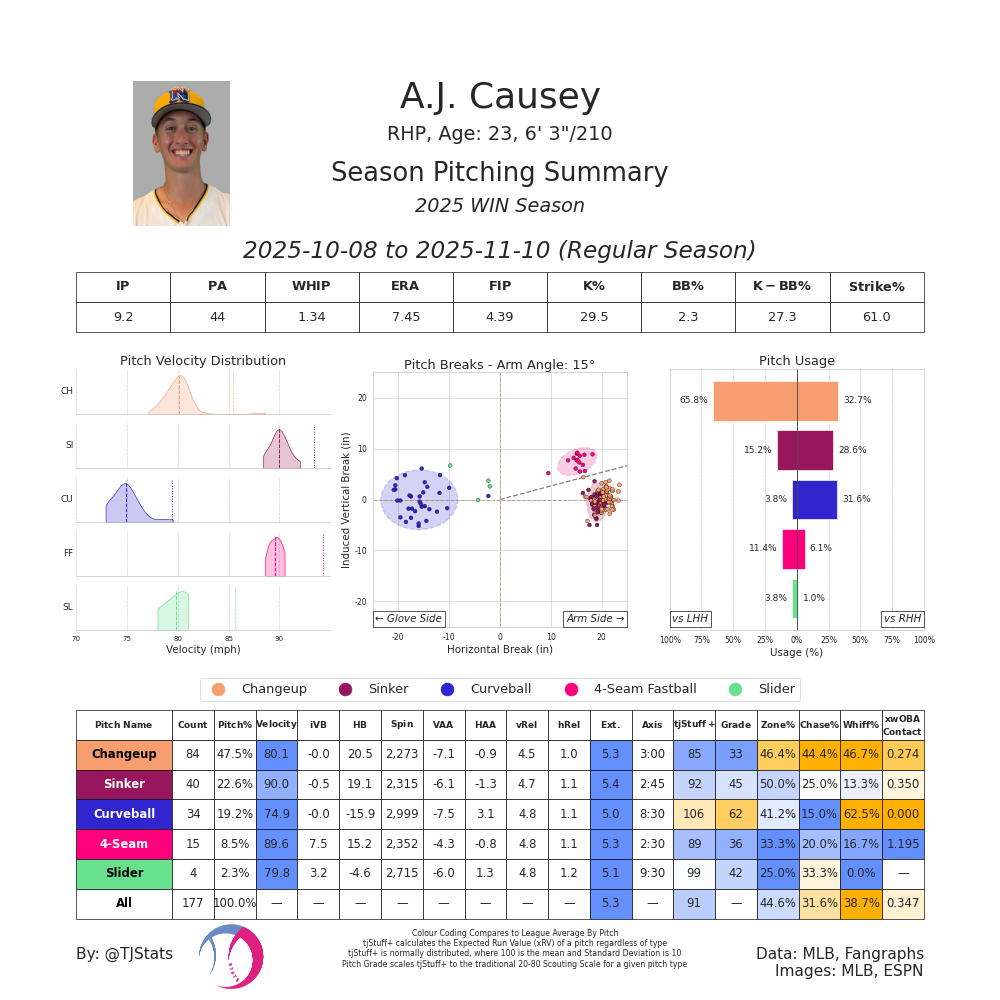
In 9.2 IP, Causey posted a 7.45 ERA and 1.34 WHIP. However, his FIP was much better at 4.39, and he struck out hitters in bunches (29.5% K rate) while limiting free passes on the basepaths (27.3% K-BB%). He also sported excellent chase (31.6%) and whiff rates (38.7%), as well as a decent xwOBACON.
The main issue with Causey in the AFL was that he maybe threw TOO MANY strikes in hittable parts of the zone and hitters made him pay, especially since most of his repertoire rates as below average on a TJ Stuff+ end (91 overall). His curve may arguably be the best pitch in the Royals’ farm system (106 TJ Stuff+; 62.5% whiff rate in AFL). Unfortunately, his slider was the only other pitch that had a TJ Stuff+ over 92.
Causey will get some time in Major League camp this spring, which will be good exposure for him when it comes to getting tutelage from pitching coaches Brian Sweeney and Mike McFerran. Hopefully, they can help him make some tweaks to his pitches, especially his fastball offerings, which can help him be more effective as he climbs up the ladder in the Kansas City farm system.
Hiro Wyatt, RHP (Projected Starting Level: High-A)
A third-round pick in the 2023 MLB Draft out of Connecticut, Wyatt was seen as a bit of a sleeper pitching prospect last year after posting a 2.67 ERA in 27 IP in Low-A Columbia in 2024.
As expected, he started the year again with the Fireflies. Unfortunately, the results weren’t as impressive.
At 20, he posted a 4.78 ERA, 1.46 WHIP, 22.3% K rate, and 14% K-BB% in 21 outings (20 starts) and 79 IP. His FIP was slightly better at 4.47, but some prospect analysts felt that Wyatt, selected as a bit of a project in the 2023 MLB Draft, didn’t make expected progress after a solid Low-A debut in 2024.
While his numbers didn’t blow fans or experts away, there is still a lot to be hopeful about with Wyatt in 2026.
Wyatt didn’t generate a whole lot of whiffs in 2025 (8.4% SwStr%). However, he still did a good job generating strikes overall, as illustrated by 47% F-Strike%, 17.6% Called Strike rate, and 26.1% CSW. He also kept the ball on the ground effectively, inducing a GB% of 47.1%. Lastly, his HR/FB% wasn’t exactly low at 11.9%, but it’s tolerable and could be subject to improvement, especially if he can do a better job of inducing whiffs in 2026.
The righty is only 21 years old and isn’t arbitration eligible until 2027. Thus, the Royals have time to continue developing him as a pitcher in their system. He has the potential to be a solid No. 3-5 starter, especially with his ability to work efficiently (2.69 K/BB ratio) and keep the ball on the ground. Even if he plateaus a bit with more innings, he at the very least could be a solid reliever at the Major League level, with setup man potential.
He is not an “elite” prospect, but Wyatt is one Royals fans should watch closely in 2026, likely in High-A Quad Cities.
Kyle DeGroat, RHP (Projected Starting Level: Low-A)
When it came to Complex League pitchers, David Shields (our No. 3 prospect) and Kendry Chourio (our No. 4 prospect) got more hype, and rightfully so. They did matriculate to Low-A and found various levels of success in the Carolina League, after all.
While DeGroat didn’t get as much time in Columbia (he only made one start with the Fireflies), he did show some progress in the Complex League, and he is a talented pitcher who shouldn’t be taken lightly in the Royals farm system.
At the surface level, DeGroat doesn’t seem like a prospect worth following too closely. He posted a 4.11 ERA, 1.40 WHIP, and 4.89 FIP in 12 outings (11 starts) and 46 IP in the Arizona Complex League.
Furthermore, he was a 14th-round pick in the 2024 MLB Draft. That said, he fell in the draft because he was seen as a firm commitment to the University of Texas at the time. Instead, DeGroat surprised folks and accepted a $350,000 signing bonus. Here’s what Burnt Orange Nation, a Texas Longhorns blog, said about DeGroat’s pitching profile after he signed with the Royals.
Quote
A late riser who committed to Texas last October, DeGroat was ranked as the No. 239 prospect by MLB.com and as high as No. 138 by Prospects Live. At the time of DeGroat’s selection, his slide in the draft possibly indicated signability concerns by organizations or a willingness by the Royals to make an offer to the 6’0, 205-pounder more in line with his draft projections…
As a senior at Wallkill, DeGroat allowed four earned runs in nine appearances for a 0.60 ERA with 102 strikeouts. He didn’t allow a single extra-base hit, limiting opponents to 16 singles.
Even though DeGroat doesn’t have the prototypical size for a power arm, his delivery features enough juice to consistently sit from 92-94 mph with his fastball and reach 97 mph from a low arm slot that makes it difficult on hitters. An improving, sweeping slider features plenty of horizontal break in addition to a promising curveball.
Even though he’s an older prep prospect (he just turned 20 on January 30th), it seems like the Royals handled DeGroat with more kid gloves than they did Shields and Chourio, other teenage pitching prospects. He also had a rough stretch from June 23rd to July 14th, where he gave up 15 runs (12 earned) in four starts. Take that stretch away, and his ERA numbers look a whole lot different.
Lastly, he put up a solid outing in his lone Low-A performance, allowing no runs and no hits while walking one and striking out three in 3.1 IP.
He is on the outside-looking-in right now when it comes to the Royals’ Top-20 Prospects list. However, if he makes progress in Columbia, it wouldn’t be surprising to see him not just a Top-20 prospect, but maybe a Top-15 or Top-10 one by midseason. That’s how much upside DeGroat still has.
Interested in learning more about the Kansas City Royals’ top prospects? Check out our comprehensive top prospects list that includes up-to-date stats, articles and videos about every prospect, scouting reports, and more!