
Perhaps no other Twin in recent memory saw their prospect stock rise more rapidly than Zebby Matthews. Selected with the 234th pick in the 2022 draft out of Western Carolina and signed for a paltry $125,000, Matthews grew from an afterthought to a top prospect at virtually the speed of light, debuting by mid-August 2024.
Unfortunately, Matthews’s once-bright flame has dimmed in the eyes of some, due to inconsistent performance across 117 major-league innings. His rise was fueled by an uncanny ability to live in the zone, missing bats and not giving up any walks, while drastically improving his fastball velocity. In the majors, his walk rates have nearly tripled from approximately 2.0% in the minors to 6.6%, while his strikeout rates have dropped by roughly eight percentage points.
These decrements in performance, albeit in a relatively small sample, have begun to beg the question: Is Zebby Matthews’s future in the starting rotation or the bullpen?
Zebby Matthews’s Stuff & Pitch Arsenal
On paper, Matthews boasts a prototypical 2026 starting pitcher repertoire. He primarily relies on his four-seamer and slider, dispatching them against lefties (293 and 140, respectively, in 2025) and righties (263 and 199) at an equal clip. Matthews employs his cutter slightly more often against left-handed hitters (103 vs 73), though the sample size for each is quite small, and virtually only throws his changeup against lefties (104 vs. 39). Sprinkle in the occasional curve and sinker to keep hitters on their toes, and Matthews arsenal is sufficient for a starting pitcher… in theory.
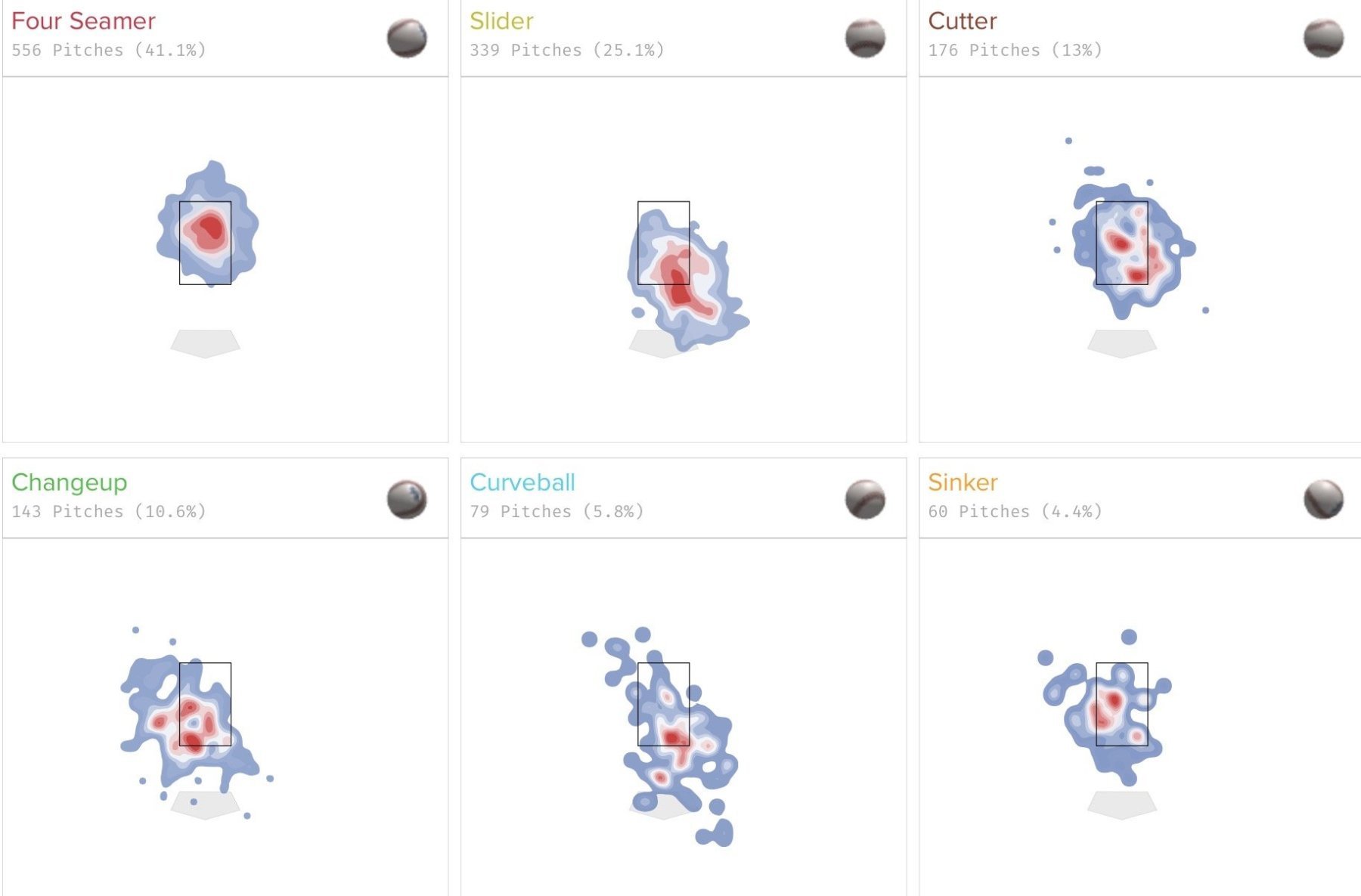
In practice, at least at the MLB-level to date, Matthews really only has one pitch that has performed well: his gyro slider. As shown in the movement profile graph and implied in the slider heat map above, Matthews’s slider features significantly more drop (vertical break) than it does sweep (horizontal break). This is due to the pitch featuring more gyroscopic (think football spiral) spin than side spin. Gyroscopic spin does not influence pitch movement, meaning that the majority of the ball’s movement is simply due to the pull of gravity as it flies through the air.
Across 525 major league offerings, opposing hitters have managed a meager .568 OPS against Matthews’s slider, per FanGraphs, driven by a high-30% whiff rate in combination with a 42% ground ball rate. In essence, when Matthews’s throws his slider there’s high chance that the batter is either going to miss it entirely or pound it into the ground.
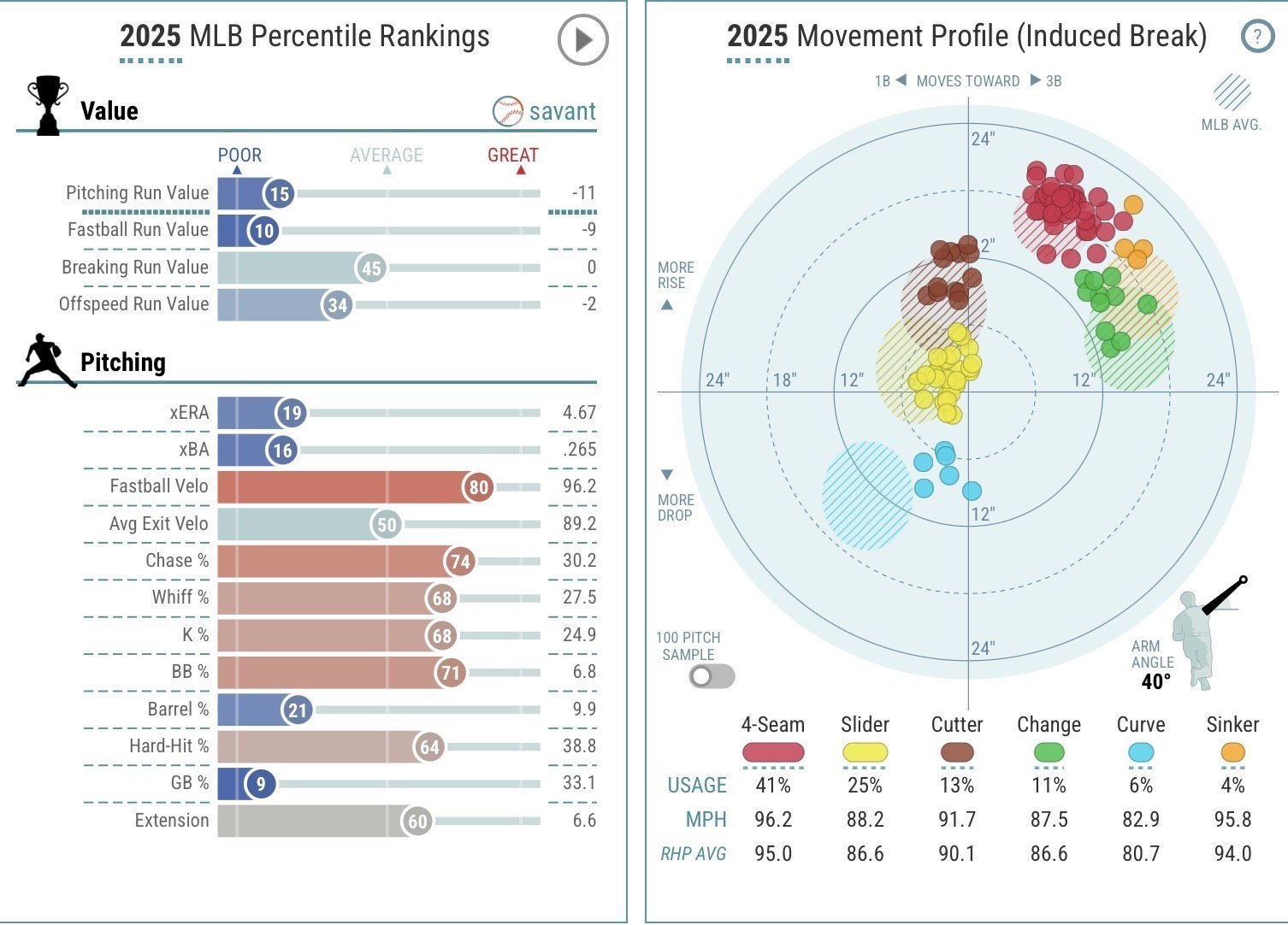
The rest of Matthews’s arsenal has been varying degrees of lackluster, even this four-seam fastball, whose crazy velocity creep helped him rapidly rise through the minors. Pitchers can overpower minor league hitting with pure velocity, something Matthews and his mid-90s fastball accomplished. However, the same can’t be said for major league hitting. Generally speaking, if a fastball is going to be a pitcher’s best offering in the majors, it not only needs to possess high velocity readings but also have a movement profile that makes hitting it squarely extremely difficult. MLB hitters can hit straight gas; hitting moving or deceptive gas is much more difficult.
When analyzing the movement profile, or shape, of a fastball, there are two metrics worth considering: induced vertical break and horizontal break. Induced vertical break measures how much the ball drops solely due to its spin, taking gravity out of the equation. If a fastball has a high degree of spin, it will, more often than not, register a higher induced vertical break, meaning it doesn’t drop. This will produce an illusion in the hitter’s brain, making it seem as though the ball is rising. Horizontal break measures how much the ball moves, well, horizontally; if it moves towards the glove side of the pitcher, we say it has ‘cut’, and if it moves towards the hand side, we say it has ‘run’.
Year
Pitch Type
#
# RHB
# LHB
%
MPH
PA
AB
H
1B
2B
3B
HR
SO
BBE
BA
XBA
SLG
XSLG
WOBA
XWOBA
EV
LA
Spin
Ext.
Whiff%
PutAway%
2025
Four Seamer
556
263
293
41.1
96.2
123
112
40
25
8
0
7
30
85
.357
.303
.616
.571
.422
.394
92.7
23
2331
6.6
22.4
19.4
2025
Slider
339
199
140
25.1
88.2
113
107
16
11
2
0
3
50
58
.150
.184
.252
.326
.193
.237
87.5
10
2419
6.4
38.5
24.3
2025
Cutter
176
73
103
13.0
91.7
54
42
14
12
1
0
1
3
40
.333
.318
.429
.482
.405
.414
88.7
15
2494
6.5
24.2
8.6
2025
Changeup
143
39
104
10.6
87.5
32
31
11
7
3
0
1
1
31
.355
.317
.548
.426
.374
.346
86.3
6
1499
6.4
26.3
5.3
2025
Curveball
79
38
41
5.8
82.9
14
14
5
4
1
0
0
2
12
.357
.304
.429
.487
.342
.338
88.9
38
2435
6.3
34.5
10.5
2025
Sinker
60
58
2
4.4
95.8
18
17
8
8
0
0
0
2
16
.471
.264
.471
.320
.415
.255
77.2
6
2317
6.6
7.7
50.0
2024
Four Seamer
307
115
192
42.8
94.9
66
59
17
7
5
0
5
17
42
.288
.262
.627
.592
.417
.394
94.3
19
2230
6.5
17.8
21.3
2024
Slider
186
92
94
25.9
87.2
57
52
16
12
2
0
2
20
32
.308
.251
.462
.400
.363
.318
90.2
11
2349
6.4
37.6
23.5
2024
Cutter
116
62
54
16.2
90.9
30
29
10
7
0
0
3
2
27
.345
.295
.655
.674
.434
.418
87.3
17
2403
6.4
18.2
18.2
2024
Changeup
57
2
55
7.9
85.8
9
9
2
1
1
0
0
0
9
.222
.348
.333
.512
.237
.378
86.6
-5
1550
6.4
31.3
0.0
2024
Curveball
51
9
42
7.1
81.7
15
15
6
4
1
0
1
4
11
.400
.327
.667
.558
.455
.377
87.9
16
2369
6.3
17.4
14.8
Generally, there is a trade-off between a fastball’s induced vertical break and horizontal break; more in one generally leads to less of another. This is where Matthews’s fastballs—both his four-seam and sinker—struggle. The induced vertical break of his four-seamer is 16.6 inches, and his horizontal break is 9.0 inches of run; for his sinker, it is 13.1 inches and 15.2 inches, respectively. These are what are known in the industry as “dead zone” fastballs. Essentially, to the batter’s eye, they appear straight, not having enough induced vertical break to produce the rising illusion and not enough horizontal break to be difficult to square up.
Since Matthews’s made his debut, opponents have produced a .944 OPS (839 pitches) against his four-seamer and a 1.368 OPS (82 pitches) against his sinker. His cutter (.955; 294), changeup (.817; 200), and curve (.931; 130) haven’t fared much better.
However, there are some intriguing data points embedded within Matthews’s splits statistics. Namely, they suggest that he is much better against righties than lefties to the tune of .230 points of OPS (.944 OPS against 278 lefties and .714 OPS against 253 righties) and 4.0% K-BB% (20.2% vs. 16.2%). Which informs…
What Should Zebby Matthews’s Role Be In 2026?
It’s extremely difficult to be an MLB-caliber starting pitcher with only one good pitch. Luckily, carving out a productive career out of the bullpen is relatively achievable. Matthews’s career to date is not all that dissimilar to that of Glen Perkins, Tyler Duffey, and, more recently, Griffin Jax. These were all starting pitchers who experienced great success in the minors before struggling mightily once they reached the majors because their middling repertoires were exposed. However, a shift to the bullpen and increased emphasis on their best pitches transformed them into, at times, devastating backend relievers.
For Matthews to project as a starting pitcher moving forward, he likely needs to add at least one more above-average pitch—perhaps a sweeper or kick-change to complement his gyro slider?—and/or improve the shape of his fastball. Neither is a particularly easy task, though adding a new pitch is significantly more trainable than adding isolated pitch spin/induced vertical break. The Twins have far more metrics available to them, including whether Matthews is more of a natural pronator or supinator, which would influence which pitches would be easier to add, as well as linear and rotational force-velocity data, which would indicate if there is any additional athletic performance meat being left on the bone.
The Twins may continue to employ Matthews as a starter, but, as things stand right now, his profile is much more suitable for a bullpen role.