
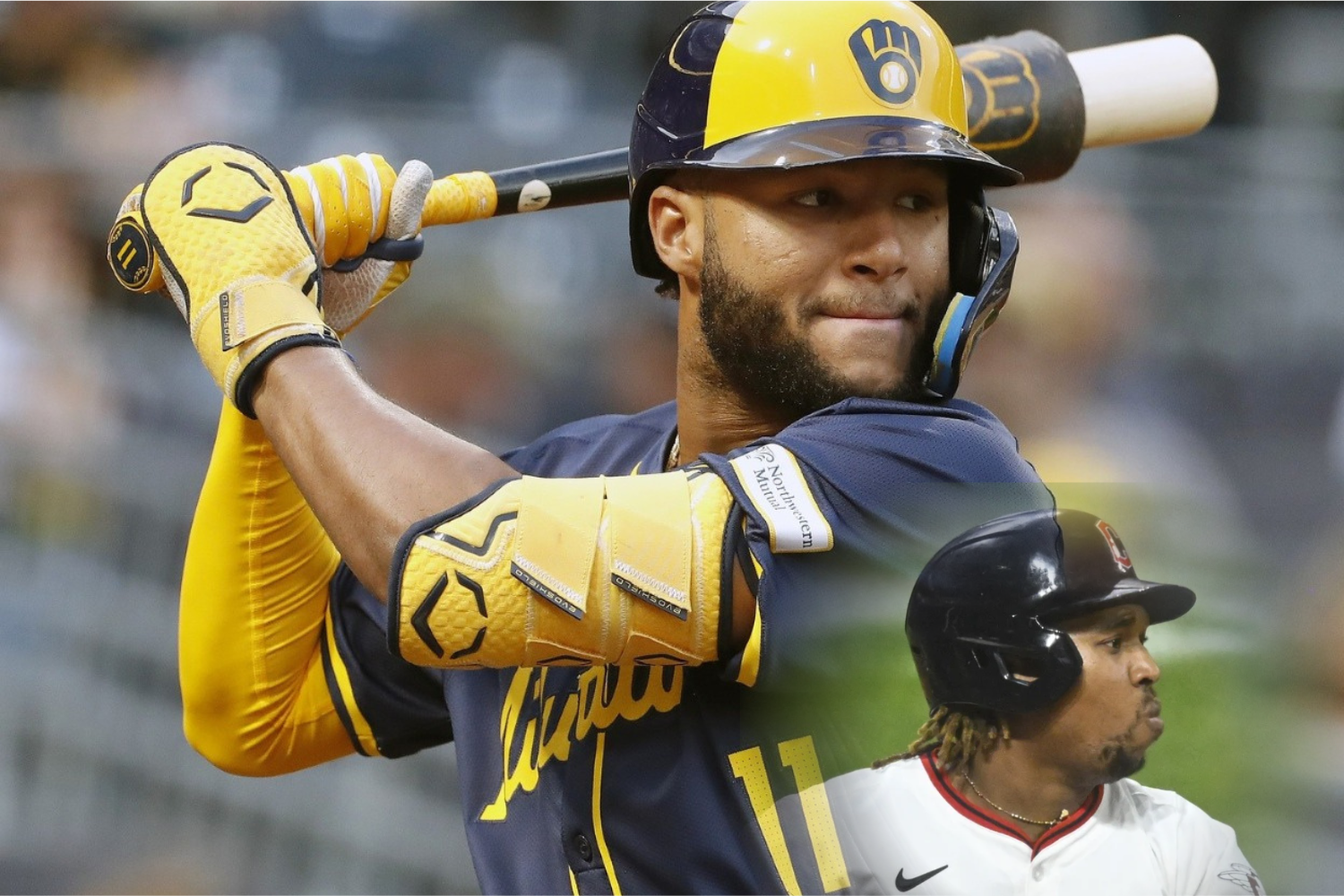
Milwaukee and Cleveland have a lot in common. They’re both in what many coastal dwellers would deem “flyover states.” They both sit on the shores of one of the Great Lakes, where they became major hubs of commerce because of their ports. Both cities have seen their populations stagnate or shrink, relative to other big cities, as the things that powered their economies have been made obsolete or changed in such major ways that they no longer dominate the marketplace, but neither absorbed quite as hard a punch as Detroit and Pittsburgh did at the end of the 20th century and beginning of the 21st. They’re tough, proud Midwestern towns.
They have even more similarities when it comes to baseball. Both teams have found consistent regular-season success despite operating on a shoestring budget, but have failed to make deep runs. Neither city has won a World Series since color television was introduced to U.S. markets. The now-Guardians last won in 1948; Milwaukee hasn’t seen a champion since before the Brewers came to town.
However, one thing the Guardians have that the Brewers don’t is a player on a Hall of Fame track who will likely wear but one jersey for his entire career. Last week, José Ramírez agreed to an extension that will keep him under club control until 2032, his age-40 season. This is the third extension he has signed with the club, but given his consistently incredible production, it’s no wonder that Cleveland wanted to keep him around for the long haul.
His $18.36-million salary in 2026 (it’s $25 million, technically, but he’ll receive just $15 million of it this year, and the deferral structure of the rest dramatically reduces its value) currently represents roughly 24% of the Guardians’ total payroll, which is more of an indictment of just how little the franchise spends than it is evidence that he’s being overpaid. The team’s current 40-man payroll of $76.2 million pales in comparison to the Brewers’ $123.5 million, which means that if they wanted to, Milwaukee could make a similar move.
The Brewers are no stranger to getting ahead of the curve when it comes to locking down promising talent on team-friendly terms. In 2023, Jackson Chourio signed an eight-year, $82-million extension, the largest in history for a player yet to debut. Before the 2020 season, Freddy Peralta signed a five-year, $15.5-million extension with club options. Aaron Ashby signed a very similar deal, for slightly more money over the same span.
None of these contracts quite stack up to Ramírez’s deal. Ashby has been held back by injury, Peralta was traded to the Mets this offseason, and Chourio could be a Brewer for life, but since he’ll be 30 years old when the final club option expires, there’s a chance he gets another long-term deal in free agency. Signing Chourio to that early deal did give the team both leverage and goodwill with him, and maybe they can convert that to tangible value by going to him with an offer for another extension in a few years, before the end of his current deal is really in sight. That’s what’s worked for the Guardians and Ramírez, but there’s no guarantee that it will work the same way with Chourio.
If none of these three will end up being Milwaukee’s Brewer for Life, are there other candidates for the role? On the current big-league roster, the answer is probably no. There simply isn’t enough compelling talent on a Hall of Fame trajectory (at least not yet) to justify it. The closest candidate might be Brice Turang, who has been one of the squad’s most valuable assets over the past two years. An extension may be in his near future, but he’ll likely hit the free market at least once before hanging up the cleats, especially if his production remains consistently strong. He’s not terribly dissimilar to the player Ramírez was at the same stage in his career, when Cleveland first captured his long-term upside with a Peralta-like deal, but Turang has already made almost $7 million in professional baseball, not to mention the $4.15 million he’ll earn on the deal he and the team have already struck for 2026. When Ramírez signed his first deal, he had made less than $1.5 million, and unlike Turang, his dad was not a former big-leaguer, so the promise of an eight-figure payday made a much bigger difference in his life.
There’s more hope in the farm system. If anyone currently in the organization has a chance of being the next franchise player, it’s one of the Brewers’ top two prospects. Both Luis Peña (MLB No. 18 overall prospect) and Jesús Made (No. 4) already have considerable hype, despite neither player being 20 years old.
Luis Peña signed for $800,000 in the 2024 class of international free agents and was exceptional in the 2024 Dominican Summer League, posting a 177 wRC+ and winning the batting title with a .393 average. He also stole 39 bases in just 44 games, making the most out of his 70-grade speed. His numbers were more modest in his first full season in the minor leagues, posting a 139 wRC+ in Low A but struggling to a 42 wRC+ over 109 plate appearances in High A.
At 19 years old, he has plenty of time to develop, but there’s too much uncertainty to warrant an extension at this time. More plate appearances against higher-level competition will give us a better idea of how his game will adapt over time. Because his biggest strength is arguably his speed, we’ll need more time to evaluate whether he can remain valuable into his late 20s and his 30s, once he loses a step.
Made was a part of the same international free agent class as Peña, and got a bigger signing bonus ($950,000). Although he’s slightly younger, he dominated High A last year, posting a 157 wRC+ across 123 plate appearances, resulting in a short stint at Double-A Biloxi. He had a 12.8% walk rate across all levels of the minor leagues, but struggled to hit for power, posting an underwhelming .128 ISO.
Although he didn’t get a chance to put his pop on full display, Made is an immensely well-rounded talent. He has few weaknesses in his game. His defensive flexibility is a strength, but the current goal seems to be to keep him at shortstop. If he stays the course, the offensive upside he brings to a premium defensive position could be too good to pass up.
Ramírez debuted in 2013, at age 20, and by the time he was 24, he signed his first five-year deal for just $26 million. His style of play and versatile profile have allowed him to maintain a consistent level of production over his 13-year career, and he hasn’t shown any signs of slowing down yet.
As things stand, Made is the closest comparison to him within the Brewers system. Like Ramírez, Made is toolsy and already off to a hot start as a baseball professional. Like Ramírez, Made won’t get a lifetime extension off the bat; he’d have to earn it and decide to embrace the community multiple times.
For a team with Milwaukee’s spending habits, getting a true franchise player is something most fans can only dream of. Christian Yelich is the closest thing the organization currently has, and he spent several of his best years in Miami. Even once you find that guy, when you play in the league’s smallest media market, he has to want to be around for the long haul. Ramírez only got $50,000 when he first signed out of the Dominican Republic, so locking him up on that first contract was easy.
With each of the last two, though, Cleveland has gotten very lucky—and has been rewarded for very good relationship-building. Ramírez loves the organization and the city, and he’s agreed to deals he knew were less lucrative than ones he could have found elsewhere. If a player is ever going to have a Ramírez-like Brewers tenure spanning their entire career, it will have to be because they, too, have fallen so in love with the team, the city and the fans that they would eschew tens of millions to stay. That could be Chourio, Turang, Made or Peña, but the truth is that it’s unlikely to happen at all—even in a city so significantly similar to the one where it’s happening now.