
The Big 12 enters 2026 defined by continuity at the top and volatility throughout the middle, with multiple programs positioned to push for postseason relevance.
While an established contender sets the early pace, the league again projects as one in which experience, pitching depth and internal development will ultimately decide separation over the course of the season.
Baseball America subscribers can find our complete 2026 Big 12 preview below, featuring projected order of finish, top 2026 MLB Draft prospects and conference award picks.
Projected Big 12 Standings
Note: Listed records are from 2025
TCU (39-20; 19-11 Big 12)
West Virginia (44-16; 19-9)
Arizona (44-21; 18-12)
Arizona State (36-24; 18-12)
Kansas (43-17; 20-10)
Oklahoma State (30-25; 15-12)
Cincinnati (33-26; 16-14)
Texas Tech (20-33; 13-17)
Kansas State (32-26; 17-13)
Houston (30-25; 12-17)
UCF (29-26; 9-21)
Baylor (33-22; 13-17)
BYU (28-27; 10-20)
Utah (21-29; 8-22)
Top 10 Big 12 Draft Prospects For 2026
Sawyer Strosnider, OF, TCU
Tommy LaPour, RHP, TCU
Chase Brunson, OF, TCU
Logan Hughes, OF, Texas Tech
Brady Ballinger, 1B, Kansas
Owen Kramkowski, RHP, Arizona
Cole Carlon, LHP, Arizona State
Andrew Williamson, OF, UCF
Ethan Thomas, RHP, TCU
Nathan Taylor, RHP, Cincinnati
Big 12 Team To Beat: TCU
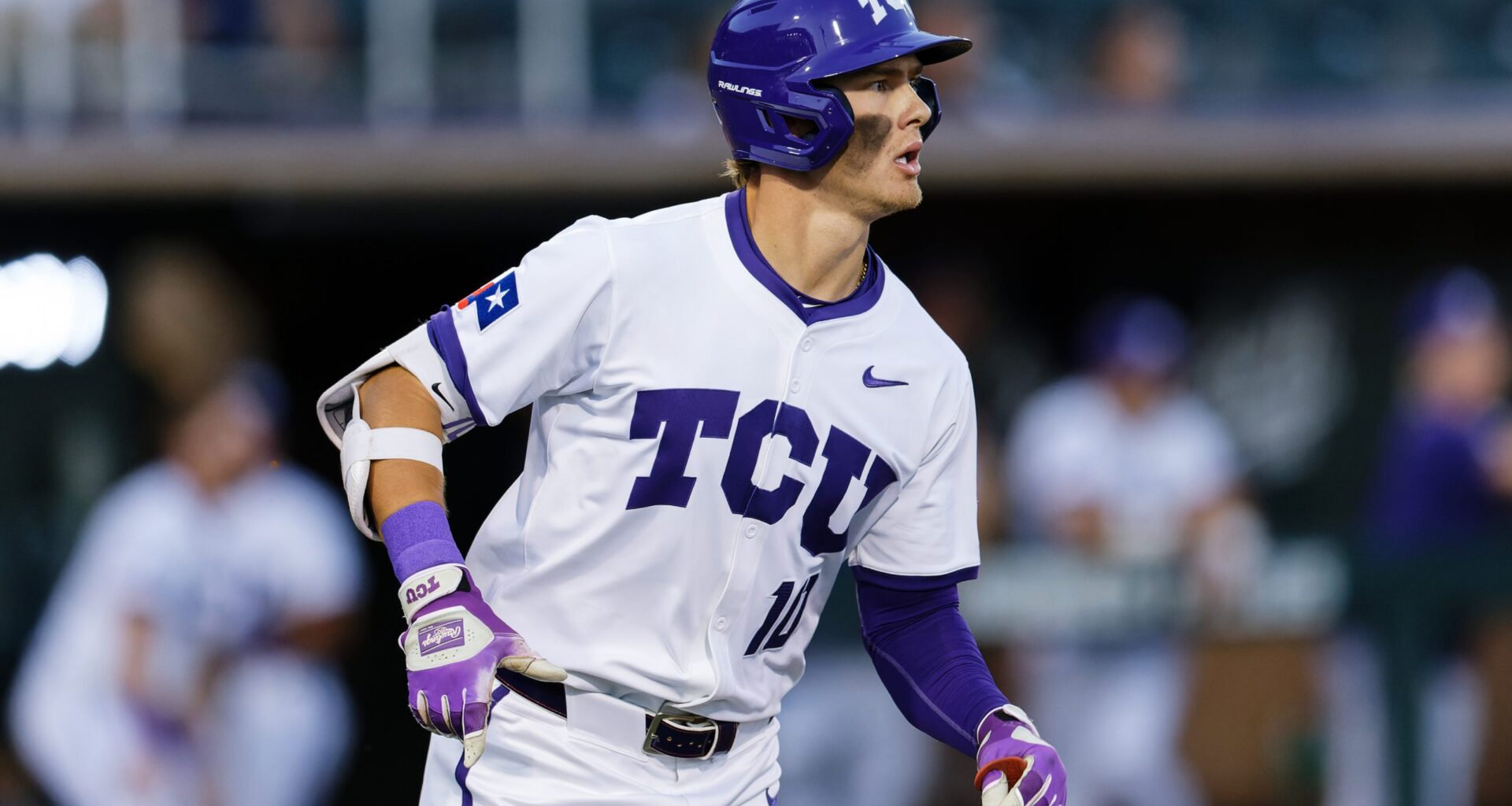
TCU enters the season with one of the most established rosters in the country after bringing back the bulk of its 2025 contributors. That continuity gives the Horned Frogs a high baseline, particularly with elite draft talents Sawyer Strosnider, Tommy LaPour and Chase Brunson at the front of the group. Strosnider returns after a breakout freshman season that confirmed his ability to change games at the college level, while LaPour leads a rotation built around returnees. Offensively, nearly every projected starter is a returner, limiting the need for internal reshuffling. First baseman Rob Liddington, a transfer from Incarnate Word, and designated hitter Kyuss Gargett, who arrives from Kentucky, are the primary additions expected to play regular roles. Their presence adds depth and complementary skill sets to an otherwise stable lineup as TCU looks to convert experience into a deep postseason run.
Preseason Big 12 Player Of The Year
Sawyer Strosnider, OF, TCU
Strosnider announced himself immediately in 2025, producing one of the most complete freshman campaigns in the country en route to Big 12 Freshman of the Year honors. He hit .350/.420/.650 with 13 doubles, 11 home runs and a nation-best 10 triples, showing an uncommon ability to generate damage in multiple ways. That offensive profile is complemented by athleticism and defensive value, with plus speed and a strong arm giving him impact beyond the batter’s box. A second-team All-American last spring, the draft-eligible sophomore could settle into center field full-time and remain a central figure in determining how far TCU can go.
Preseason Big 12 Pitcher Of The Year
Tommy LaPour, RHP, TCU
LaPour stands out in a draft class heavy on velocity because he sustains his stuff rather than simply flashing it. After transferring from Wichita State, he quickly established himself as TCU’s most dependable starter, logging 90.1 innings with a 3.09 ERA and 88 strikeouts. His value lies in reliability as much as raw ability, giving the Horned Frogs a consistent presence at the front of the rotation. Built around a strong lower-half foundation, LaPour’s delivery allows his fastball to stay in the mid-to-upper 90s well into outings, with occasional triple-digit finishes and effectiveness at the top of the zone. He complements it with a low-to-mid-80s slider that misses bats at a high rate and a firm changeup that shows late fade. That combination of stuff, command and durability positions him as a frontline starter heading into 2026.
Preseason Big 12 Freshman Of The Year
Jack Lafflam, RHP, Arizona
Lafflam is an unconventional arm with an outstanding feel for spin and an arsenal that features multiple average-or-better offerings. The 6-foot-6, 180-pound righthander works across his body from a higher three-quarters slot with a loose arm, producing a low-90s fastball with high spin and frequent cutting life. His velocity ceiling has climbed to 97 mph, though he typically settles in lower as starts progress. A mid-80s sweeping slider stands out as his best secondary, while a mid-70s curveball and firm upper-80s changeup give him four distinct looks.
Notable Big 12 Storylines
Several Big 12 coaches enter 2026 facing varying degrees of pressure to validate the direction of their programs in an era of college athletics that has grown increasingly intolerant of stagnation. Arizona State’s Willie Bloomquist broke a program-worst NCAA Tournament drought in 2025 but now needs to convert momentum and a strong offseason into measurable competitive gains. Oklahoma State’s Josh Holliday hasn’t advanced out of a regional in his last five tries, a stretch that has drawn scrutiny given the program’s historical standard. Texas Tech’s Tim Tadlock and Houston’s Todd Whitting both face seasons where simply reaching the postseason feels essential for reinforcing stability. In a landscape defined by accelerated timelines and rising investment, prolonged idling is rarely afforded patience, and these programs could be forced to reassess quickly if progress stalls.
Kansas coach Dan Fitzgerald enters the season as one of the most sought-after names in the profession after a record-setting 2025 campaign that put him on the radar for multiple high-profile openings. The Jayhawks again project as a postseason contender, and a return to the tournament would give Kansas back-to-back appearances for the first time since 1993-94. Sustaining that success may require continued institutional investment or risk Fitzgerald becoming increasingly difficult to retain.