
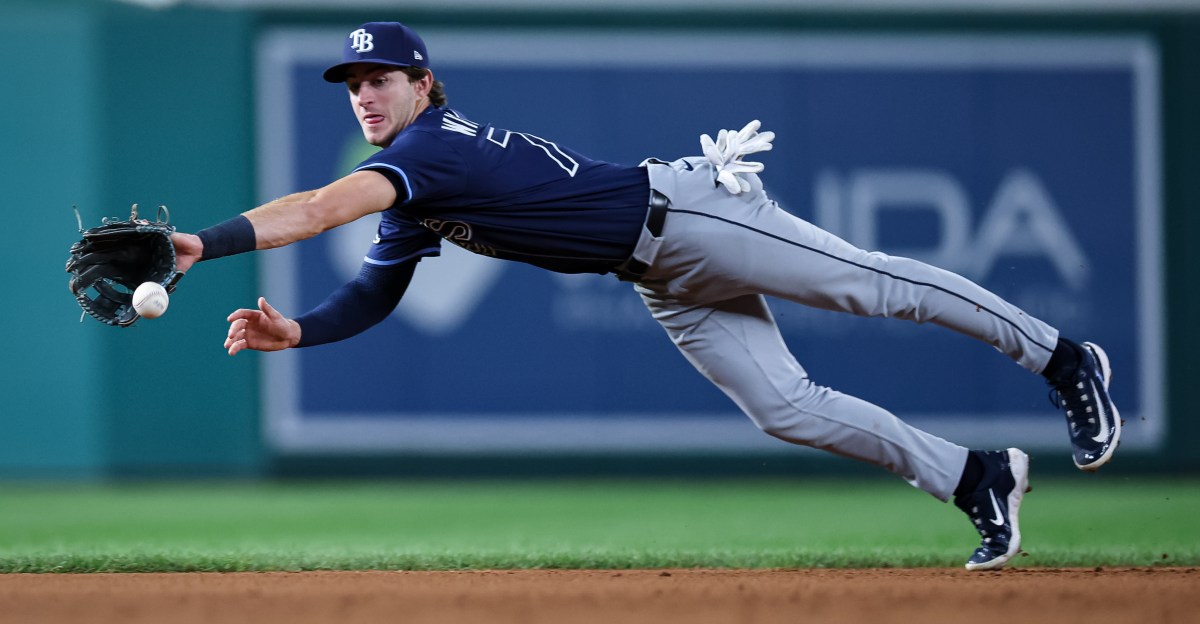
The Rays have done some shuffling among their infield group this offseason. Most notably, they traded away Brandon Lowe and have continued to prioritize bat-to-ball and plate skills over whiff-prone power bats. Gavin Lux was acquired as a stop gap at 2B, and Ben Williamson’s recent acquisition makes him the front runner to fill a right-handed utility role.
Below are some key performance indicators for the players who contributed at least 100 plate appearances to the major league infield and at DH last season, and how the group overall compared to the rest of the league. I’m excluding the catchers from this exercise and plan to cover them separately in a future article.
In-zone minus out-of-zone swing rate helps measure plate discipline, contact rate can show bat-to-ball ability, 90th percentile exit velocity is one of the best ways to measure raw power, and looking at line drive plus fly ball rates lets us see how much a player’s contact ability and power can lead to real production in-game.
PlayerPAZ-O Swing%Contact%EV90LD+FB%Junior Caminero65338.4%76.8%109.5mph53.5%Yandy Diaz65140.3%84.5%109.2mph46.4%Brandon Lowe55343.2%69.1%106.4mph61.8%Jonathan Aranda42235.7%77.1%106.9mph61.6%Taylor Walls31743.2%82.4%100.0mph69.7%Jose Caballero27533.0%74.8%101.9mph69.4%Curtis Mead13237.8%82.8%104.3mph60.3%Carson Williams10635.9%63.6%103.7mph41.8%Total3,10938.9%76.9%107.4mph56.1%League Averages 202537.1%76.9%105.1mph58.2%
The Rays infield and DH group was roughly average in all areas aside from raw power where they were plus, but they were tapping into that power at a slightly below average rate. They collectively turned in a -4.6 BsR – making them a below average base running unit. Defensively, they were a bit more average than you’d think as they have some outliers in Walls (+18 DRS at SS and 2B) and Lowe (-14 DRS at 2B).
This group was a clear strength of the team last year, ranking 1st in wRC+ at 3B, 6th at 2B, and 7th at 1B. They were 4th worst in the league in wRC+ at SS but had strong defense at the position to help make up for that lack of offense.
We’ll take a look at the group of players who are likely to occupy the infield and DH spots in 2026. The playing time projections are what seem most likely at this point in the season, and this allows us to more accurately weigh each player’s contribution to the unit. I’ll use ML data from 2024-2025 for everyone except for Ben Williamson where it’ll be his 2025 ML data, and Carson Williams where it’ll be just his 2025 AAA data.
Due to the relatively low stabilization points of these key performance indicators, the data for Williamson and Williams is highly indicative of the profiles they’ll show in the majors in 2026. The exact numbers we’ll look at are less important than the trends themselves, but it’s still helpful to understand where the offensive production will come from.
I’ll be doing this exercise similar to what I did with the outfield group, but I realized I needed to incorporate weighting to account for playing time and how each player’s individual contributions can affect the overall data for the group.
Caminero at 3B, Aranda at 1B, and Yandy at DH are the main “everyday” guys while Lux looks like he’ll lock-up long-side platoon reps at 2B. I expect Williamson to see the bulk of his reps at 2B in the short half of the platoon with Lux, but he should fill-in at 3B and SS as needed.
Williams is the clear X factor, and that’ll be depicted in how his reps at SS affect the overall production of the unit. This first iteration will assume a 45/45/10 split with Walls, Williams, and Williamson at SS. This might seem like an aggressive assignment for Williams given how over-matched he looked at times last season, but I’m confident the best place for him to continue to develop is at the major league level.
PlayerProjected Playing TimeZ-O Swing%Contact%EV90LD+FB%Junior Caminero95% at 3B36.3%75.5%109.2mph53.2%Yandy Diaz95% at DH, 5% at 1B40.4%86.0%108.6mph45.9%Jonathan Aranda95% at 1B, 5% at DH35.7%78.0%106.7mph58.4%Gavin Lux70% at 2B39.0%80.3%101.8mph51.8%Ben Williamson30% at 2B, 10% at SS, 5% at 3B28.0%80.0%104.3mph42.7%Taylor Walls45% at SS44.2%79.9%100.1mph61.9%Carson Williams45% at SS35.7%63.5%106.9mph64.7%Total 202637.3%78.5%106.1mph53.5%League Average 202537.1%76.9%105.1mph58.2%Rays 202538.9%76.9%107.4mph56.1%
We can see that the swing decisions have taken a bit of a hit from last year but still look average while the contact rate has moved into above average territory. Raw power has dropped now that Lowe is no longer with the team, but it’s still comfortably above average. However, the ability to tap into that power has taken a fairly significant step back and is now well below average.
A potential solution to ensure the group is providing more impact similar to last season would be to give more reps to Williams. Here’s how it could look if the split at SS was 70/30 between Williams and Walls:
PlayerProjected Playing TimeZ-O Swing%Contact%EV90LD+FB%Junior Caminero95% at 3B36.3%75.5%109.2mph53.2%Yandy Diaz95% at DH, 5% at 1B40.4%86.0%108.6mph45.9%Jonathan Aranda95% at 1B, 5% at DH35.7%78.0%106.7mph58.4%Gavin Lux70% at 2B39.0%80.3%101.8mph51.8%Carson Williams70% at SS35.7%63.5%106.9mph64.7%Ben Williamson30% at 2B, 5% at 3B38.0%80.0%104.3mph42.7%Taylor Walls30% at SS44.2%79.9%100.1mph61.9%Total 202637.9%77.7%106.3mph54.0%League Average 202537.1%76.9%105.1mph58.2%Rays 202538.9%76.9%107.4mph56.1%
This split keeps things relatively the same but allows for slightly greater power potential at the expense of a little bat-to-ball ability.
Health, position in a batting order, guys from the outfield group getting some DH days, and other factors will impact the numbers for each player, but – again – the trends we can derive from the data are more important than the exact numbers. Overall, finding ways to get more reps for Williams and fewer for Walls will positively impact the offensive production even with the difference in swing decisions and contact ability between the two of them.
Williamson is also interesting here because he hits the ball harder than one would expect, but most of the time it’s on the ground. His swing decisions play a role in this, so I’m wondering if being more selective could help him get the ball in the air more. It’s unlikely that Williamson will undergo any significant transformation like Isaac Paredes or Yandy Diaz after they joined the Rays, but there could be a little more impact in his bat than what he has shown. Williamson might not have the same level of pitch selection as the other two, but he does have the same near 70 grade contact skills.
I think the Rays see Williamson as someone capable of playing a solid SS, and I wouldn’t be surprised if he eventually saw time in the outfield given his athleticism and make-up. There’s plenty of value in a utility position player who plays solid or better defense at multiple positions and can grind out at-bats.
I’m confident this is at least a solid defensive group. Caminero made impressive strides defensively as the year went on and I’d say he’s at least average at 3B, Lux is a better defender at 2B than Lowe (maybe in the average to solid range), Williams and Walls are Gold Glove-level defenders at SS, and Williamson is plus at both 3B and 2B. They also have the potential to be better on the bases than they were last year given the athletes in the current group.
The infield and DH group should continue to produce better than most of the other units around the league. I’d place them in the back of the top 10 like they were last year.Finding ways to get Williams’s bat in the lineup could help them replicate their power output last season despite losing Lowe, and being able to get Williamson and Walls on the field later in games can help them make the most of those glove-first profiles – although Williamson might have a little more power potential than what he has shown.The shift towards more contact-oriented bats is similar to what we’ve seen with the changes in the outfield, but the infield should still be the group that provides most of the power in the lineup.The infield defense and base running appear to be pretty solid given their athleticism.
The Rays front office continues to fly under the radar with the improvements they’ve made to the roster. It’ll now be up to the players to make the most of their opportunity when camp opens later this month.