
Earlier this week, Matt Trueblood explored whether a pair of Chicago Cubs infielders can continue to thrive in a specific nuance within their offensive skill set. That was an analysis of squared-up contact off the bats of Nico Hoerner and Alex Bregman. Relatedly, today, let’s dig into Hoerner, and how some of that clean contact translated into power production as last year wore on.
In 2025, Nico Hoerner had his best offensive season to date. His wRC+, at 109, was a shade above the previous career mark set in 2022, while his strikeout (7.6%) and contact (89.8%) rates each checked in above anything else he’d turned in prior to last year. Such obscene contact rates aren’t always indicative of quality offensive performance on their own (see Luis Arráez), but the combination of all-fields contact and the baserunning component helped him be one of the Cubs’ most important bats despite the extremely limited power inherent to his skill set.
It’s that power aspect of his game that we’re most interested in. Hoerner’s .097 isolated power was his lowest output since 2021, and his 30.3% hard-hit rate checked in below his career average. However, looking at the full-season numbers might be hiding a small breakout.
Hoerner’s second half of the season was better than his first in almost every way. He went for a 122 wRC+, with an average that was nearly 30 points higher and a much better OBP than in the first half. His walk rate was one percentage point higher (6.6%), while his strikeout remained about the same. He also hit for slightly more power.
First Half: .094 ISO, 27.5 Hard-Hit%, 17.6% Line Drives, 16.0% Fly Balls
Second Half: .100, 34.3%, 24.3%, 30.0%
The first thing worth noting there is the minimal gap in ISO figures. Isolated power shows only how many extra bases (beyond singles) a player produces per at-bat, but if we were to throw in slugging percentage to fold in his extra singles, we’d see a jump from .377 in the first half to .418 in the second. His expected slugging increased much more, though. Hoerner went from a .361 xSLG in the first half to a .432 in the second.
As it was, he ended up with fewer doubles but more home runs than he had in the first half, all in roughly 100 fewer plate appearances. Hoerner was, objectively, a more powerful hitter in the second half of 2025 than he was in the first. That brings us to the natural question of whether or not we’ll see any carryover early in 2026.
The squared-up contact explored by Trueblood does not necessarily beget power outcomes. The mechanics of a swing are prone to too much nuance to simply declare a hitter who can square the ball up can also actually drive it. In Hoerner’s case, there doesn’t appear to be anything specific in those mechanics that enhanced his power as the season wore on. His bat speed changed only marginally throughout the months, while each of his attack direction and attack angle fluctuated in noisy ways that don’t yield much of a narrative. If we’re going to find evidence of real power development, we’ll probably find it in his pitch selection.
Hoerner’s extra-base power comes mostly against fastballs. Fifteen of his doubles, three of his four triples, and three of his seven home runs came against that pitch type. However, there did not appear to be a concerted effort from Hoerner to swing at more fastballs as the year wore on:
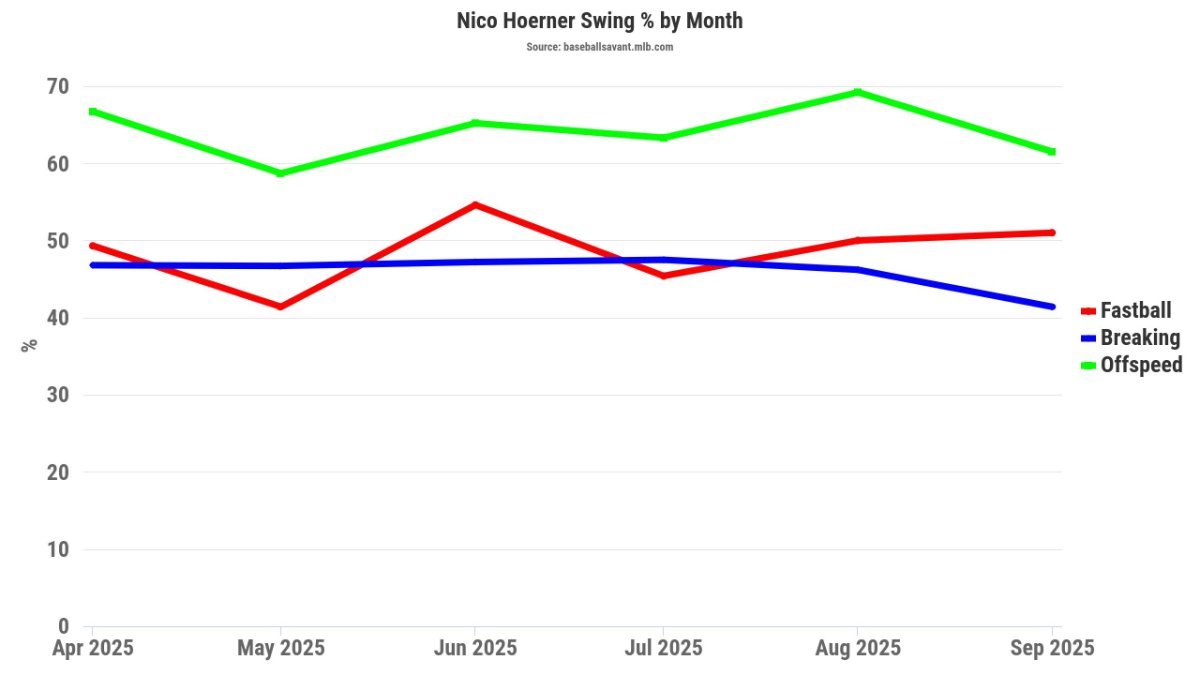
If there’s anything in the fastball aspect, it’s that Hoerner swung at more of them inside the zone in the last three months of the year. In July, he swung at 60.2% of fastballs in the zone, which increased to 63.8% in August and 66.4% in September. For a certified trend, however, we need to keep looking.
The following is (first) where Hoerner’s ISO came from in the first half of the season, and (second) his swing rate by location for that period:
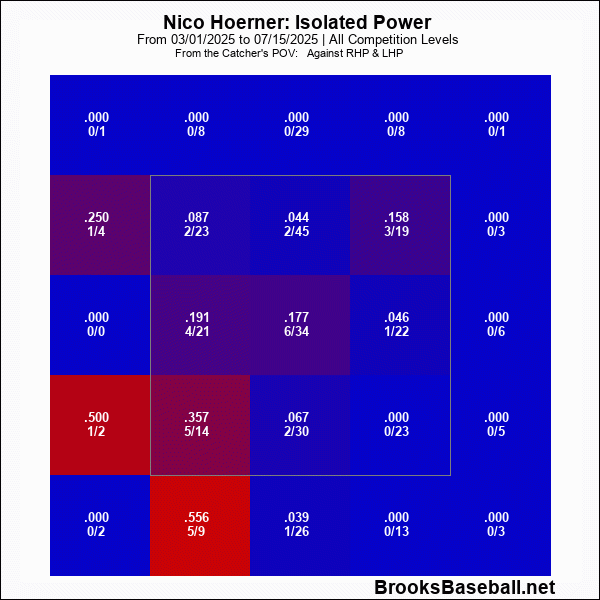
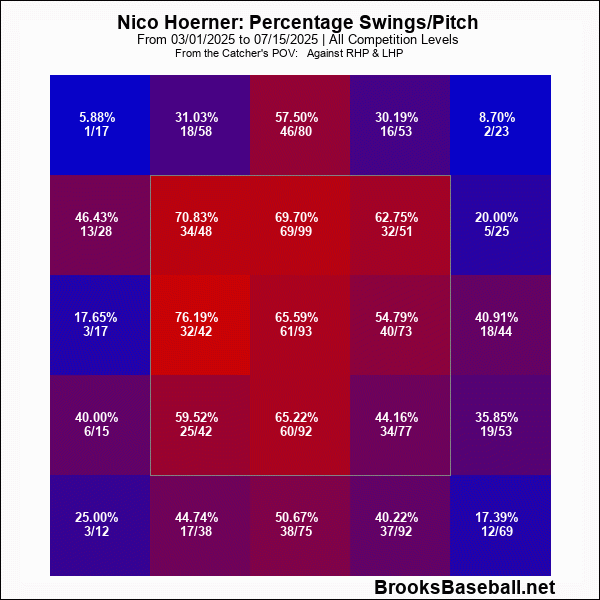
The minimal hot spots on his ISO chart are unsurprising, given how little we saw from that aspect of Hoerner’s output in the first half. He needed to be able to drop the bat head on the ball and get around it, low and in, to produce power in that span. It’s also not surprising that the range of hot spots in the swing rate is as expansive as it is; Hoerner is an aggressive hitter. He got more patient in the second half, though. When we shift each of these zones to the stretch after the All-Star Game, things get interesting. Potentially.
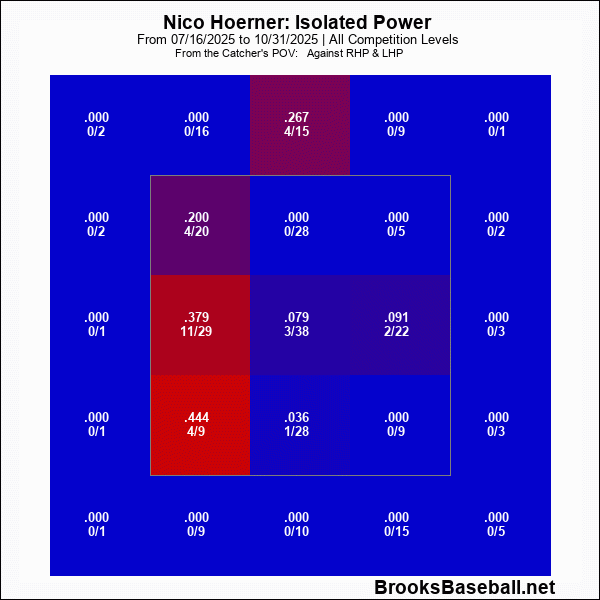
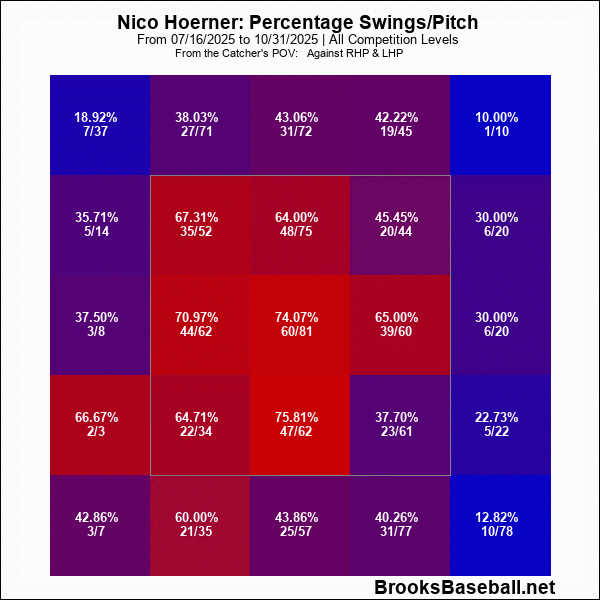
While still a pretty wide set, Hoerner’s swings became at least somewhat more concentrated on the middle and inner parts of the zone. Where has Hoerner been able to generate the most power in his career? You guessed it:
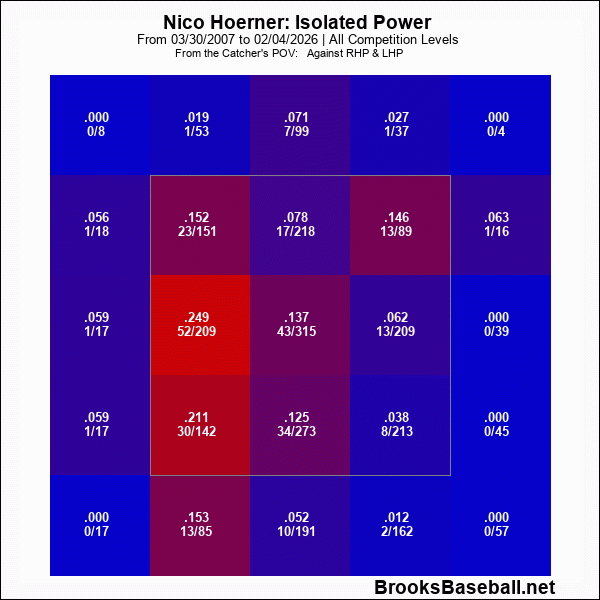
Because of the small sample size, we can’t say for sure that this is intentional, but it’s a noteworthy change. If Hoerner is more committed to selectivity within the zone, emphasizing the locations where he can generate power but attacking in-zone fastballs, he could sustain a higher level of power production than he’s shown for most of his time in the majors.
We certainly shouldn’t be expecting Hoerner to evolve into a 20-homer guy in 2026. Even his increased power output didn’t put him on pace for anything like that. However, Hoerner seems to be honing an approach that can work in a more consistent way, with a balance of elite hitting for average and modest but measurable pop.