
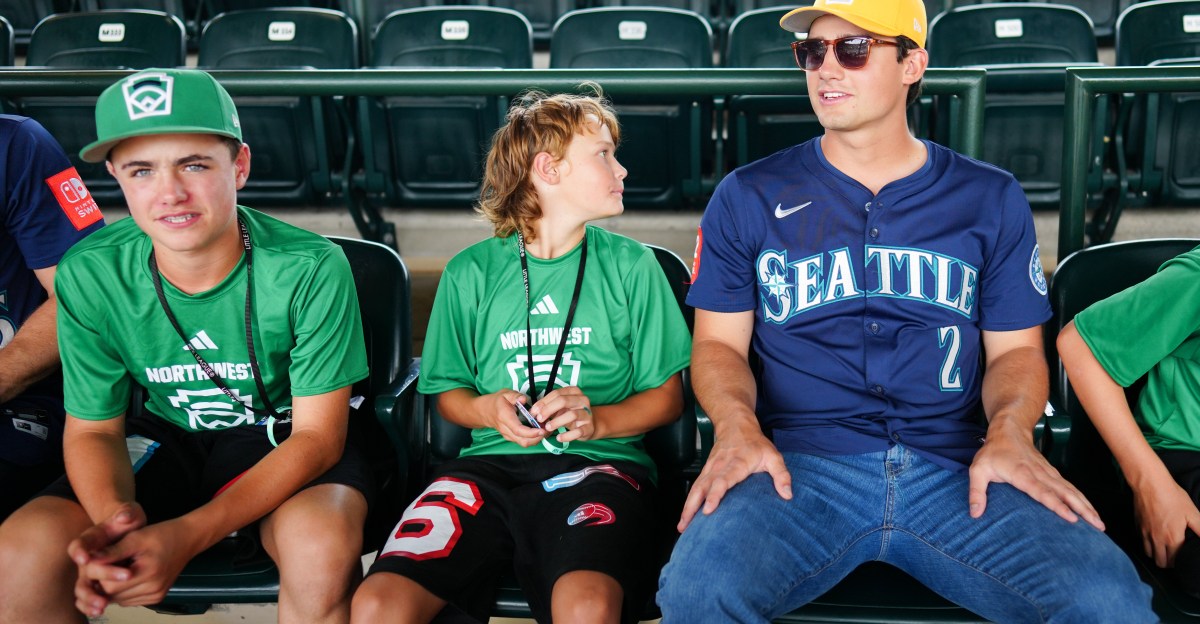
Cole Young is here for a reason.
Young made his MLB debut on May 31, 2025, after a carousel of misbegotten second basemen struggled to hold down the position… for the eighth year in a row. The Mariners haven’t found competence at second base since Robinson Canó was suspended in May 2018. It’s not been for a lack of effort or creativity, as they’ve trotted out prospects and veterans and platoons and Donovan Walton. But the “2Bs who were not to be” (sorry) posted a combined .651 OPS from 2018 through 2024 — dead last in MLB.
Young, unfortunately, carried the torch. He posted a .607 OPS (81 wRC+) in 257 plate appearances. His playing time evaporated as the season got late and outcomes mattered more. He didn’t play in the postseason.
It’s unclear what Young’s role will be in 2026. The Mariners on Monday added Brendan Donovan to the infield depth chart. Donovan plays several positions, but the one he’s played the most (and the best) is second base. It’s possible he’ll play third base instead, as the trade that brought him here coincidentally opened a hole there. But tip-top prospect Colt Emerson is expected to tryout for third in Spring Training, pitting Young in a staring contest with his precocious mirror.
Don’t expect Young to blink first, though. There were still several positives to take from his rookie year. First and foremost, this pitch:
I’m rarely stunned by baseball, but that stunned me. Young hit a middle-middle fastball from Kumar Rocker 456 feet into the second deck at T-Mobile Park. It was the longest home run hit at T-Mobile Park in 2025 and one of the 10 longest in Seattle in the Statcast Era.
Young hit the ball 114.1 mph, which places him in the top 10% by max velocity. That’s crucial. As Davy Andrews pointed out for Fangraphs (in a post about a young Victor Robles), rookie max exit velocity is one of the strongest predictors of future performance. Here’s how he summarized the results (in a separate post worth reading):
… for rookies with at least 200 balls in play, wRC+ was less predictive of their future performance than max exit velocity. That blew my mind. Knowing just one measurement, the velocity of a player’s hardest-hit ball, was more useful than knowing about their overall performance through their entire rookie season.
I think Young’s blast was a bit anomalous, even for the concept of “max” exit velocity. His Prospect Savant profile shows solid but less spectacular peak power data, and Fangraphs offers a similar report. Though it’s worth considering this quote from Director of Player Development Justin Toole in an interview with David Laurila where he says all the things you’d expect someone to say about Young and then slips in, “I think Cole’s power at times will surprise you.” So one person wasn’t stunned.
It won’t be necessary for Young to hit the ball that hard all the time. Nearly a quarter of the balls he put in play last year were in the air to pull side, which was solidly above average. Maybe it’s obvious, but its good to hit the ball in the air because that’s a perquisite for getting it over the fence, and its good to the ball to the pull side because that’s where the fence is the closest. Cal Raleigh lead the league by that stat in 2025, if further endorsement is needed.
That’s a tremendously exciting premise. Young’s ascendant tool in the minor leagues wasn’t his power but “contact and hitability,” in the words of Toole. Basically, he had a strong strikeout-to-walk ratio. That seemed to transfer over in his rookie season , with a 18.3% strikeout rate and a 10.9% walk rate. He whiffed a bit more than expected (just about the median), but his knowledge of the strike zone was as advertised. He looks like a legitimate “guy who would have batted second 30 years ago” …. while still having the modern “anybody can hit 20 home runs” dressings. That gives him a few believable paths to success. The industry seems to agree: :
It’s not just the Mariners who like Young, either. One rival executive describes Young as “the league model darling right now,” pointing out that analytically based projection systems value him more highly than scouts do.
I’m curious to see what if any adjustments Young makes this offseason. An 81 wRC+ with interesting peripherals is still an 81 wRC+. Often it seemed he was swinging too big and throwing his timing off because of it. The data potentially supports that theory. He got torched by fastballs, swung at pitches very deep in the zone, and swung at full strength more often than most (as the plot below shows). Maybe it’s just about telling him to chill. Or maybe the approach is fine and the timing will eventually catch up. I don’t expect major intervention, regardless.

It’s harder to find nice things to say about the glove. It was bad. Terrible, even. He posted -9 OAA in less than half a season, making him one of the worst infielders in MLB on a rate basis. He especially struggled going to his right and throwing back across his body. His arm was the third weakest among second baseman; it lacked accuracy, or maybe conviction. He just looked kinda overwhelmed out there.
The extent to which Young struggled is surprising more than anything. Fangraphs scouted him well above average in the field heading into 2025. While public scouting isn’t fully prescient, OOPSY projection system creator Jordan Rosenblum points out Fangraphs is generally pretty good at estimating defensive ability. I just don’t think scouts would have graded him as positively as they did if they were seeing the types of plays in the video above. To me that implies an aberration, or maybe an injury. And conveniently, there were reports that he injured his throwing arm early in the season. Maybe his defense will have healed come Spring.
I don’t think it’s a coincidence Young survived the offseason in Seattle, and I don’t think it’s a coincidence they’ve left some playing time up for grabs. His rookie season did not go well, but he’s tremendously talented with a nearly unlimited ceiling. As the Mariners search for a second baseman approaches a decade, perhaps Young is meant to be.