
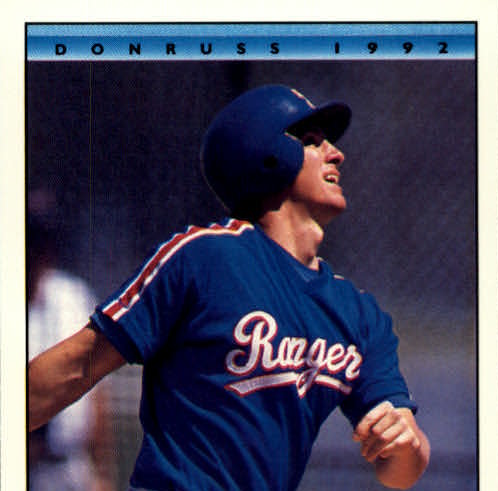
RIP to Rob Maurer, a former first baseman and a Hall of Fame ballplayer for the University of Evansville. He hit one of the most significant home runs in the school’s history, in fact. He died unexpectedly in his home on January 21, just two weeks after his 59th birthday. Maurer’s 6-year career in professional baseball included stints with the Texas Rangers in 1991 and 1992.
Robert John Maurer was born in Evansville, IN, on January 7, 1967. As early as 1981, he was demonstrating his baseball skills, as he was a heavy hitter for the city’s Pony League Midwest Regional Tournament team. He competed in multiple sports at Mater Dei High School. He was named to the Evansville Courier All-City Football Team in 1983 as the top quarterback, narrowly beating Central High’s Andy Benes. Maurer’s 782 passing yards were about half as many as Benes, but the Courier gave him the nod for his “running abilities and field leadership.” He threw for 7 touchdowns, ran for 6 more, and guided Mater Dei into a playoff berth. Maurer was also named to the All-City Baseball Team in 1984 after establishing himself as one of the best hitters in town. The first baseman led Evansville high schoolers with 5 home runs, was third with 32 RBIs and second in batting with a .475 mark. He also had a 3-3 record and 3.00 ERA as a pitcher. Maurer also was a wrestler and finished third in the 177-pound class in a 1985 state tournament.
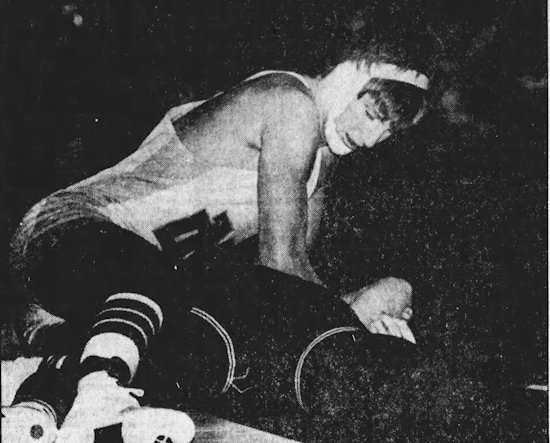 Rob Maurer was a great baseball and football player in high school, and he also finished third in a statewide wrestling tournament. Source: Evansville Press, February 24, 1985.
Maurer concluded his high school career with another placement on the 1985 All-City team and the All-State team. His .513 batting average was fourth-best in the entire state. He moved on to the University of Evansville after graduation and became one of the greats of the Purple Aces baseball program. University trainer Lester Hagan learned the hard way. During Maurer’s 1986 freshman season, Hagan and the ballplayer made a wager. If Maurer made two or more outs in a game, he owed the trainer a steak dinner. If he made two or fewer outs, Hagan owed him a steak. The trainer was regretting the decision after just four games, in which Maurer went 8-for-16 and won 3 steaks. “I don’t know how much more I can afford to lose,” Hagan griped. Maurer continued to hit throughout his college career, batting .369 for the Aces. In 1988, he batted .396, which remains the fifth-best mark in UE history. He also swatted 16 home runs, 23 doubles (a team record broken in 1998), and 9 triples (a team record tied in 1991 and 1993 and broken in 2010) while scoring 66 runs (a team record not broken until 2024). All that production came after Maurer was benched briefly because coach Jim Brownlee felt the laid-back hitter wasn’t concentrating enough. “Yeah, he’s hitting almost .380. But honest to God, he should be hitting 40 points higher than that,” Brownlee said. Maurer had been going through a slump at the time, so the benching wasn’t without cause. “The main thing is being ready to hit every time, having an idea of what I want to do at the plate in every situation…” Maurer noted. “It’s a matter of making yourself think about that at-bat and nothing else, and that’s something I really wasn’t doing.” Scouts who were coming to Evansville games to see the team’s standout pitcher, Andy Benes (who’d given up on his own quarterback career), also got an eyeful of Maurer’s hitting feats.
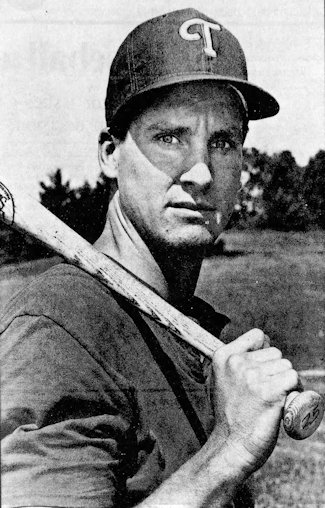 Source: Evansville Courier and Press, September 18, 1990.
The Aces won the Midwestern Collegiate Conference tournament in 1988 to gain a berth in the NCAA Division 1 tournament for the first time in team history. The unranked team wasn’t expected to go far, and UE won just one game. However, it was a game that was remembered in Evansville for decades to come. Benes threw a 1-0 shutout against powerhouse Arizona State, and a Maurer home run accounted for the only run in the game. That June, Benes was taken by San Diego as the first overall draft pick in the June Amateur Draft, and the Texas Rangers picked Maurer in the Sixth Round. Maurer signed and was sent to the Butte Copper Kings of the Rookie-level Pioneer League. The Rangers expected Maurer to hit, but he surpassed all expectations by winning the batting title with a .391 average. He hit 18 doubles, 3 triples and 8 home runs, driving in 60 runs. The performance earned him some comparisons to an earlier Evansville first baseman, Don Mattingly. Still, he wasn’t completely satisfied with the season. Marty Scott, Rangers player of development, said that the only negative on Maurer was that he got down on himself too much. Maurer agreed. “There were times when I’d get ticked off at the way I was hitting and one of the guys would say, ‘Hey, you’re still hitting .370,” he told the Evansville Courier. Maurer moved up to Port Charlotte of the Class-A Florida State League in 1989 and held his own, though not with the same dominance. He slashed .276/.397/.395, which was good but not great. He rebounded in 1990 for Double-A Tulsa, batting an even .300 while raising his home run total to 21, even while missing a month of the season with a foot injury. More importantly to the Rangers, he also showed a more mature outlook. “He has vastly improved in temperament — keeping an even keel,” noted Scott. The Rangers had a first baseman in Rafael Palmeiro and an up-and-comer in Kevin Reimer, but Maurer had put himself in the conversation about the team’s future first basemen.
Maurer continued his orderly progression up the Rangers organization by playing for Triple-A Oklahoma City in 1991. He won the American Association Rookie of the Year Award and the Rangers Minor League Player of the Year Award after batting .301 with 20 homers and 77 RBIs. He earned a promotion to the majors that September, but Palmeiro was in the midst of a fantastic season — .322 batting average, 26 homers, AL-leading 49 doubles — and rarely took days off. Maurer appeared in 13 games but started just twice. He made his debut as a DH on September 8, 1991, against the Chicago White Sox. He was 0-for-2 and walked twice. His first major-league hit came in Maurer’s third game, on September 17, entering the game in the seventh inning with the California Angels leading 7-0. Maurer batted in the bottom of the eighth after Brian Downing and Julio Franco had singled, and he smashed a 2-run double against reliever Scott Lewis. It was his only Rangers hit on the season. Maurer went 1-for-16 in those 13 games with 2 walks and 6 strikeouts.
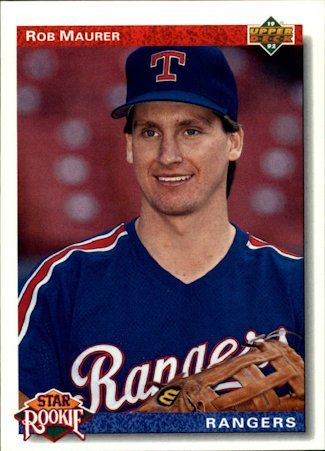
Maurer endured a long slump for Oklahoma City in 1992 that saw him bat just .189 over 42 games, with a single home run. “I was kind of telling myself that I couldn’t see the ball even before I went to the plate,” he said. He recovered nicely and ended the year as one of the team’s top hitters as Oklahoma City won its first American Association championship. Still, Maurer’s .288 batting average and 10 home runs were not on par with his previous years, even though he drove in a career-best 82 runs. He made it back to the majors in September and again struggled to find playing time. Five of his 8 appearances came as a pinch-hitter, and he had 2 hits in 9 at-bats with an RBI. Maurer was left unprotected in the November 1992 expansion draft that welcomed the Florida Marlins and Colorado Rockies into the National League, but neither team took a chance on him. He returned to spring training in 1993 to compete as a left-handed designated hitter. Maurer had undergone arthroscopic knee surgery over the offseason, and his chances to make the Opening Day roster slipped away as his sore knee kept him on the sideline. The knee never got better, and Maurer needed season-ending surgery on his right kneecap in May. “It’s very unfortunate any time a good, young player is set back like this,” said Tom Grieve, Rangers general manager. “He’s been on the verge of being a big-league player. Basically, Rafael Palmeiro has been in his way.” Maurer returned to Oklahoma City in 1994 and hit .258 with 11 homers in 61 games before his season ended early because of continuing knee problems that led to two additional surgeries. As he rehabbed from his latest setback, Maurer also made plans to work on his undergraduate degree from the University of Southern Indiana. “I’m going to spring training [in 1995], but I don’t know what the Rangers are thinking. They could release me any second. I’ve kind of got my mind prepared for it, but it would still be hard for me,” he said. Texas released Maurer, 28, on April 26, 1995, because of those chronic knee problems.
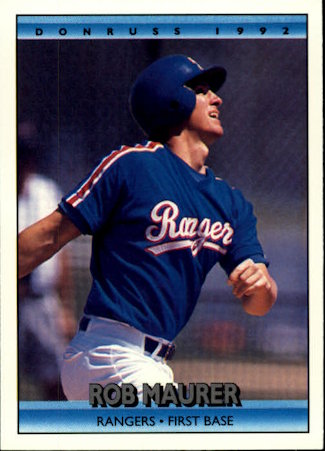
“Rob did everything he could on the field. But after more than two years, doctors still couldn’t say if his knee would ever be completely healed. It’s too bad,” said Monty Klegg, Rangers assistant to the director of player development.
Over parts of 2 seasons in the majors, Maurer played in a total of 21 games for Texas. He had 3 hits in 25 at-bats for a .120/.241/.160 slash line. He had a double, drove in 3 runs, and scored twice. Maurer also batted .298 and slugged .493 over 6 minor-league seasons, with 76 home runs.
Following his baseball career, Maurer returned to Evansville and worked for Toyota until his retirement last year. He also coached youth baseball and softball teams in the area. He remained a supporter of University of Evansville baseball and was inducted into the school’s Athletic Hall of Fame. Maurer’s name is, as noted, still found throughout the Purple Aces record book, but that home run he hit in the school’s 1-0 victory over Arizona State in the 1988 College World Series is one of the school’s greatest baseball moments. Maurer married his wife, Kathryn, in 2022. He is also survived by his daughters Ashton, Madi and Ali, as well as their families and a large extended family.
For more information: Pierre Funeral Home
Follow me on Instagram: @rip_mlb
Follow me on Facebook: ripbaseball
Follow me on Bluesky: @ripmlb
Follow me on Threads: @rip_mlb
Discover more from RIP Baseball
Subscribe to get the latest posts sent to your email.