
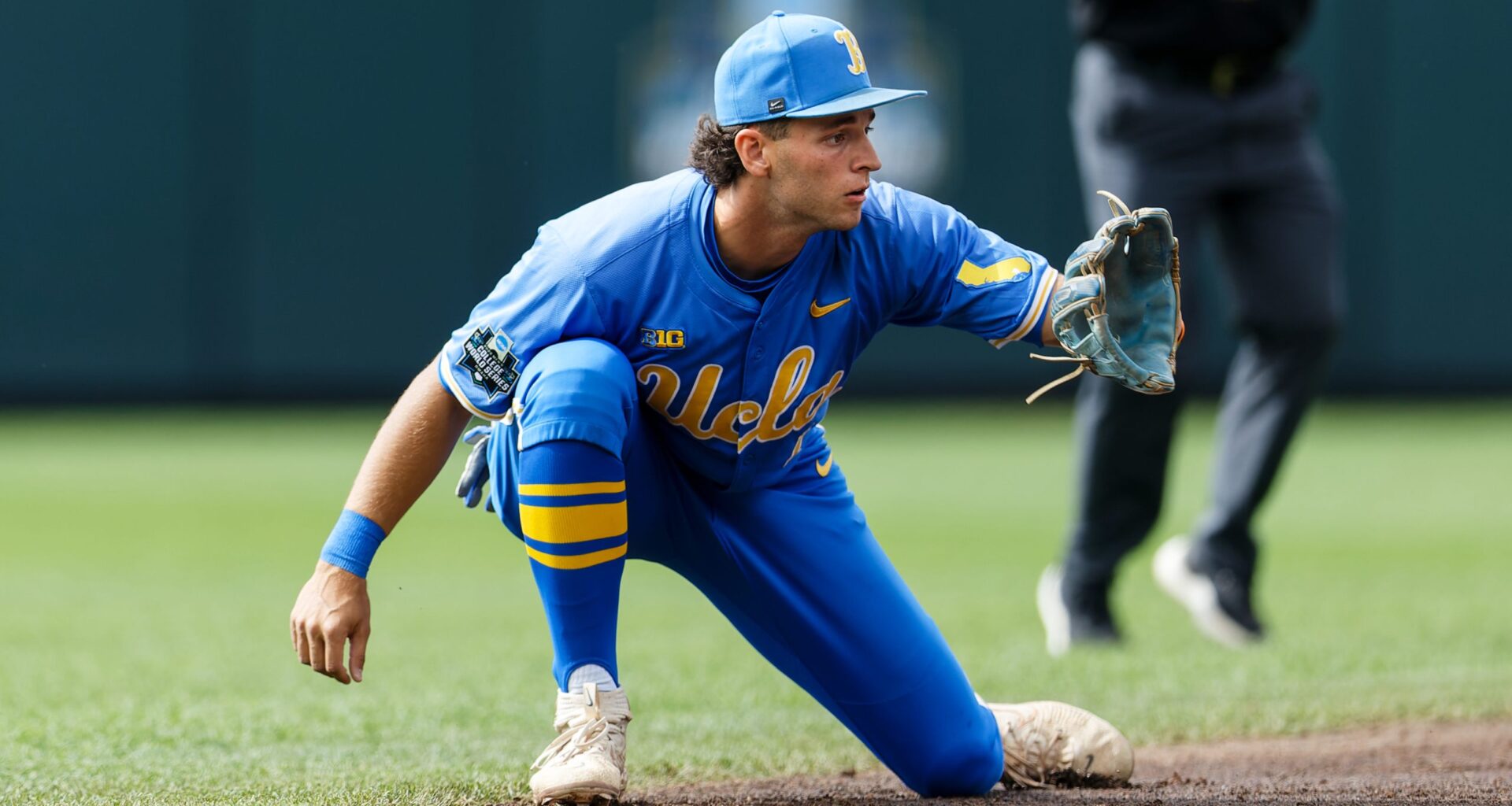
The Big Ten season projects to have a clear favorite at the top, supported by a cluster of teams capable of competing on a weekly basis. The league again features a mix of returning production and draft talent spread throughout the standings.
Behind the front-runner, much of the conference remains closely packed, with separation likely to come through depth, pitching and in-season development. How that middle tier sorts itself out will shape the league’s postseason footprint.
Baseball America subscribers can find our complete 2026 Big Ten preview below, featuring projected order of finish, top 2026 MLB Draft prospects and conference award picks.
Projected Big Ten Standings
Note: Listed records are from 2025
UCLA (48-18; 22-8 Big Ten)
Oregon (42-16; 22-8)
Indiana (32-24; 16-14)
Nebraska (33-29; 15-15)
USC (37-23; 18-12)
Penn State (33-23; 15-15)
Iowa (33-22-1; 21-9)
Michigan (33-23; 16-14)
Washington (29-28; 17-13)
Illinois (30-24; 14-16)
Rutgers (29-28; 15-15)
Northwestern (25-27; 13-17)
Michigan State (28-27; 13-17)
Maryland (27-29; 12-18)
Minnesota (24-28; 10-20)
Purdue (31-23; 11-19)
Ohio State (13-37; 5-25)
Top 10 Draft Prospects For 2026
Roch Cholowsky, SS, UCLA
Maddox Molony, SS, Oregon
Logan Reddemann, RHP, UCLA
Mulivai Levu, 1B, UCLA
Mason Edwards, LHP, USC
Roman Martin, 3B, UCLA
Peyton Bonds, OF, Rutgers
Cal Randall, RHP, UCLA
Collin Jennings, OF, Illinois
Will Gasparino, OF, UCLA
Want more draft rankings? You can find BA’s Top 200 board here.
Big Ten Team To Beat: UCLA
UCLA enters the season positioned as the national title favorite after committing to a high school-heavy recruiting approach that required patience in 2023 and 2024 but paid off with a return to the College World Series in 2025. Last year’s sophomore-driven roster, led by shortstop Roch Cholowsky, proved capable of handling the demands of a deep postseason run and largely remains intact for 2026. Cholowsky returns after a historic sophomore season and is surrounded by a veteran core that brings back production across nearly every position, including first baseman Mulivai Levu and a pitching staff headlined by Wylan Moss and Michael Barnett. UCLA supplemented selectively through the transfer portal and beat the draft to add freshman righthander Angel Cervantes and infielder Dominic Cadiz. With minimal turnover from an outstanding team, the Bruins open the year with uncommon continuity and a proven foundation.
Preseason Big Ten Player Of The Year
Roch Cholowsky, SS, UCLA
Cholowsky’s 2025 season already placed him in rare company, as he became just the sixth non-draft-eligible player to earn BA’s College Player of the Year honors. Now the unanimous top prospect in the 2026 draft, he enters his junior season with the chance to push into unprecedented territory. No player has ever repeated as POY, yet Cholowsky’s track record makes the possibility more than theoretical. He hit .353/.480/.710 a year ago with 23 home runs, 19 doubles and 45 walks to just 30 strikeouts over 324 plate appearances. Given that history, matching his previous production would likely be enough to challenge a barrier no player has ever crossed.
Preseason Big Ten Pitcher Of The Year
Logan Reddemann, RHP, UCLA
UCLA didn’t need much out of the transfer portal this offseason, which allowed it to utilize a chunk of its resources to acquire a frontline pitcher. It settled on Reddemann, beating several SEC teams, which had the former San Diego starter at the top of their transfer boards. A 6-foot-2, 185-pound righty, Reddemann sits in the low-to-mid 90s with a fastball that has solid carry at the top of the zone and drew a 25% chase rate in front of Trackman in 2025. His signature weapon is a comfortably plus low-to-mid 80s changeup with fade and tumble. Reddemann finished his sophomore season at San Diego with a 2.29 ERA and 53 strikeouts to 12 walks over 55 innings.
Preseason Big Ten Freshman Of The Year
Brayden Jaksa, C, Oregon
BA’s No. 76 prospect in the 2025 draft class, Jaksa arrived in college as one of the more advanced high school bats in his class and has already begun to reshape his physical profile. The 6-foot-5 catcher added roughly 20 pounds during his first collegiate fall and showed the kind of game power that separates him from typical first-year players, along with a solid feel for the defensive demands of the position. That combination positions Jaksa to factor into the lineup early in Eugene and gives him a chance to stand out among the Big Ten’s freshman class.
Notable Big Ten Storylines
The Big Ten has long been defined by football and, to a lesser extent, basketball. Baseball has lagged well behind. The conference has not produced a College World Series champion since Ohio State in 1964 and, prior to UCLA’s run to Omaha last season, had sent only two teams to the super regional round since 2010. While the league has produced early-round draft picks in recent years, no program has consistently assembled the depth required to contend on a national stage. UCLA’s arrival has already shifted the conference’s profile, bringing immediate relevance and a higher competitive ceiling. With the Bruins entering 2026 as the clear favorites to win it all, the Big Ten finds itself with a rare and legitimate chance to challenge a national championship drought that has stretched more than six decades.
Though it won’t affect the conference race until 2027, Penn State made one of the most eye-opening recruiting moves of the offseason by landing Japanese righthander Genei Sato. A flamethrower with a splitter that has drawn rave reviews, Sato largely overmatched USA Collegiate National Team hitters during summer competition in Japan, putting himself firmly on the radar of evaluators well beyond the college game. His commitment represents a rare elite recruiting win for an original Big Ten program and stands as the most significant recruiting coup in Penn State baseball history.