
Before diving into this article, we recommend reading part one, Gold Standard Padres, Infield Edition. With that said, let’s look at the gold standard Padres of the outfield and designated hitter.
LF Greg Vaughn “Vaughnie” “Hootie” 1998 (6.3 WAR) The Sultan of the Fifty
AVG: .272 | H: 156 | R: 112 | 2B: 28 | HR: 50 | RBI: 119 | SB: 11 | BB: 79 | OPS: .960
NL All-Star | Silver Slugger | TSN NL Comeback Player of the Year | Players’ Choice NL Comeback Player | NL Player of the Week 7/19 | Padres Team MVP | Padres Chairman’s Award
The Five Pillars of Hootie
Innovation: After a disastrous 1997 season where many thought his career was fading, Vaughn innovated his entire offensive philosophy by apprentice-studying under Tony Gwynn. He abandoned his “all-or-nothing” pull-heavy swing for a shorter, more scientific stroke that utilized the gaps. Under Gwynn’s mentorship, Greg spent countless hours in the video room, learning to stay back on the ball and drive outside pitches to the opposite field. This mechanical overhaul allowed him to remain a terrifying power threat while significantly improving his plate discipline, turning him into a surgical slugger who punished pitchers for nibbling at the strike zone.
Impact: Vaughn was the indispensable engine of the 1998 squad, providing the middle-of-the-order gravity that allowed Tony Gwynn to see better pitches. By launching a franchise record (50) home runs and finishing 4th in NL MVP voting, he single-handedly altered the defensive strategy of every opponent the Padres faced. His production reached a crescendo in the World Series; in Game 1 against the Yankees, his two-homer performance silenced the Bronx and gave San Diego a legitimate belief they could capture a title. He was the emotional heartbeat of a clubhouse that won a franchise record (98) games, which remains the winningest season in franchise history and still stands years 28 later.
Legend: The “Legend of Hootie” is etched into San Diego lore as the man who conquered the 50-home run plateau, a feat no other Padre has ever achieved. While the national media focused on the McGwire-Sosa race, Vaughn was the blue-collar hero of the West Coast, delivering massive shots that seemed to defy the heavy marine layer at Qualcomm Stadium. His story is one of pure resilience, having gone from the trade block to the MVP conversation in the span of twelve months. He became a folk hero for his grit, culminating in his (50th) blast on the final day of the season—a moment that remains a cornerstone of Padres history.
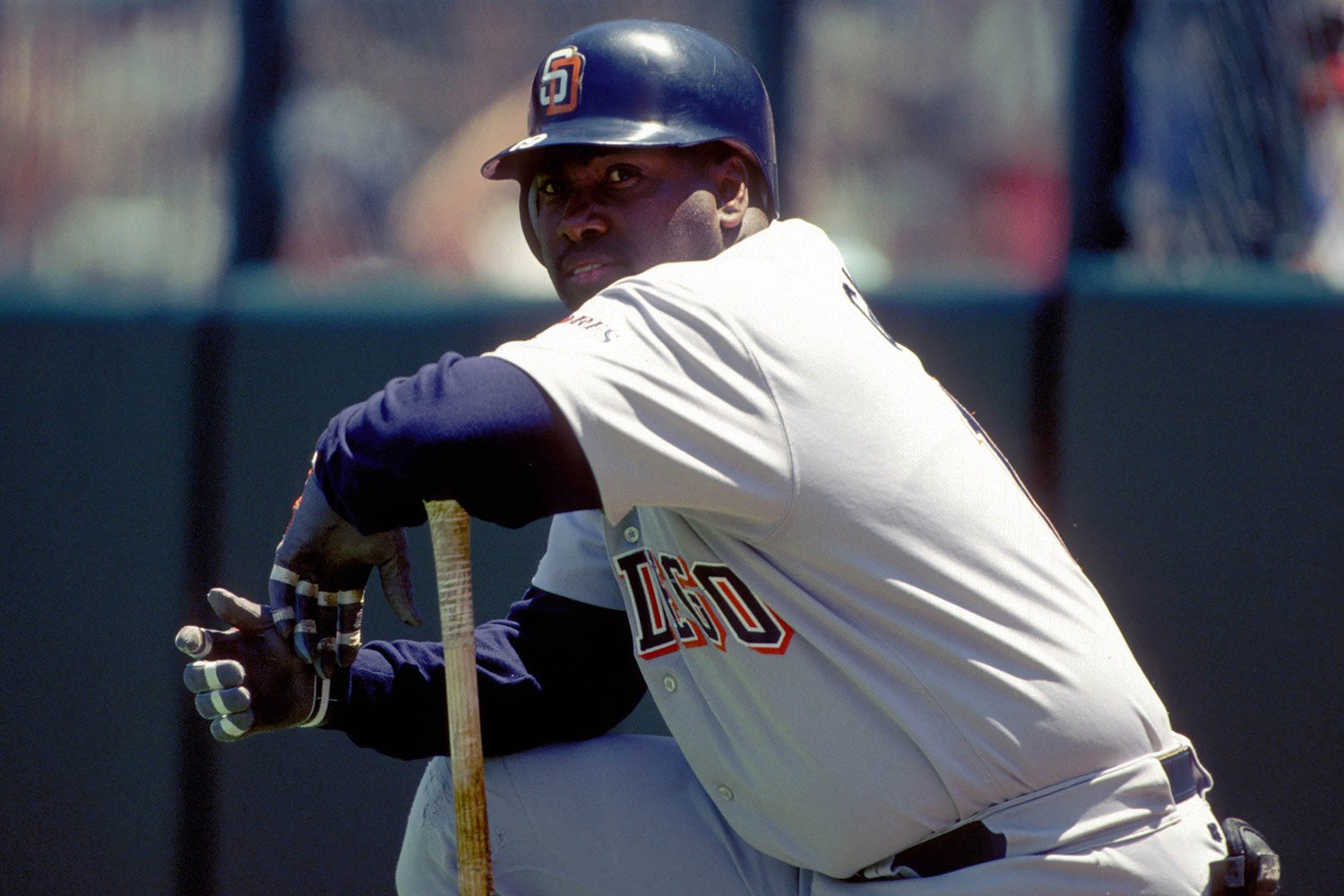
Iconic Look: Standing in the box with a menacing, wide-legged stance and a high, rhythmic bat waggle, Vaughn was a terrifying silhouette. His visual presence was defined by his trademark goatee and jersey sleeves stretched to the breaking point over his massive biceps. Clad in the home white jerseys where navy pinstripes served as the sharp accent, paired with the navy cap featuring the white and orange interlocking “SD,” he looked like a modern-day gladiator. The “Vaughn Trot”—a slow, purposeful stroll around the bases punctuated by his signature gold chain catching the stadium lights—became a symbol of 1998 dominance. Every at-bat felt like a heavyweight title fight, with his violent follow-through serving as the definitive exclamation point.
The “Did You Know” Factor: Did you know that Greg Vaughn was the first player in the National League to reach the 10, 15, and 20-homer milestones during the historic 1998 home run chase? While the national media eventually shifted focus to Mark McGwire and Sammy Sosa, Vaughn was the one setting the pace for the first two months of the greatest power-hitting season in baseball history. He even became the only Padre in history to hit two home runs in a single World Series game, going deep twice off David Wells in Game 1. Furthermore, he joined an exclusive group by winning the Silver Slugger and Comeback Player of the Year awards in the same season. Despite the high-strikeout era, his discipline in 1998 was elite; he drew 79 walks and posted a .960 OPS, which still stands as one of the top offensive seasons in team history, proving he was a complete offensive force
CF Steve Finley “Fins” 1996 (7.2 WAR) The Five-Tool Technician
AVG: .298 | H: 198 | R: 126 | 2B: 45 | 3B: 9 | HR: 30 | RBI: 95 | SB: 22 | XBH: 84 | TB: 348 | OPS: .924
Gold Glove (1995-1996) | NL Player of the Week (7/7/96)
The Five Pillars of Fins
Innovation: Finley was a pioneer in “Biomechanical Longevity.” Holding a degree in physiology, he treated his body like a laboratory, innovating a training regimen of chiropractic care, yoga, and precise nutrition long before they were standard in MLB clubhouses. He incorporated visual conditioning exercises to sharpen ocular tracking and neural reaction speeds, maintaining the twitch-fiber explosiveness of a man a decade younger. He wasn’t just “talented”; he was a finely tuned machine who mastered a way to sustain peak “Speed-Power” output for six months straight. This commitment to physiological maintenance demonstrated that elite athleticism could be extended through science—a philosophy that allowed him to play until age 42.
Impact: The statistical impact of Finley’s 1996 is massive, but his “clutch impact” was global. He dominated the historic “Monterrey Series” in Mexico, hitting the first-ever regular-season home run on Mexican soil to ignite a sweep of the Mets that galvanized the San Diego fan base. On the field, he was a statistical vacuum; he led the Majors with 655 at-bats while setting franchise records for total bases (348), extra-base hits (84), and runs scored (126)—benchmarks that remain the franchise’s all-time single-season records 30 years later. This offensive engine was anchored by his defensive erasure in center field; his elite range earned him the Gold Glove, as he turned sure-fire doubles into outs and provided an essential safety net for the pitching staff. This combination of iron-man durability and defensive mastery was the primary catalyst that powered the Padres to a 91-win division title.
Legend: The legend of Steve Finley is that of the ultimate “Five-Tool Technician.” He possessed a “Zen-like” focus that made him arguably the best defensive center fielder in the history of Jack Murphy Stadium. His legend was cemented on the final day of the 1996 season in a head-to-head battle for the National League West title against the Dodgers, where his consistent pressure helped San Diego clinch the division crown. His historical legend is tied to his membership in two of baseball’s most exclusive clubs: he is one of only three players, joining Willie Mays and George Brett, to record 300 home runs, 425 doubles, and 100 triples; furthermore, he and Mays are the only two in that group to also surpass 300 career stolen bases
Iconic Look: Finley’s iconic look was the epitome of lean, mid-90s baseball grace. Standing 6’2″ with a wiry, athletic frame, he featured a silhouette that seemed perfectly designed for the expansive gaps of “The Murph.” His stance was a masterclass in balance: a low, controlled crouch followed by a smooth, left-handed “loop” swing that generated effortless whip. Clad in the classic white-and-navy pinstripes with his pants worn high to emphasize his speed, he was the ultimate technician in motion. The most enduring image of Finley is him at a full sprint in center field, closing the gap with elite acceleration before a perfectly timed, head-first dive that preserved a late-inning lead.
Did You Know” Factor: Did you know that in 1996, Steve Finley became only the second player in Padres history, after Tony Gwynn, to record 5 hits and a home run in the same game, with Finley’s performance featuring a go-ahead home run. He also established a “Gold Standard” for versatility that year, finishing just one triple shy of becoming the first player in major league history to join the 30/40/10 club, ending the season with 30 home runs, 45 doubles, and 9 triples. Most impressively, his strict “physiology-first” lifestyle allowed him to start 161 games in center field, proving that his specialized conditioning made him one of the most reliable and durable fixtures in the National League during the Padres’ title run.
RF Tony Gwynn “Mr. Padre” 1987 (8.6 WAR) The High-Tech Hit King
AVG: .370 | H: 218 | R: 119 | 2B: 36 | 3B: 13 | HR: 7 | RBI: 54 | SB: 56 | BB: 82 | IBB: 26 | SO: 35 | OBP: .454 | OPS: .958
8x NL Batting Champion (1984, 1987-1989, 1994-1997) | 5x Gold Glove (1986-1987, 1989-1991) | 7x Silver Slugger (1984, 1986-1987, | 8x Silver Bat Award | (1984, 1987-1989, 1994-1997) | 1989, 1994-1995, 1997) | 15x NL All-Star (1984-1987, 1989-1999) | 5x NL Player of the Month (May 1984, May 1987, July 1988, Aug 1993, May 1997) | 11x NL Player of the Week (June 7 & June 21, 1987) | 7x Padres Team MVP (1984, 1986-1988, 1990, 1994-1995) | Branch Rickey Award (1995) | Padres Chairman’s Award (1995) | Lou Gehrig Memorial Award (1998) | Roberto Clemente Award (1999) | Padres Hall of Fame (2002) | #19 Retired by the San Diego Padres (2004) | National Baseball Hall of Fame (2007)
The Five Pillars of Mr. Padre
Innovation: Gwynn pioneered the “Information Age” by becoming the sport’s first true video junkie in 1987. He traveled with two professional-grade VCRs, utilizing shuttle-search frame-by-frame technology to build a mental and physical database of pitcher tendencies, release points, and sequence patterns. This was the birth of the “Captain Video” era. That same year, he overhauled his physical approach to develop explosive hand speed, which he maximized by using some of the smallest, lightest bats in MLB history—typically 32 to 33 inches and weighing only 31 ounces. This technical combination of video study and precise swing-weight innovation resulted in a .370 average, which was his career high at the time.
Impact: The 1987 campaign remains the most complete individual season in Padres history. Gwynn’s 8.6 bWAR was fueled by a historic dual-threat performance where he earned a Silver Slugger while leading the league in (AVG .370), (H 218), and (158 Runs Created) while swiping a career-high (56 SB). His situational impact was statistically staggering—he hit a remarkable .375 with runners in scoring position for the entire 1987 season. He was the only player in the 20th century to finish a season with at least 200 hits, 100 runs, and 50 stolen bases while hitting over .350. Defensively, he utilized his “basketball feet” and elite lateral quickness to record 348 putouts and 10 assists in right field, earning his second Gold Glove
Legend: Tony Gwynn remains the only player to serve as the heartbeat of both Padres World Series teams (1984 and 1998). In 1987, he maintained a historic “Contact Gap,” striking out only 35 times in 680 plate appearances; he was 1.6 times more likely to steal a base (56) than he was to strike out. His bat control was so precise that he recorded only one multi-strikeout game during that entire campaign and maintained a .300 average even when reaching a two-strike count. This mastery was defined by his ownership of the “5.5 hole” between third base and shortstop, a corridor he exploited so often that it became his personal trademark. His status was solidified by his performance against the era’s elite; he hit a combined .331 against Hall of Famers Greg Maddux, Tom Glavine, John Smoltz, and Pedro Martinez.
Iconic Look: His 1987 aesthetic was deeply rooted in the Padres’ vintage “Brownie” era (1985-1990) uniforms, in which the pinstripes emphasized his lean point guard physique, which still carried the athletic grace of his time on the court. Taller and more agile than in later years, he sported a closely trimmed mustache that framed an intense focus. He stood in a signature “closed” batting style, defined by a constant, rhythmic circular bat waggle and an inward knee-knock that triggered his legendary weight transfer. On his hands, he sported black Franklin batting gloves paired with vibrant orange wristbands on each arm, while his Rawlings glove was known for its distinctively soft, broken-in leather. Completing the late-eighties look was the clean, straight-line aesthetic of the ribbon sock style and a high-shine reflective brown helmet that caught the glint of the San Diego sun.
The “Did You Know” Factor: Did you know that in 1987, Tony Gwynn became the first player in National League history to win a batting title and record over 50 stolen bases in the same season? This campaign stands alone in the Padres’ record books as the only time a player hit the “200 Hit / 100 Run / 50 Steal” trifecta—a benchmark that has never been challenged in the decades since. Gwynn recorded a staggering 73 multi-hit games that year, meaning he collected more than one hit in nearly half of his appearances (46.5%). Furthermore, he showcased rare gap-to-gap power by tying the franchise record with 13 triples; fittingly, his 200th hit of the year was one of those record-setting triples. He capped off the season by winning the batting title by a massive 32-point margin over runner-up Pedro Guerrero, a gap that remains one of the largest in the modern era of the National League.
Vince Coleman after John Kruk error – 1987″ width=”200″>
DH Gary Sheffield “Sheffield of Dreams” “Sheff” 1992 (7.0 WAR) The Triple Crown Chaser
AVG: .330 | H: 184 | R: 87 | 2B: 34 | 3B: 3 | HR: 33 | RBI: 100 | SB: 5 | BB: 48 | IBB: 12 | SO: 40 | OBP: .385 | SLG: .580 | OPS: .965 | OPS+ 168 | wRC+ 172
NL Batting Champion (1992) | Silver Bat Award (1992) | NL Silver Slugger (1992) | NL All-Star (1992) | NL Player of the Month (August 1992) | NL Player of the Week (May 24, 1992) | Sporting News MLB Player of the Year (1992) | Sporting News NL Comeback Player of the Year (1992) | Padres Team MVP (1992)
The Five Pillars of Sheffield of Dreams
Innovation: Sheffield engineered a swing that prioritized violent bat speed over traditional weight transfer in a way the league had never seen. His signature “bat waggle” served as a timing mechanism that allowed him to keep his hands back until the last possible moment, making him able to turn on triple-digit fastballs with ease. In 1992, he refined a lift-and-separate timing mechanism that maximized rotational force in his lower half, allowing him to dominate the inside pitch. He utilized a distinct open-stance foundation, providing a clear vantage point to identify the pitch early before the trigger synchronized his body for the point of contact. This mechanical shift allowed him to put backspin on the ball, which in the modern Statcast era is recognized as the foundation for spin rate, launch angle, and exit velocity.
Impact: The impact of Sheffield’s 1992 campaign is defined by a 7.0 Peak Value. He secured the NL Batting Title with a .330 average, becoming the first Padre other than Tony Gwynn to win the crown and the youngest player to do so since Tommy Davis in 1962. He remains the only player in franchise history to win a batting title while also hitting 30+ home runs in the same season. Sheffield led the Major Leagues with 323 total bases and produced an elite strikeout-to-home-run ratio, recording only 40 strikeouts despite smashing 33 home runs. His dominance was further cemented on August 6, 1992, when he and Fred McGriff became the first teammates since 1955 to hit back-to-back home runs twice in a single game. This 1992 breakout earned him the Sporting News Major League Player of the Year award and 9 first-place votes in the NL MVP race, where he finished 3rd behind Barry Bonds and Terry Pendleton.
Legend: The 1992 season was a display of offensive dominance where Sheffield nearly rewrote history, fueled by a pursuit of the first NL Triple Crown since 1937. This chase represented the closest any National League player has come to the feat in the last 88 years—a drought that continues in the Senior Circuit to this day. He held the lead in all three Triple Crown categories as late as August 23rd and ultimately finished just two home runs and nine RBIs shy of the Crown. A fractured finger that ended his season a week early was the only thing that could stop the pursuit. By capturing the batting title that season, he became the first National League third baseman to do so since 1933—a 59-year historical gap spanning from the Great Depression to the end of the Cold War. This campaign established the foundation for a career that saw him become the first player in MLB history to record 100-RBI seasons with five different franchises.
Iconic Look: Sheffield’s visual profile was the definition of “90s cool.” He wore the white home navy pinstripe jersey featuring the navy-and-orange accented “Padres” script across the chest, paired with matching navy headwear showcasing the white-and-orange interlocking “SD”. To commemorate San Diego hosting the Midsummer Classic, the 1992 All-Star Game patch was featured on both the side of his cap and his left jersey sleeve—drawing attention to his massive forearms. This look was further defined by thick navy wristbands, Franklin batting gloves, white-and-navy Nike high-tops, and a swinging gold chain. Every at-bat felt intense, as Sheffield stared down pitchers while pacing in the box and holding his pine-tar-stained Rawlings bat high, swinging it like a cobra.
The “Did You Know” Factor: Traded to San Diego just 11 days before the 1992 season began, Sheffield arrived as a key piece of “The Four Tops”—the legendary quartet of Tony Fernandez, Tony Gwynn, Gary Sheffield, and Fred McGriff. Whenever any of the four recorded a hit at Jack Murphy Stadium, the PA system would blare Motown hits. Notably, Sheffield credited his entire transformation to Tony Gwynn, who took him under his wing after the trade and taught him how to “think” like a professional hitter. Despite being traded away in 1993, Sheffield famously said he cried when leaving San Diego because of the bond he had formed with Gwynn and the city. The ultimate family showdown occurred on May 12, 1992, when he faced his uncle, Dwight Gooden, at Shea Stadium; Sheffield famously smiled at the mound before lacing a line-drive single off the Cy Young winner.
Think you could write an article like this one? We’re looking for additional contributors, and we pay for all our content! Please click here, fill out the form, and someone will reply with more information.